
Are hedgehogs venomous? It is a question that comes up often, usually from people who have heard something about hedgehogs and toxins and are trying to make sense of it. The straightforward answer is no — hedgehogs are not venomous. They have no venom glands, no venom delivery system, and they produce no toxic secretions of their own that they inject into other animals. But the story behind why people ask this question is genuinely interesting, because hedgehogs have a more complex and scientifically remarkable relationship with toxins than most people realize — just not in the direction the question implies.
What Does Venomous Actually Mean?
The distinction between venomous and poisonous is important here, and it is one of the most commonly confused pairs of terms in popular biology discussions.
A venomous animal actively delivers a toxin — typically through a bite, sting, or spine — using a specialized delivery mechanism. The toxin is produced internally and injected into another organism. Classic examples include venomous snakes that inject venom through hollow fangs, bees that deliver venom through a stinger, and stonefish that have venomous spines that puncture skin on contact. Venom is an active, targeted delivery of a self-produced toxic compound.
A poisonous animal, by contrast, is harmful when touched or consumed — the toxin is passive rather than actively delivered. Poison dart frogs are the classic example: their skin secretes toxins that harm anything that contacts or consumes them.
Neither definition applies to hedgehogs. They have no mechanism for producing and delivering venom, and they do not secrete toxins from their skin. Our companion article on whether hedgehogs are poisonous covers the poisonous question in full; this article focuses specifically on the venom classification and why it sometimes comes up.
Are Hedgehog Quills Venomous?
No. Hedgehog quills are modified hairs made of keratin — the same structural protein as human fingernails, rhinoceros horn, and bird feathers. They are sharp and can deliver a painful poke, but they carry no venom, contain no toxic glands, and produce no chemical compound capable of causing pharmacological harm through puncture.
This is a meaningful distinction from genuinely venomous spines, like those found in stonefish (Synanceia species), which have venom glands at their base and deliver venom directly into whatever they puncture. Hedgehog quills have no such glandular structure — they are passive mechanical defenses only.
A quill poke from a hedgehog causes a standard puncture wound — potentially uncomfortable, occasionally breaking skin, requiring basic wound care to prevent secondary bacterial infection. But it delivers no venom, no toxin, and no chemical compound that should concern anyone beyond the normal hygiene considerations that apply to any animal-caused wound. Our article on whether hedgehogs bite covers the wound care basics for both bites and quill pokes.
Why Do Some People Think Hedgehogs Might Be Venomous?
The confusion about hedgehog venom typically arises from one of three sources: the self-anointing behavior, misunderstandings about the European water shrew (a completely different animal), or general pattern-matching from the presence of sharp spines.
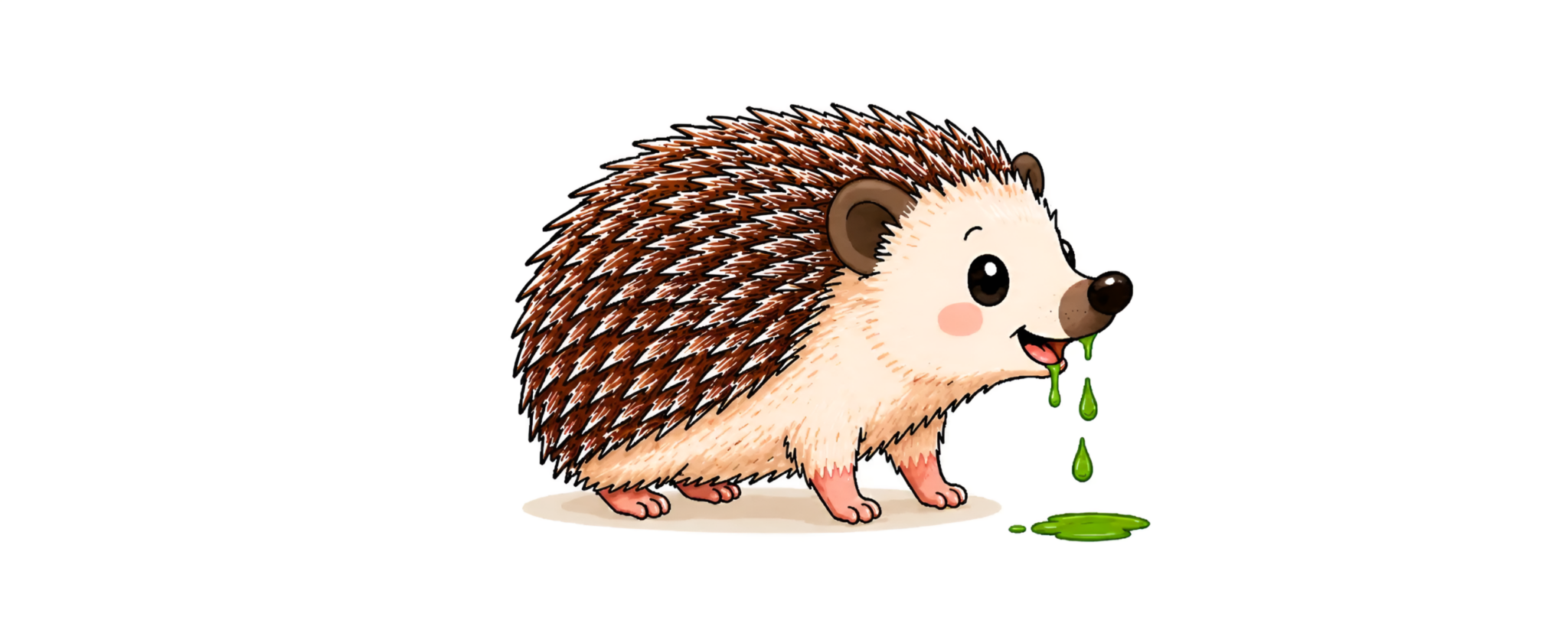
The self-anointing behavior is the most relevant and most interesting source of confusion. When a hedgehog encounters a novel or strongly scented substance — including biologically active compounds like toad skin secretions — it will chew or lick the substance, produce a frothy mixture of saliva and the compound, and spread it over its own quills. This extraordinary behavior, fully explained in our article on hedgehog self-anointing, means that a hedgehog that has recently anointed itself with a genuinely toxic substance may have trace amounts of that compound on its quill tips.
Research published in the Journal of Chemical Ecology has investigated whether self-anointed hedgehog quills can deliver biologically active compounds — specifically whether hedgehogs in areas with access to bufonid toads (which have potent skin toxins) carry meaningful concentrations of toad cardiotoxins on their quills after anointing. The findings suggest some transfer does occur, though whether the concentrations are sufficient to affect the behavior of larger predators remains debated in the literature.
This is not venom. The hedgehog does not produce the compound, does not have a delivery mechanism, and the behavior is opportunistic rather than systematic. But it is a remarkable biological strategy — the only known mammal to deliberately use externally sourced toxins as a defensive tool by applying them to its own quills — and it is understandable how this behavior, when encountered in scientific literature, might be interpreted by a lay reader as something approaching venomous behavior.
The water shrew confusion is a separate matter. The European water shrew (Neomys fodiens) — a small, semi-aquatic mammal that is distantly related to hedgehogs in the broad sense of being an insectivore — does have venomous saliva that it uses to paralyze invertebrate prey. Some popular science writing on venomous mammals groups the water shrew and hedgehog family in discussions of insectivore biology, which can create the impression that hedgehog-family animals are venomous. They are not — the hedgehog’s defensive strategy is entirely different from the water shrew’s predatory one.
The Self-Anointing Behavior in Detail
Because the self-anointing behavior is the most scientifically interesting aspect of hedgehog biology related to the venom question, it deserves careful examination.
The behavior proceeds in a characteristic sequence. The hedgehog encounters a substance that triggers the response — which can be a plant, animal secretion, food item, or even an inanimate object with a strong or unusual smell. It investigates intensely using its sense of smell and taste, then bites or licks the substance repeatedly. This produces a frothy, foamy saliva. The hedgehog then twists its body in a remarkably flexible contortion — considering how round hedgehogs generally are — to reach its own back and flanks with its tongue, spreading the frothy saliva mixture over as many quills as possible. The behavior can be repeated multiple times and can continue for extended periods with a particularly stimulating stimulus.
The evolutionary purpose of this behavior remains one of the more debated questions in hedgehog biology. Several hypotheses have been proposed: scent camouflage (the applied substance masks the hedgehog’s own scent from predators), antipredator chemical deterrence (the applied compound makes quill contact more aversive), ectoparasite deterrence (certain plant compounds have insecticidal or acaricidal properties that reduce mite and flea loads), sexual signaling (novel scents may be attractive in mate-finding contexts), or simply a behavioral response to novel stimuli with no specific adaptive function.
A 2010 paper in Acta Ethologica reviewed the competing hypotheses and concluded that the antipredator chemical deterrence hypothesis has the strongest evidential support, noting that the behavior is most reliably elicited by substances with known biological activity — particularly those with defensive properties in other animals — rather than by random novel scents. This supports the interpretation that hedgehogs deliberately seek out and apply compounds that make their quills more deterrent.
If this interpretation is correct, it means the hedgehog has independently evolved a functional analog to venom delivery — not true venom, but an externally acquired chemical deterrent applied to a physical delivery mechanism. This is biologically remarkable and unique among mammals.
Hedgehog Resistance to Actual Venom
One more dimension of the hedgehog-venom story runs in a completely different direction: hedgehogs are notably resistant to the venom of several other species, particularly viper snakes.
The European hedgehog (Erinaceus europaeus) has long been known to have an elevated tolerance for adder (Vipera berus) venom compared to other mammals of similar size. Research published in the British Journal of Pharmacology documented this resistance in the mid-20th century, attributing it to a serum protein — sometimes called erinacin in older literature — that appears to neutralize some venom components. More recent immunological research has refined the understanding of this resistance, suggesting multiple mechanisms are involved.
This resistance is not absolute — a sufficiently severe envenomation from a large viper can still be dangerous to a hedgehog — but the hedgehog’s tolerance is genuinely higher than most comparably sized mammals. In wild European hedgehog populations, this resistance is practically relevant because adders are part of their natural range and may occasionally be encountered while foraging. Research published in the Journal of Zoology on hedgehog foraging behavior notes that hedgehogs have been observed attacking and consuming adders — a behavior that would be suicidal for most small mammals in the same size range.
This venom resistance is another aspect of the hedgehog’s unusual biochemical relationship with toxins — they resist some, they deliberately apply others, and they encounter and consume animal species that most comparably sized mammals could not safely engage with.
Does Any Part of the Hedgehog Deliver a Chemical Harm?
Setting aside the self-anointing scenario with externally sourced substances, and speaking strictly about intrinsic hedgehog chemistry, no part of the hedgehog delivers chemical harm to humans through normal contact.
The saliva is not toxic — it contains the same range of enzymes and bacteria present in most mammalian saliva. The primary bacterial concern is Salmonella, which hedgehogs can carry and shed in their droppings, but this is an infectious disease risk rather than a toxicological one. The Centers for Disease Control and Prevention documents Salmonella outbreaks linked to hedgehog contact and recommends thorough handwashing after handling.
The skin secretes no toxins. The quills carry no venom. Hedgehog urine and feces carry the same bacterial and parasitic risks as most small mammal waste — requiring basic hygiene rather than toxin-specific concern.
A hedgehog that has recently self-anointed with an irritating substance may have trace amounts of that substance on its quill tips, which in theory could cause localized irritation on particularly sensitive skin if quill contact occurred immediately after anointing. This is the closest any property of the hedgehog’s body comes to a chemical interaction with human skin beyond normal bacterial concerns — and even this is dependent on the substance the hedgehog happened to encounter and anoint with, not an intrinsic property of the hedgehog itself.
Are Hedgehog Bites Venomous?
No. Hedgehog bites deliver saliva and mechanical injury, not venom. There are no venom glands in a hedgehog’s mouth, no venomous compounds in their saliva in any pharmacological sense, and no delivery mechanism for venom through a bite.
What hedgehog bites can do is introduce bacteria from the oral cavity into a wound, which is why basic wound care — thorough washing, antiseptic application, monitoring for infection — is appropriate after any hedgehog bite that breaks the skin. This is a universal consideration with any animal bite, not something specific to hedgehogs. Our article on whether hedgehogs bite covers bite prevention and first aid in practical detail.
Are Hedgehogs Safe Around Children and Other Pets?
Hedgehogs are not venomous and pose no pharmacological toxicity risk to children or other pets through normal contact. The practical safety considerations are mechanical — quill pokes, the possibility of biting — and hygienic, primarily the Salmonella consideration. Neither is a venom-related concern.
Children should always wash hands after hedgehog contact, should be supervised during handling, and should be taught to treat the animal gently to avoid defensive responses including biting and quill erection. Treating a hedgehog well makes it less likely to display the defensive behaviors that produce the minor physical injuries that occasional hedgehog contact can cause.
Our article on whether hedgehogs are good pets gives a full and honest assessment of hedgehog ownership considerations, including household safety factors, that helps prospective owners make an informed decision.
Frequently Asked Questions
Do hedgehog quills inject venom? No. Hedgehog quills are smooth keratin structures with no venom glands and no chemical toxicity. They cause mechanical puncture injuries only.
Is hedgehog saliva venomous? No. Hedgehog saliva contains no venom. The primary concern with hedgehog saliva and bites is bacterial, particularly Salmonella, not toxicological.
Can hedgehogs make their quills venomous? Through self-anointing, hedgehogs can apply externally sourced biologically active compounds to their quills — a behavior that may increase the aversiveness of quill contact. This is not making themselves venomous but rather using environmental chemicals as an acquired defensive tool.
Are any members of the hedgehog family venomous? No hedgehog species is venomous. The European water shrew, sometimes grouped with hedgehogs in discussions of insectivores, does have venomous saliva — but it is a completely different animal from a different family.
Why are hedgehogs resistant to snake venom? European hedgehogs possess serum proteins and other physiological mechanisms that provide elevated tolerance to certain viper venoms, likely an adaptation to the presence of venomous snakes in their natural range. This resistance is genuine but not absolute.
Final Thoughts on Whether Hedgehogs Are Venomous
Are hedgehogs venomous? No — not by any scientific definition. They produce no venom, have no delivery mechanism, and pose no pharmacological toxicity risk through normal contact. What they do have is a uniquely fascinating relationship with the toxic chemistry of their environment — collecting and applying toxic compounds through self-anointing, resisting the venom of animals that would be dangerous to most similarly sized mammals, and representing one of the most biochemically interesting small pets available. That is not a dangerous biology — it is a remarkable one.
A pet this fascinating deserves care that is equally thoughtful. Find every product you need to give your hedgehog a healthy, enriching life — from housing and heating to food, grooming, and health essentials — at the Herdurbia Best Hedgehog Products hub, where every small pet gets the care it deserves.