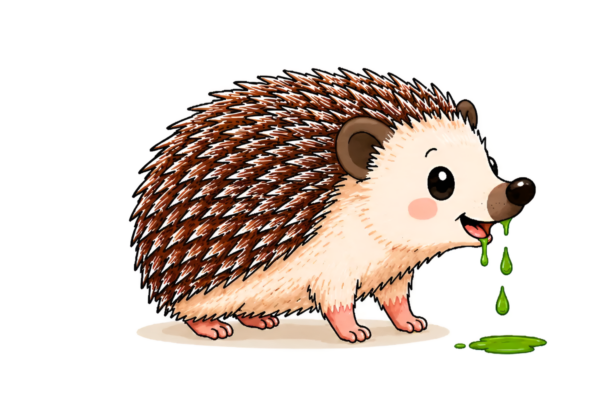

Hedgehog quills are the defining physical feature of these animals — the first thing people notice, the first handling challenge new owners face, and one of the most fascinating aspects of hedgehog biology. Understanding what hedgehog quills actually are, how they work, what happens during quilling, and how to handle a spiny hedgehog safely and confidently transforms the quill from an obstacle into simply part of getting to know a remarkable animal. This guide covers all of it in thorough detail.
What Are Hedgehog Quills Made Of?
Hedgehog quills are modified hairs made primarily of keratin — the same protein that makes up human fingernails, hair, and the outer layer of skin. This is a crucial distinction from porcupine quills, which are also keratin but are structured and barbed very differently. Hedgehog quills are smooth, not barbed, which means they do not embed in skin the way porcupine quills do when they make contact.
Each quill has a smooth outer shaft and a rounded tip. The base of the quill tapers and sits in a follicle in the hedgehog’s skin — anchored in the muscle layer rather than attached rigidly to bone or cartilage. This follicular attachment means that quills can and do fall out as part of a natural growth cycle, and the muscles beneath the skin allow the hedgehog to raise, lower, and angle its quills actively rather than having them sit in a fixed position.
According to research cited by the Smithsonian’s National Zoo, an adult African pygmy hedgehog carries between 5,000 and 7,000 quills covering the back, sides, and top of the head. The face, belly, legs, and sides below the quill line are covered in soft fur — the quills exist only on the dorsal (upper) surface of the animal.
The coloration of hedgehog quills — white tips, darker banding toward the base — is one of the primary factors that determines the animal’s overall color morph or variety. This is why color is described in terms of quill banding pattern as much as skin color, as explored in our article on hedgehog breeds.
How Do Hedgehog Quills Work as Defense?
The quill defense system in hedgehogs is one of the most effective passive defense mechanisms in the small mammal world. When threatened, a hedgehog contracts the orbicularis muscle — a band of muscle running around the perimeter of the quilled area — which draws the quilled skin over the face and down to cover the entire body, creating a tight, armored ball with quills pointing outward in all directions. This rolling behavior is the hedgehog’s primary defensive response.
The muscles beneath the skin that control individual quill position allow the hedgehog to erect its quills when alarmed, making them stand upright and maximizing the deterrent effect. A relaxed hedgehog has its quills lying relatively flat and angled backward; an alarmed hedgehog raises them to stand erect and angled outward, presenting a much more formidable barrier.
The effectiveness of this defense is well-documented. Most hedgehog predators — foxes, badgers, large owls — find a tightly balled hedgehog difficult to attack without injury to their own mouth or paws. The hedgehog simply waits in its defensive ball until the threat moves on. This strategy works well enough in the wild that hedgehogs have relatively few successful predators compared to other animals of their size.
In captivity, this same defense mechanism activates in response to perceived threats — which initially includes being handled by an unfamiliar human. The huffing, clicking, and balling up that new owners encounter is the defensive response functioning exactly as it is supposed to. Understanding this helps owners approach hedgehog handling with patience rather than frustration.
Do Hedgehog Quills Hurt?
This is the question most new owners ask before their first handling session, and the honest answer is: it depends on the situation.
A relaxed hedgehog with quills lying flat can be held without significant discomfort by most people. The quills feel firm and slightly sharp at the tips but are smooth-shafted and not barbed, so they do not catch or tear skin on casual contact. Many experienced owners describe holding a relaxed hedgehog as feeling like holding a very stiff hairbrush.
An alarmed hedgehog with quills erect is a different experience. The erect quills are positioned to puncture rather than slide, and pressing against them — as happens when you try to pick up a tightly balled, defensive hedgehog — can produce quite sharp pokes that some people find genuinely painful. The degree of discomfort varies by individual pain sensitivity and skin thickness.
The quills are at their most uncomfortable when the hedgehog makes rapid, jerky movements while being held. A hedgehog that huffs and pushes repeatedly against a handler’s palm drives its erect quills in a jabbing motion that produces a stinging sensation. Learning to cup a hedgehog in both hands with the quills angled away from your palms — and waiting calmly for the hedgehog to relax rather than trying to fight its defense response — is the technique that makes handling comfortable for both parties.
People with sensitive skin or a lower pain threshold sometimes find hedgehog quills more uncomfortable than expected, particularly during early handling sessions before the hedgehog has become accustomed to contact. Using a soft fleece blanket or small towel as an initial buffer while the hedgehog settles allows it to emerge and explore without the full quill contact that can discourage new owners.
Are Hedgehog Quills Dangerous?
Hedgehog quills are not inherently dangerous in the same way porcupine quills are. Because they are smooth and unbarbed, they do not embed in skin — a quill that pokes you withdraws cleanly with no barb to pull out. Quill pokes, while potentially painful, do not create the wound complications that porcupine quill embeds do.
There is an important caveat related to a behavior called hedgehog self-anointing. When a hedgehog encounters a novel scent or taste, it sometimes produces saliva and spreads it over its own quills — a behavior whose evolutionary function is not fully understood but may relate to scent camouflage or toxin application. While this behavior is usually harmless, some hedgehogs self-anoint with irritating or mildly toxic plant compounds found in their environment. Handling a hedgehog that has recently self-anointed with an irritating substance and then touching your eyes or mouth without washing hands first is the most realistic scenario in which quill contact leads to anything beyond simple skin puncture.
The Centers for Disease Control and Prevention notes that hedgehogs can carry Salmonella and other zoonotic bacteria, so handwashing after handling is always recommended — relevant here because quill pokes that break the skin create a potential route of entry for bacteria. Basic wound care for any skin-breaking quill poke and thorough handwashing after all hedgehog contact addresses this risk adequately for healthy adults.
Whether hedgehog quills are genuinely dangerous to more vulnerable individuals — young children, immunocompromised people, pregnant women — is worth discussing with a healthcare provider, as the CDC recommends for exotic pet contact generally.
What Is Quilling? The Hedgehog Quill Shedding Process
Quilling is one of the most important hedgehog phenomena for new owners to understand, because it looks alarming if you do not know to expect it.
Hedgehogs are born with a set of baby quills beneath a fluid-filled skin membrane that protects the mother during birth. These baby quills emerge within hours of birth. As the hedgehog develops, these baby quills are replaced by a second set of juvenile quills, which are themselves replaced by the final adult quills as the hedgehog matures.
The primary quilling periods occur at approximately 6–8 weeks of age — when the first quills are replaced by juvenile ones — and again at approximately 4–6 months of age when adult quills come in. During these periods, old quills fall out and new quills push through the skin to replace them. The skin during active quilling is tender and sensitive, which is why quilling hedgehogs are often more irritable, more likely to bite, and more resistant to handling than they are at other times.
What quilling looks like from the outside is a hedgehog that appears to be losing quills at a noticeable rate, has visible gaps or patches in its quill coverage, and may have small red or irritated-looking follicle openings where new quills are emerging. This can look very similar to the quill loss caused by hedgehog mites or stress-related quill loss, which is why understanding the timing and context is important.
The key differentiators: quilling occurs at predictable ages, produces quill loss across the back with new quills visibly emerging in the gaps, and is accompanied by a specific age period rather than appearing at random in an otherwise healthy adult. Mite-related quill loss tends to be patchier, more concentrated, and accompanied by skin flaking, crusting, or the hedgehog scratching excessively.
During quilling, minimize handling to what is necessary. When handling is required, be gentle and patient, and understand that irritability is a normal response to physical discomfort rather than a behavioral problem. A warm oatmeal bath can sometimes soothe the skin during active quilling — our guide on how to bathe a hedgehog covers appropriate bathing technique.
Quill Loss in Adult Hedgehogs: When to Be Concerned
Some quill loss in adult hedgehogs is normal — quills have a growth cycle and individual quills fall out and regrow throughout the hedgehog’s life. Finding a few quills in the cage bottom or on bedding is not cause for alarm.
Significant quill loss in an adult hedgehog that is past the quilling age warrants investigation. The most common causes of abnormal quill loss are mites, fungal skin infections, stress, poor nutrition, and certain systemic illnesses. Our article on hedgehog mites covers the most frequent cause of unexpected quill loss and what symptoms accompany it. A hedgehog with mites will typically show skin flaking, crusting around the quill bases, excessive scratching, and sometimes an off-white dust visible in the cage or on the animal’s skin.
Fungal skin infections — particularly ringworm — also cause quill loss and can present similarly to mites. Unlike mites, ringworm is zoonotic and can spread to humans, so any suspected fungal skin issue in a hedgehog should be addressed by an exotic vet promptly.
Nutritional deficiencies, particularly inadequate protein or essential fatty acid intake, can cause quill loss and dull, brittle quill texture. If quill quality has declined alongside other symptoms like dull coat on the soft fur areas and reduced energy, reviewing the diet with reference to our guide on what hedgehogs eat is a useful starting point.
Monitoring hedgehog weight alongside quill condition is good practice — unexplained weight loss combined with quill loss is a stronger signal of systemic illness than either symptom alone.
How to Handle a Hedgehog with Quills Safely
Handling a hedgehog without being poked excessively is a skill that takes a little practice but becomes natural quickly.
The scoop method is the most effective approach for picking up a hedgehog that is not already balled up defensively. Slide both hands under the hedgehog from the sides — palms up, fingers together — and scoop upward in a smooth motion. The quills, angled backward on a relaxed hedgehog, lie relatively flat against your palms and are not uncomfortable. The hedgehog’s weight is distributed across both palms, and it has a stable, secure feeling that encourages it to remain calm.
For a balled-up, defensive hedgehog, the patience approach is more effective than any force. Scoop the balled hedgehog onto your palm and simply wait, holding it cupped without squeezing or jostling. Most hedgehogs, when they feel stable and unthreatened, will begin to unroll within a few minutes. Let the hedgehog set the pace. Any attempt to pry open the ball increases stress and the likelihood of being poked or bitten.
Avoid gripping the hedgehog around its midsection — the quills on the sides are positioned in a way that makes sideways squeezing uncomfortable for the handler. Cupping from below rather than gripping from the sides is always more comfortable for both parties.
Gloves are an option for brand new owners who are anxious about quill contact, but they should be used as a temporary measure rather than a permanent one. Gloves reduce the scent transfer that is important for hedgehog familiarization — hedgehogs learn that their owners are safe partly through repeated exposure to the same scent, and handling through gloves slows that process. Transitioning to bare-hand handling as soon as you are comfortable will improve your relationship with the hedgehog more quickly.
Quill Color and What It Tells You
Quill color in African pygmy hedgehogs is determined by the banding pattern of dark and light pigment along each quill’s shaft, combined with the pigmentation of the skin beneath. In standard salt-and-pepper hedgehogs, quills have a dark base banding and cream or white tips. In albino hedgehogs, quills are completely white with no banding. In darker varieties, the banding is deeper or more extensive, producing a darker overall appearance from a distance.
Quill color can change subtly between the juvenile and adult quill sets — some hedgehogs appear slightly lighter or darker after their adult quills come in compared to their juvenile coat. This is normal and does not indicate any health issue.
A sudden change in quill texture — quills becoming dull, brittle, dry-feeling, or developing an unusual coating — in an adult hedgehog is a signal worth investigating. Healthy quills should feel smooth and slightly waxy. Changes in texture can accompany skin conditions, nutritional deficiencies, or systemic illness.
Frequently Asked Questions About Hedgehog Quills
Do hedgehog quills grow back? Yes. Individual quills that fall out — whether naturally or during quilling — are replaced by new quills growing from the same follicle. In cases of mite damage or fungal infection, quills may regrow more slowly while the underlying skin condition is being treated, but regrowth typically occurs once health is restored.
Can hedgehog quills be removed? No, and they should never be intentionally removed. Quills are living structures anchored in follicles in the skin, and removing them causes pain, injury, and stress. Quills that fall out naturally are harmless to handle — the concern is about forcible removal.
Are hedgehog quills hollow? Yes, like many other keratinous structures including hair and porcupine quills, hedgehog quills have a hollow internal structure that makes them both lightweight and structurally strong — an efficient design for a structure that needs to deter predators without adding excessive weight.
Why does my hedgehog have fewer quills than usual? Some individual quill loss is normal. Significant quill loss in an adult past quilling age is most commonly caused by mites, fungal infection, stress, or nutritional issues. If the loss is patchy, accompanied by skin symptoms, or occurring alongside other health changes, an exotic vet visit is the appropriate response.
How many quills does a hedgehog have? Between approximately 5,000 and 7,000 in an adult African pygmy hedgehog. The exact number varies by individual and changes somewhat through the quilling process as baby and juvenile quills are replaced by adult ones.
Final Thoughts on Hedgehog Quills
Hedgehog quills are not a barrier between you and your pet — they are part of what makes hedgehogs the extraordinary animals they are. Understanding their biology, respecting the quilling process, learning to handle with patience and confidence, and recognizing when quill changes signal a health problem are all skills that develop naturally with time and attention. A well-socialized hedgehog with healthy quills is a joy to handle, and getting there starts with knowledge.
Give your hedgehog everything it needs to thrive — from the right bedding and cage setup to food, skin care, and health supplies — all available in one place at the Herdurbia Best Hedgehog Products hub, because every great pet deserves a great setup.