
Are hedgehogs poisonous? It is a question that comes up regularly among prospective owners, parents researching pet safety, and curious people who have heard something about hedgehogs and toxins. The short answer is no — hedgehogs are not poisonous in the way that most people mean when they ask the question. They do not produce venom, they do not secrete toxins through their skin, and contact with a hedgehog does not cause poisoning in humans or pets. But the full picture is more interesting than a flat denial, because hedgehogs do have a fascinating and unusual relationship with toxic substances — just not in the direction most people expect.
- What Does “Poisonous” Actually Mean?
- Are Hedgehogs Poisonous to Touch?
- The Self-Anointing Behavior: Where the Toxin Question Gets Interesting
- Are Hedgehogs Immune to Poisons?
- Are Hedgehogs Dangerous to Cats, Dogs, or Other Pets?
- What About Hedgehogs and Toxic Plants?
- Hedgehogs, Salmonella, and Human Health
- Are Hedgehog Bites Poisonous?
- Hedgehog Quills: Are They Toxic?
- Frequently Asked Questions
- Final Thoughts on Whether Hedgehogs Are Poisonous
What Does “Poisonous” Actually Mean?
Before addressing whether hedgehogs are poisonous, it is worth clarifying what the term actually means, because “poisonous” and “venomous” are often used interchangeably but describe fundamentally different things.
A poisonous animal is one that causes harm when touched or ingested — the toxin is delivered passively through contact or consumption. Classic examples include poison dart frogs, which carry potent skin toxins that cause harm on contact. A venomous animal, by contrast, actively delivers toxin through a bite, sting, or spine — like a snake, bee, or stonefish.
Hedgehogs are neither. They do not produce skin toxins that cause harm through contact, they do not have venom glands, and their quills are simple keratin structures — the same protein as human fingernails — with no chemical toxicity. A quill poke may be sharp and uncomfortable, but it delivers no chemical harm. Our companion article on whether hedgehogs are venomous covers the venom question in specific detail; this article focuses on the poisonous classification.
Are Hedgehogs Poisonous to Touch?
No. Handling a hedgehog does not expose you to any toxic substance from the animal’s body. The quills are mechanically sharp but chemically inert. The skin and fur carry no toxins. The saliva is not toxic in any meaningful pharmacological sense, though like all animal saliva it contains bacteria — relevant for hygiene purposes rather than toxicology. Normal contact with a hedgehog carries no poisoning risk.
The primary hygiene concern associated with hedgehog contact is bacterial, not chemical. Hedgehogs can carry Salmonella in their intestinal tract and shed it in their droppings, and the Centers for Disease Control and Prevention documents Salmonella outbreaks linked to hedgehog contact in the United States. This is an infectious disease risk rather than a poisoning risk — the distinction matters because the appropriate response is hygiene (thorough handwashing) rather than toxin treatment. But it reinforces the importance of washing hands after handling any hedgehog or cleaning its cage.
The Self-Anointing Behavior: Where the Toxin Question Gets Interesting
This is where the hedgehog’s relationship with toxic substances becomes genuinely fascinating. Hedgehogs engage in a behavior called self-anointing — or anointing — that involves deliberately applying potentially toxic or irritating substances to their own quills. Understanding this behavior is central to accurately answering whether hedgehogs are poisonous.
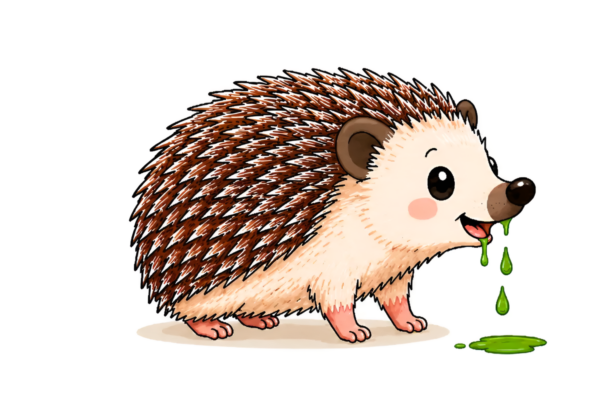
When a hedgehog encounters a novel, strongly scented, or chemically interesting substance, it will bite or lick at the source, produce a frothy saliva mixture that incorporates the substance, and then twist its body to spread the resulting mixture over its own quills using its tongue. This behavior is documented across virtually all hedgehog species and has been observed in hedgehogs encountering an enormous range of substances including plants, animal secretions, tobacco, leather, strong perfumes, and in wild animals, toad skin secretions.
The substances that most reliably trigger the most vigorous self-anointing tend to be biologically active — alkaloids, terpenes, toad skin toxins — suggesting that the behavior has an adaptive function related to applying these compounds to the quills. Several hypotheses have been proposed for why hedgehogs do this, and you can read a full discussion of the behavior in our article on hedgehog self-anointing.
The toxin-coating hypothesis is the most well-studied. Research published in the Journal of Chemical Ecology has examined whether hedgehog self-anointing with toad skin secretions in particular — specifically the bufonid toad toxins that wild African and European hedgehogs sometimes encounter — results in quills that are pharmacologically active. The findings suggest that anointed quills may carry measurable concentrations of the ingested compound, potentially making a quill poke from a recently anointed hedgehog more irritating or aversive than an unanointed one.
This does not make hedgehogs poisonous in any standard sense — it means a hedgehog that has deliberately applied toad toxins to its quills may deliver a slightly more irritating quill poke than one that has not. The concentrations involved are far below any clinically meaningful toxic threshold for humans, and wild hedgehogs with access to toad secretions are the population most likely to exhibit this extreme form of the behavior. Pet hedgehogs self-anoint with whatever they find interesting in their domestic environment — typically far less pharmacologically active substances.
Are Hedgehogs Immune to Poisons?
Here is another dimension of the hedgehog-poison relationship that is genuinely remarkable. Hedgehogs display measurable resistance to certain toxins that would be harmful or fatal to most other mammals of their size.
Viper and adder venom resistance is the most extensively documented. European hedgehogs have a higher tolerance for viper (Vipera berus) venom than most comparably sized mammals, a finding documented in wildlife biology literature dating back to the mid-20th century. A 1951 study published in the British Journal of Pharmacology by Jezierski and colleagues documented the hedgehog’s resistance to adder venom, attributing it partly to a serum factor that neutralizes certain venom components and partly to physical factors including the hedgehog’s thick skin and quill protection. Subsequent research has confirmed and elaborated on this resistance.
Plant alkaloid resistance is also notable. Hedgehogs can consume certain plant compounds — including some that are toxic to other mammals — with limited ill effect. This is functionally relevant to the self-anointing behavior, as consuming toad skin secretions during the anointing process would be harmful to most small mammals but appears to be tolerated by hedgehogs.
Interestingly, research cited in the Journal of Zoology and reviewed by the Mammal Society documents that this toxin resistance is a genuine pharmacological property rather than simple behavioral avoidance — the hedgehog’s physiology includes mechanisms that reduce the impact of certain toxins compared to other species. This makes the hedgehog an interesting subject for toxicological research far beyond its importance as a pet.
This toxin resistance is relevant to the “are hedgehogs poisonous” question in an indirect way: the same biology that allows hedgehogs to tolerate and incorporate certain toxic substances may be part of a defensive system that can be externally expressed through self-anointing. The hedgehog is not passive in its relationship with toxins — it is an active collector and user of chemical defenses.
Are Hedgehogs Dangerous to Cats, Dogs, or Other Pets?
Another version of the poisonous question relates to whether hedgehogs pose a toxicity risk to other animals. If a cat or dog were to attempt to bite or mouth a hedgehog, would they be harmed by chemical exposure?
Under normal circumstances, no. A hedgehog that has not recently self-anointed with a biologically active substance poses no chemical toxicity risk to a cat or dog that contacts it. The quills will cause pain and potential physical injury from the sharp points — which is itself a significant deterrent — but there is no chemical poisoning involved.
A hedgehog that has been self-anointing with genuinely toxic materials — toad skin secretions, for instance, in a setting where a wild toad has been encountered — could theoretically transfer some of that compound to an animal that attempts to bite it. This is plausible as a defensive function of the self-anointing behavior itself. However, in typical domestic pet settings, the substances a pet hedgehog has access to for self-anointing are not pharmacologically significant.
The more significant concern with cats, dogs, and hedgehogs sharing a space is physical injury from quills and the potential disease transmission risk — particularly Salmonella — through contact with hedgehog droppings. Our article on whether hedgehogs are good pets touches on household compatibility considerations in more detail.
What About Hedgehogs and Toxic Plants?
Some owners are curious whether hedgehogs themselves can be poisoned by plants or substances in their environment. The answer is yes — despite their notable toxin resistance in certain contexts, hedgehogs are not universally immune to plant toxins and can be harmed by a range of common plants and household substances.
Toxic plants that can harm hedgehogs if ingested include avocado, onion, garlic, tulip bulbs, oak leaves, and many common garden plants. While hedgehogs are unlikely to seek out plant material — they are insectivores rather than herbivores, as covered in our what do hedgehogs eat article — a hedgehog with access to a garden or unsupervised outdoor time could encounter and attempt to eat or self-anoint with harmful substances.
Household chemicals including cleaning products, pesticides, and rodenticides are dangerous to hedgehogs and should be completely inaccessible. The ASPCA Animal Poison Control Center maintains guidance on toxic substances for pets generally, and while hedgehog-specific data is limited compared to dogs and cats, the general principle that common household toxins pose genuine risks applies.
Hedgehogs, Salmonella, and Human Health
The most practically significant health concern associated with hedgehogs — and the one most likely to actually affect a hedgehog owner — is Salmonella, which deserves direct and clear treatment in any article about hedgehog safety.
Hedgehogs can carry Salmonella bacteria in their digestive tract without showing any signs of illness themselves. They shed the bacteria in their droppings, and because hedgehogs walk through their own waste and are handled directly, Salmonella can be transferred to human hands and surfaces. The CDC has documented multiple multistate Salmonella outbreaks linked to hedgehog contact in the United States since 2011, with cases involving owners who handled their hedgehogs without adequate handwashing afterward.
This is not a poisoning risk in the toxicological sense, but it is a genuine, documented public health concern. The prevention is consistently practicing good hygiene: thorough handwashing with soap and water after every hedgehog contact, after cleaning the cage, and after touching anything in the hedgehog’s environment. Cleaning hedgehog cages and equipment away from food preparation areas and disinfecting surfaces afterward is also important.
The risk is manageable for healthy adults who practice appropriate hygiene. Young children, elderly people, pregnant women, and immunocompromised individuals should be more cautious and discuss hedgehog ownership with their healthcare provider.
Are Hedgehog Bites Poisonous?
No. A hedgehog bite delivers no toxic compound — it is a mechanical injury only, caused by the hedgehog’s small but sharp teeth. The bite may be painful and can break skin in a determined defensive bite, creating a standard wound that requires the same basic care as any small animal bite — thorough washing, antiseptic application, and monitoring for infection. Our article on whether hedgehogs bite covers bite behavior, prevention, and first aid in full detail.
The bacteria concern applies here just as it does for general contact: any break in the skin from a hedgehog’s teeth represents a potential route for bacterial transmission, including Salmonella. Basic wound care and hygiene address this appropriately.
Hedgehog Quills: Are They Toxic?
No. Hedgehog quills are made of keratin — the same protein as human fingernails — and carry no chemical toxicity in their own right. A quill poke is a mechanical puncture injury only. The exception, as discussed above in the self-anointing context, is that a hedgehog that has recently anointed with a biologically active substance may have trace amounts of that substance on its quill tips — but this is a secondary application from outside, not an intrinsic property of the quills themselves, and the concentrations involved in a domestic pet context are not a meaningful concern.
The physical injury concern from quills is real — they are sharp and can poke painfully, and repeated quill contact over time can cause skin sensitization in some particularly sensitive individuals. Some owners develop mild skin irritation from extended hedgehog handling, which may involve an element of minor allergic response to hedgehog proteins rather than any toxin. This is uncommon and is an individual sensitivity rather than a toxic property of the animal.
Frequently Asked Questions
Are hedgehogs safe to handle? Yes, with normal hygiene precautions. Hedgehogs are not toxic to touch, and regular handling poses no chemical risk. The practical safety measure is handwashing after contact, primarily to manage Salmonella risk.
Can hedgehog quills poison you? No. Quills are sharp keratin structures with no intrinsic toxicity. A quill poke causes a mechanical puncture injury, not poisoning.
Are hedgehogs dangerous to children? Hedgehogs can bite and their quills can poke, both of which cause minor injuries. The Salmonella risk is a more significant consideration for young children. Children should always wash hands after hedgehog contact, and direct unsupervised handling by very young children is not advisable.
Can hedgehogs make themselves poisonous? Through self-anointing, hedgehogs can apply externally sourced biologically active compounds to their quills — a behavior that may increase the aversiveness of a quill encounter. This is not making themselves intrinsically poisonous but rather using environmental chemicals defensively.
Is hedgehog saliva toxic? No, hedgehog saliva is not toxic in any pharmacological sense. Like all animal saliva, it contains bacteria, which is the relevant hygiene concern rather than chemical toxicity.
Final Thoughts on Whether Hedgehogs Are Poisonous
Are hedgehogs poisonous? No — not in any meaningful sense that should concern a pet owner. They do not produce toxins, they do not secrete venom, and contact with a healthy hedgehog in a domestic setting poses no chemical poisoning risk to humans or other pets. The real health considerations associated with hedgehogs are bacterial rather than toxicological — primarily Salmonella — and these are entirely manageable with consistent, simple hygiene. The genuinely fascinating part of the hedgehog-poison story is what they do with other animals’ toxins: collecting, applying, and potentially weaponizing them through self-anointing in a way that speaks to millions of years of evolutionary ingenuity.
Safe, healthy hedgehog ownership starts with knowing the facts — and it continues with having everything your hedgehog needs to thrive. From cages and bedding to health supplies and hygiene essentials, find the full collection at the Herdurbia Best Axolotl Products hub, where informed pet care always comes first.