
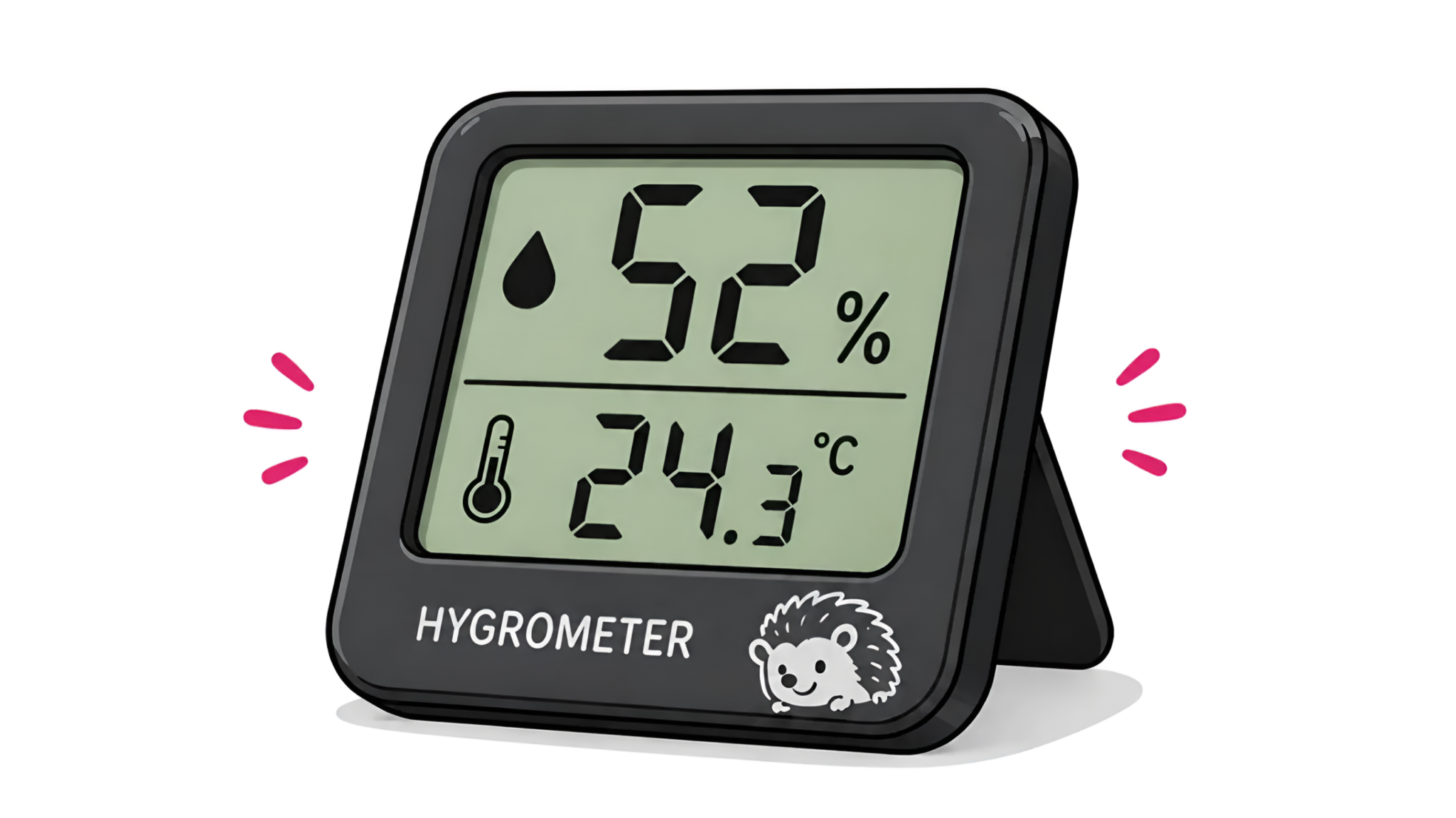
Temperature gets all the attention in hedgehog care guides, and for good reason — the consequences of getting it wrong are immediate and serious. Humidity gets far less attention, but it matters more than most owners realise. Hedgehog skin is already prone to dryness, and low humidity makes that significantly worse. High humidity creates the opposite problem, encouraging bacterial and fungal growth in bedding, on skin, and in the respiratory system. Both extremes cause health problems that are entirely preventable with the right information, and the only way to have that information is with a hygrometer inside or near the cage.
The hedgehog community and veterinary guidance have largely converged on the same target: humidity below 40% is preferred for hedgehogs according to the Merck Veterinary Manual, while Dubia.com’s care sheet suggests that humidity below 30% can cause discomfort and dry, itchy skin, making the practical target somewhere between 30% and 40% for most setups. What that means in practice is that you need a device that reads both temperature and humidity simultaneously, because the two interact — warmer air holds more moisture, so a cage that hits the right humidity at one temperature may not at another. This guide covers everything you need to know and our top picks for every budget.
Why a Separate Hygrometer Matters
Many owners already have a thermometer in the cage and assume that covers their monitoring needs. Temperature and humidity are separate variables requiring separate sensors, and while some thermometers include a basic humidity reading, the accuracy of the hygrometer function varies enormously between products. A thermometer with a humidity display that’s consistently off by 15% isn’t telling you anything useful about actual conditions in the cage.
The other practical reason is placement. Temperature needs to be monitored at cage floor level where your hedgehog lives. Humidity, while also relevant at floor level, gives a fuller picture when you can track how it changes over the course of a day and night — which is where a device with data logging becomes genuinely valuable rather than a nice-to-have. An enclosure that hits 38% during the evening but drops to 22% in the early morning hours during winter heating season is one where your hedgehog’s skin is being stressed every night, and a device that only shows you the current reading won’t reveal that pattern.
Hedgehog Precision specifically recommends using a Bluetooth-connected device that logs data continuously so you can see the full 24-hour picture of both temperature and humidity, not just a snapshot at the moment you check. This is particularly important during seasonal transitions when heating systems change the indoor climate significantly.
What to Look for in a Hedgehog Cage Hygrometer
Accuracy is the starting point. A hygrometer that reads 10% higher or lower than actual humidity is worse than useless — it gives you false confidence. Look for sensors rated at ±3% relative humidity or better. The Swiss-made sensors used in Govee’s product line are among the most accurate available at this price point and are independently tested across the reptile and small animal community.
Data logging separates a useful hygrometer from a basic one. A device that shows only the current reading tells you nothing about what happened while you were asleep or at work. Min/max memory at minimum, and ideally continuous graphed data accessible through an app, gives you the overnight picture that matters for diagnosing problems and confirming your setup is stable.
Alert notifications are the feature that turns passive monitoring into active safety. When you set a humidity threshold and receive a push notification if it’s breached, you can respond to a problem the same day rather than discovering it a week later when your hedgehog’s skin is visibly dry and irritated.
Temperature monitoring alongside humidity in the same device is practical — it means one device on the cage reads both variables simultaneously, and your separate probe thermometer can serve as an independent cross-check.
Our Top Hedgehog Cage Hygrometer Picks
Best Overall: Govee Bluetooth Hygrometer Thermometer H5075
The Govee Bluetooth Hygrometer is the device Hedgehog Precision names as their personal favourite for monitoring both temperature and humidity in a hedgehog enclosure — and coming from a breeder that treats enclosure environmental data seriously enough to write about 24-hour monitoring cycles, that recommendation carries real weight. The Swiss-made sensor delivers humidity accuracy of ±3%RH and temperature accuracy of ±0.54°F, updating every two seconds for near-real-time readings. The clear LCD display shows both temperature and humidity simultaneously with large numbers readable from across the room, and the device connects to the Govee Home app via Bluetooth to log data continuously and send alerts when either reading falls outside the range you’ve set.
The 20-day onboard data storage means that even when the Bluetooth connection drops, the device keeps logging and syncs everything when reconnected. The compact size allows placement inside the cage on a flat surface or outside the cage hung near the wire wall, and the built-in stand and hanging hole cover both options. Battery life runs to approximately six months on two AAA batteries, and the Govee H5075 is available on Amazon in single and multipacks. For owners with more than one cage or who want one inside the cage and one outside for comparison, the multipack offers meaningful cost savings.
Best Budget Option: ThermoPro TP50 Digital Hygrometer and Thermometer
Already covered in our best hedgehog thermometer guide as the best compact thermometer option, the ThermoPro TP50 doubles as a practical everyday hygrometer at a lower price than any Bluetooth-connected option. It displays temperature and humidity simultaneously, tracks daily high and low records for both readings, and updates every ten seconds. The humidity accuracy sits at ±5%RH, which is slightly less precise than the Govee’s ±3%RH but sufficient for confirming your cage environment is broadly within the right range.
What the TP50 doesn’t offer is Bluetooth connectivity, app alerts, or continuous data logging beyond the daily min/max. For owners who check the cage every morning as part of their routine and want a quick visual confirmation that both temperature and humidity are where they should be, that’s often enough. The TP50 is available in multipacks on Amazon at very low cost per unit, making it practical to keep one inside the cage at floor level and one outside for comparison without meaningful expense. If you’re starting out and want a simple, reliable humidity monitor before committing to a Bluetooth device, the TP50 is the most sensible starting point.
Best for Remote Monitoring: Govee WiFi Thermo-Hygrometer
For owners who want to monitor cage humidity from anywhere rather than only within Bluetooth range, the WiFi version of the Govee thermo-hygrometer extends monitoring capability to anywhere with a phone signal. Temperature accuracy is ±0.54°F and humidity accuracy is ±3%RH using the same Swiss-made sensor as the Bluetooth model, updating every two seconds. The Govee Home app receives push notifications in real time when either reading falls outside your configured range, regardless of where you are, and logs continuous graphed data for weeks and months of review.
For owners who travel, work long shifts, or simply want the reassurance of knowing what’s happening in the cage while away from home, the WiFi version makes the humidity and temperature picture complete alongside the Govee WiFi thermometer already covered in the thermometer guide. The same 2.4GHz WiFi requirement applies — it doesn’t work on 5GHz networks — and a stable home connection is necessary for reliable alert delivery. The device is available on Amazon and comes in packs of two, which is useful given how naturally it pairs with a second unit elsewhere in the home for comparison.
Addressing the Humidity Sources in a Hedgehog Cage
Understanding where humidity comes from inside a hedgehog cage helps you manage it rather than just monitor it. The hedgehog’s own respiration is a meaningful source — a small mammal exhaling warm moist air in an enclosed space adds measurable humidity, particularly in enclosed bin cages with limited ventilation. Wet bedding from urine is another significant contributor. This is why ventilation quality matters so much to humidity management: wire-sided cages with open mesh walls allow moisture to dissipate naturally, while bin cages with limited ventilation holes can accumulate it.
If your hygrometer consistently shows humidity above 40%, the first responses to try are increasing ventilation, reducing how much moisture is reaching the bedding surface by improving litter box use and litter training, and spot cleaning more frequently. If you’re consistently below 30% and your hedgehog is showing dry, flaky skin, a small room humidifier positioned nearby rather than aimed directly at the cage is the practical fix.
Conclusion
A hygrometer is one of the least expensive and most informative additions to a hedgehog setup. Temperature tells you whether your hedgehog is warm enough. Humidity tells you whether the environment is aggravating their skin and respiratory system or supporting it. Together, the two readings give you the full environmental picture that good hedgehog care requires — and a Bluetooth device that logs the overnight data gives you that picture honestly, not just at the moment you happen to look.
For thermometers, thermostats, heat lamps, and the full temperature and environmental monitoring setup, our best hedgehog products page has everything in one place.