
Finding the best axolotl nightcrawlers is one of the most impactful decisions you can make for your axolotl’s long-term nutrition. While quality sinking pellets are the most convenient everyday food, nightcrawlers — large earthworms — are widely regarded by experienced axolotl keepers and aquatic salamander researchers as the single most nutritionally complete and species-appropriate food available for axolotls in captivity. They are accepted enthusiastically by almost all axolotls, require no special storage equipment, and deliver a protein, fat, and mineral profile that closely mirrors the natural prey of wild Ambystoma mexicanum. This guide covers everything you need to know about axolotl nightcrawlers: why they are the best staple food, what types of earthworm are safe, how to prepare and feed them correctly, and our top Amazon picks. Pair this with our best axolotl food guide and our full axolotl care guide for the complete picture on axolotl nutrition.
Why Nightcrawlers Are the Best Staple Food for Axolotls

Axolotls are strict carnivores that evolved to eat a varied diet of aquatic and semi-aquatic invertebrates in the wild. The wild axolotl population (Ambystoma mexicanum) is critically endangered in its native Xochimilco lake system in Mexico City, where declining prey availability is one of the pressures the species faces. In captivity, replicating a nutritionally appropriate diet is the most powerful thing a keeper can do for long-term axolotl health and potential breeding success.
Nightcrawlers — primarily Lumbricus terrestris (Canadian nightcrawlers) and Eisenia hortensis (European nightcrawlers, also called red wigglers or super reds) — are the earthworm species most commonly used in axolotl keeping and the ones with the best documented nutritional profile for aquatic salamander feeding. According to research published in Aquaculture, earthworms provide a crude protein content of approximately 60–70% on a dry weight basis and a fat composition that closely matches the natural aquatic invertebrate prey consumed by wild axolotls. Critically, they also contain appropriate calcium and phosphorus levels for bone and skeletal health, and a complete essential amino acid profile that supports the extraordinary regenerative capacity that makes axolotls scientifically remarkable.
By comparison, bloodworms — which many keepers rely on heavily — are protein-rich but deficient in calcium and several essential amino acids. High-quality pellets are excellent for convenience but vary in digestibility. Nightcrawlers sit above both as the most nutritionally complete, most naturally appropriate, and most readily accepted food source available. The Ambystoma Genetic Stock Center at the University of Kentucky — which maintains the world’s largest research colony of axolotls — includes earthworms as a primary food source in established axolotl care protocols for this reason.
Types of Nightcrawlers Safe for Axolotls
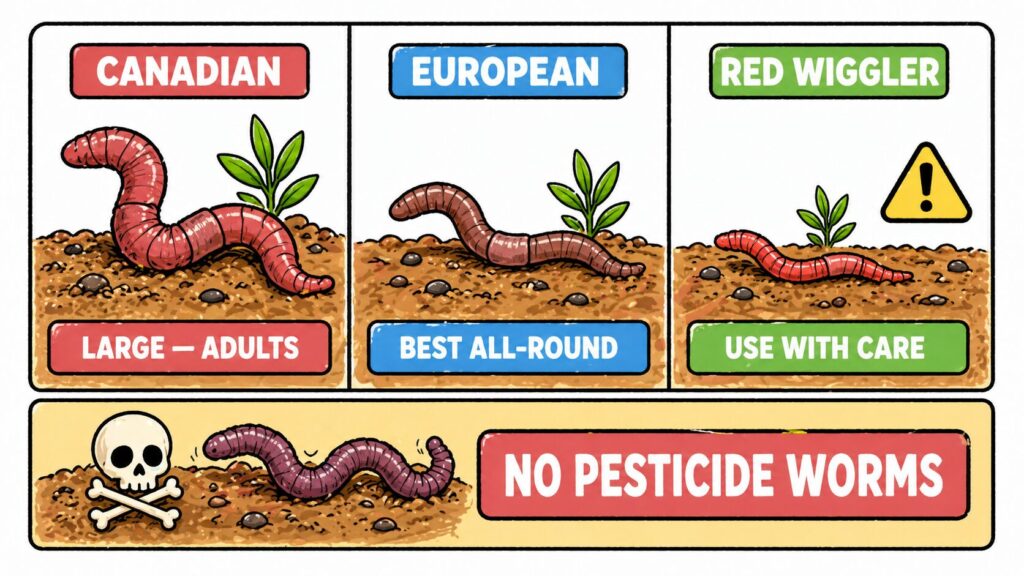
Canadian Nightcrawlers (Lumbricus terrestris) are the large, familiar earthworm found in lawns and gardens and sold at fishing tackle shops across North America. They are typically 4–8 inches long and represent the majority of “nightcrawler” products sold for fishing and composting. For adult axolotls (5+ inches), Canadian nightcrawlers cut into 1–1.5 inch pieces are an ideal feeding portion. They are full of natural moisture and nutrients and are eagerly accepted by most axolotls.
European Nightcrawlers / Super Reds (Eisenia hortensis) are a smaller, slightly thinner earthworm than Canadian nightcrawlers, typically 3–5 inches long. They are commonly sold for composting as “super red” worms and are an excellent choice for sub-adult axolotls (3–5 inches) where the smaller diameter makes them easier to manage than a cut piece of the larger Canadian nightcrawler. European nightcrawlers are also particularly active and wriggly when placed in water, which makes them irresistible to axolotls whose feeding strike is triggered by movement.
Red Wigglers (Eisenia fetida) are the most common composting worm, smaller and more slender than European nightcrawlers. They can be used for axolotls but produce a defensive excretion when stressed that has a strong, pungent smell and is mildly irritating to sensitive tissues. While not dangerous in the small quantities involved in axolotl feeding, many experienced keepers prefer European nightcrawlers or Canadian nightcrawlers over red wigglers specifically to avoid this excretion risk.
What to avoid. Wild-dug earthworms from soil that may have been treated with pesticides, herbicides, or chemical fertilisers must never be used as axolotl food. Pesticide residues can be fatal to axolotls. Only use worms from verified pesticide-free sources — purpose-bred worm farm products or reputable fishing bait suppliers.
Preparing Nightcrawlers for Axolotl Feeding

Purging before feeding (recommended but optional). Freshly harvested or received earthworms often contain soil and organic matter in their digestive system. Purging — keeping worms for 24–48 hours in a clean, moist paper-lined container without food — allows them to pass any soil content from their gut. This is standard practice among experienced keepers and removes any trace of soil contaminants from the worm before it is fed to the axolotl. Simply place the worms in a small container lined with damp paper towels, keep them at room temperature or in the refrigerator, and wait 24–48 hours before feeding.
Rinsing. Always rinse nightcrawlers thoroughly under cool running water before offering them to your axolotl. This removes surface soil, debris, and any residue from the worm container or packaging. Rinse gently and briefly — you do not want to stress the worm significantly before feeding.
Cutting to appropriate size. This is the most important preparation step. Axolotls swallow food whole and cannot chew — any piece that is too large to swallow in one motion will be mouthed and rejected, potentially causing stress or regurgitation. The rule of thumb is that each piece should be no wider than the space between the axolotl’s eyes and no longer than its head width. For an adult axolotl of 8–10 inches, a 1–1.5 inch piece of nightcrawler is ideal. Use clean scissors or a sharp knife to cut quickly and cleanly.
Temperature matching. Cold worms straight from the refrigerator can cause a temperature shock to your axolotl’s cold but stable tank water. Allow cut worm pieces to sit at room temperature for 5–10 minutes before dropping them into the tank, or rinse briefly in room-temperature dechlorinated water to warm them slightly before feeding.
How to Feed Nightcrawlers to Axolotls Correctly
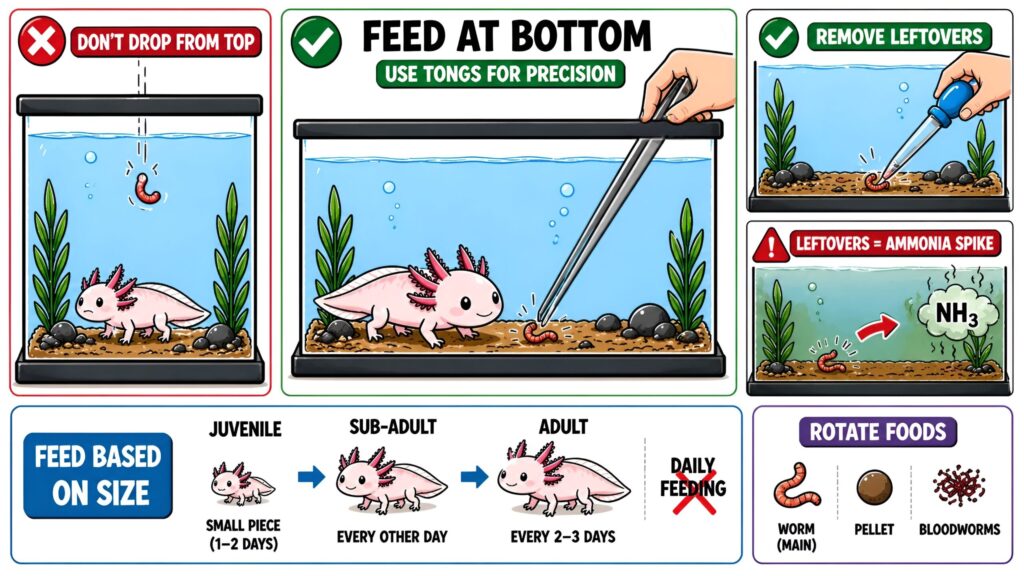
Use feeding tongs for precise delivery. Our guide to the best axolotl feeding tongs covers the best products for this, but any clean pair of long aquarium tongs works. Hold the cut worm piece gently and lower it to the tank floor level near your axolotl’s nose. The worm piece will move slightly as you lower it, which triggers the axolotl’s feeding response powerfully. Most axolotls strike immediately when the worm is within detection range.
Drop at floor level. Axolotls feed at the bottom. Never drop nightcrawler pieces from the water surface — worm pieces that tumble through the water column are much less likely to be detected than those placed directly on the substrate near the axolotl.
Remove uneaten pieces promptly. Any worm piece not consumed within 30–60 minutes should be removed with a turkey baster or tongs. Uneaten worm pieces decompose rapidly and produce significant ammonia, directly stressing your filter bacteria and water quality. This is one of the most common causes of ammonia spikes in axolotl tanks fed on live food.
Feed appropriate portions at the right frequency. Juveniles (under 4 inches): a small piece every 1–2 days. Sub-adults (4–6 inches): one appropriate piece every other day. Adults (6+ inches): one to two pieces every 2–3 days. Adult axolotls have a surprisingly low metabolic rate and do not need to be fed daily — overfeeding nightcrawlers leads to obesity, which is a genuine health concern detailed in our article on whether axolotls can get fat, and rapidly degrades water quality between maintenance sessions.
Vary the diet. Nightcrawlers are the best staple food but benefit from being rotated with high-quality pellets and occasional bloodworm treats. A varied diet ensures no single nutritional gap develops over the many years of your axolotl’s life — axolotls can live 10–15 years in captivity with excellent care, and nutritional variety supports that longevity.
Storing Nightcrawlers

Live nightcrawlers can be kept alive and in good condition for several weeks with simple care. Store them in a breathable container — a ventilated plastic tub or cardboard worm box — with damp (not wet) bedding material. Coconut coir, damp newspaper, or purpose-made worm bedding all work well. Keep the container in the refrigerator at approximately 40–50°F (4–10°C). Earthworms become dormant and survive well at refrigerator temperatures.
Feed the worms every 1–2 weeks if keeping them for extended periods. Small amounts of vegetable scraps, coffee grounds, or commercial worm food provide nutrition that maintains the worms in good condition and actually improves their nutritional value for your axolotl over time as the worms process their food.
Check your stored worms every 2–3 days and remove any dead individuals promptly — a dead worm in the container will attract bacteria that can kill the remaining healthy worms. A thriving worm container stored this way can last 4–8 weeks from delivery with minimal maintenance.
Our Top Axolotl Nightcrawler Picks on Amazon
Best for Adult Axolotls: Uncle Jim’s Worm Farm European Nightcrawlers Composting and Fishing Worms (1lb Pack)
The Uncle Jim’s Worm Farm European Nightcrawlers 1lb Pack is our top overall recommendation for most axolotl keepers. European nightcrawlers (Super Reds) from Uncle Jim’s Worm Farm are one of the most reliably sourced, pesticide-free earthworm products available on Amazon, shipped live directly to your door. At 3–5 inches long, European nightcrawlers are an ideal size for adult and large sub-adult axolotls — a single worm cut in half or thirds provides 2–3 appropriately sized feeding portions. The 1lb pack provides a substantial supply that will last a single-axolotl keeper several weeks with proper refrigerated storage. Uncle Jim’s Worm Farm has been a trusted name in live worm supply for decades and their worms arrive consistently healthy and active.
Best for Trying First: Uncle Jim’s Worm Farm European Nightcrawlers (100 Count)
For keepers who want to try nightcrawler feeding with a smaller initial quantity before committing to a larger order, the Uncle Jim’s Worm Farm European Nightcrawlers 100 Count is the right starting point. 100 European nightcrawlers provide enough for several weeks of feeding for a single adult axolotl, giving you time to assess how well your axolotl accepts them and how long you can maintain them in refrigerated storage before ordering a larger quantity.
Best for Multiple Axolotls: Uncle Jim’s Worm Farm European Nightcrawlers (250 Count)
For keepers with two or more axolotls — having carefully read our guides on axolotl cannibalism and whether axolotls can have tank mates before housing them together — the Uncle Jim’s Worm Farm European Nightcrawlers 250 Count provides a larger supply that keeps the cost-per-worm ratio reasonable for more frequent feeding across multiple animals. The same refrigerated storage approach applies — 250 worms is a manageable quantity that can realistically be used within 3–4 weeks.
Best Large Supply for Frequent Feeders: Uncle Jim’s Worm Farm European Nightcrawlers (500 Count)
For keepers with several axolotls, for those who maintain a breeding colony and are conditioning breeding pairs through enhanced feeding as part of their axolotl breeding protocol, or for any keeper who feeds nightcrawlers as the exclusive or near-exclusive staple, the Uncle Jim’s Worm Farm European Nightcrawlers 500 Count provides volume that justifies the slightly better per-worm cost and reduces the frequency of reordering. A dedicated worm keeper who maintains the container properly can keep 500 worms alive and thriving for 6–8 weeks, providing a substantial supply throughout.
Best for Juvenile and Sub-Adult Axolotls: Uncle Jim’s Worm Farm Red Wiggler Composting Worms (250 Count)
For smaller axolotls (3–5 inches) where European nightcrawlers may still be slightly large, the Uncle Jim’s Worm Farm Red Wiggler Composting Worms 250 Count provides access to a smaller, thinner worm that is easier for sub-adult axolotls to manage. Red wigglers are smaller than European nightcrawlers and can be offered as a half-worm or even whole for smaller juveniles. The mild defensive excretion of red wigglers is not dangerous at feeding quantities, but rinse the worm briefly before feeding to remove surface slime. As your axolotl grows beyond 5 inches, transition to European nightcrawlers or Canadian nightcrawlers for better nutritional volume per feeding item.
Nightcrawlers and Axolotl Water Quality
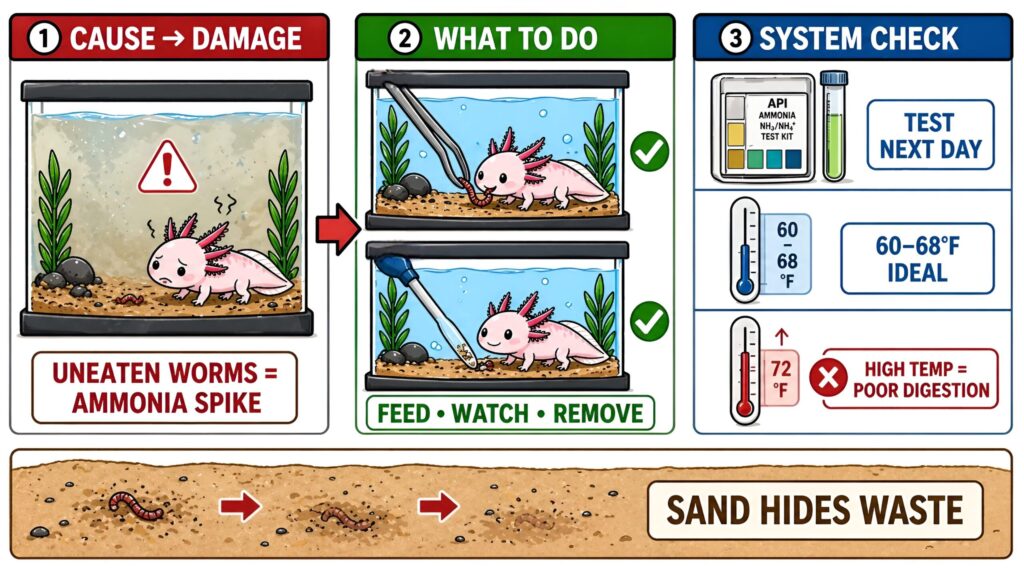
It is important to understand that nightcrawlers, while the best food for axolotl nutrition, are also the food most likely to cause water quality problems if not managed carefully. A worm piece that is missed during feeding, or that the axolotl regurgitates, will break down rapidly in water and produce a significant ammonia spike. This is particularly true in sand-substrate tanks where a small worm piece can sink into the substrate and be invisible to the keeper.
Always use feeding tongs to deliver food precisely and watch each feeding session through to completion so you know whether the piece was consumed. After feeding, do a visual scan of the tank floor and use a turkey baster to remove anything not eaten. Test your water parameters with your water test kit the day after a worm feeding — this quickly tells you whether any uneaten worm material is affecting ammonia levels. Our guides on how to clean an axolotl tank and how often to clean an axolotl tank cover the maintenance routine needed to keep water quality excellent around a live food feeding schedule.
Maintain your axolotl tank temperature correctly throughout — as detailed in our guide on what temperature axolotls need, the correct range of 60–68°F supports the axolotl’s digestion of worms correctly. At temperatures above 72°F, both the axolotl’s digestive efficiency and appetite decrease — making nightcrawler feeding less effective and leaving more uneaten material in the tank. Keep temperature managed with your water chiller or cooling fan and monitor with your thermometer.
Frequently Asked Questions
Are nightcrawlers the best food for axolotls? Yes — nightcrawlers are widely considered the most nutritionally complete and species-appropriate staple food for axolotls in captivity. They provide complete protein, natural moisture, calcium, and a full essential amino acid profile that supports long-term health, growth, and potentially axolotl lifespan better than any single alternative food.
Can I use nightcrawlers from my garden? Only if you are absolutely certain the soil has never been treated with pesticides, herbicides, or chemical fertilisers. Pesticide residues on earthworms can be fatal to axolotls. The safest approach is to always use purpose-bred worm farm products from a reputable supplier like Uncle Jim’s Worm Farm.
How large should nightcrawler pieces be for my axolotl? Each piece should be no wider than the space between your axolotl’s eyes and approximately 1–1.5 inches long for adults. Axolotls swallow food whole — a piece that is too large will be mouthed, regurgitated, and left to foul the water. When in doubt, cut smaller rather than larger.
How long do live nightcrawlers last in the refrigerator? With proper care — damp bedding, ventilated container, refrigerator temperature of 40–50°F — Uncle Jim’s European nightcrawlers typically stay alive and healthy for 4–8 weeks. Check regularly and remove any dead worms.
Do I need to gut-purge nightcrawlers before feeding? It is good practice but not strictly mandatory. A 24–48 hour purge in a clean, damp paper-lined container before feeding removes soil from the worm’s digestive tract, reducing any trace of soil contaminants. This is especially recommended when worms arrive from a new supplier or if you notice they contain visible soil.
Can juvenile axolotls eat nightcrawlers? Yes, from approximately 2–3 inches in length. Cut worm pieces must be sized appropriately smaller for juveniles — a 0.5 inch piece is appropriate for a 3-inch axolotl. For very tiny juveniles under 2 inches, consider baby brine shrimp or micro worms before transitioning to nightcrawlers.
The Food That Does It All
Nightcrawlers are the closest thing axolotl keeping has to a perfect food — nutritionally complete, eagerly accepted, widely available, and deeply appropriate for an animal that evolved eating aquatic worms and invertebrates in the wild. Keep a live supply in your refrigerator, feed them correctly, and your axolotl has one of the most powerful foundations for a long, healthy life that captive care can provide. For the complete, keeper-tested guide to every product your axolotl depends on — from the tank and filtration to health supplies, hides, and enrichment — Best Axolotl Products is your one-stop resource for the best gear in every category of axolotl care.