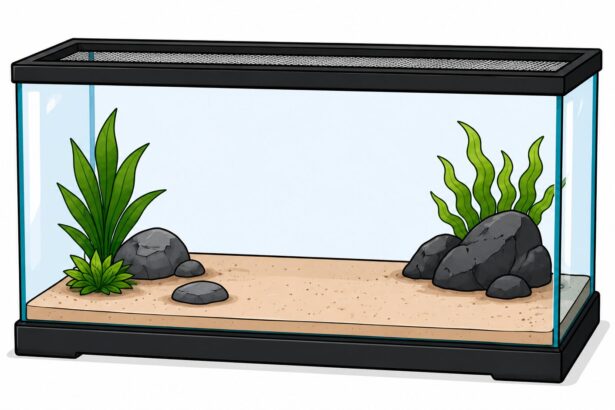

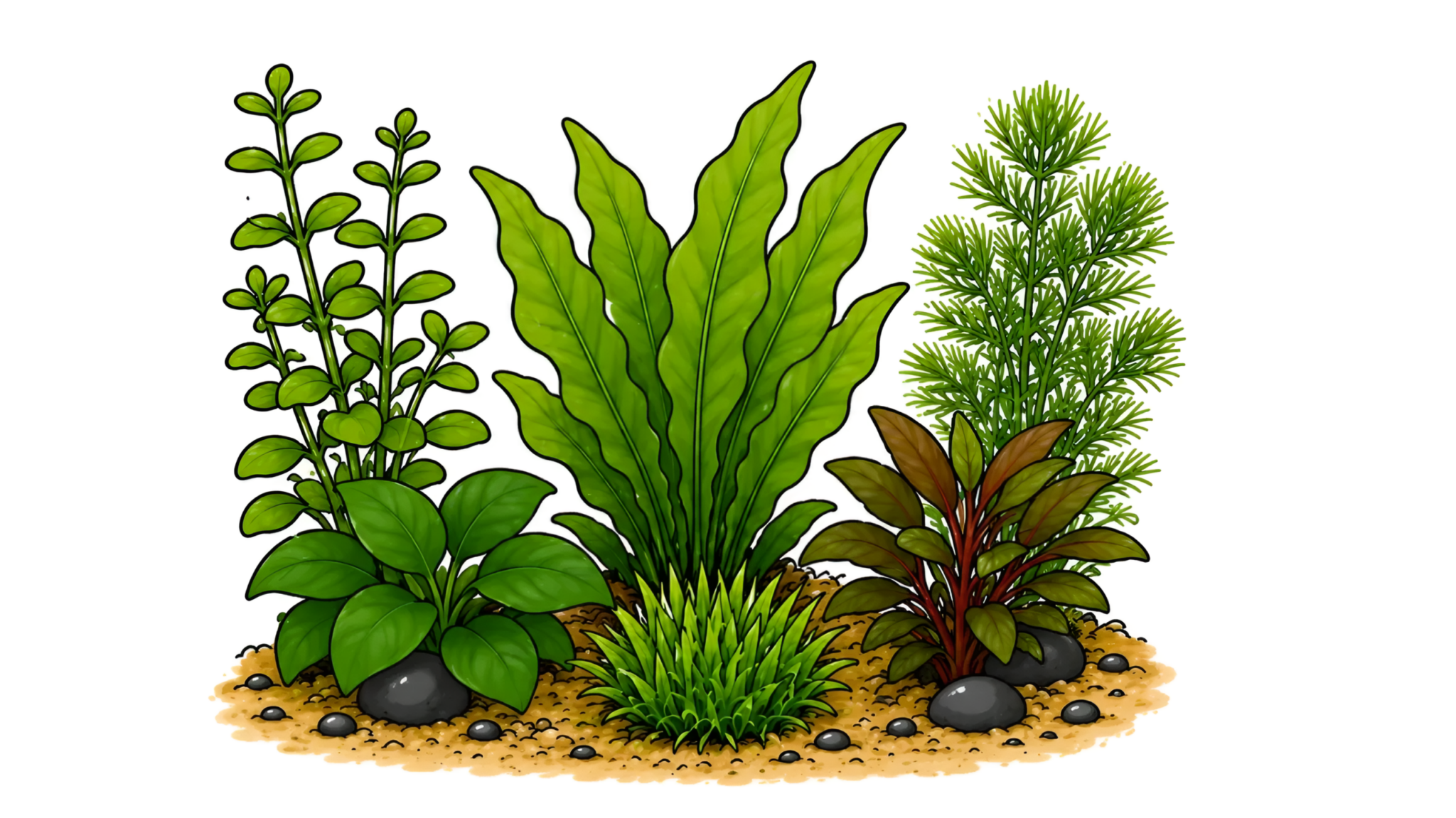
Choosing the best axolotl tank plants is one of the most rewarding decisions you can make for your axolotl’s environment. Plants transform an axolotl tank from a bare, clinical box into a visually stunning, ecologically functional habitat that genuinely improves your axolotl’s quality of life. The right plants provide natural shelter that reduces stress, improve water quality by absorbing nitrates, oxygenate the water, outcompete nuisance algae, and create a naturalistic environment that encourages your axolotl to display its natural behaviours. The challenge is that axolotl tanks have very specific conditions — cold water, low light, no CO2 injection — that many popular aquarium plants cannot handle. This guide covers everything: why plants matter for axolotl welfare, which species thrive in cold axolotl water, what to avoid, and our top Amazon picks for both live and silk plants. Pair this with our full axolotl care guide and our guides on best axolotl tank decor, best axolotl hides, best axolotl caves, and best axolotl tank light for the complete enrichment and aquascape picture.
Why Plants Matter for Axolotl Welfare and Water Quality
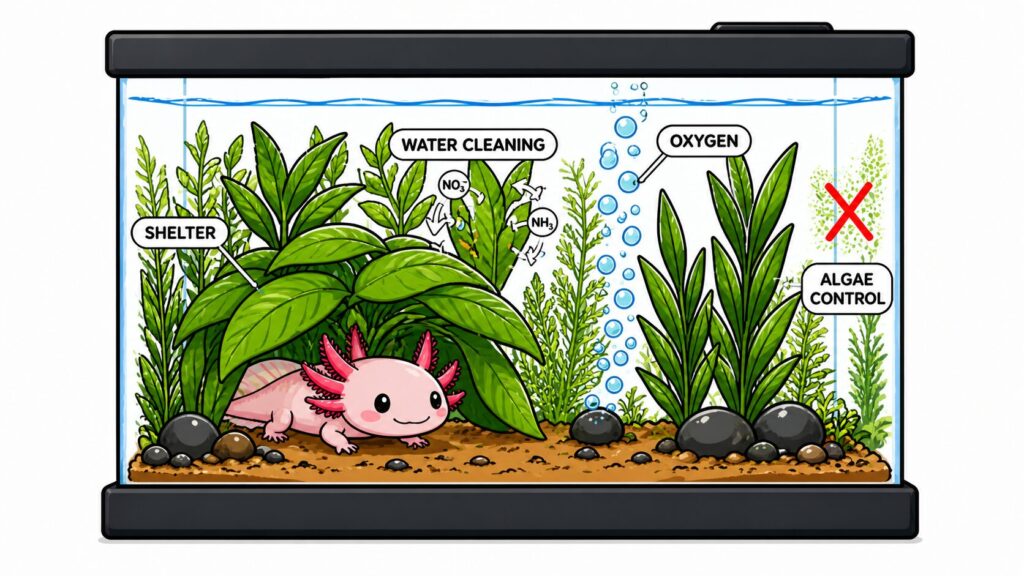
Axolotls (Ambystoma mexicanum) are native to the Xochimilco lake system in Mexico City — a shallow, densely vegetated freshwater environment where aquatic plants are a fundamental feature of the habitat. The wild axolotl population is critically endangered, and their natural environment provides direct guidance on what captive conditions should offer. In Xochimilco, axolotls shelter among aquatic plant stems, rest beneath floating plant canopies, and forage through vegetated areas. Plants in a captive tank provide an analogous habitat that supports the same natural behaviours.
Beyond behaviour, live plants provide measurable water quality benefits. Aquatic plants absorb ammonia, nitrite, and nitrate from the water column as part of their nutrient uptake — directly competing with and reducing the same compounds that your filter works to process. According to research published in Aquaculture, planted aquatic environments consistently show reduced nitrate accumulation between water changes compared to unplanted equivalents — the plants act as a living, continuous water polishing system that supplements mechanical filtration. Hornwort in particular is one of the fastest-absorbing macrophytes available in the aquarium hobby, capable of drawing down nitrate faster than a standard aquarium filter under good growth conditions.
Plants also oxygenate the water during daylight hours through photosynthesis. For an axolotl tank — which needs to maintain cold water with higher dissolved oxygen capacity, as detailed in our guide on what temperature axolotls need — this additional oxygenation from plants complements the surface agitation of your air pump and filter output.
Finally, plant stems and leaves provide natural shelter. An axolotl that can rest between plant stems or under a floating plant canopy has more shelter options than one with only a single cave hide — and more shelter options translate directly to lower stress levels and better long-term health outcomes.
The Critical Challenge: Cold Water and Low Light
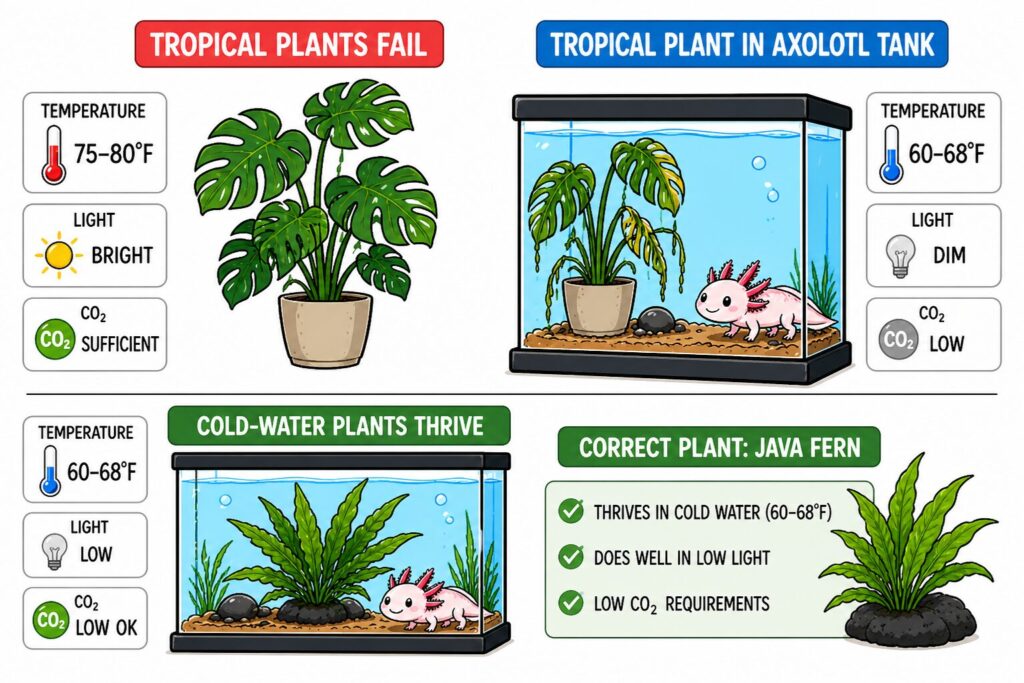
The most important thing to understand about plants for axolotl tanks is that most popular aquarium plants are adapted for tropical freshwater environments — warmer temperatures (72–82°F) that are far outside the axolotl’s safe range of 60–68°F (16–20°C). Many otherwise excellent aquarium plants will decline, rot, or die in an axolotl tank because the cold temperature slows their metabolism below the minimum needed for healthy growth.
Additionally, axolotls require dim lighting to avoid stress — as covered in detail in our best axolotl tank light guide. This means plants that require intense lighting for photosynthesis are not appropriate for an axolotl setup. The plants that work best for axolotl tanks are those that thrive in cold water AND low light — which narrows the field considerably but still leaves excellent options.
A further consideration is that axolotl tanks are typically not injected with supplemental CO2 — the carbon dioxide that drives plant growth in high-tech planted setups. The best axolotl tank plants must therefore grow without CO2 injection, using only the dissolved CO2 naturally present in the water from fish respiration and organic decomposition.
The Best Live Axolotl Tank Plants
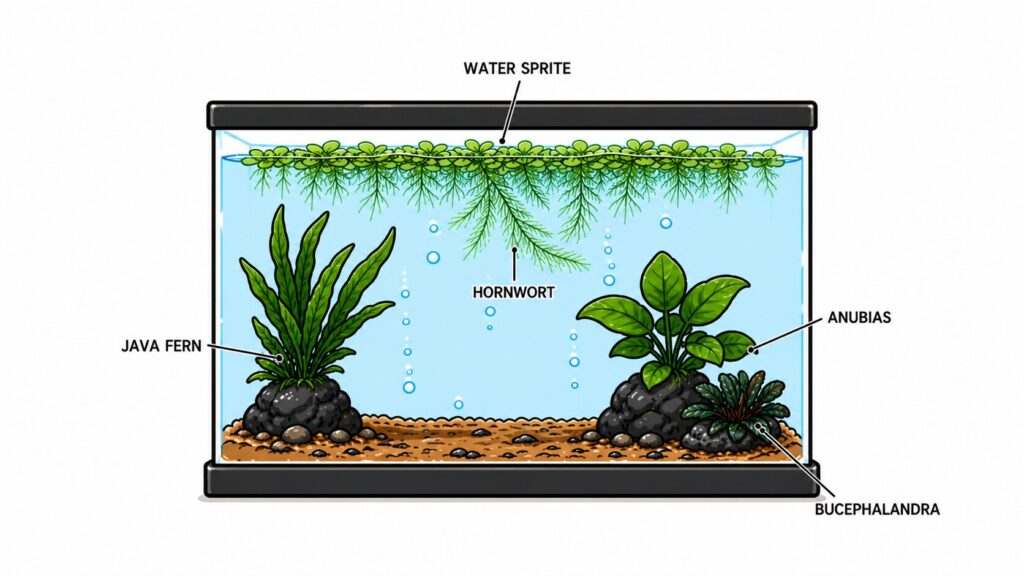
Java Fern (Microsorum pteropus) — Best Overall Live Plant
Java Fern is the single most widely recommended live plant for axolotl tanks, and it earns that position through a combination of cold-water tolerance, low-light growth, ease of care, and safety. Java Fern (Microsorum pteropus) thrives across a temperature range of 60–82°F — making it one of the only popular aquarium plants that grows comfortably at the full range of axolotl-safe temperatures. It grows at low light intensities without CO2 injection or special fertiliser. It is an epiphyte — it attaches to surfaces like driftwood and slate rather than rooting in substrate — which means it is equally suited to bare-bottom, tiled, or sand-substrate axolotl tanks. Its broad, firm leaves provide good physical shelter for axolotls to rest beneath, and its tough leaf texture means axolotls generally ignore it rather than accidentally damaging it.
Java Fern grows slowly, so it does not require frequent pruning, but its steady growth does absorb nitrates continuously over time. It can be attached to driftwood or slate pieces using thread or aquarium-safe glue, and once established it anchors itself with root growth and requires no ongoing intervention beyond occasional pruning of older leaves.
Hornwort (Ceratophyllum demersum) — Best for Nitrate Absorption
Hornwort (Ceratophyllum demersum) is the most effective natural nitrate absorber in the aquarium plant world and one of only a handful of plants that genuinely thrives in cold water. According to research published in the Journal of Aquatic Plant Management, Ceratophyllum species are among the most effective macrophytes for removing inorganic nitrogen from freshwater systems, with documented nitrate reduction rates exceeding those of most filter media in well-lit conditions. For an axolotl keeper who wants natural support for water quality between water changes, hornwort is invaluable.
Hornwort is a fast-growing, stem plant that does not root — it floats freely or can be anchored by weighting the base. In an axolotl tank it works beautifully as a floating plant colony near the water surface, where it receives whatever ambient light is available while remaining away from the substrate where the axolotl walks. Its dense, needle-like foliage provides excellent cover for axolotls that feel secure resting beneath a floating hornwort canopy. The main management task is periodic thinning — hornwort grows quickly and needs to be pulled back every few weeks to prevent it from taking over the surface.
Anubias (Anubias barteri) — Best Low-Light Attached Plant
Anubias is another epiphytic plant that attaches to driftwood, rocks, and tiles rather than rooting in substrate. Like Java Fern, it grows at very low light intensities without CO2 injection. Its preferred temperature range extends down to approximately 62°F, making it suitable for axolotl tanks running at the lower end of the safe temperature window. Anubias barteri and its compact variant Anubias nana are both widely available and highly forgiving.
Anubias is an exceptionally slow-growing plant that absorbs relatively modest amounts of nitrate compared to hornwort, but it contributes to environmental enrichment through its dense, broad leaves that create natural cover and a beautiful aquascape structure. It pairs naturally with Java Fern and slate hardscape for a naturalistic setup. Its extremely slow growth means almost no maintenance once established.
Bucephalandra (Bucephalandra spp.) — Best Premium Low-Light Plant
Bucephalandra species are beautiful, slow-growing rhizome plants from Borneo that attach to hardscape like Anubias. They come in a remarkable variety of leaf colours and textures — green, deep blue-green, brown-red — and create exceptionally attractive aquascapes. They are comfortable at temperatures down to 62°F and grow at very low light levels without CO2. The tradeoff compared to Anubias is price — Bucephalandra is more expensive — and the fact that they grow even more slowly. For keepers who prioritise an outstanding visual result, they are worth the investment.
Water Sprite (Ceratopteris thalictroides) — Best for Surface Cover and Shelter
Water Sprite is a versatile fern that can be grown either rooted in substrate or floating at the surface. As a floating plant in an axolotl tank, it creates a dense, leafy surface canopy that provides excellent diffused lighting and natural shelter directly below it — axolotls frequently rest beneath floating Water Sprite in a way that clearly demonstrates the comfort it provides. Its temperature tolerance extends to the lower end of axolotl-safe ranges, and it grows without CO2 injection or special lighting.
Water Sprite grows faster than Java Fern or Anubias and needs periodic thinning, but its growth rate also means it absorbs nitrates effectively. It is included in the Canton Aquatics axolotl plant bundle alongside Java Fern and Hornwort as one of the three most beginner-appropriate plants for cold axolotl tanks.
Plants to Avoid in Axolotl Tanks
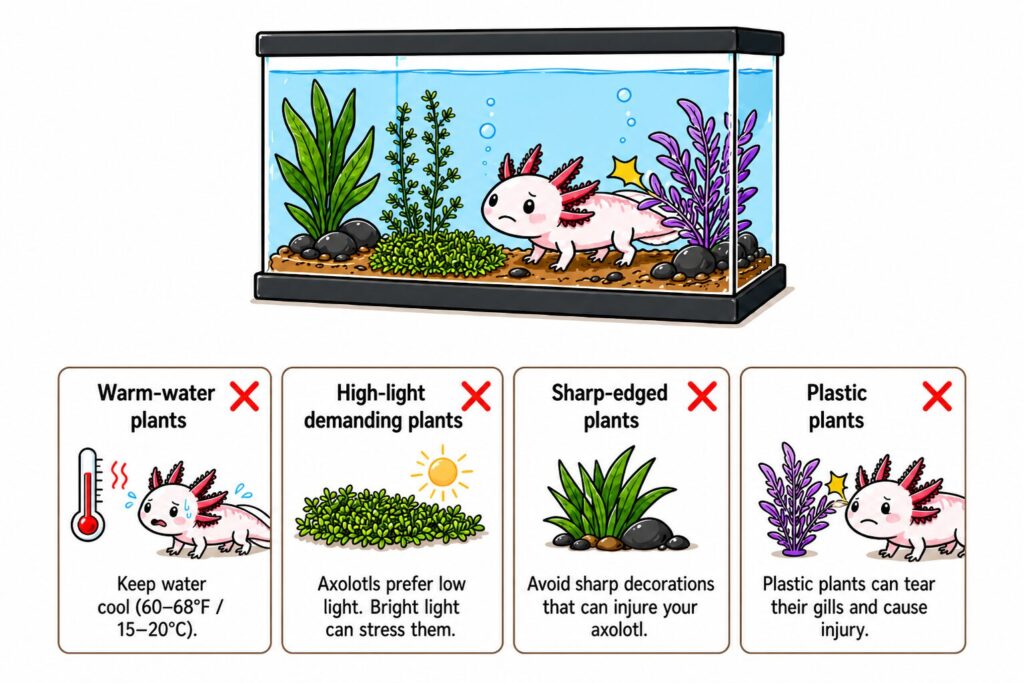
Warm-water plants. The majority of popular aquarium plants — Amazon Sword, Ludwigia, Rotala, stem plants like Bacopa — are adapted for tropical temperatures above 72°F. They may survive initially in a cold axolotl tank but will decline over weeks to months as the cold temperature suppresses their metabolism below the threshold for healthy growth. Dying and rotting plant material adds to the organic load and spikes ammonia, directly harming water quality.
High-light demanding plants. Plants like Glossostigma, Hemianthus, or high-tech carpeting plants require intense lighting that is incompatible with axolotl lighting requirements. These plants will not grow adequately under the dim, axolotl-appropriate lighting levels recommended in our best axolotl tank light guide and will decline rapidly.
Sharp-edged plants. Some large-leaved tropical plants have slightly serrated or firm leaf edges. While not dangerous for fish, these can potentially irritate axolotl gill plumes that brush against them during regular movement. Stick to plants with soft, smooth leaf edges.
Plastic plants. Hard plastic aquarium plants with moulded stems and sharp leaf edges are genuinely dangerous for axolotls — they can lacerate gill plumes. If you want artificial plants, use only silk plants with soft, flexible leaves. Never use hard plastic plants in an axolotl tank.
Our Top Axolotl Tank Plant Picks on Amazon
Best Live Plant Starter Bundle: CANTON AQUATICS Axolotl Live Plants Bundle (Java Fern, Hornwort, Water Sprite — 3 Species, 6 Plants)
The CANTON AQUATICS Axolotl Live Plants Bundle is the most practical starting point for any new axolotl keeper who wants to add live plants. It is the only axolotl-specific live plant bundle on Amazon, assembled and sold explicitly for axolotl tanks by a dedicated aquatic plant supplier. The bundle includes Java Fern, Hornwort, and Water Sprite — the three cold-water-compatible, low-light, beginner-friendly species that experienced axolotl keepers most consistently recommend. All three species are confirmed cold-water compatible at 60–72°F, require no CO2 injection, need no special fertilisers, and arrive alive with a guarantee from the seller. For a new keeper who wants live plants without research overwhelm, this is the definitive starting bundle.
Best Individual Java Fern: SubstrateSource Java Fern Live Aquarium Plant (Bare Root, 1 Piece)
The SubstrateSource Java Fern Live Aquarium Plant (Bare Root) is our recommended individual Java Fern product for keepers who want to source their own plants separately. SubstrateSource inspects each plant prior to shipping and ships in healthy, stable condition with appropriate packing materials. The bare root format (no pot or wool substrate to remove) is the cleanest option for attaching directly to driftwood, slate pieces from our best axolotl tank tiles guide, or other hardscape. Ships at 4–6 inches, compatible with the full axolotl-safe temperature range, and requires no CO2 or special lighting.
Best Java Fern for Larger Tanks: Aquatic Arts Java Fern Live Aquarium Plant — Large 3″×5″ Mat with 30–50 Leaves
For keepers who want immediate, substantial Java Fern coverage in a 40-gallon or larger axolotl tank rather than starting from a small plant, the Aquatic Arts Java Fern 3″×5″ Mat with 30–50 Leaves provides a generous established mat that creates an immediate visual impact and meaningful nitrate-absorbing capacity from day one. This is the same species in a much larger starting quantity, cut from a live aquarium plant maintained in water rather than packaged in plastic — meaning it arrives in actively healthy condition.
Best Anubias: SubstrateSource Anubias Nana Live Aquarium Plant (Potted)
The SubstrateSource Anubias Nana Live Aquarium Plant (Potted) is a compact, slow-growing Anubias variant that is one of the most forgiving aquarium plants available. Its minimum temperature tolerance of approximately 62°F makes it suitable for axolotl tanks running at the lower end of the safe range. It arrives potted with healthy root structure and can be immediately attached to hardscape after removing the pot and wool substrate. Its broad, dark green leaves complement Java Fern beautifully and create a naturalistic layered aquascape when both species are used together.
Best Silk Plant Alternative: Axolotl Hide Tube with 2 Soft Artificial Silk Plants Set
For keepers who want the visual appeal and enrichment benefits of plants without the care requirements of live aquatic plants, the Axolotl Hide Tube and 2 Artificial Plants Set — which we also recommended in our best axolotl tank decor and best axolotl hides guides — provides two soft silk-style artificial plants alongside a functional axolotl hide in one bundle. The soft artificial plants have flexible leaves that will not damage axolotl gill plumes, create natural-looking cover around the hide entrance, and require no maintenance, no lighting consideration, and no cold-water compatibility concern. For keepers who want a zero-maintenance planted look, this is the practical solution.
How to Set Up Live Plants in an Axolotl Tank
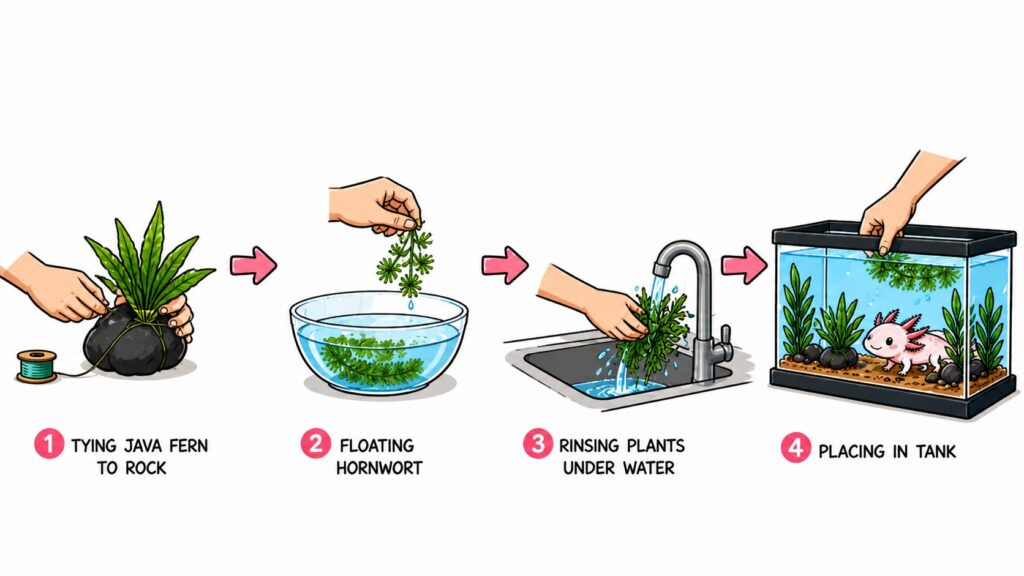
Attaching epiphytes to hardscape. Java Fern and Anubias should never be buried in substrate — their rhizomes (the horizontal stems from which roots and leaves grow) must remain above the substrate or they will rot. Instead, tie them to driftwood or slate pieces using cotton thread, fishing line, or aquarium-safe plant glue. Over 2–4 weeks, the plant will grow roots that anchor it to the surface permanently, at which point the tying material can be removed or left to degrade naturally.
Floating hornwort and water sprite. Simply place hornwort or Water Sprite on the water surface and allow it to float freely. It will drift with filter current and settle naturally. If you want to prevent it from covering the full surface, use a floating plant ring — a ring of airline tubing formed into a circle and floated on the surface — to corral floating plants into a designated area.
Rinsing new plants before adding. Always rinse new live plants thoroughly under cool running water before adding them to your axolotl tank. This removes any surface debris, snail eggs, and any organisms that might be hitchhiking on the plant. A 10-minute soak in a dechlorinated water container is also good practice before introduction.
Lighting duration for plants. Live plants need light for photosynthesis but will grow at the low intensities appropriate for axolotl keeping. Running your tank light — set to axolotl-appropriate low intensity — for 8–10 hours per day provides enough photosynthetic energy for Java Fern, Anubias, Hornwort, and Water Sprite to grow steadily. These are all low-light species that specifically do not require intense illumination.
Monitoring plant health. Yellowing leaves on Java Fern or Anubias indicate insufficient light or nutrient deficiency — try a small dose of liquid fertiliser (without copper, which is toxic to axolotls) or slightly increase lighting duration. Blackening leaf edges on Anubias typically indicate too much direct light — move to a more shaded position. Hornwort that is becoming leggy and sparse needs more light or more frequent thinning to prevent shading itself.
Plants and Axolotl Tank Maintenance
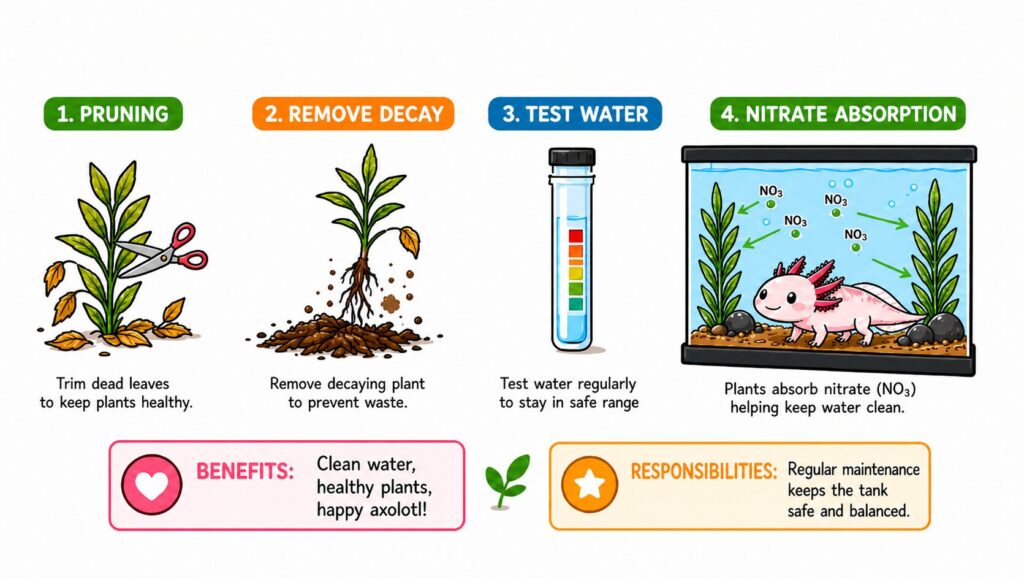
Live plants change the maintenance dynamic of an axolotl tank in largely positive ways. They absorb nitrate between water changes, which may allow slightly longer intervals between changes without nitrate accumulating to harmful levels. However, they do add periodic pruning tasks — removing dead leaves, thinning fast-growing species like hornwort, and occasionally repositioning epiphytes that have been disturbed. Dead or decaying plant material produces ammonia as it breaks down, so always remove dying leaves promptly with feeding tongs or your turkey baster.
Continue testing your water parameters with your water test kit and maintaining your water conditioner routine with every water change. Our guides on how to clean an axolotl tank and how often to clean an axolotl tank provide the complete maintenance framework.
Frequently Asked Questions
Do axolotls eat live plants? No. Axolotls are strict carnivores and have no interest in plant material whatsoever. They will not eat, uproot, or intentionally damage live plants. They may accidentally disturb a lightly anchored plant while walking, but this is not intentional feeding behaviour.
Will live plants grow in cold axolotl water? The species-appropriate ones will. Java Fern, Hornwort, Anubias, Bucephalandra, and Water Sprite all tolerate or actively prefer cooler water temperatures that overlap with axolotl-safe ranges. Tropical plants adapted to 72–82°F will not grow well in a 60–68°F axolotl tank.
Do live plants need substrate to grow in an axolotl tank? The best plants for axolotl tanks — Java Fern and Anubias — are epiphytes that attach to hardscape surfaces rather than rooting in substrate. They are equally suited to bare-bottom, tiled, and sand-substrate axolotl tanks. Hornwort and Water Sprite float freely and also require no substrate. This is one of the reasons these species are particularly well-matched to axolotl keeping.
Can I use plastic plants instead of silk or live plants? Hard plastic plants are not safe for axolotls — their moulded edges and rigid stems can lacerate gill plumes. If you want artificial plants, use only soft silk plants with flexible leaves. However, live plants are strongly preferred for both the environmental enrichment and water quality benefits they provide.
How many plants does an axolotl tank need? There is no strict minimum, but more plant coverage generally produces better results — more nitrate absorption, more visual shelter, and a more natural-feeling environment. For a 40-gallon breeder, a combination of 2–3 Java Fern plants attached to hardscape, a floating section of hornwort, and an Anubias nana or two creates a beautiful and functionally effective planted axolotl aquascape.
A Living Tank Is a Thriving Tank
Plants bring an axolotl tank to life in a way that no amount of resin decor can fully replicate — the gentle movement of hornwort in the filter current, the dappled light filtering through a Java Fern canopy, the natural shelter that sends your axolotl out into the open with quiet confidence. They are the finishing touch that transforms a functional setup into a genuinely beautiful and ecologically rich environment. For the complete, keeper-tested guide to every product your axolotl depends on — from the tank and filtration through to food, health supplies, and every category of enrichment and decor — Best Axolotl Products is your definitive resource for the best gear in every aspect of axolotl care.