




Do axolotls need substrate? It is one of the most common questions new axolotl keepers ask when setting up their first tank, and the answer is more nuanced than a simple yes or no. The short answer is that axolotls do not strictly require substrate to survive — many experienced keepers and breeders run perfectly healthy axolotls in bare-bottom tanks. But substrate, when chosen correctly, offers real benefits that go beyond just aesthetics. And chosen incorrectly, it becomes one of the most serious preventable health hazards in axolotl keeping. This article covers everything: the biological context behind substrate needs, the arguments for and against each approach, which substrate types are safe, which are dangerous, and how to make the right decision for your specific setup. For the complete picture on substrate options and specific product picks, read this alongside our dedicated guide on the best substrate for axolotls and our full axolotl care guide.
- The Biological Context: What Do Axolotls Walk On in the Wild?
- Do Axolotls Need Substrate? The Honest Answer
- The Case for a Bare-Bottom Tank
- The Substrate Safety Hierarchy
- Fine Sand: The Best of Both Worlds
- Tiles: The Hybrid Solution
- How Substrate Choice Affects Other Aspects of Axolotl Care
- Making the Right Decision for Your Axolotl
- Frequently Asked Questions
- Every Good Setup Starts With the Right Decisions
The Biological Context: What Do Axolotls Walk On in the Wild?
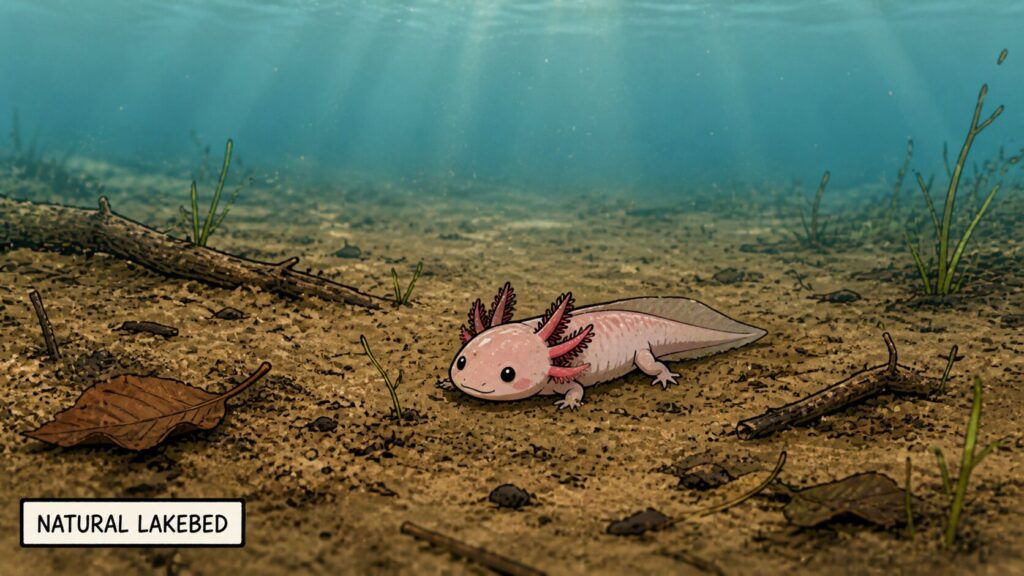
To understand whether axolotls need substrate, it helps to understand what they naturally walk on. Axolotls (Ambystoma mexicanum) are native to the high-altitude lake complex of Xochimilco in Mexico City — a shallow, turbid, heavily vegetated freshwater environment. According to the IUCN Red List documentation of Ambystoma mexicanum, the natural lakebed of Xochimilco is composed of fine silt, soft mud, and organic debris — not gravel, not coarse rock, and not bare glass. The wild axolotl population is critically endangered, and understanding their natural environment helps us make better captive care decisions.
This tells us several important things. First, axolotls have evolved to walk on soft, fine-grained surfaces rather than slippery glass or coarse stone. Second, they regularly interact with the substrate during foraging — sifting through the lakebed material using their sensitive mouths and feet. Third, the organic, fine-grained nature of natural Xochimilco sediment means axolotls do not encounter the impaction risk that comes with coarser captive substrates. A captive substrate that most closely mimics this natural environment — fine sand — supports the most natural behaviour while remaining biologically appropriate.
Do Axolotls Need Substrate? The Honest Answer

No, axolotls do not biologically require substrate in the way that some animals require specific cage furniture. They will not die in the absence of substrate, and many axolotls live long, healthy lives in bare-bottom tanks maintained by experienced keepers. However, “does not strictly require” is not the same as “makes no difference.” Substrate — when appropriate — provides real welfare benefits that a bare-bottom tank cannot replicate:
Traction for walking. Axolotls spend their entire lives at the bottom of their tank, walking rather than swimming. On smooth glass without any substrate or textured covering, axolotls frequently slip and struggle for grip. This is not just an aesthetic concern — ongoing traction difficulties cause unnatural gait, stress the animal physically, and over time represent a real quality-of-life issue. Fine sand gives axolotl feet the grip they need to walk naturally, comfortably, and without constant compensatory effort.
Natural foraging behaviour. Axolotls on fine sand substrates demonstrate natural substrate-sifting behaviour — using their mouths and feet to investigate and interact with the bottom material in a way that mirrors their wild foraging activity. This behavioural enrichment matters for captive animal welfare. An axolotl in an enriched environment with substrate foraging opportunities is a more behaviourally complete animal than one on bare glass with nothing to interact with on the tank floor.
Bacterial surface area for biological filtration. Fine sand provides substantial additional surface area for the beneficial bacteria that process ammonia and nitrite as part of the nitrogen cycle. While the filter media is the primary bacterial habitat, substrate adds meaningful supplementary surface area that improves the overall robustness of the biological filtration. Our guides on the best axolotl filter and best axolotl cycling bacteria cover biological filtration in full detail.
Aesthetic and environmental enrichment. A sand-bottomed tank with natural hardscape and live plants creates a more naturalistic, visually enriched environment than bare glass. This is not purely an aesthetic consideration — a naturalistic environment that includes substrate allows for the addition of tank plants, hides, and caves in ways that create a genuinely richer living space.
The Case for a Bare-Bottom Tank

The bare-bottom approach — running the tank with no substrate at all on the glass floor — is widely used and has legitimate advantages that should not be dismissed.
Zero impaction risk. The most dangerous thing about choosing the wrong substrate is the risk of gastrointestinal impaction — an axolotl ingesting substrate particles that are too large to pass through the digestive tract, causing a fatal blockage. According to research published in Aquaculture, foreign body ingestion is one of the most common and preventable causes of mortality in captive aquatic salamanders. A bare-bottom tank eliminates this risk entirely.
Easiest tank to clean. In a bare-bottom tank, all waste sits visibly on the glass floor rather than settling into or beneath substrate. It can be removed precisely and quickly with a turkey baster on a daily basis and with a tank siphon during weekly water changes — no substrate technique required, no risk of accidentally removing substrate during siphoning. Our guides on how to clean an axolotl tank and how often to clean an axolotl tank cover the full maintenance routine.
Preferred by breeders. Most serious axolotl breeders run bare-bottom tanks for their breeding and rearing setups because the ease of maintenance, clarity of waste visibility, and absence of substrate-related risks make management of multiple animals much more practical. If you are interested in axolotl breeding — our articles on how axolotls mate and axolotl breeding cover the full process — bare-bottom tanks are the standard recommendation.
Simpler initial setup. Setting up a bare-bottom tank involves no substrate purchasing, no rinsing, no layering, and no depth management. For a new keeper who wants to get their tank established and cycling correctly without additional variables, bare-bottom is the simplest starting point.
The main practical mitigation for the traction problem in bare-bottom tanks is to add flat tiles in the areas where your axolotl most frequently rests and walks. A few pieces of natural slate — covered in our best axolotl tank tiles guide — provide the traction of a substrate-covered tank in those specific areas without introducing any loose particle impaction risk.
The Substrate Safety Hierarchy
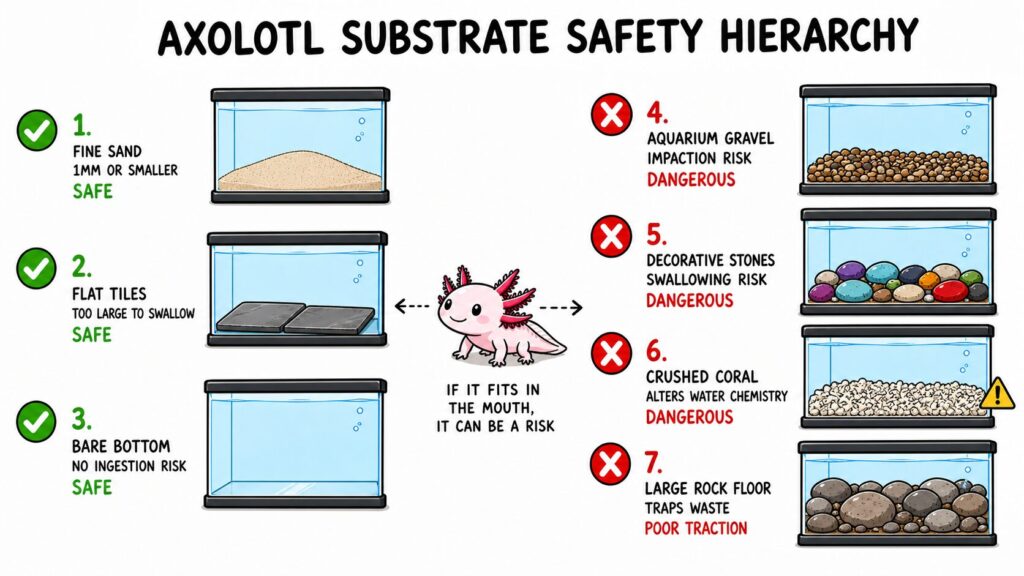
Not all substrates are equally safe for axolotls. Understanding the safety hierarchy is the most important knowledge any axolotl keeper can have about substrate:
Safe: Fine sand with particles of 1mm or smaller. Particles at this size are too small to cause impaction even if swallowed — they pass harmlessly through the digestive tract. This is the gold standard for loose substrate in an axolotl tank.
Safe: Large flat tiles (slate, unglazed ceramic, smooth natural stone) too large to be ingested. Tiles present no swallowing hazard and provide excellent traction.
Safe: Bare bottom with no substrate at all. No swallowing risk, easiest to maintain.
Dangerous: Standard aquarium gravel (3–10mm particles). These are small enough for an axolotl to swallow during feeding but too large to pass through the digestive tract safely. Impaction risk is real and serious. Gravel should never be used in an axolotl tank regardless of how it is marketed.
Dangerous: Decorative pebbles, coloured stones, or crushed coral. Same impaction logic as gravel. Crushed coral also alters water chemistry significantly.
Dangerous: Large decorative rocks as primary floor covering (gaps between rocks trap waste and provide poor traction).
The rule of thumb that many experienced keepers use: if a particle can fit in an axolotl’s mouth, it is a potential impaction hazard. Anything above roughly 2–3mm that could be swallowed falls into the danger zone.
Fine Sand: The Best of Both Worlds

For keepers who want the benefits of substrate — traction, natural foraging behaviour, bacterial surface area, aesthetic appeal — without the risks of gravel or coarser materials, fine aquarium sand is the clear answer. Fine sand particles of 1mm or smaller are definitively safe. Even if swallowed accidentally during feeding (which will happen occasionally), fine sand passes harmlessly through the axolotl’s digestive system and is excreted without issue.
Fine sand closely mimics the natural fine silt substrate of Xochimilco, provides good traction for walking axolotls, supports beneficial bacterial colonisation on grain surfaces, looks beautiful in a display tank, and enables natural substrate-sifting behaviour. The tradeoffs compared to bare-bottom are that waste is less visible in sand (requiring more careful siphoning technique) and managing sand depth requires attention — a 1–2 inch layer is ideal, avoiding both the risk of anaerobic pockets (in deeper layers) and the instability of very thin coverings.
Our comprehensive guide to the best axolotl tank sand covers the top products with verified Amazon links, and our best axolotl tank substrate guide provides a full comparison across all safe substrate types.
Tiles: The Hybrid Solution

Flat slate or unglazed ceramic tiles offer a genuinely attractive middle path between bare-bottom and sand. They provide the traction of a covered floor without loose particles, are easier to clean than sand (waste sits visibly on the flat surface), and can be removed entirely for deep cleaning without the challenge of re-levelling a sand layer. They do not support bacterial colonisation as effectively as sand, and they do not allow natural substrate-sifting behaviour, but for keepers who want ease of maintenance alongside the traction benefits of a covered floor, tiles are an excellent choice.
Many experienced keepers use a hybrid approach — tiles in the feeding area (where most waste accumulates) and sand in the resting and exploration areas — combining the easy cleaning of tiles where it matters most with the natural feel of sand where the axolotl spends most of its time. Our best axolotl tank tiles guide covers the best products for this approach.
How Substrate Choice Affects Other Aspects of Axolotl Care
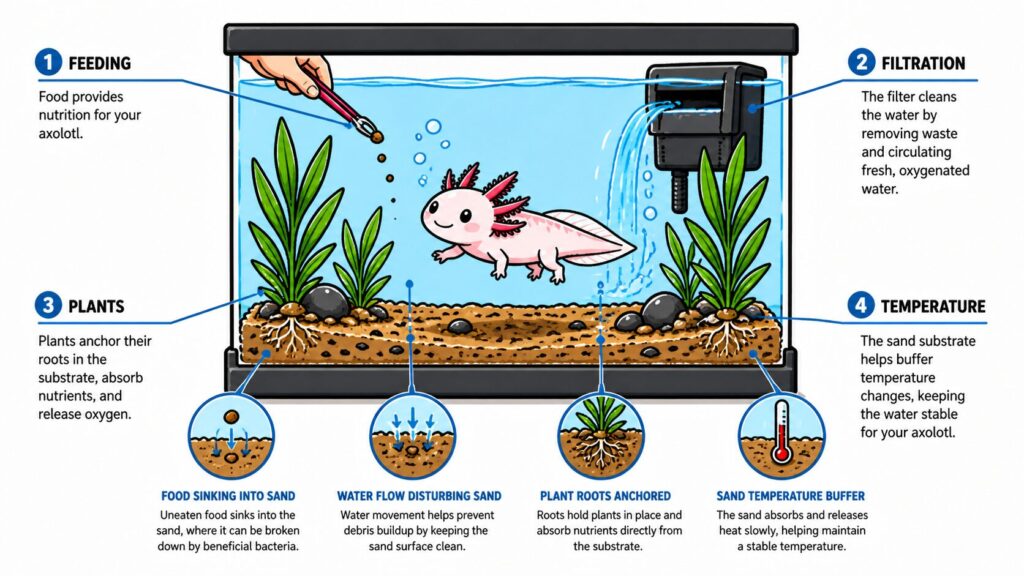
Your substrate choice has knock-on effects throughout your axolotl’s care routine.
Feeding. On fine sand, food items dropped during feeding can disappear below the surface and be missed by both the axolotl and the keeper. Always remove uneaten food promptly using feeding tongs and a turkey baster within 30–60 minutes of feeding. Dedicated keepers sometimes place food on a small designated tile in a sand-substrate tank to prevent this. For guidance on what to feed, see our guides on the best axolotl food, best axolotl pellets, best axolotl nightcrawlers, and best axolotl bloodworms.
Filtration. Fine sand adds biological filtration surface area that supports your filter’s bacterial colony. However, sand can be disturbed by high-flow filter outputs and scatter into the water column — ensure your filter output is baffled to low flow levels as covered in our best axolotl filter guide.
Plant options. Sand substrate opens up a wider range of planted tank options compared to bare-bottom tanks. While the best axolotl plants — Java Fern and Anubias — are epiphytes that attach to hardscape regardless of substrate, a sand substrate allows for a richer overall aquascape aesthetic. Our best axolotl tank plants guide covers species that thrive in cold axolotl water.
Temperature. Substrate has a minor but real thermal effect — sand has slightly higher thermal mass than bare glass, meaning it buffers small temperature fluctuations marginally better. This is a minor factor compared to the effect of your water chiller or cooling fan, but it is worth noting as a small secondary benefit of using sand. For full temperature management guidance, see our article on what temperature axolotls need.
Making the Right Decision for Your Axolotl

There is no universally correct answer to whether axolotls need substrate — the right choice depends on your priorities, your axolotl’s specific needs, and your maintenance preferences. Here is how to think through the decision:
If you are a new keeper who wants the simplest, lowest-risk setup while learning axolotl care, a bare-bottom tank with a few flat slate tiles for traction is the most practical starting point. It eliminates impaction risk entirely, is the easiest to maintain, and gives you one less variable to manage while you learn the fundamentals.
If you are a keeper who prioritises a natural environment and wants to see your axolotl display natural behaviours, fine aquarium sand is the best choice. Take time to learn correct siphoning technique for sand-bottom tanks, and verify your specific sand product is fine enough (1mm or smaller particles) to be safe.
If you want the easiest maintenance with some traction improvement, flat tiles across all or part of the tank floor give you a clean, safe, and practical floor covering that is straightforward to maintain and remove for deep cleaning.
If you are a breeder or experienced keeper managing multiple animals, bare-bottom is almost certainly the most practical approach, as experienced axolotl breeders consistently use and recommend.
Whatever you choose, always verify that any loose substrate you use is 1mm or finer — and never use standard aquarium gravel regardless of its marketing claims. Monitor your water parameters closely and maintain a proper water conditioner routine with every water change. The substrate is just one component of a complete, well-managed axolotl setup — read our best axolotl tank and best tank size for axolotl articles for guidance on the broader setup decisions.
Frequently Asked Questions
Can axolotls live without substrate? Yes — many axolotls live long, healthy lives in bare-bottom tanks. Substrate is beneficial when chosen correctly but not biologically essential.
Is gravel safe for axolotls? No. Standard aquarium gravel is not safe for axolotls. Gravel particles in the 3–10mm range are the most dangerous substrate choice — small enough to be swallowed but too large to pass safely through the digestive system, causing fatal impaction. Never use gravel in an axolotl tank.
What is the safest substrate for axolotls? Fine aquarium sand with particles of 1mm or smaller is the safest loose substrate. Flat tiles are also completely safe. Bare-bottom tanks carry no substrate-related risk at all.
How deep should the sand be in an axolotl tank? A depth of 1–2 inches is ideal — deep enough for natural interaction but not so deep that anaerobic (oxygen-free) pockets form in the bottom layers, which can produce toxic hydrogen sulphide gas.
Does substrate affect water quality? Yes, in both directions. Fine sand provides additional bacterial surface area that supports biological filtration, which is beneficial. But substrate also traps waste between particles, which produces ammonia if not siphoned regularly. A regular tank siphon routine is essential in sand-substrate tanks.
Can I switch from gravel to sand after setting up my tank? Yes — and you should, if your axolotl is currently on gravel. Remove the gravel carefully, check your axolotl for any signs of impaction or distress, and replace with rinsed fine sand. Monitor water parameters carefully during the transition as disturbing substrate can temporarily affect water chemistry.
Every Good Setup Starts With the Right Decisions
Substrate is just one of many decisions that shape your axolotl’s life over the years ahead. Every choice you make — from the tank size to the filtration, the lighting to the food, the hides to the temperature management — contributes to whether your axolotl simply survives or genuinely thrives. If you want a trusted, comprehensive resource for every product decision in axolotl care — reviewed, tested, and recommended by experienced keepers — Best Axolotl Products covers everything your axolotl needs from start to finish.
