
Origin And History
The Entlebucher Mountain Dog, known in German as the Entlebucher Sennenhund and affectionately called the Entle by its devotees, is the smallest of the four Swiss mountain dog breeds and one of the most energetic, athletic, and independent-minded of the Sennenhund family. Its name encodes its geographic origin: Entlebuch is a region in the canton of Lucerne in central Switzerland, and Sennenhund means dog of the Senn, the herders and dairymen of the Swiss Alps who relied on these dogs for cattle driving, livestock guarding, and farm protection across the demanding terrain of the Alpine foothills.
The Sennenhund breeds as a group trace their ancestry to the Roman Molossian dogs that accompanied Julius Caesar’s legions as they crossed the Alps and invaded the territories of what is now Switzerland approximately 2,000 years ago. These Roman dogs, massive guardian and driving breeds, interbred with local Swiss working dogs over subsequent centuries to produce the four distinct regional types that Swiss farmers and herdsmen used across the mountain valleys. The four Sennenhund breeds, the Greater Swiss Mountain Dog, the Bernese Mountain Dog, the Appenzeller Sennenhund, and the Entlebucher Mountain Dog, share the characteristic tricolor coat of black, white, and rust markings that is one of the most immediately recognizable features across all four types.
The Entlebucher’s specific working role reflected its smaller size among the four breeds. While the larger Sennenhund breeds pulled milk carts and managed large cattle herds, the Entlebucher was particularly valued for driving cattle across the Alpine terrain, moving livestock between the lower valleys and the higher Alpine pastures as the seasons changed, and sometimes assisting in driving cattle across national borders into Germany, Italy, and France. The breed was widespread in the Alpine regions since at least the medieval period.
The breed’s formal recognition history is a story of near-extinction and recovery. The first documented mention of the breed under the Entlebucher name appeared in 1889 when the Swiss Kennel Club entered it in its stud book. In 1913, a critical moment occurred when four bobtail Entlebucher Sennenhunds were shown to Professor Albert Heim, the Swiss biologist and passionate advocate for indigenous Swiss dog breeds who was instrumental in formalizing all four Sennenhund breeds. Heim was so impressed that he formally classified the Entlebucher as the fourth Swiss mountain and cattle dog breed, distinct from the Appenzeller with which it had previously been conflated.
What happened next was catastrophic: World War I interrupted the breeding programs that had been developing across Switzerland and Europe, and when the war ended, the Entlebucher had essentially disappeared. By around 1926, the breed was functionally extinct. The recovery of the breed was the work of a single dedicated Swiss breeder named Franz Schertenleib, who in 1927 gathered 16 surviving specimens and established a fresh breeding program from this extremely narrow genetic foundation. This bottleneck has meaningful implications for the breed’s genetic diversity and health profile that remain relevant today.
The first breed standard was established in 1927, the same year Schertenleib began his revival work, under the Swiss Club of Entlebucher Cattle Dogs. The breed was recognized by the FCI and became established in Switzerland and neighboring countries across the 20th century. The first Entlebucher arrived in the United States in the late 1990s, and the National Entlebucher Mountain Dog Association (NEMDA) was founded to support the breed. The breed was officially accepted into AKC records on December 1, 2010, and became eligible to compete in the AKC’s Herding Group starting January 1, 2011, making it one of the more recently fully recognized breeds in the AKC’s history.
Breed Overview
| Trait | Details |
|---|---|
| Breed Group | Herding |
| Height | Males 44–52 cm (17–21 inches) / Females 42–48 cm (16–20 inches) |
| Weight | 20–30 kg (45–65 pounds) |
| Lifespan | 11–13 years |
| Coat | Short, dense, close-lying double coat |
| Colors | Tricolor: black with symmetrical rust and white markings |
| Temperament | Energetic, loyal, intelligent, independent, protective |
| FCI Recognition | Yes |
| AKC Recognition | 2011 |
Appearance And Size
The Entlebucher Mountain Dog is a medium-sized, compact, and powerfully muscled herding dog that presents with the sturdy, athletic appearance of a breed built for sustained work across demanding Alpine terrain. Males stand 44 to 52 centimeters at the shoulder and weigh between 20 and 30 kilograms. Females are somewhat smaller. The overall impression is of a well-proportioned, strong, agile dog that carries its substance with the quick, purposeful energy that reflects its cattle-driving heritage.
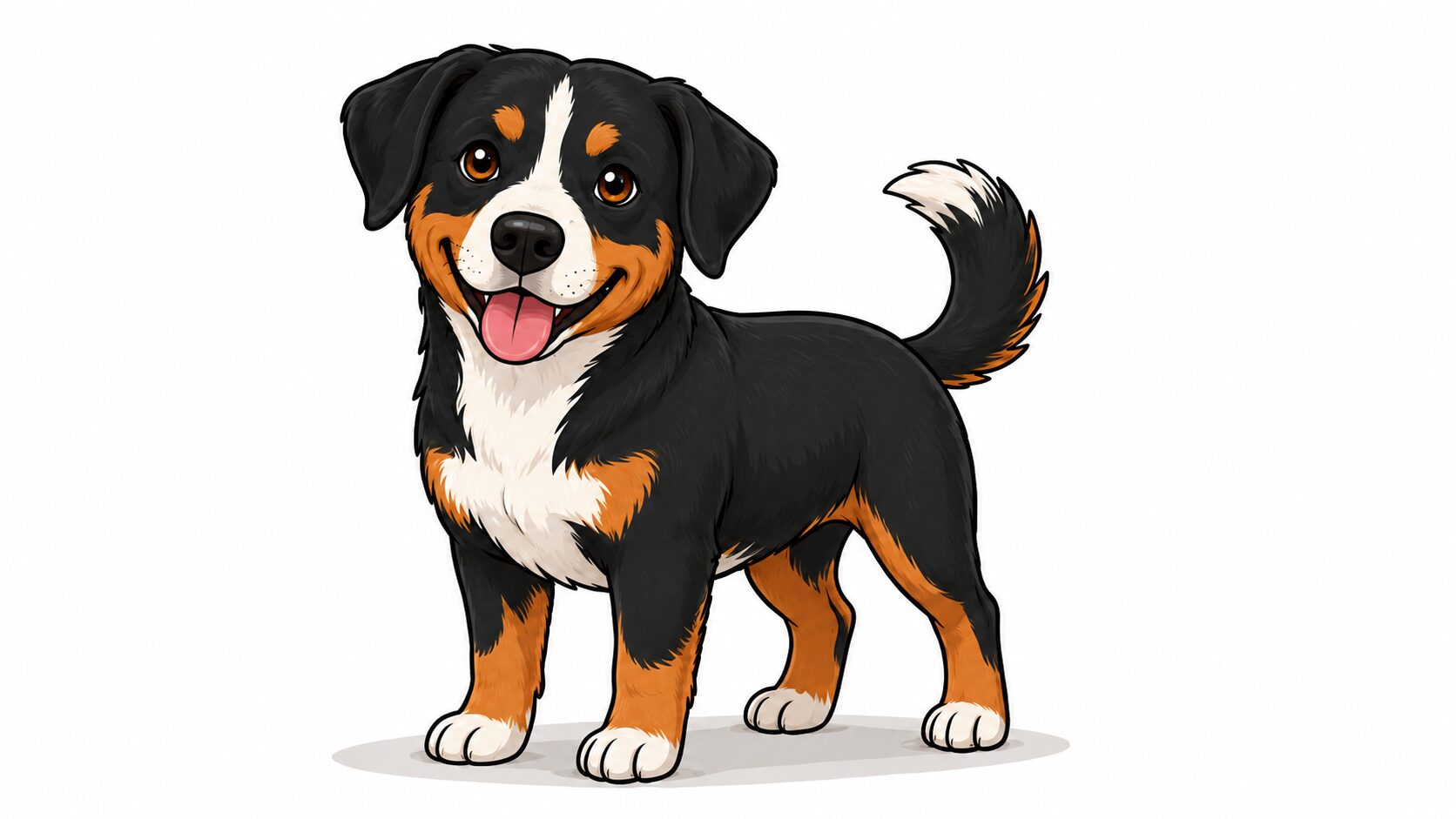
The tricolor coat pattern shared by all four Sennenhund breeds is the most immediately recognizable feature. The base is glossy black, with symmetrical rust or tan markings appearing above the eyes, on the cheeks, muzzle, chest, and lower legs, and bright white markings on the muzzle, chest, and feet. The symmetry of these markings is considered important in conformation evaluation. The coat is short, dense, and close-lying, forming a practical field coat that provides weather resistance without the intensive maintenance demands of longer-coated breeds.
The head is clean and slightly rounded, with a broad, flat skull and a strong muzzle. The eyes are small, dark brown, and almond-shaped, carrying the bright, alert, intelligent expression that characterizes the breed. The ears are moderate in size, triangular, rounded at the tip, and hang close to the cheeks.
The body is compact and slightly longer than tall, with a deep chest, a level or very slightly sloping topline, and well-muscled hindquarters. The tail is naturally short in some individuals or medium in length, and docking where practiced follows national regulations.
Housing And Living Requirements
The Entlebucher Mountain Dog’s housing requirements are shaped clearly by its heritage as an active cattle-driving breed that worked across demanding Alpine terrain, and being direct about these requirements serves prospective owners considerably better than any softening of the practical realities.
A home with meaningful outdoor access is the baseline appropriate setting. Rural and semi-rural environments where the dog has space to move, work, and engage its herding intelligence legitimately are most suitable. Suburban settings with committed, genuinely active owners are workable. Urban apartment living is a poor match for a breed this energetic and this working-heritage-oriented regardless of how diligent the owner is about structured daily exercise.
The breed is intensely loyal and devoted to family and will only be completely happy if allowed to be with its people at all times. Consigning an Entlebucher to the yard and leaving it alone for extended periods is a recipe for an unhappy, behavioral problem-generating dog. This is not a breed that manages prolonged daily isolation with equanimity.
A securely fenced garden is essential for a breed with herding instinct and the athletic capability to act on it. Inside the home, a well-exercised Entlebucher is a warm, devoted, and settled companion. A large dog bed in a social position suits the breed’s people-oriented nature during rest periods.
Exercise Requirements
The Entlebucher Mountain Dog is a high-energy working breed with genuine daily exercise needs that reflect its heritage as a cattle-driving dog covering significant terrain across the Swiss Alps. At least 60 to 90 minutes of vigorous daily exercise is appropriate for most adults, combining structured physical activity with the mental engagement that the breed’s considerable working intelligence specifically requires.
The breed excels across a wide range of performance activities: herding trials, dog agility, tracking, obedience competition, search and rescue, and all forms of dog sport that combine physical challenge with handler-focused mental engagement. A set of dog agility equipment at home provides structured physical and cognitive engagement for a breed that thrives on purposeful activity with its people.
Puzzle toys and enrichment activities are genuinely important between physical exercise sessions. A GPS tracker is a practical safety investment for outdoor exercise in any open or unfenced area.
Grooming Requirements
The Entlebucher Mountain Dog’s short, dense, close-lying double coat is one of the most practically low-maintenance grooming commitments of any herding breed. Brushing once or twice a week under normal conditions removes loose hair and keeps the coat in healthy condition. During the seasonal shedding periods in spring and fall, more frequent brushing is necessary to manage the undercoat release. The breed sheds moderately throughout the year with heavier seasonal output.
Bathing every six to eight weeks is appropriate under normal conditions. The short, dense coat dries relatively quickly after bathing.
The ears should be checked and cleaned weekly. Dental care should be established as a consistent routine from puppyhood. Nails should be trimmed monthly.
Diet And Nutrition
The Entlebucher Mountain Dog is a medium-sized, highly active herding breed with significant daily caloric needs that should be matched to its actual size and activity level. A high-quality medium or large breed formula with a named protein source as the first ingredient provides the nutritional foundation this athletic breed requires.
Most adults do well on two measured meals per day. Maintaining appropriate weight throughout the dog’s life is one of the most practically meaningful ongoing health investments an owner can make, directly protecting against the hip dysplasia to which the breed is predisposed. Extra weight directly worsens arthritic changes in dysplastic joints.
Growth management during puppyhood is important for a breed of this size. High-impact exercise during the growth phase, including repetitive hard-surface running and jumping, should be limited while bones and joints are still developing.
Discussing joint supplements with your veterinarian as the dog reaches middle age is worthwhile. Training treats are effective motivators and should be counted into the daily calorie total.
Compatibility
The Entlebucher Mountain Dog’s compatibility profile is one of genuine family devotion combined with the independent, herding character and watchdog instincts of a working Alpine breed.
With its own family, the breed is intensely loyal and devoted. The Entlebucher’s attachment to its own people is one of its most celebrated and most consistently described domestic qualities, expressing through the close, watchful proximity of a dog that regards its family as its most fundamental responsibility. They expect lots of cuddles and physical contact from the people they love.
With children, the breed is generally good-natured when raised alongside them and properly socialized. However, the herding instinct that makes the Entlebucher such an effective cattle driver also makes it prone to herding children, attempting to round up stragglers by bumping or nipping at heels. This instinct is not aggressive but can result in toddlers being pushed to the ground by a dog this sturdy and energetic, making active supervision and consistent training to redirect herding behavior particularly important in households with very young children.
With strangers, the breed’s guardian character is genuine and consistent. Wary of strangers, they make great guard dogs, always announcing the arrival of visitors. This wariness is the authentic expression of a working breed that was expected to guard the farmstead as well as the cattle. Early and thorough socialization from puppyhood ensures this natural alertness is expressed as appropriate discernment rather than reactive aggression.
With other dogs, the breed is generally sociable when well-socialized from early in life. A dog crate sized appropriately is a useful management tool during puppyhood.
Behavior And Temperament
The Entlebucher Mountain Dog’s temperament is one of the most specifically described in the Swiss herding breed world: energetic, quick, athletic, and intensely devoted to its people, with the independent working intelligence of a cattle-driving dog that made its own decisions across the Alpine terrain and the guardian conviction of a farmstead protector that took its responsibilities seriously.
The energy is the most immediately practically relevant quality for any prospective owner to understand honestly. This is a genuinely high-energy breed that was developed for sustained outdoor work in demanding terrain, and that energy does not have an off switch simply because the dog lives in a suburban house rather than an Alpine farm. The Entlebucher that is not receiving adequate daily exercise and mental stimulation will find its own activities, and its intelligence and determination make those self-generated activities considerably more elaborate and more problematic than those of less capable breeds.
The independence is genuine and shapes the training relationship in ways worth understanding clearly. A breed that drove cattle across mountain passes without constant handler direction retains that self-directed working character in the domestic setting, and training must engage this quality rather than attempt to override it with simple compliance demands.
The devotion and loyalty are total and completely genuine. The Entlebucher commits to its family with the full conviction of a breed that has been working in close partnership with Swiss farming families for centuries.
Training And Handling
The Entlebucher Mountain Dog is a highly intelligent, capable, and genuinely trainable breed whose training relationship requires consistent, confident, positive handling and the genuine engagement of its considerable working intelligence. The breed’s intelligence makes it highly trainable for owners who approach training correctly, and one of the most creative management challenges for those who do not.
Positive reinforcement methods are the approach that works most reliably. The Entlebucher responds to reward, to genuine engagement, and to training that feels purposeful and collaborative. Its food motivation makes treat-based training highly productive, and training treats used purposefully in sessions produce quick, reliable results. The independence that is authentic to the breed means that repetitive drilling produces declining engagement, while varied, purposeful sessions that respect the breed’s intelligence maintain enthusiasm.
Early socialization beginning in puppyhood is the most important single investment an Entlebucher owner can make. Exposing the young dog to a wide range of people, other dogs, environments, and situations during the critical developmental window shapes the adult dog’s ability to navigate varied social contexts with the confident, measured response that the breed’s character supports when properly developed.
The herding instinct toward children and other animals should be addressed in training from the earliest days. Teaching an alternative behavior, such as sitting and waiting when family members move through the house, provides a constructive outlet for the herding impulse without allowing it to create safety problems.
Health And Lifespan
The Entlebucher Mountain Dog is generally a healthy breed with a lifespan of 11 to 13 years. Its development from the narrow genetic foundation of 16 surviving dogs in 1927 means that the breed carries a limited gene pool with elevated risk of certain hereditary conditions, and the breeding community’s active health testing infrastructure reflects the serious attention responsible Entlebucher breeders give to managing these risks.
Progressive Retinal Atrophy (prcd-PRA) PRA is the most breed-specifically notable hereditary health concern in the Entlebucher, and the breed community’s response to it is a model of proactive health management. The Entlebucher carries the gene for PRA, an inherited eye disease causing gradual retinal degeneration and eventual blindness, with most affected dogs experiencing the late-onset variety. In 2004, NEMDA worked with Cornell University and Optigen to develop a DNA test specifically for PRA in the Entlebucher, funded through breeder fundraising. NEMDA’s Breeder Code of Ethics requires that all breeding Entlebuchers be DNA tested to determine their PRA status as Pattern Normal, Carrier, or Affected. Sourcing from breeders who provide PRA DNA testing documentation for both parents is essential.
Hip and Elbow Dysplasia Abnormal joint development causing pain, restricted movement, and progressive arthritis is the most consistently documented hereditary orthopedic concern in the breed. OFA hip evaluation is required for breeding animals participating in NEMDA’s Breeder Code of Ethics. Maintaining appropriate weight throughout the dog’s life and managing exercise during the growth phase are the most meaningful protective measures. Discussing joint supplements with your veterinarian as the dog reaches middle age is worthwhile.
Entlebucher Urinary Syndrome (EUS) This breed-specific condition affecting the urinary tract, particularly involving ectopic ureters and other urinary abnormalities, is documented in the breed. Investigations are ongoing to understand the genetic basis and improve breeding assessments that prevent propagation.
Juvenile Dilated Cardiomyopathy (JDCM) Heart conditions including dilated cardiomyopathy and heart murmurs are documented in the breed. DNA screening for JDCM is available, and annual cardiac evaluation as part of routine preventive care allows for early detection.
Immune-Mediated Conditions Autoimmune hemolytic anemia (AIHA) and immune-mediated thrombocytopenia (ITP) are documented in the breed at rates that the Entlebucher community monitors. These conditions, in which the immune system attacks the dog’s own red blood cells or platelets, can be serious and require prompt veterinary management. Awareness of early signs including lethargy, pale gums, and unusual bruising allows for prompt attention.
Patellar Luxation Kneecap dislocation is documented in the breed. It ranges from mild, requiring only monitoring, to severe, requiring surgical correction. OFA patellar evaluation is recommended for breeding animals.
Cataracts and Additional Eye Conditions Cataracts, glaucoma, and other hereditary eye conditions beyond PRA are documented in the breed. Regular annual CAER eye examinations allow for early detection and appropriate management.
Routine preventive care, including regular vet check-ups, consistent dental hygiene, up-to-date vaccinations, and parasite prevention, provides the foundation for a healthy Entlebucher across its lifespan.
Price And Availability
The Entlebucher Mountain Dog is a genuinely rare breed in the United States, with a small but dedicated community of reputable breeders working to maintain genetic health and breed quality. From reputable breeders, expect to pay between $1,500 and $3,500 for a well-bred puppy from health-tested parents. The limited number of active breeders means wait times are common, and prospective owners should be prepared for meaningful wait times from reputable sources.
The National Entlebucher Mountain Dog Association is the most authoritative starting point for locating breeders in the United States who breed to the AKC standard and conduct appropriate health testing. NEMDA’s Breeder Code of Ethics requires OFA hip evaluation, PRA DNA testing, CAER eye certification, and cardiac evaluation on all breeding animals, with documentation published in the OFA database. Responsible breeders will ask thorough questions about the prospective buyer’s lifestyle, activity level, and experience with independent working breeds.
Adoption is possible through NEMDA’s rescue network and through general herding breed rescue organizations on an occasional basis, though the breed’s rarity means this is an infrequent option.
Conclusion
The Entlebucher Mountain Dog was the cattle-driving workhorse of the Swiss Alpine foothills for centuries before industrialization ended the great cattle drives that defined its purpose, was nearly wiped out by the First World War, was resurrected by a single dedicated Swiss breeder from 16 surviving dogs in 1927, and finally arrived at AKC recognition in 2011 having spent the intervening 84 years quietly building a devoted following in Switzerland and earning new admirers across the Atlantic. It is the smallest of the four Swiss mountain dogs, the most independent and athletic of the group, the one most likely to develop its own strong opinions about the household management choices of its people, and the one whose devotion, when earned, is as total and as complete as any breed’s. The PRA DNA testing is non-negotiable. The hip evaluation is essential. The exercise commitment is genuine and daily. The training requires confident, consistent engagement. And in return, the Entlebucher offers a companionship of extraordinary loyalty, athletic capability, and Swiss Alpine working character that its small community of devotees considers entirely worth the investment. Get properly set up before bringing one home. Our Best Dog Products page has everything you need for compact, tricolored, whole-heartedly devoted Swiss cattle dogs that carry centuries of Alpine herding heritage into every home they grace.