
Getting the temperature right in your mantis enclosure is one of those things that seems straightforward until you realize how many ways it can go wrong. Too cold and your mantis becomes sluggish, stops eating, and struggles to molt. Too hot and you’ve got a very different — and much more serious — problem on your hands. Here’s everything you need to know to get it right from the start.
Does Your Mantis Even Need Additional Heating?
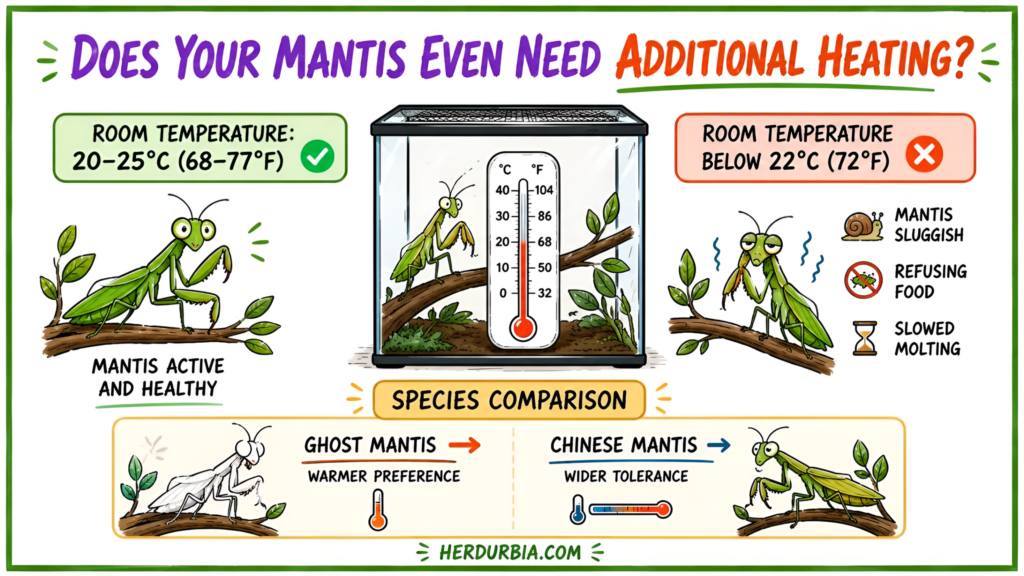
Not every mantis keeper needs to worry about heating — and this is the first thing to figure out before you spend money on equipment you might not need. Most mantis species do well at temperatures between 20°C and 25°C (68–77°F), which happens to be the temperature most homes sit at naturally. If your home stays comfortably warm year-round, there’s a good chance your mantis is already in its ideal temperature range without any additional heating at all.
The time to start thinking about supplemental heating is when your room temperature regularly drops below 22°C (72°F), particularly at night or during colder months. A mantis kept consistently below this threshold will become sluggish, eat less, and its growth and molting can be negatively affected. So check the temperature in the room where you keep your mantis — not just the ambient room temperature, but inside the enclosure itself — and go from there.
It’s also worth researching the specific species you keep. A Ghost Mantis from Africa has different requirements than a Chinese Mantis that’s adapted to a wider temperature range. Always use your species’ natural habitat as your guide.
Create A Temperature Gradient
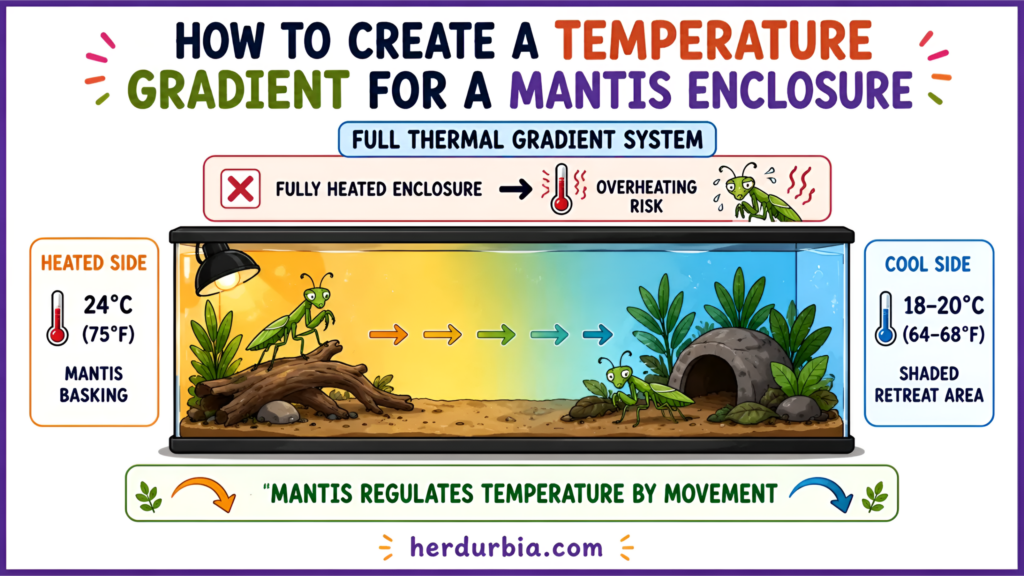
Before we get into heating methods, there’s one concept that every mantis keeper needs to understand — the temperature gradient. Because mantis are cold-blooded, they regulate their body temperature by moving between warmer and cooler areas, just like they would in the wild by moving in and out of sunlight. In captivity, you need to replicate this by heating one side or end of the enclosure and leaving the other side cooler.
This gives your mantis the ability to choose where it wants to sit based on how warm or cool it feels at any given moment. A mantis that has no cooler area to retreat to — because the whole enclosure is uniformly heated — can easily overheat. High temperatures are actually more dangerous to mantis than lower ones, so always err on the side of a slightly cooler enclosure over a too-hot one.
Heat Mats — The Most Practical Option
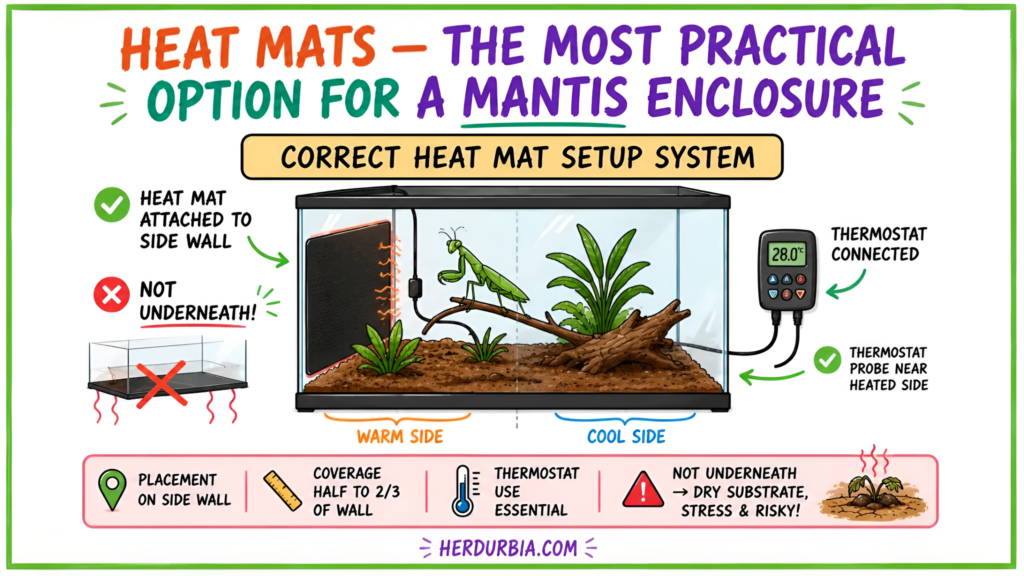
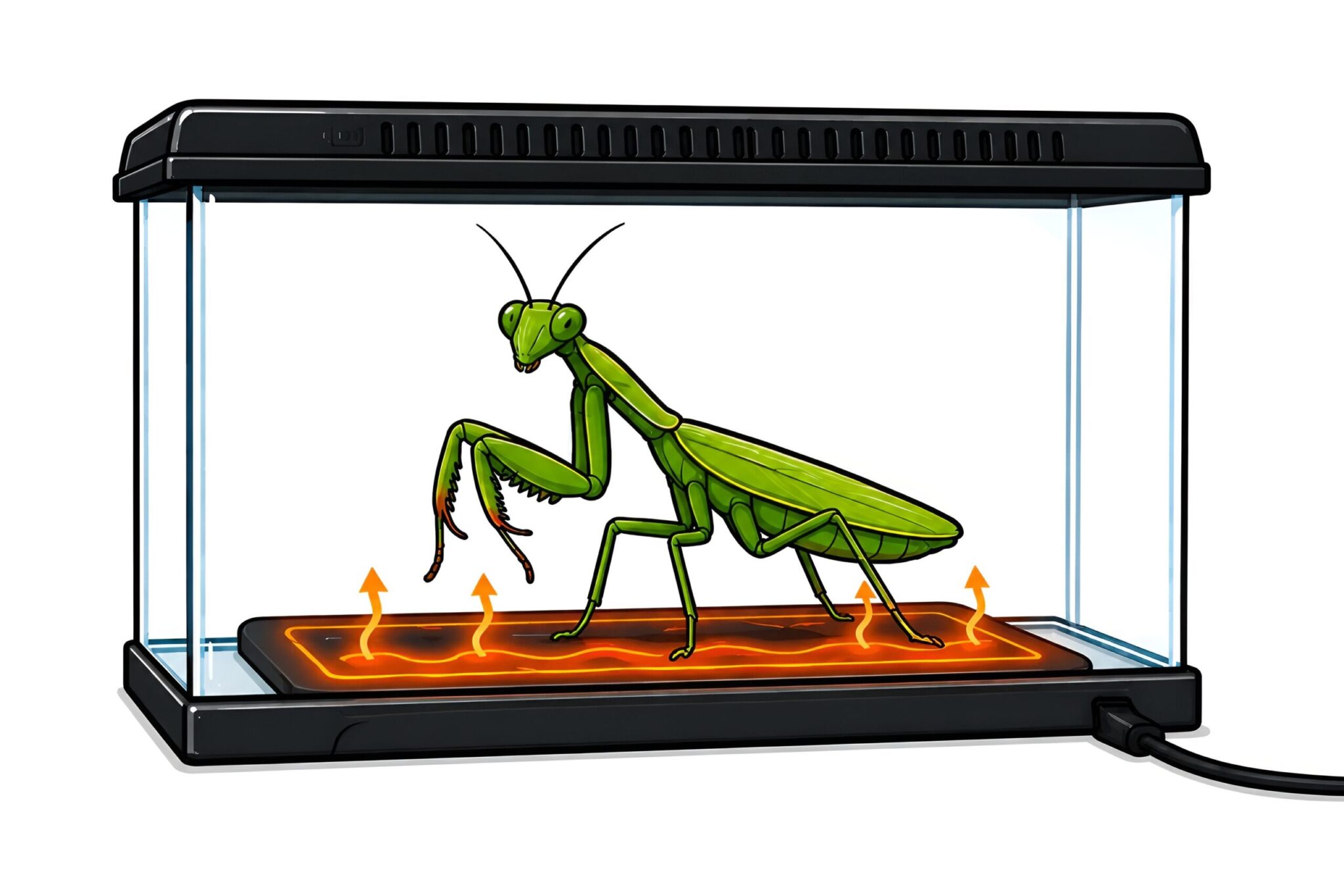
For most mantis keepers, a heat mat is the simplest, most affordable, and most effective heating solution available. Heat mats produce a gentle, consistent warmth and are easy to position on the side or back of the enclosure — never underneath it, since placing a heat mat directly under the enclosure can dry out substrate too quickly and make it harder to maintain appropriate humidity. Position the mat on the outside of one wall, covering roughly half to two-thirds of that surface, so the other side stays cooler.
One critical addition — always pair your heat mat with a thermostat. A thermostat regulates the heat mat’s output and prevents the enclosure from overheating, which is something you absolutely cannot rely on a heat mat alone to do. Matstats — thermostats designed specifically for use with heat mats — are inexpensive and easy to find. Place the thermostat probe inside the enclosure, adjacent to the heat mat, and set it to your target temperature. This takes all the guesswork out of temperature management.
One more important warning — never place a plastic or glass enclosure in direct sunlight as a heating method. The greenhouse effect inside a transparent enclosure sitting in a sunny window can spike the temperature to lethal levels within minutes. It’s one of the most common accidental causes of mantis death and one of the easiest to avoid.
Heat Lamps — When They’re Worth Considering
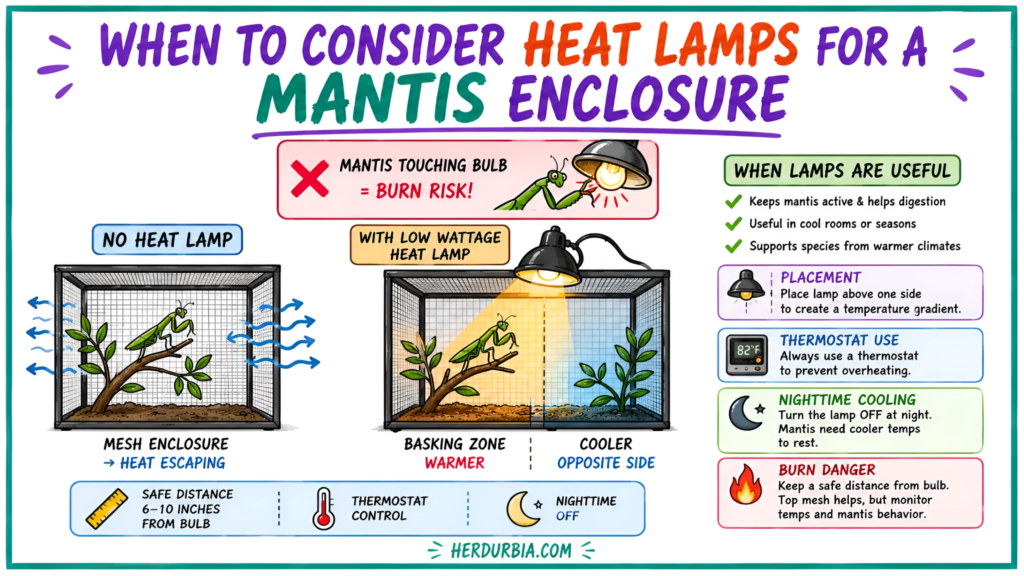
Heat lamps are another option, particularly useful if you keep your mantis in a mesh or screen enclosure where a heat mat on the side is less effective since heat escapes quickly through the mesh. A low-wattage bulb positioned above or to the side of the enclosure can create a warm basking area while the rest of the enclosure stays at a lower ambient temperature.
The key things to get right with heat lamps are distance and thermostat control. Always make sure your mantis cannot physically reach or touch the bulb — a mantis that walks onto a hot bulb will burn itself. Keep the lamp at a safe distance and always use it with a thermostat. Heat lamps should also be turned off at night to replicate the natural temperature drop that occurs in the wild after dark. A slight overnight dip in temperature is completely fine and actually mirrors natural conditions.
Heating Baby Mantis Nymphs
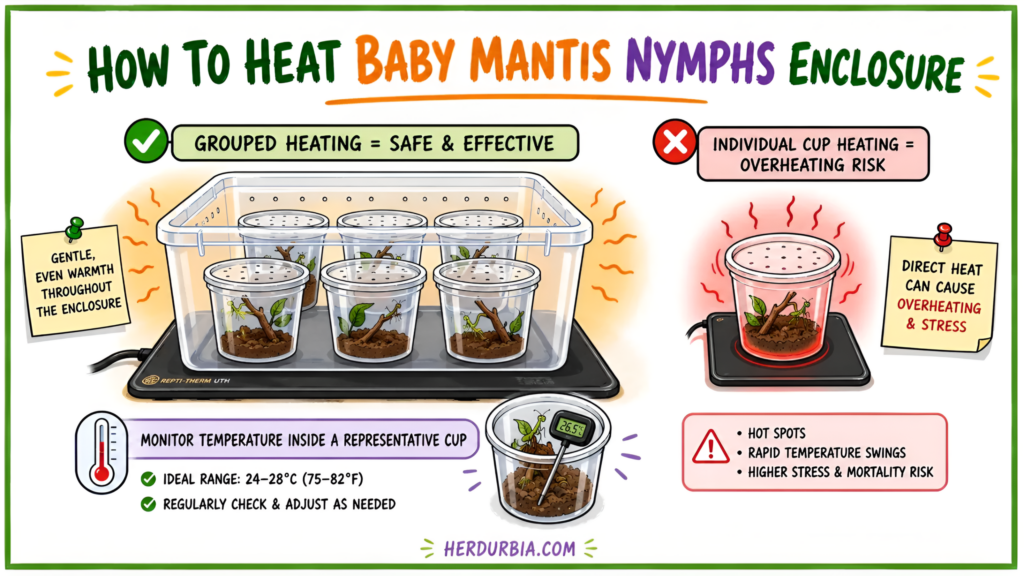
Heating individual nymph enclosures is a genuine challenge because the small containers most nymphs are kept in — deli cups and small vials — can overheat extremely quickly with even a modest heat source nearby. One practical solution is to place all the individual nymph containers together inside a larger enclosure, and then heat the larger enclosure with a single heat mat or low-wattage lamp. This creates a warm ambient environment for all your nymphs without the risk of any single container getting too hot. Just make sure you’re still monitoring the temperature inside a representative container — not just the ambient temperature of the larger enclosure — to make sure everything is within the right range.
What Temperature Should You Aim For?
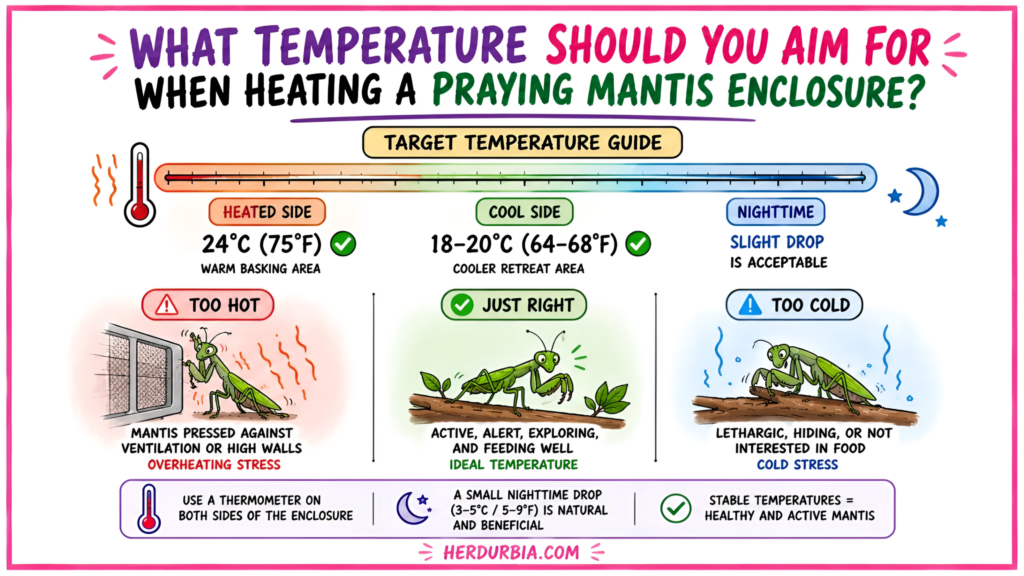
As a reliable general target, aim for a warm spot of around 24°C (75°F) on the heated side of the enclosure, allowing the cooler side to sit around 18–20°C (64–68°F). Overnight drops below this are fine as long as temperatures don’t stay low for extended periods. Always check the temperature inside the enclosure with a reliable digital thermometer — the temperature outside the enclosure can be misleading, especially with well-insulated glass setups.
And remember — if your mantis is sitting pressed against the ventilation area of its enclosure, that’s a sign it’s too hot inside. If it’s barely moving and refusing food, it may be too cold. Watch your mantis’s behavior and let it tell you what it needs. You can find more on what temperature praying mantis can survive on our dedicated page.
Conclusion
Heating a mantis enclosure well comes down to three things — knowing your species’ requirements, creating a temperature gradient rather than uniform heat, and always using a thermostat with whatever heating method you choose. Get those three things right and your mantis will stay active, eat well, and molt safely all year round. Whether you need a quality heat mat, a reliable thermostat, or a digital thermometer to monitor your setup, everything you need is right here at Best Praying Mantis Products.