
Finding the best axolotl tank lid is something many new keepers overlook when setting up their tank for the first time — and it is a mistake that can have serious consequences. Axolotls are far more capable of escaping their tanks than most people expect, and a tank without a properly fitted lid is a genuine safety hazard. This guide covers everything you need to know about axolotl tank lids: why they matter, what features to look for, which lid types work best, and our top picks with Amazon links so you can get exactly the right lid for your setup. If you are still putting your full setup together, pair this guide with our articles on the best axolotl tank and the best tank size for axolotls for a complete picture.
Do Axolotls Really Need a Lid?
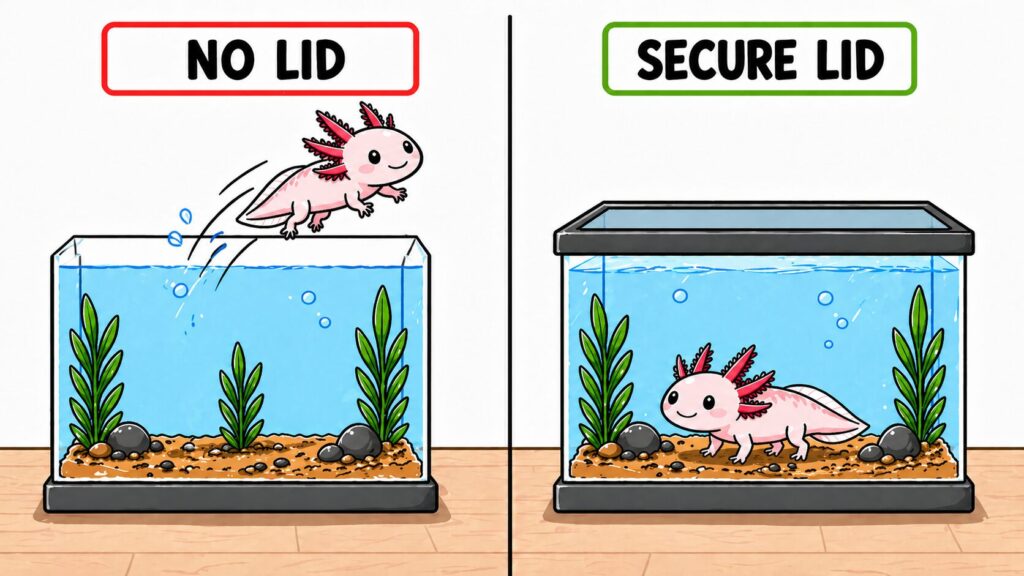
Yes — unambiguously. A tank lid is not optional for axolotls. These animals are far more capable of escaping than their slow, plodding appearance suggests. Axolotls jump, particularly when startled, during feeding responses, when stressed by poor water quality, or when they detect changes in light and vibration around the tank. An axolotl found on the floor is almost always an axolotl that has died, as they dehydrate and suffocate quickly once out of water.
According to the Ambystoma Genetic Stock Center at the University of Kentucky — which houses and studies the world’s most significant captive axolotl population — secure enclosures are listed as a basic husbandry requirement for captive Ambystoma mexicanum. This is not a precautionary nicety; it is a fundamental aspect of responsible axolotl care. Beyond escape prevention, a lid also reduces evaporation significantly, which matters for temperature stability in a cold-water tank. It also keeps dust, household chemicals, and curious pets out of your axolotl’s water. If you want to understand the full scope of what axolotls need to thrive, our axolotl care guide covers everything from temperature to feeding.
What Makes the Best Axolotl Tank Lid?
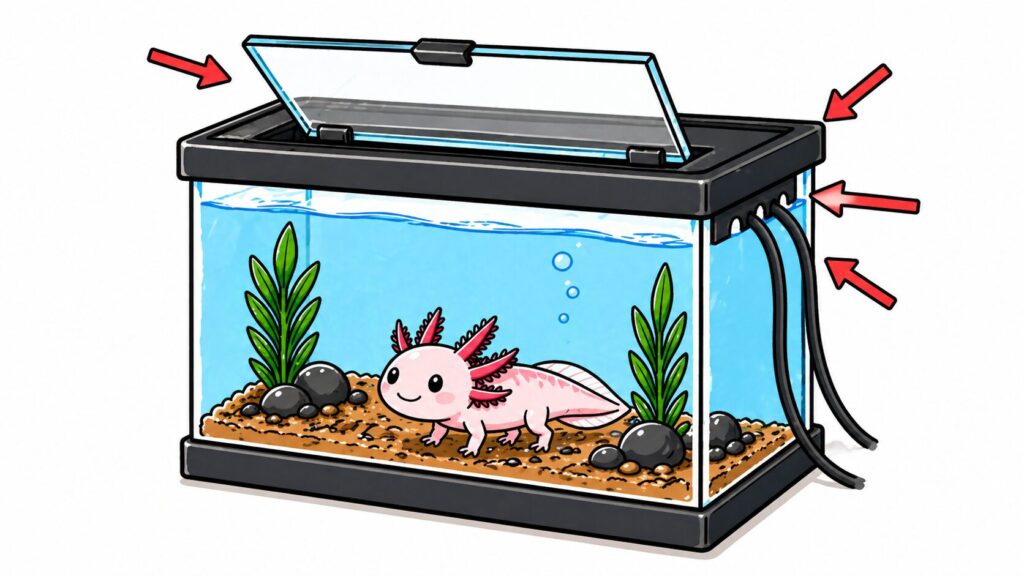
Not every aquarium lid is right for an axolotl tank. Axolotls have specific requirements that make some features more important than they would be for a standard fish setup.
Secure fit with no gaps. The most important feature of any axolotl tank lid is that it fits the tank properly and does not leave gaps large enough for an axolotl to push through. Axolotls are stronger than they look, and a lid that merely rests loosely on the rim of the tank can be shifted by an animal determined to explore. A snug fit is essential.
Good ventilation. Axolotls are cold-water animals that need stable temperatures between 60–68°F (16–20°C). A fully sealed glass lid traps warm air above the water surface and can contribute to temperature rise — the last thing you want for an axolotl. According to research published in Comparative Biochemistry and Physiology, temperature regulation is a critical welfare factor for aquatic salamanders. Lids with ventilation cutouts or strip openings at the back allow heat to dissipate while still keeping your axolotl contained. Our dedicated guide on what temperature axolotls need explains this in more detail.
Easy access for maintenance. You will be reaching into this tank regularly for water changes, feeding, and cleaning. A lid that has to be completely removed every time you do anything is frustrating and increases the chances of your axolotl escaping during maintenance. Hinged lids, feeding doors, or lids with removable sections make day-to-day care far more manageable. A turkey baster and tank siphon are the tools you will use most frequently, and your lid needs to accommodate them easily.
Cutouts for equipment. Almost every axolotl tank has equipment running through or over the rim — filter intakes and outputs, air pump tubing, thermometer probes, and possibly a cooling fan. A good axolotl tank lid should either come with pre-cut notches or be easy to trim to accommodate whatever equipment your setup uses. Rigid lids that cannot be modified make this much harder.
Durability and light transmission. Glass lids are heavy but scratch-resistant and allow maximum light transmission. Polycarbonate lids are lighter, shatter-resistant, and easier to trim and customise, but can scratch more easily over time. Both are valid choices depending on your priorities. Acrylic tends to yellow and warp over time and is generally the weakest option for long-term use.
Correct dimensions. This sounds obvious, but tank lid sizing can be confusing. The 40-gallon breeder — the most commonly recommended axolotl tank — has a 36″ × 18″ footprint, but not all lids designed for “40-gallon” tanks will fit it because the 40-gallon standard has a different footprint than the 40-gallon breeder. Always verify the exact dimensions of your specific tank before buying a lid.
Types of Axolotl Tank Lids
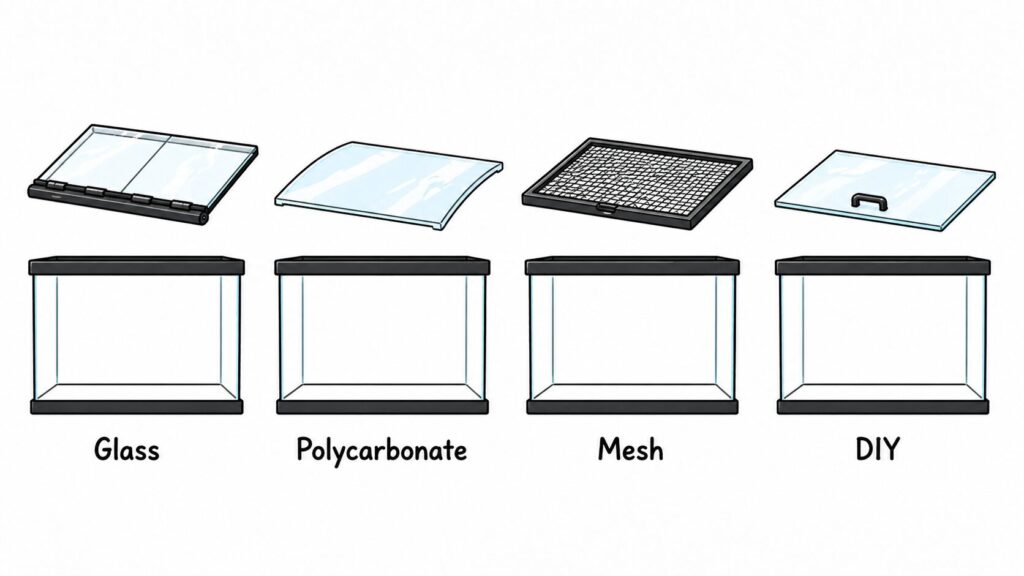
Hinged glass canopies are the most widely used lid type for axolotl tanks. They sit inside the rim of the tank, are made from clear glass, and feature a hinged front panel that opens for feeding and maintenance without removing the entire lid. They allow excellent light transmission and have a clean, finished look. Most come with a vinyl or plastic back strip that can be cut to accommodate filter tubing and other equipment. The main downsides are weight and fragility — glass lids can crack if dropped or knocked, and some designs trap warm air unless you cut ventilation into the back strip.
Polycarbonate canopies are becoming increasingly popular among axolotl keepers who want a lighter, more customisable option. Polycarbonate is shatter-resistant, easy to score and trim with a knife, and significantly lighter than glass. These lids often come in two-piece sets that allow you to open one side at a time. For axolotl tanks where you run a cooling fan at the back to manage temperature — which is a common strategy for keepers without a dedicated chiller — polycarbonate lids are much easier to modify to accommodate the fan. Our guide on the best axolotl cooling fan covers this in more detail.
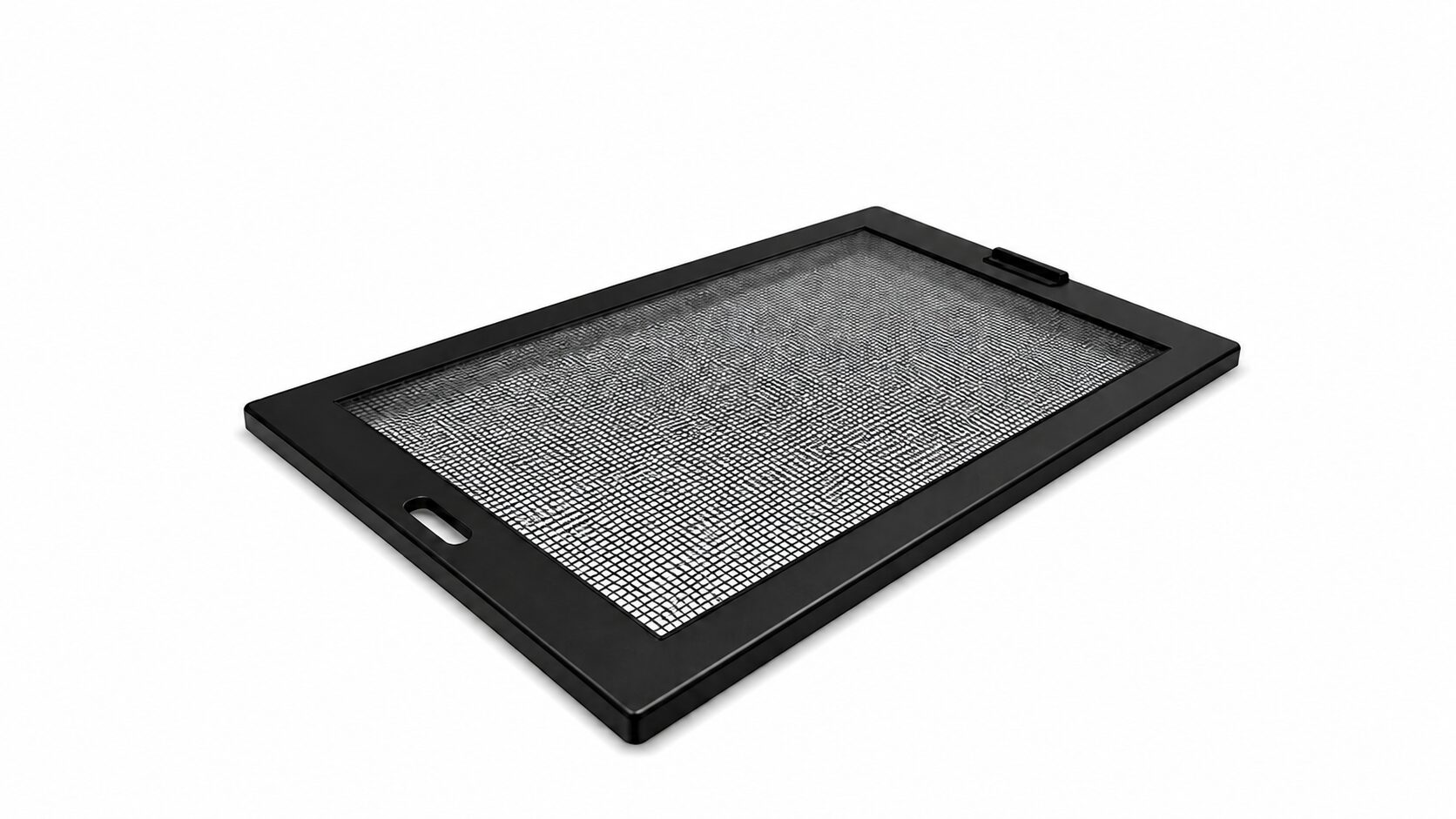
Full mesh or screen lids are common in reptile keeping but are generally less suitable for axolotl tanks. They allow too much evaporation, which makes temperature management harder and forces more frequent top-offs. They also do not reduce water surface splashing, which can make the area around your tank messy. Unless you specifically need maximum ventilation for a cooling strategy, a glass or polycarbonate lid is the better choice.
DIY and custom glass lids are a popular option for keepers with non-standard tank sizes or rimless tanks. A local glass shop can cut tempered or regular glass to your exact specifications for a relatively modest cost. Add a plastic adhesive handle and some plastic back strips cut to fit, and you have a perfectly fitted lid for a fraction of the price of a branded option. This is particularly useful for premium rimless tanks like those from Landen, which do not come with purpose-made lids.
Our Top Axolotl Tank Lid Picks
Best Overall: Aqueon Versa-Top Hinged Glass Top for 30/40 Breeder
The Aqueon Versa-Top Hinged Glass Top is the single most widely recommended lid for the Aqueon 40-gallon breeder — which is itself the most widely recommended axolotl tank. It is purpose-designed to fit Aqueon’s 30-gallon and 40-gallon breeder tanks, sits snugly inside the rim, and features a hinged front panel for easy access during feeding and maintenance. The clear vinyl back strip can be cut to custom fit around filter tubing, air lines, and other equipment. It is the default lid choice for most experienced axolotl keepers, and for good reason — it is reliable, fits perfectly, and does exactly what it needs to do. This is the lid to buy if you are running an Aqueon 40-gallon breeder.
Best Budget Option: All Glass Aquarium Versa-Top 36″ × 18″
For those wanting a similar hinged glass canopy at a slightly lower price point, the All Glass Aquarium AAG29051 Versa Top for 36″ × 18″ Tanks is a solid alternative. It features the same heavy 3/16″ glass construction with notched corners for air lines and a hinged design for easy access. It covers the same footprint as the Aqueon breeder lid and provides excellent coverage with minimal gap. This is a particularly good option if you want genuine glass coverage and do not want to pay a premium.
Best Polycarbonate Option: Sieral Polycarbonate Canopy for 30/40 Breeder (Without Center Brace)
For keepers who want a lighter, shatter-resistant lid that is easy to cut and customise, the Sieral Polycarbonate Canopy 35.13″ × 17.13″ is an excellent choice. It is explicitly sized for 30-gallon and 40-gallon breeder tanks without a center brace, which makes it a direct fit for the Aqueon 40-gallon breeder. The polycarbonate material is far lighter than glass, includes a handle for easy removal, and can be trimmed with the included hook knife to accommodate any equipment you have running through the back of your tank. This is the ideal lid if you are fitting a cooling fan alongside your setup, since polycarbonate is trivial to modify compared to glass.
Best for 55-Gallon Two-Axolotl Setups: Perfecto Glass Canopy 36″ Hinged
For keepers running a 55-gallon or other larger tanks for two axolotls, the Perfecto Glass Canopy 36″ Hinged is a time-tested option. Its hinged glass construction provides excellent coverage and light transmission, and it is sized for standard rectangular aquariums. Note that for a full 55-gallon tank (48″ long), you will typically need two panels to cover the length completely — confirm your exact tank dimensions before ordering.
Best for Rimless Tanks: Blue Spotted Glass Canopy Two-Piece Set for 36″ × 18″ Tanks
If you are running a rimless low-iron glass tank — popular among keepers who want the best visual experience with their axolotl — the Blue Spotted Glass Canopy Two Piece Set for 36″ × 18″ Tanks is one of the best solutions available on Amazon. It comes with glass panels, a plastic handle, plastic clips, and a back strip that can be cut to fit your equipment. Rimless tanks require a canopy that rests on the glass rim using clips rather than sitting inside a plastic frame, and this set is designed with exactly that in mind.
How to Choose the Right Lid for Your Specific Tank
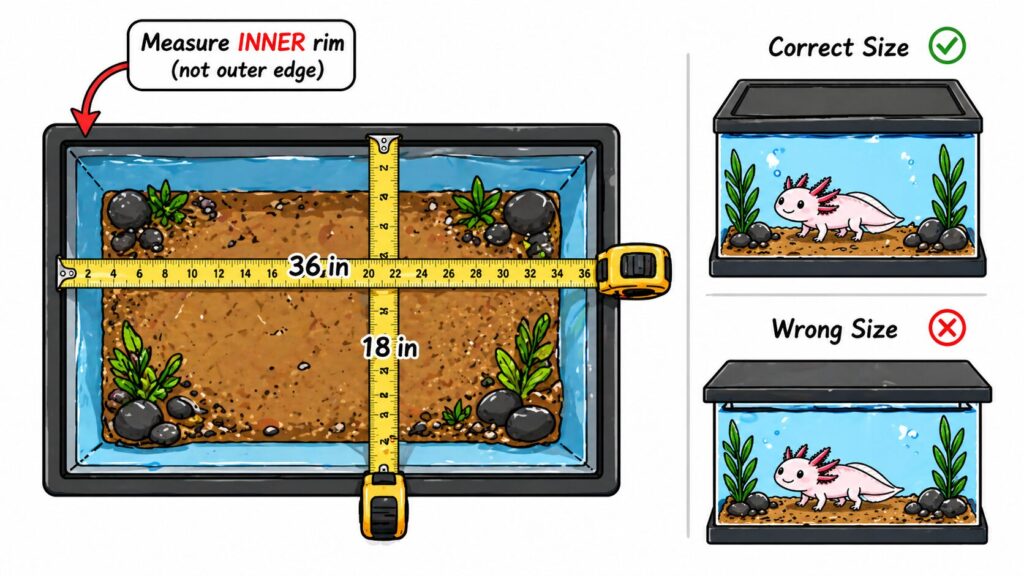
The most important step before buying any lid is measuring your tank’s exact internal dimensions — not the external dimensions, but the internal lip or rim where the lid will rest. Write these down and compare them against the lid’s stated dimensions before purchasing.
For the Aqueon 40-gallon breeder, the Aqueon Versa-Top is the obvious default choice since it is purpose-built for that tank. For other brands of 40-gallon breeder — and there are several, including Seapora and Deep Blue, which have slightly different internal dimensions — you will need to verify compatibility carefully. Some lids that claim to fit “40-gallon tanks” are designed for the 40-gallon standard (which has a different footprint than the 40-gallon breeder) and will not fit correctly.
For rimless tanks, the situation is different again — rimless tanks have no plastic frame for a traditional hinged lid to rest inside, so you need either a lid designed for rimless tanks with clip-on supports or a custom-cut glass panel. If you are unsure which tank you have, our guide to the best axolotl tank covers the most common options and their specifications in detail.
If you are running a tank kit that came with a hood already, check whether it provides adequate coverage and ventilation for an axolotl specifically. Some hoods designed for tropical fish tanks trap too much heat, which is a serious concern for cold-water axolotls. Our guide to the best axolotl tank kit covers which kits come with suitable lids and which need to be supplemented.
Tips for Fitting a Lid Around Equipment
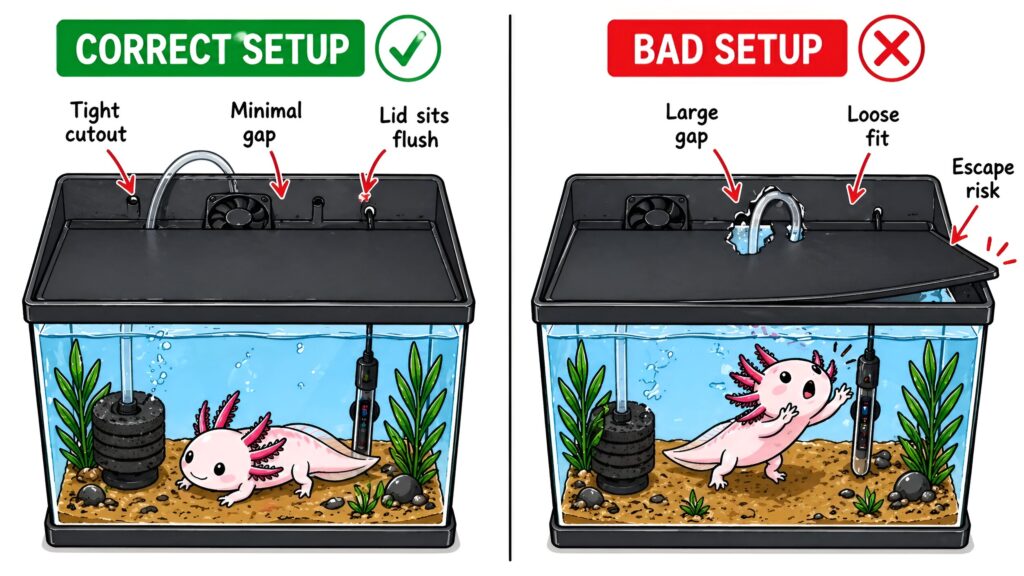
Getting a clean, gap-free fit around your filter, air tubing, thermometer probe, and cooling equipment takes a little thought, but it is very manageable with the right approach.
Glass lids come with a vinyl or plastic back strip that is designed to be cut. Use sharp scissors to cut notches for each piece of equipment running through the back of your tank, keeping the cuts as small as possible — you want to accommodate the equipment with minimal gap left over. If you need to cut into the glass itself, a local glass shop can do this for a small fee, but in most cases the vinyl strip provides enough clearance.
Polycarbonate lids are significantly easier to modify. The included hook knife that comes with most Sieral lids, for example, allows you to cut custom openings quickly and cleanly. If you run a cooling fan mounted at the back of your tank — a common and effective way to manage temperature without a full chiller — a polycarbonate lid with a cutout is far more practical than a glass one. Pair your cooling setup with our guide to the best axolotl water chiller if you are in a warmer climate and need more powerful temperature management.
If you run a sponge filter with an air pump, the air line tubing is thin and easy to accommodate through a small notch in the vinyl back strip of most glass lids. A dedicated air pump for your sponge filter is one of the most axolotl-friendly filtration setups available, and it works perfectly alongside any of the lids mentioned in this guide.
Whatever lid you choose, check around the entire perimeter after installation and look for any gaps larger than a few millimetres. Axolotls are surprisingly adept at finding and exploiting openings, and a gap you think is too small to matter can be enough for a determined axolotl to squeeze through or lever the lid open. Pay particular attention to the corners and any equipment cutouts. If you do find gaps, foam backer rod or even strips of mesh cut to size can be used to plug them without blocking ventilation entirely.
Maintaining good water quality is also one of the best ways to reduce the likelihood of escape attempts in the first place — stressed, unhealthy axolotls are far more likely to try to escape than calm, well-fed ones in clean water. Our guides on how often to clean an axolotl tank and how to clean an axolotl tank will help you stay on top of water quality. Pairing good maintenance with the right water test kit and water conditioner gives you the full picture on keeping conditions stable and your axolotl settled.
Frequently Asked Questions
Do axolotls really jump out of tanks? Yes. Axolotls jump, particularly when startled during feeding, during water changes, or when water quality is poor and they are stressed. An unsecured or poorly fitted lid is a real risk, and axolotls that escape their tanks rarely survive long outside of water.
Can I use a reptile screen lid for my axolotl tank? A mesh or screen lid will keep your axolotl contained, but it allows significant evaporation and does nothing to retain humidity above the water surface. For axolotls in cold water, the increased evaporative cooling this causes can actually be beneficial in warmer weather, but it also means you need to top up the tank water much more frequently. Most keepers prefer a glass or polycarbonate lid for the better seal it provides.
What lid fits a 40-gallon breeder tank? The Aqueon Versa-Top (35″ × 15″) is purpose-built for Aqueon’s 30-gallon and 40-gallon breeder tanks. For other brands of 40-gallon breeder, you need to verify the internal dimensions carefully before buying. The 40-gallon breeder footprint is 36″ × 18″, but lids designed for “40-gallon standard” tanks have a different footprint and will not fit.
Does a lid affect temperature in my axolotl tank? Yes, and this matters for cold-water axolotls. A fully sealed glass lid with no ventilation can trap warm air above the water surface and contribute to temperature rise over time. A good axolotl tank lid should have ventilation at the back — either through the equipment cutouts or through the design of the back strip — to allow warm air to escape. Pairing your lid with a water chiller or cooling fan and monitoring temperature with a reliable thermometer gives you full control over your tank’s thermal environment.
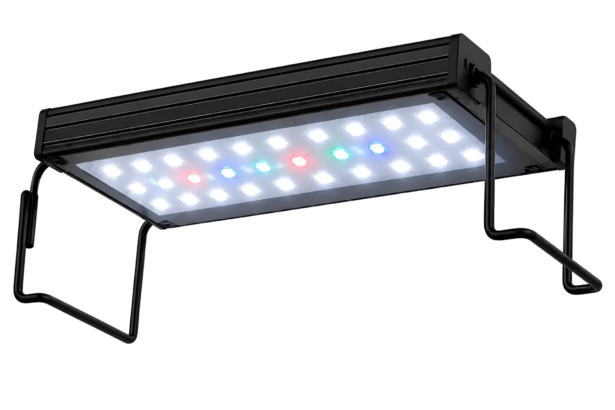
Can I use my tank lid with a light on top? Yes, and this is actually one of the benefits of glass lids — they protect light fixtures from water splash. Axolotls do not need or appreciate bright lighting, so if you do use a light, keep it dim. Our guide to the best axolotl tank light covers low-intensity options that work well with glass lid setups.
Is a lid necessary if I have a very deep tank? Yes. The depth of the water does not prevent an axolotl from jumping. Axolotls can and do leap from the water surface, and a deep tank simply means a longer fall once they clear the rim. A lid is necessary regardless of water depth.
Great Care Starts With the Right Gear
Locking down the right lid is one piece of a much bigger puzzle. From the substrate your axolotl walks on to the food it eats and the tools you use to keep the tank spotless, every product in your care routine matters. If you want a single, trusted resource for keeper-tested recommendations across every category of axolotl care, head over to Best Axolotl Products — everything your axolotl needs, all in one place.