

Choosing the right axolotl tank is the single most important decision you’ll make as an axolotl owner. I know that sounds like an overstatement, but it genuinely isn’t. Everything else you do from managing water quality, keeping temperatures stable, setting up filtration, and adding enrichment builds on top of getting the tank right first. Buy something too small or too tall, and you’ll spend months fighting problems that were completely avoidable from day one. Buy the right tank, set it up correctly, and your axolotl can live a healthy, stress-free life for 10 to 15 years.
That’s why this guide covers everything about getting the perfect tank for your axolotl. We’ll touch on everything – from what features actually matter, which tank types work best, our top picks, all the equipment you need, and a complete step-by-step setup process.
So If you’re new to axolotls, read this alongside our full axolotl care guide for the complete picture.
What Makes the Best Axolotl Tank?

The best axolotl tank isn’t the flashiest or most expensive one on the market. It’s the one that best matches the biology and natural behaviour of these beautiful creatures. That’s because these animals have very specific requirements that differ significantly from all other tropical fish out there, and a tank that works perfectly for a community fish setup can be completely wrong for an axolotl.
So before you spend anything, please try and understand what these animals actually need first. Check our list below:
Wide footprint, not tall height. Axolotls are exclusively bottom-dwelling animals. They spend their entire lives walking along the floor of their tank, foraging, resting, and exploring at ground level. They’re not strong swimmers and have no real use for the upper half of a tall tank. A wide, long, low-profile tank gives them vastly more usable living space than a tall narrow one of equivalent volume. The Ambystoma Genetic Stock Center at the University of Kentucky, which maintains the world’s largest living axolotl research colony, lists ample horizontal space as a core welfare requirement for captive axolotls.
Cold, stable water temperature. Axolotls come from the high-altitude lake system of Xochimilco in Mexico City, where water temperatures stay naturally cool year-round. They thrive between 60 and 68°F (16 to 20°C) and begin to struggle above 72°F (22°C). Sustained exposure above 74°F causes heat stress, appetite loss, immune suppression, and eventually death. This is why your tank needs to work effectively with cooling equipment from day one. For a full breakdown of thermal needs, read our guide on what temperature axolotls need.
Gentle, low-flow filtration. Axolotls need clean, biologically filtered water, but their delicate feathery gill plumes are easily stressed and physically damaged by strong water currents. A high-powered filter that’s perfectly fine for fish can batter an axolotl’s gills and cause chronic stress. You need filtration that delivers strong biological cleaning while keeping output flow soft and diffuse.
A secure, escape-proof lid. Despite their placid appearance, axolotls can and do jump — particularly when startled during feeding or water changes. An open-top tank is a genuine safety risk that’s easy to avoid.
Room for meaningful enrichment. Axolotls benefit significantly from hides, caves, plants, and decorations that allow them to express natural sheltering and foraging behaviours. A tank that’s too small doesn’t leave adequate room for this, which leads to chronic low-level stress you’ll see reflected in their behaviour over time.
Glass over acrylic. Glass is scratch-resistant, doesn’t discolour or warp over time, and stands up well to the regular cleaning that axolotl tanks require. Unless you specifically need a lighter tank, glass is the better long-term material for most keepers.
Best Tank Size for Axolotls

Tank size is non-negotiable, and this is one area where going with the bare minimum is rarely the right decision. The absolute minimum recommended size for a single adult axolotl is 20 gallons, but the vast majority of experienced keepers recommend 40 gallons as the practical standard. The reason is straightforward: larger water volumes buffer far better against temperature fluctuations, ammonia spikes, and sudden shifts in water chemistry. In a 20-gallon tank, a single missed water change or a warm afternoon can push conditions from acceptable to dangerous within hours. In a 40-gallon tank, you have substantially more margin for error.
The 40-gallon breeder format — typically measuring 36″ × 18″ × 16″ — is the consensus choice among experienced axolotl keepers. Its wide footprint gives a single adult axolotl excellent usable floor space, and its moderate height means you are not heating or chilling water column your axolotl will never use. Every gallon above 20 makes your tank more forgiving and your axolotl more comfortable.
If you plan to house two axolotls together, start with a minimum of 55–75 gallons. Before you do that, read our guides on whether axolotls can have tank mates and whether axolotls are cannibalistic. Even two similarly sized axolotls can bite and injure each other, especially as juveniles, and going in without understanding the risks leads to preventable harm.
For a full breakdown of dimensions, gallon recommendations by axolotl size and number, and common sizing mistakes to avoid, see our dedicated guide to the best tank size for axolotls.
Best Axolotl Tank Types
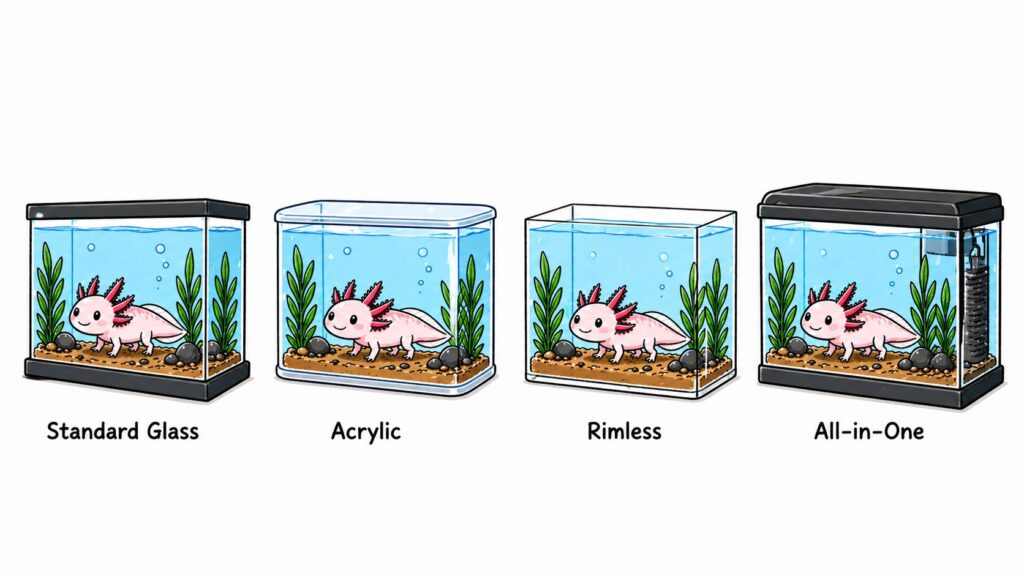
Not all aquariums are built the same way, and the differences matter more for axolotls than for many other aquatic pets.
Standard rectangular glass aquariums are the most popular choice by a significant margin, and with good reason. They’re widely available at every price point, come in all the sizes axolotls need, are structurally reliable, and are easy to source compatible equipment for. Glass resists scratching from cleaning tools, doesn’t yellow or warp over time, and provides a clean, clear view of your animal. For most axolotl keepers — especially those just starting out — a standard rectangular glass tank is the right choice.
Acrylic aquariums are lighter than glass and offer slightly better thermal insulation, which can be a minor advantage for temperature management. The significant downsides are that acrylic scratches far more easily than glass, and axolotl tanks require frequent siphoning and scrubbing. Acrylic tanks also tend to cost more for the same volume. Unless you specifically need the weight reduction, glass is generally the better long-term choice.
Low-iron (starphire) glass tanks use a glass formulation that eliminates the greenish tint found in standard aquarium glass, resulting in outstanding optical clarity. If you’re keeping one of the more striking axolotl morphs — melanoid, copper, mosaic, or a vivid leucistic — low-iron glass makes a dramatic visual difference. These are premium tanks at premium prices, but for display-focused setups they’re genuinely impressive.
All-in-one aquariums have built-in rear filtration compartments that keep the main display area clean and uncluttered. They often come with matching lights and a pump included. The main issue for axolotl keepers is that the included pumps frequently generate more current than axolotls tolerate comfortably, requiring modification or replacement. If you choose an all-in-one, plan to baffle the output or swap the pump for something gentler.
Rimless aquariums have clean, polished edges and no plastic frame, giving them a sleek, modern look. They’re open-top by design, which means you’ll need to source a custom-fitted or magnetic lid separately to keep your axolotl safely contained.
Tank kits bundle a tank with essential equipment like a filter and lid, which can offer reasonable value for new keepers who want a simpler starting point.
Our Top Axolotl Tank Picks
Best Overall: Aqueon 40-Gallon Breeder Tank
The Aqueon 40-Gallon Breeder is the most consistently recommended axolotl tank in the hobby, and it earns that reputation entirely on merit. Its 36″ × 18″ footprint gives a single adult axolotl generous floor space, its moderate 16″ height avoids wasting water volume, and its 40-gallon capacity provides real stability in water parameters. It’s built from standard glass with a black plastic frame, widely available, and priced accessibly relative to its quality. It also fits a huge range of aftermarket lids, filters, and stands designed around its footprint. This is the tank the vast majority of experienced axolotl keepers use, and it’s the one I’d recommend to almost anyone starting out or upgrading from a smaller setup.
Best Budget Option: Aqueon 20-Gallon Long Tank
For keepers on a limited budget or setting up a tank for a juvenile axolotl, the Aqueon 20-Gallon Long is the right call. The “long” format is critical here — it gives a 30″ × 12″ footprint, which is substantially better for axolotls than the same volume in a “high” format. It’s affordable, reliable, and widely available. Just understand from the outset that this is a starter or juvenile tank. A single adult axolotl will need more space as it grows, so plan to upgrade in time.
Best Premium Option: Landen 60P Rimless Low-Iron Glass Aquarium
The Landen 60P is a genuinely beautiful piece of equipment. Its starphire glass is extraordinarily clear, the rimless design looks sharp and contemporary, and the overall build quality is excellent throughout. At 16 gallons it’s best suited to a juvenile or a smaller adult axolotl. You’ll need to source a lid separately given the open-top design, which is worth factoring into the total cost. If you want a slightly larger version, the Landen 60H 25.4-Gallon offers the same exceptional glass quality with more volume.
Best All-in-One Option: Fluval Flex 32.5 Gallon
The Fluval Flex 32.5 Gallon is one of the better all-in-one options for axolotl keepers willing to make a small modification. Its curved front panel looks distinctive, the rear filtration chamber keeps the display area clean, and it comes packaged with a decent LED light and a multi-stage filtration system. The flow from the included pump will need to be dialled back and baffled to bring it to an axolotl-safe level — this is straightforward to do and well worth it. At 32.5 gallons it works well for a single adult axolotl and makes for an attractive display setup.
Best for Two Axolotls: Aqueon 55-Gallon Standard Tank
For a two-axolotl setup, the Aqueon 55-Gallon Standard Aquarium is a practical and cost-effective choice. Its 48″ footprint gives both animals room to establish separate territories, and 55 gallons provides the water volume needed to keep parameters stable when two animals are producing waste. Before housing two axolotls together, make sure you’ve read our articles on axolotl cannibalism and tank mate compatibility so you understand the risks involved.
Essential Equipment for Your Axolotl Tank

Buying the right tank is step one. Equipping it correctly is step two. Here is everything you need to turn an empty aquarium into a safe, functional axolotl habitat.
Filter. Your filter is the biological backbone of your entire setup. It hosts colonies of nitrifying bacteria that convert deadly ammonia — produced by axolotl waste and decaying uneaten food — into nitrite, and then into the far less harmful nitrate. Without an established filter, your tank cannot safely house an axolotl for any meaningful period. For axolotls specifically, you need a filter that delivers strong biological and mechanical filtration while keeping output current gentle and diffuse. Sponge filters driven by an air pump are the most axolotl-friendly filtration method available. They produce no appreciable current and provide excellent biological filtration. If you prefer a canister or hang-on-back filter, just ensure the output is baffled to reduce current to a safe level.
Air pump. Pair your filter with a quality air pump to drive surface agitation and maintain dissolved oxygen levels, which becomes particularly important during warmer months when oxygen saturation naturally drops.
Temperature management. Keeping your tank consistently in the 60 to 68°F range is one of the most challenging aspects of axolotl keeping, particularly in warmer climates or during summer. A dedicated aquarium water chiller is the most reliable solution. For keepers in milder climates, a clip-on cooling fan can reduce tank temperature by several degrees at a fraction of the cost. Whichever cooling approach you use, monitor temperature consistently with a quality tank thermometer.
Substrate. Substrate choice matters far more for axolotls than for most aquatic pets, because axolotls regularly pick things up from the tank floor during feeding. Standard aquarium gravel is genuinely dangerous — particles that fit in an axolotl’s mouth can be swallowed and cause fatal intestinal blockage. The two safe options are fine aquarium sand with particles of 1mm or smaller, and large flat tiles that cannot be swallowed at all. A bare-bottom tank is also a completely valid choice that many experienced keepers prefer for ease of cleaning. Our article on whether axolotls need substrate explains the full reasoning behind each option.
Hides, caves, and decor. Axolotls are naturally secretive animals that feel significantly more secure when they have sheltered spaces to retreat into. Without adequate hides, axolotls can exhibit chronic stress behaviours including pacing, reduced appetite, and gill curling forward. Every axolotl tank should contain at least one hide per animal, ideally positioned in a corner or low-light area.
Plants. Live plants improve water quality by consuming nitrates and carbon dioxide, provide additional natural shelter, and make your tank look genuinely beautiful. Cold-water species like Java fern, Anubias, and Hornwort do particularly well in axolotl tank conditions. Silk plants are a safe and attractive alternative if you prefer not to deal with live plant maintenance.
Lighting. Axolotls don’t have eyelids and are sensitive to bright light. Strong overhead lighting causes them to hide constantly and contributes to chronic stress. Dim, low-intensity lighting that replicates the naturally murky, shaded conditions of Lake Xochimilco is far more appropriate. The IUCN Red List entry for Ambystoma mexicanum describes the naturally turbid, low-light conditions of their native habitat, which is exactly why bright tank lighting causes them so much distress.
Water conditioner. Tap water contains chlorine and chloramines that are immediately harmful to axolotls and to the beneficial bacteria living in your filter. Every drop of tap water that enters your tank must be treated with a dechlorinator before use. This is non-negotiable.
Water test kit. Monitoring your water parameters is not optional — it’s essential, particularly during the initial nitrogen cycle and any time your axolotl shows signs of stress or illness. You need to track ammonia, nitrite, nitrate, and pH at a minimum. Liquid test kits are significantly more accurate than test strips. The API Freshwater Master Test Kit is the industry standard and what most experienced keepers rely on. According to Caudata.org, one of the longest-running online communities dedicated to salamander and newt husbandry, inadequate water testing is one of the most common causes of preventable axolotl health problems.
Cycling bacteria and ammonia solution. To cycle your tank safely before adding your axolotl, you need to establish colonies of nitrifying bacteria in your filter. Seeding the tank with bottled beneficial bacteria dramatically accelerates this process. You’ll also need a pure ammonia solution to feed those bacteria during a fishless cycle.
Food and feeding tools. Once your tank is cycled and your axolotl is settled in, feeding correctly matters enormously for long-term health. Axolotls eat a varied diet that can include high-quality sinking pellets, bloodworms, and nightcrawlers as staples. A pair of feeding tongs lets you deliver food precisely without it scattering across the tank, and a turkey baster is invaluable for removing uneaten food before it breaks down and spikes ammonia.
Tank stand. A 40-gallon tank filled with water, substrate, and decor weighs well over 400 pounds. Standard household furniture is rarely designed to support that kind of sustained, concentrated load. A purpose-built aquarium stand is the only safe option.
Quarantine tub. A quarantine tub is something every responsible axolotl keeper should have on hand before they ever need it. If your axolotl becomes ill, requires treatment, or you bring a new animal home, you need somewhere clean and separate to house them while keeping your display tank uncontaminated. Products like Indian almond leaves, methylene blue, and aquarium salt are all commonly used in quarantine and treatment situations and are worth keeping in your supplies before you ever need them.
How to Set Up an Axolotl Tank Step by Step
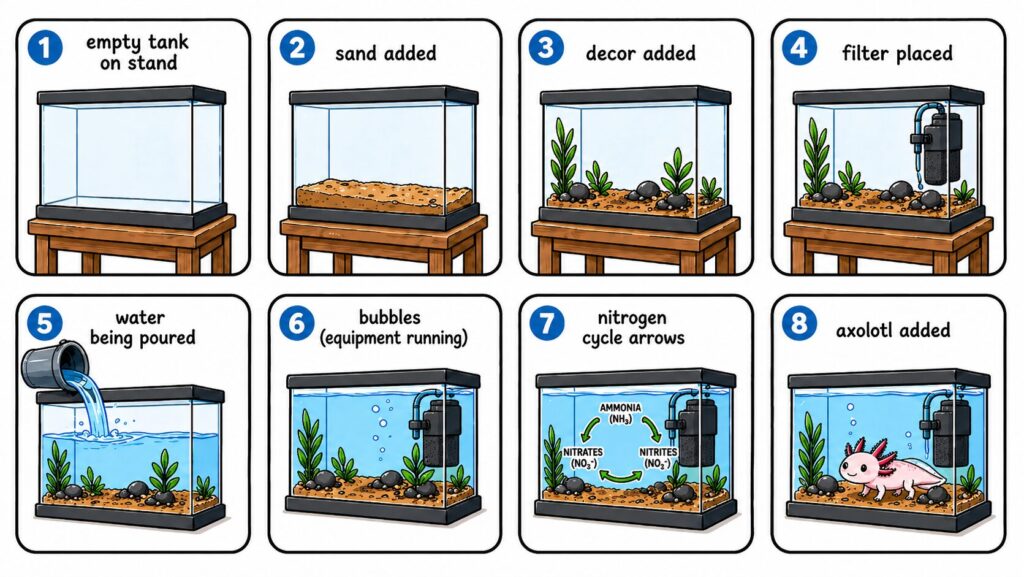
With your tank and equipment in hand, here is how to put everything together correctly from the start.
Step 1: Position your tank on its stand before adding anything. Choose your permanent location first — ideally away from direct sunlight, radiators, and air conditioning vents, all of which cause temperature fluctuations. Make sure the stand and floor surface are level. A full aquarium cannot be safely moved, so get placement right before you begin.
Step 2: Add and rinse your substrate. If you’re using fine sand, rinse it thoroughly in a clean bucket until the water runs completely clear, then spread it evenly across the tank bottom in a layer roughly 1 to 2 inches deep. If you’re using tiles, lay them flat across the base before adding water. Skip this step entirely if you’re running a bare-bottom setup.
Step 3: Add hides, caves, plants, and decor. Arrange your enrichment items before filling with water. Position at least one hide per axolotl in a sheltered corner or low-light area. Make sure any items are rinsed and confirmed safe for aquarium use.
Step 4: Install your filter. Set up your filter according to the manufacturer’s instructions, but don’t plug it in yet — filters should only be run when submerged in water.
Step 5: Fill the tank slowly. Place a plate or clean bowl on the substrate to diffuse the water flow and prevent your layout being disturbed as the tank fills. Add dechlorinator to each bucket of tap water before it goes in, or treat the full tank volume once filled.
Step 6: Start your equipment. Plug in your filter, air pump, thermometer, and any cooling equipment. Do not add a heater — axolotls don’t need one and warm water is actively harmful to them.
Step 7: Cycle your tank. This is the most critical step and the one most commonly skipped by new keepers to their detriment. The nitrogen cycle establishes the bacterial colonies in your filter that make the tank biologically safe. A fishless cycle using bottled ammonia and seeded cycling bacteria typically takes 2 to 6 weeks. Test your water daily with a liquid test kit. The cycle is complete when both ammonia and nitrite consistently read zero and nitrate is detectable. The U.S. Environmental Protection Agency’s guidance on nitrogen in aquatic systems gives useful background on how nitrogen compounds affect aquatic environments — the same chemistry applies in miniature in your tank. Rushing or skipping this step is genuinely the most common cause of early axolotl fatalities among new keepers.
Step 8: Add your axolotl. Only once ammonia and nitrite have both been at zero for several consecutive days is it safe to introduce your axolotl. Float the bag or container your axolotl arrived in on the tank surface for 15 to 20 minutes to allow temperatures to equalise, then gently release your animal into its new home.
Axolotl Tank Maintenance

Even the best axolotl tank setup requires consistent, regular maintenance to remain healthy. Axolotls are messy animals that produce significant waste relative to their size, and without regular attention water quality deteriorates faster than you might expect.
Perform a 20 to 25% water change at least once a week, siphoning waste from the substrate or tank floor as part of each change. Use a tank siphon to vacuum the bottom effectively, and a turkey baster for daily spot-cleaning of visible waste and uneaten food between changes. Always treat replacement water with dechlorinator before it goes into the tank.
Test your water parameters weekly at minimum, and immediately any time your axolotl appears lethargic, loses interest in food, or shows physical symptoms like gill deterioration. For a full walkthrough of cleaning technique and scheduling, read our guide on how to clean an axolotl tank.
Frequently Asked Questions
What is the best axolotl tank size for a single adult? A 40-gallon breeder tank is the best size for a single adult axolotl. It provides sufficient floor space, a stable water volume, and room for proper enrichment. For two axolotls, a 55 to 75 gallon tank is the recommended starting point.
Can an axolotl live in a 10-gallon tank? No. A 10-gallon tank is far too small for an adult axolotl and will result in rapidly deteriorating water quality and chronic stress. Even juveniles should be moved into a 20-gallon long format as they approach 5 to 6 inches in length.
Do I need a heater in my axolotl tank? No. Axolotls are cold-water animals and don’t need a heater. In fact, adding one raises water temperature above the safe range and causes real harm. You may instead need a water chiller or cooling fan to keep temperatures down during warmer months.
Is it legal to own an axolotl where I live? Laws vary significantly by location. Axolotls are restricted or prohibited outright in several US states and in other countries. Before purchasing, check our guide on whether it is legal to own an axolotl and our article on why axolotls are illegal in some places for detailed information.
How often do I need to clean my axolotl tank? Weekly water changes of 20 to 25% are the standard minimum for most setups, along with daily spot-cleaning of waste.
Are axolotls endangered in the wild? Yes. The wild axolotl population is critically endangered, with the species now surviving in extremely limited numbers in the remnants of the Xochimilco lake system. You can read more in our article on whether axolotls are endangered. This makes responsible captive husbandry all the more meaningful.
What are the different axolotl morphs available? Axolotls come in a wide range of colour morphs, from the common leucistic and wild type to rarer melanoids, coppers, and mosaics. Our guide to axolotl morphs covers every variety with descriptions of what makes each one distinct.
Your Axolotl Deserves the Best — Here Is Where to Find It
The right tank gets your axolotl off to the best possible start, but great care goes well beyond the tank itself. Every product your axolotl relies on — the food it eats, the water it lives in, the tools you use to keep it clean and healthy — makes a real difference over the course of its life. If you want a trusted, keeper-tested resource for every product category in axolotl care, our Best Axolotl Products hub has you covered from top to bottom. Consider it your go-to guide for giving your axolotl exactly what it needs, every step of the way.