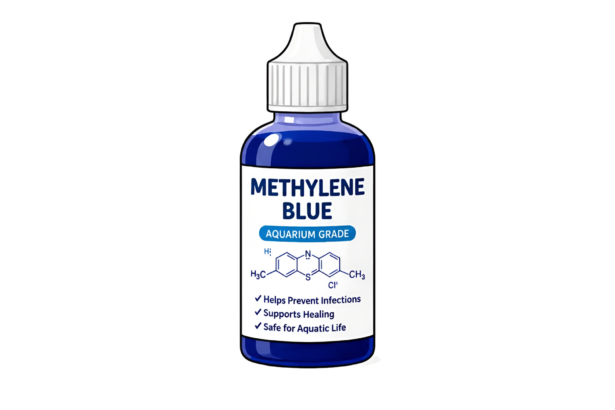

Understanding the best axolotl aquarium salt to use — and equally importantly, when and how to use it — is something every responsible axolotl keeper should know. Salt is one of the most widely discussed topics in axolotl health care, and it is also one of the most frequently misused. Used correctly at the right dose in the right situation, aquarium salt can provide meaningful support for an axolotl recovering from illness, fungal infection, or skin irritation. Used incorrectly — too high a dose, too frequently, or in the wrong context — it causes osmotic stress that makes your axolotl’s condition worse rather than better. This guide covers everything you need to know: the science behind salt use in axolotls, exactly when it is appropriate, what dosage is safe, what products to use, and what to avoid completely. Pair this guide with our full axolotl care guide and our guides on the best axolotl quarantine tub, best axolotl water test kit, and best axolotl methylene blue for the complete health care picture.
The Truth About Aquarium Salt and Axolotls
Aquarium salt is a more nuanced topic for axolotls than it is for most fish, and this nuance matters enormously for getting the results you want. Understanding the physiological context before using salt prevents the mistakes that are most commonly made.
Axolotls are freshwater amphibians. Their body chemistry is adapted to the low-salinity environment of the Xochimilco lake system in Mexico City, where they are native. The IUCN Red List documents their natural habitat as a freshwater lake complex with specific mineral and salt chemistry very different from saltwater or even moderately brackish conditions. As critically endangered animals, understanding and respecting their natural biology is part of responsible captive care.
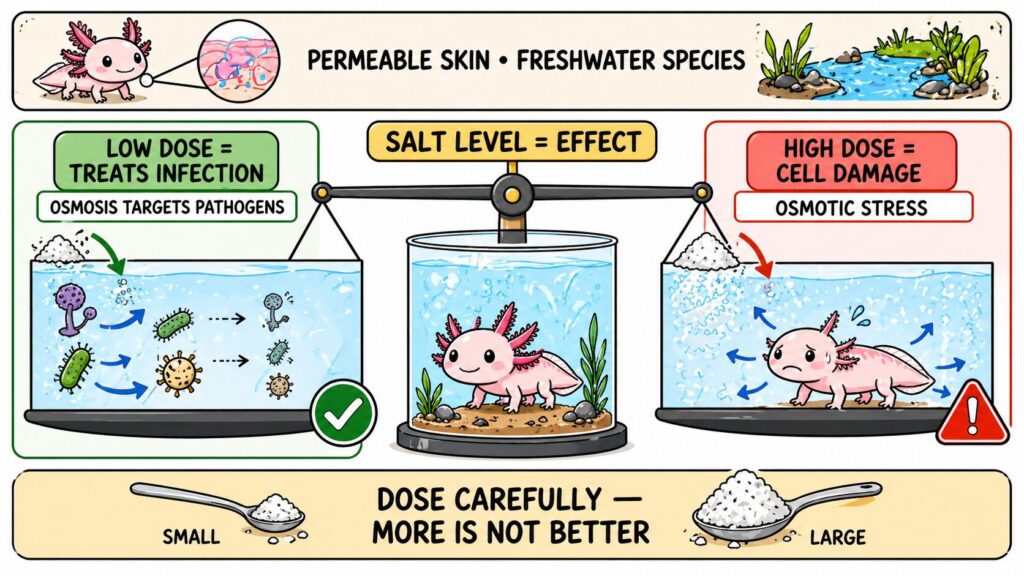
Unlike fish, which can tolerate salt concentrations relevant to their natural environments, axolotls are amphibians with highly permeable skin. This permeability is fundamental to their biology — they absorb oxygen and water through their skin as well as through their gills and lungs. The same permeability that makes them so environmentally sensitive also means that salt concentration in the surrounding water has a direct and rapid effect on their internal osmotic balance.
At the correct low dose, aquarium salt creates a slightly elevated osmolarity in the water that draws water out of fungal and bacterial pathogens by osmosis — the same principle explains why salt kills surface bacteria on wounds. This makes low-dose salt a genuinely useful supportive treatment for fungal infections, skin irritation, and wound healing in axolotls. According to research on amphibian physiology published in Comparative Biochemistry and Physiology, salinity stress in aquatic amphibians begins at concentrations significantly higher than the therapeutic doses used in axolotl salt treatment — meaning a correctly dosed salt bath or quarantine treatment is within safe physiological limits.
At elevated doses, the osmotic effect works in both directions — it begins to draw water out of the axolotl’s own cells and gill tissue, causing osmotic stress, dehydration at the cellular level, and gill damage. This is why the correct dose is so critical.
When Aquarium Salt Is Appropriate for Axolotls

Salt is not a general tonic or a daily maintenance product for axolotls — it is a targeted treatment for specific situations. Here is when it is and is not appropriate.
Appropriate uses:
Fungal infections — particularly the white fluffy fungal growth that sometimes appears on gill plumes or skin — respond well to low-dose salt treatment. Salt baths or salt-dosed quarantine water inhibit fungal growth and support recovery when combined with good water quality management. Fungal infections are one of the most common health issues in captive axolotls, often triggered by poor water quality, temperature stress, or physical injury.
Skin irritation and minor wounds — including abrasions, small tears, and early-stage fin or gill fraying — benefit from low-dose salt treatment that supports the natural healing process by reducing bacterial contamination at the wound surface.
Quarantine treatment — when moving an axolotl to a quarantine tub for observation or recovery, a low-dose salt addition supports the axolotl’s health during the stress of transfer and treats minor issues concurrently.
Not appropriate for:
Salt should not be added to a main display tank as a routine practice. Unlike in some fish setups where low-level salt is maintained continuously, axolotls are not benefited by permanent low-level salt exposure and the osmotic adjustment it requires costs them physiological energy over time. Salt is a treatment tool, not a maintenance supplement.
Salt is also not appropriate in tanks with live plants, as even low salt concentrations damage or kill most freshwater aquatic plants. Our guide to the best axolotl tank plants covers the best cold-water plant species — all of which should be kept in a salt-free main tank.
Salt will not resolve bacterial infections that require targeted antibiotic treatment, and it will not address underlying water quality problems that are causing illness. Always pair salt treatment with identifying and fixing the root cause — which usually means checking ammonia, nitrite, nitrate, and temperature with your water test kit and thermometer.
Correct Dosing for Axolotl Salt Treatment

The safe and effective dose for axolotl salt treatment is significantly lower than what is typically used for fish. The standard recommended dose in the experienced axolotl community and referenced in amphibian veterinary literature is:
1 litre of salt bath treatment: 2–3 grams of non-iodised aquarium salt per litre of water. This is used as a 10–15 minute salt bath in a separate container — the axolotl is moved into the salt solution for a brief period, monitored closely, and then returned to clean dechlorinated water. Salt baths should not exceed 15 minutes and should be done no more than once daily.
Low-dose quarantine water: 1 gram per litre (approximately 1/4 teaspoon per gallon) added to quarantine tub water for extended treatment periods. At this concentration the treatment is gentle enough for sustained exposure while still providing therapeutic benefit.
Important: Always dissolve salt completely in a separate container of tank water before adding it to any container with your axolotl. Never add salt crystals directly to the water with the axolotl present — undissolved salt crystals that contact the axolotl’s skin or gills can cause localised burning injuries.
Monitor closely during any salt treatment. If your axolotl shows signs of acute stress — curling of the body, frantic swimming, excessive mucus production, or attempting to leave the water — remove it from the salt solution immediately and return it to clean fresh water. The dose may be too high or the individual axolotl may be particularly sensitive.
Never use iodised table salt, sea salt, Himalayan salt, or road salt for axolotl treatment. These products contain additives — iodine, anti-caking agents, minerals — that are toxic to axolotls. Only use non-iodised, additive-free aquarium salt specifically formulated for freshwater aquarium use.
What Makes the Best Axolotl Aquarium Salt?

Non-iodised, pure sodium chloride. The only appropriate salt for axolotl treatment is pure sodium chloride (NaCl) with no additives. Iodine, which is added to most table salt, is directly toxic to the bacteria in an aquarium filter and can harm axolotls at the concentrations found in iodised salt. Anti-caking agents and minerals found in specialty salts introduce unnecessary variables. Only use products that explicitly state non-iodised, additive-free formulation.
Made from evaporated sea water. Quality aquarium salts are made from evaporated sea water that is then processed to remove marine minerals and contaminants, leaving pure sodium chloride. This is the safest and most consistent source for aquarium-grade salt.
Fine to medium granule size for easy dissolving. Salt should dissolve quickly and completely when mixed in water. Very coarse crystals take longer to dissolve and increase the risk of inadvertent direct contact with undissolved salt. Fine to medium granule sizes — typical of API Aquarium Salt — dissolve readily when mixed in a small amount of warm water before adding to the tank.
Trusted, established brand. For a product as critical as a health treatment, using a trusted aquarium brand with decades of track record and clear formulation standards is important. API has been the industry-standard freshwater aquarium salt for decades and is the one consistently recommended by experienced keepers.
Our Top Axolotl Aquarium Salt Picks
Best Overall: API Aquarium Salt Freshwater (36oz Box)
The API Aquarium Salt (36oz Box) is the most widely used and recommended aquarium salt in the freshwater hobby and the product we recommend for axolotl salt treatment. It is made from evaporated sea water and is 100% non-iodised with no additives, dyes, or anti-caking agents — meeting every requirement for safe axolotl use. According to API’s product documentation, it is formulated to provide electrolytes that support gill function and stress recovery in freshwater animals. At 36 ounces it provides ample salt for multiple treatment courses, and the resealable box keeps unused salt dry and clean for long-term storage. This is the salt to keep in your axolotl health kit — not used routinely, but ready when you need it.
Best Small Starter Box: API Aquarium Salt (16oz Box)
For new keepers who want to stock aquarium salt as a precautionary health supply without buying a large quantity they may not use frequently, the API Aquarium Salt (16oz Box) is the practical starting size. Same formulation, smaller quantity — appropriate for a single keeper with one or two axolotl tanks who will use salt occasionally for treatment rather than regularly. The 16oz box provides enough salt for many individual treatment doses or several quarantine courses.
Best Large Format for Multiple Tanks: API Aquarium Salt (65oz Box)
For keepers running multiple axolotl tanks — a main display tank and a dedicated quarantine tub, or breeders with several enclosures — the API Aquarium Salt (65oz Box) provides a larger quantity at a better cost-per-ounce ratio. Aquarium salt has an indefinite shelf life when kept dry, so buying in a larger format and storing the remainder does not waste any product.
How to Perform a Salt Bath for an Axolotl

A salt bath is the most common way to use axolotl aquarium salt therapeutically — it provides a concentrated but brief exposure to salt that treats fungal or surface infections without maintaining elevated salt levels in the main tank or quarantine water.
Equipment needed: A clean container (a small clean bucket or a plastic tub works well — see our best axolotl quarantine tub guide), dechlorinated tank water at the same temperature as the main tank, and API Aquarium Salt. A timer is also essential.
Step 1: Fill the container with 1–2 litres of dechlorinated water treated with Seachem Prime. Measure the temperature — it must match your main tank temperature within 1–2°F. An axolotl moved into water at a significantly different temperature will experience thermal shock on top of osmotic treatment, which compounds stress unnecessarily. Check with your thermometer.
Step 2: Dissolve 2–3 grams of API Aquarium Salt per litre of water in a small amount of warm water from the container before adding it back. Stir until fully dissolved. 1 gram is approximately 1/4 level teaspoon; 2–3 grams is approximately 1/2 to 3/4 teaspoon per litre. If you use this regularly, a small digital kitchen scale accurate to 0.1g is the most precise way to measure.
Step 3: Gently transfer your axolotl into the salt solution using a clean net or by guiding it with your hand. Set a timer for 10 minutes. Do not leave the axolotl unattended — observe it continuously throughout the bath.
Step 4: Watch for stress signs throughout. Normal bath behaviour: the axolotl may move around the container and may appear mildly agitated initially as it adjusts, then settle. Concerning signs requiring immediate removal: curling of the body into a C-shape, frantic swimming, excessive mucus production, or loss of orientation. If any of these occur, remove immediately.
Step 5: At 10 minutes (or earlier if any stress signs appear), gently return your axolotl to its quarantine container or main tank. Do not extend beyond 15 minutes. Rinse the salt bath container thoroughly after use.
Salt baths can be performed once daily during active treatment. If fungal growth is not improving after 3–4 days of daily salt baths, or if the condition is worsening, consult an exotic animal veterinarian — some situations require prescription treatments like methylene blue or antifungal medications beyond what salt alone can address.
Salt as Part of a Broader Health Approach

Salt treatment works best as part of a comprehensive response to an axolotl health issue, not as a standalone solution. The most important thing to address alongside any salt treatment is the water quality problem that likely contributed to the illness in the first place. Fungal infections and skin irritation in axolotls are almost always secondary to stress from poor water quality, temperature issues, or physical injury — fixing the root cause is what prevents recurrence.
Move your axolotl to a quarantine tub during treatment so you can manage its water independently without affecting the main tank’s filter or live plants. Daily 100% water changes in the quarantine tub with fresh, dechlorinated, temperature-matched water are the foundation of recovery — clean water is more important than any treatment product. Test the quarantine water daily with your water test kit to ensure ammonia and nitrite remain at 0 ppm. Keep the quarantine water at the correct temperature — between 60–68°F (16–20°C) as detailed in our guide on what temperature axolotls need. Monitor your main tank during the quarantine period and make any necessary improvements to filtration, temperature management, or maintenance frequency before returning your axolotl.
For serious infections or situations that do not respond to salt and water quality improvement within a week, consult a veterinarian with exotic animal or aquatic species experience. Axolotls can be treated with prescription antifungal and antibiotic medications when required, and attempting to manage a serious infection with salt alone when veterinary treatment is needed wastes valuable time.
Frequently Asked Questions
Can I add aquarium salt to my axolotl’s main tank? Salt should not be a permanent addition to an axolotl’s main tank. It is a treatment tool for specific situations, not a daily maintenance supplement. Adding salt to the main tank also harms live plants and can create ongoing osmotic stress for your axolotl.
How much aquarium salt is safe for axolotls? For salt baths: 2–3 grams per litre for 10–15 minutes maximum. For quarantine water: 1 gram per litre for extended treatment. These are the maximum safe doses — using less is preferable if you are uncertain.
Can I use table salt for my axolotl? No. Table salt is iodised and contains anti-caking agents that are harmful to axolotls and aquarium bacteria. Only use non-iodised aquarium salt specifically formulated for freshwater aquarium use, such as API Aquarium Salt.
How often can I give my axolotl a salt bath? Once daily at most, for no longer than 10–15 minutes per session. Always monitor throughout.
Does aquarium salt kill fungal infections on axolotls? At the correct dose, salt inhibits fungal growth and supports healing by creating osmotic conditions unfavourable to fungal pathogens. For mild early-stage fungal infections, daily salt baths combined with daily 100% water changes in a quarantine tub often resolve the issue within a week. More advanced infections may require additional treatments.
Will salt harm my axolotl’s beneficial filter bacteria? At the low doses used in quarantine water (1g/L), salt has minimal impact on established nitrifying bacteria. Salt baths in a separate container do not affect your main tank’s filter colony at all. This is one reason salt baths are preferred over dosing the main tank.
Healthy Axolotls Start With Healthy Habits
Knowing when and how to use aquarium salt is one piece of a much larger care picture. The best way to use salt is rarely — because an axolotl in well-maintained water at the right temperature with good nutrition rarely needs it. If you want a complete, keeper-tested guide to every product that supports excellent axolotl health — from the tank and filter to the food, hides, and full health supply kit — Best Axolotl Products is your definitive resource for everything your axolotl needs.