



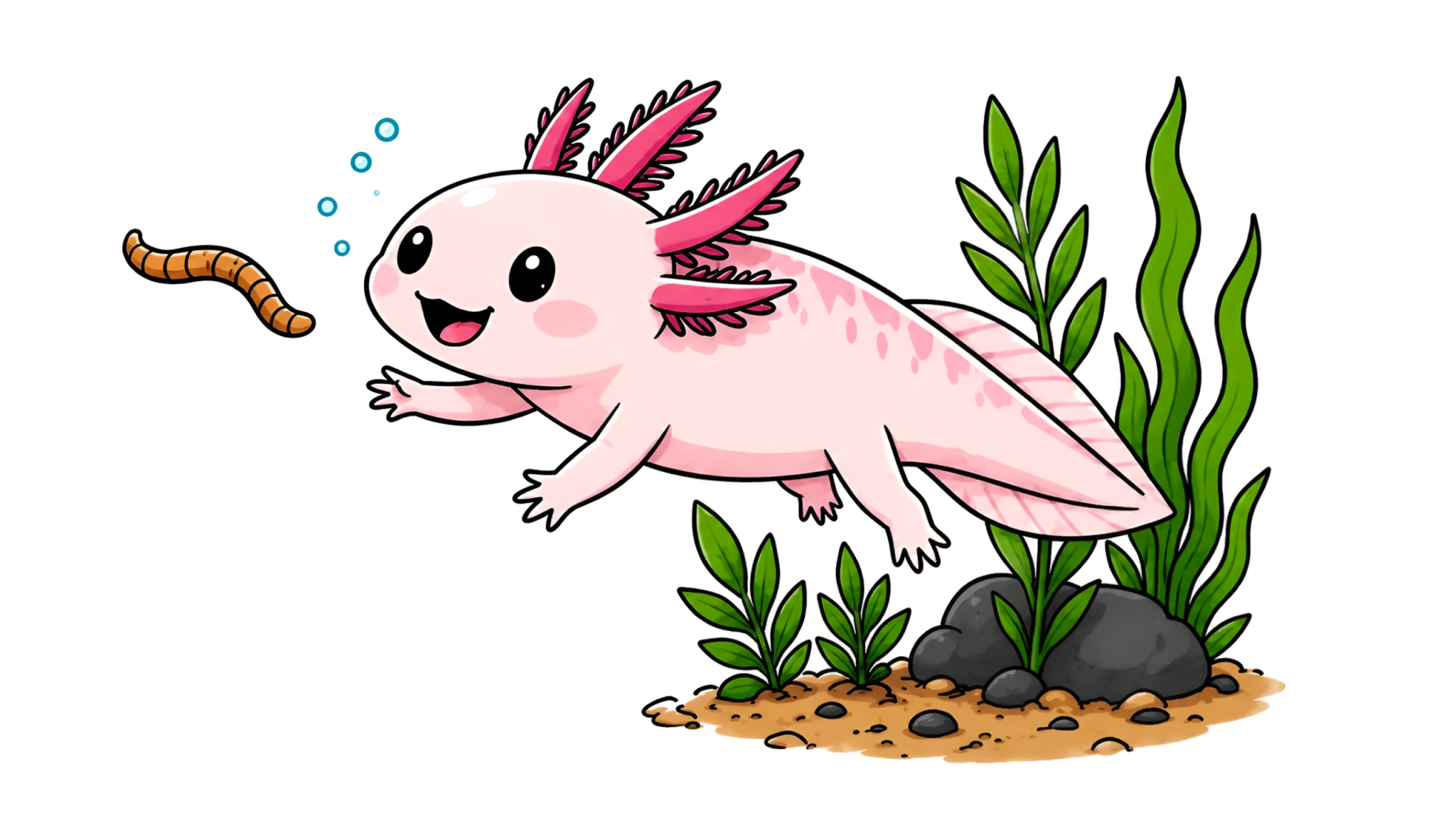
Are axolotls carnivores, herbivores, or omnivores? The answer is straightforward: axolotls are carnivores. They eat meat exclusively, have no ability to digest plant matter meaningfully, and are equipped with a feeding anatomy designed entirely around capturing and consuming prey. Understanding this is not just interesting biology — it directly shapes every decision you make about feeding your axolotl in captivity, from what food you buy to how often you feed and how much. This article covers the full picture of axolotl dietary classification, what they eat in the wild, what they should eat in captivity, and what happens when owners get feeding wrong.
Axolotls Are Carnivores: The Biology Behind It
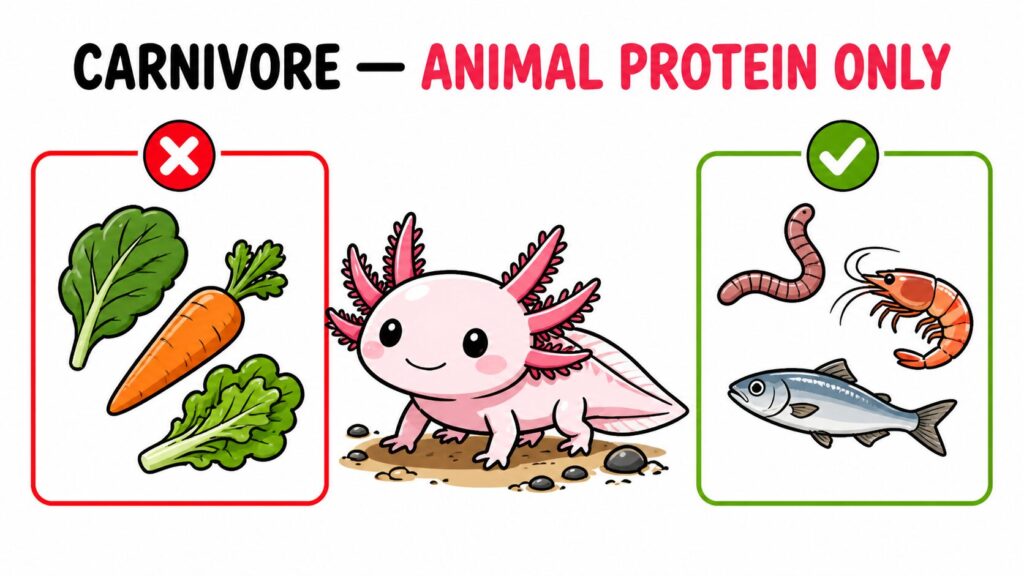
The classification of axolotls as carnivores is not a matter of preference or feeding habit — it is built into their anatomy and digestive physiology. Every physical feature of an axolotl’s feeding system is designed for capturing, subduing, and consuming animal prey.
Axolotls have a wide, flat mouth that opens extremely rapidly through a mechanism called suction feeding. When prey comes within range, the axolotl opens its mouth in a fraction of a second, creating a powerful inward rush of water that pulls the prey item inside. This is one of the fastest and most effective feeding mechanisms in the vertebrate world, and it works best on soft-bodied animal prey — worms, crustaceans, small fish, and insect larvae. It is not a mechanism that has any use for plant matter, which neither swims nor needs to be ambushed.
Inside the mouth, axolotls have small, vestigial teeth — technically referred to as pedicellate teeth — that are not used for chewing but rather for gripping prey items and preventing escape before swallowing. Axolotls are suction feeders that swallow prey whole, so their digestive system is optimized for processing high-protein animal matter, not cellulose or plant starches.
Research published through the Ambystoma Genetic Stock Center at the University of Kentucky, which maintains one of the world’s most important axolotl research colonies, confirms that Ambystoma mexicanum is an obligate carnivore whose digestive chemistry is tuned entirely to animal protein metabolism. They lack the specialized gut bacteria and enzyme profiles that herbivores and true omnivores rely on to extract nutrition from plant material.
What Do Axolotls Eat in the Wild?
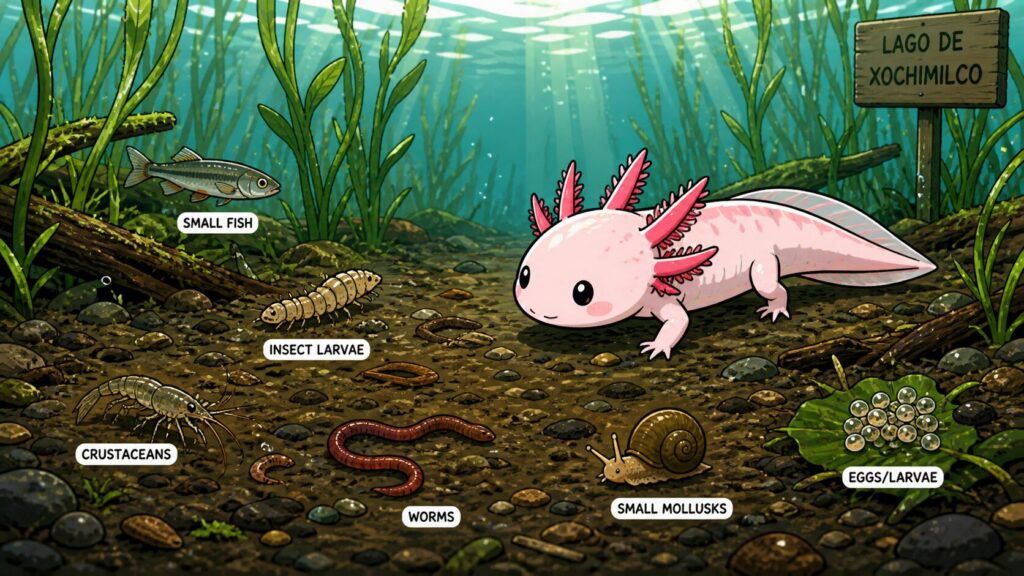
In their native Lake Xochimilco habitat — a freshwater lake system in Mexico City — wild axolotls are opportunistic carnivores that eat whatever animal prey is available and catchable. Their natural diet includes small fish and fish fry, aquatic invertebrates including water insects and their larvae, small crustaceans such as freshwater shrimp and water fleas, earthworms and other worms that enter the water from surrounding soil, small mollusks, and occasionally the eggs or larvae of other amphibians.
The wild axolotl hunts primarily by ambush and suction, relying on movement and water vibration to detect prey rather than visual acuity, since their eyesight is poor. They are bottom-dwellers that forage along the lakebed, moving slowly and patiently until something edible comes within range. This hunting strategy works exclusively on animal prey — plant matter does not move, does not trigger the axolotl’s feeding response, and is not nutritionally useful to them even if accidentally consumed.
Sadly, wild axolotl populations are now critically endangered. The IUCN Red List classifies Ambystoma mexicanum as Critically Endangered, with fewer than 1,000 individuals estimated to remain in the wild. Habitat destruction, pollution, and invasive species have all contributed to the collapse of the Xochimilco ecosystem. You can read more about this in our article on whether axolotls are endangered.
Will Axolotls Eat Plants?
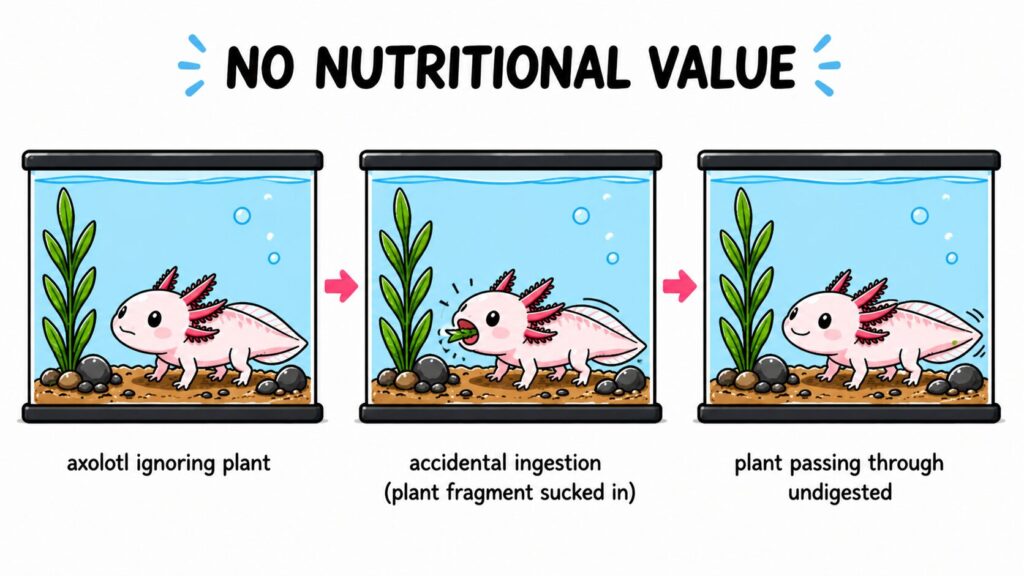
Axolotls will not deliberately eat living plants. They have no interest in vegetation as a food source and will not bite or consume aquarium plants in their tank. This makes live plants a perfectly safe addition to an axolotl setup — you can read about the best options in our axolotl tank plants guide.
The only way an axolotl might ingest plant matter is accidentally — a small fragment of an aquatic plant that gets pulled into the mouth during a feeding lunge, for instance, or some algae inadvertently consumed along with prey. This is incidental and not a meaningful part of their diet. The plant matter passes through without being digested or providing any nutrition, because axolotls lack the digestive machinery to process it.
This is an important distinction from true omnivores, which have digestive systems capable of extracting nutrition from both animal and plant sources. Axolotls are not omnivores — they are carnivores for whom plant matter is biologically irrelevant as food.
What Should You Feed an Axolotl in Captivity?
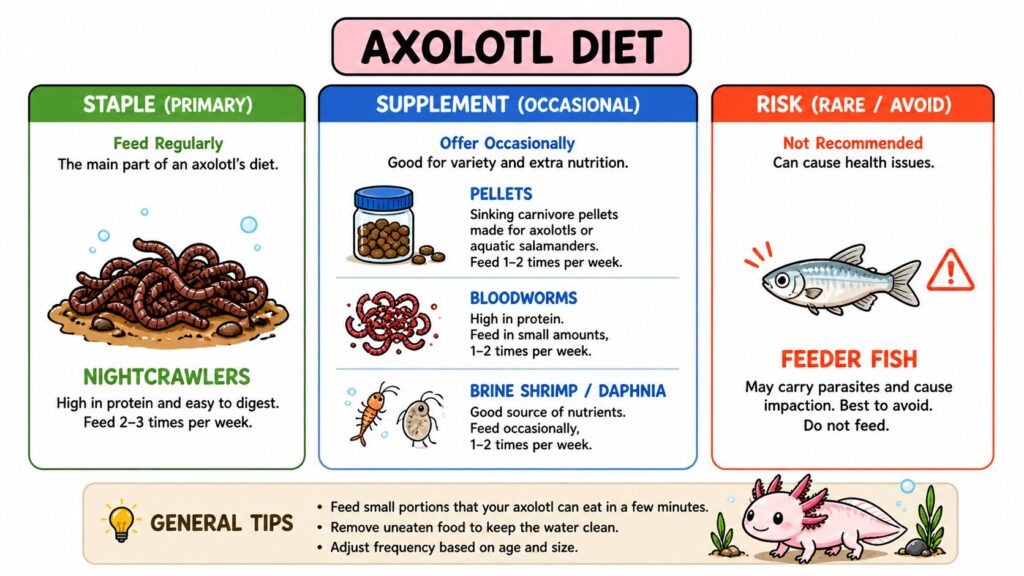
Because axolotls are carnivores, their captive diet needs to consist entirely of high-quality animal protein sources. There is no need to provide fruits, vegetables, or plant-based supplements — these will simply be ignored or, if accidentally consumed, will pass through undigested.
The best foods for captive axolotls are:
Nightcrawlers (earthworms) are widely regarded as the single best staple food for adult axolotls. They are nutritionally complete, containing protein, fat, and a range of vitamins and minerals that closely match what axolotls would consume in the wild. Most axolotls take to nightcrawlers eagerly, and they can form the foundation of a healthy diet on their own. Cut them to appropriate sizes for your axolotl — juveniles need smaller pieces, adults can take larger segments or whole worms. Our guide to the best axolotl nightcrawlers covers what to look for and where to source quality worms.
High-quality sinking pellets formulated for axolotls or large carnivorous fish are a convenient, nutritionally reliable alternative to live or fresh food. Good pellets are protein-rich, free of excessive filler ingredients, and sink immediately — which matters because axolotls feed from the bottom and are not well-equipped to chase floating food. Our guide to the best axolotl pellets covers the top options. Pellets are particularly useful for owners who find worms impractical to maintain.
Bloodworms — available frozen, freeze-dried, or live — are another excellent protein source and are enthusiastically accepted by most axolotls. They work best as a supplement or treat rather than a complete diet, as they are less nutritionally complete than nightcrawlers or quality pellets. Frozen bloodworms are generally preferred over freeze-dried, as they retain more nutritional value and moisture. See our guide to the best axolotl bloodworms for the most suitable products.
Brine shrimp, daphnia, and other aquatic invertebrates can work as occasional supplements, particularly for younger or smaller axolotls. They are lower in nutritional density than worms or pellets but are useful for variety and enrichment.
Small feeder fish such as guppies or small goldfish are sometimes offered, but these carry risks. Feeder fish can introduce parasites and diseases to the tank, and the nutritional value varies considerably depending on what the feeder fish themselves were fed. If offered at all, feeder fish should be from a known, reputable source and quarantined before use. For more on the risks of fish in axolotl tanks, see our article on whether axolotls can have tank mates.
Our comprehensive axolotl food guide covers all of these options in more detail and can help you build a feeding plan suited to your individual axolotl.
How Often Should You Feed an Axolotl?
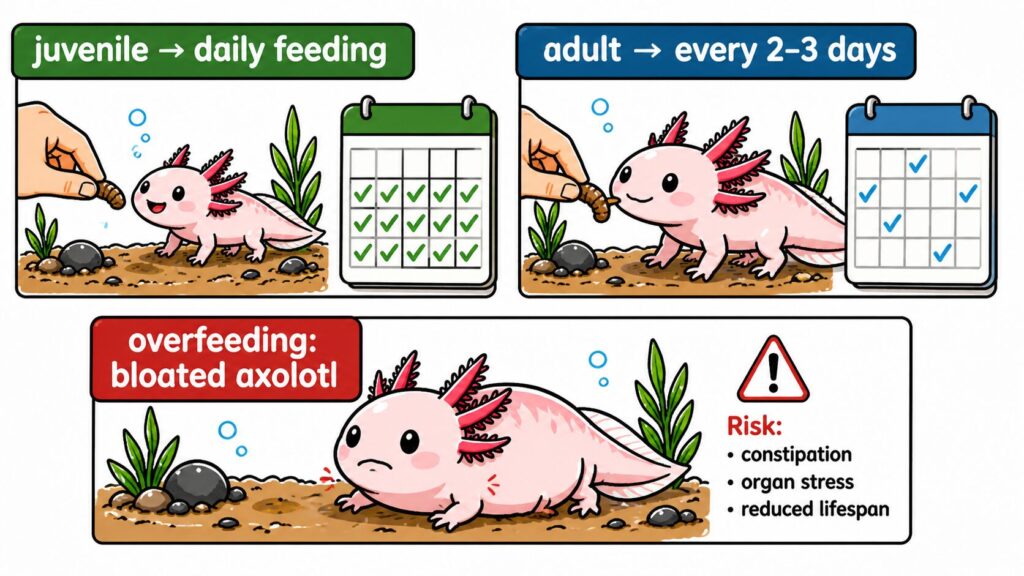
Because axolotls are carnivores with a metabolism calibrated to consuming relatively large, protein-dense prey at intervals — rather than grazing continuously on plant matter as an herbivore might — they do not need to eat every day as adults.
Adult axolotls (12 months and older) should generally be fed every two to three days. Each feeding should consist of an amount they can consume in a few minutes. Remove any uneaten food promptly using a turkey baster or feeding tongs, as decomposing food spikes ammonia levels rapidly in a freshwater tank — a significant concern covered in our article on ammonia burn in axolotls.
Juvenile axolotls — those under 12 months — have faster metabolisms and higher protein requirements to support rapid growth. They should be fed daily, or even twice daily for very young animals in their first few months of life.
Overfeeding is a genuine concern and more common than underfeeding among new owners. An overfed axolotl will develop a bloated, unhealthily round belly, and excess waste from uneaten food degrades water quality rapidly. Our article on whether axolotls can get fat covers what healthy body condition looks like and how to recognize overfeeding before it becomes a problem.
The Carnivore Diet and Cannibalism
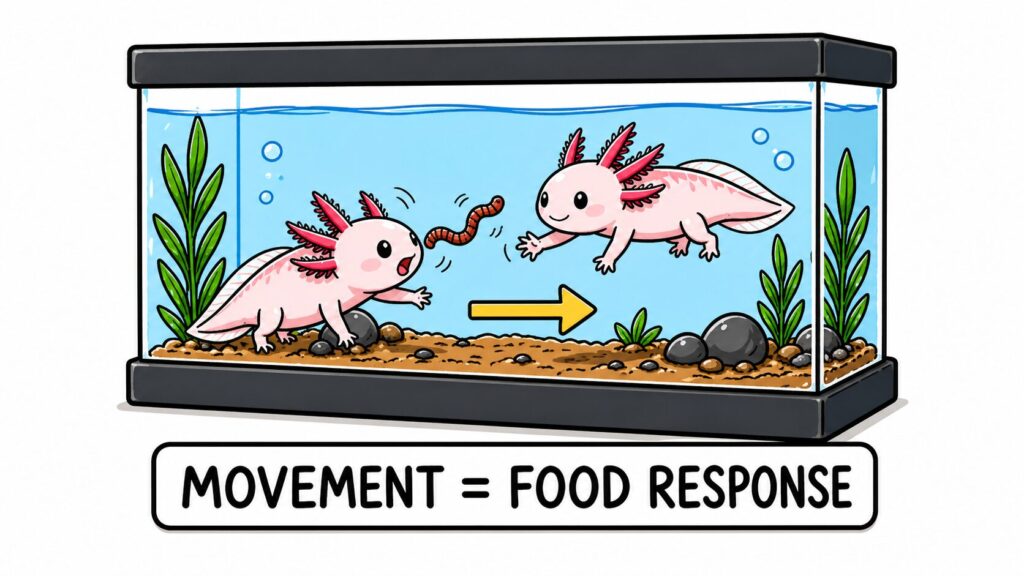
One of the more confronting aspects of axolotl carnivory is that their feeding instinct does not distinguish between tank mates and prey. An axolotl will attempt to eat anything that moves near its mouth and fits inside it — including the limbs, gills, and bodies of other axolotls. This is not aggression in any social sense; it is purely the same carnivorous feeding reflex that makes them lunge at a worm.
This is why axolotls are considered cannibalistic under certain conditions, particularly among juveniles of different sizes or when animals are kept in overcrowded or understimulating conditions. Our article on whether axolotls are cannibals covers this topic in full, including how to prevent it through proper feeding schedules and appropriate tank mate management.
Understanding that axolotls are carnivores with an instinct-driven feeding response — rather than deliberate predators making strategic decisions — helps owners manage their tanks more thoughtfully. A well-fed axolotl that has recently eaten is significantly less likely to bite at a tank mate than a hungry one, which is one of the reasons consistent, appropriately timed feeding is so important in any multi-axolotl setup.
Does Axolotl Diet Change Through Their Life?
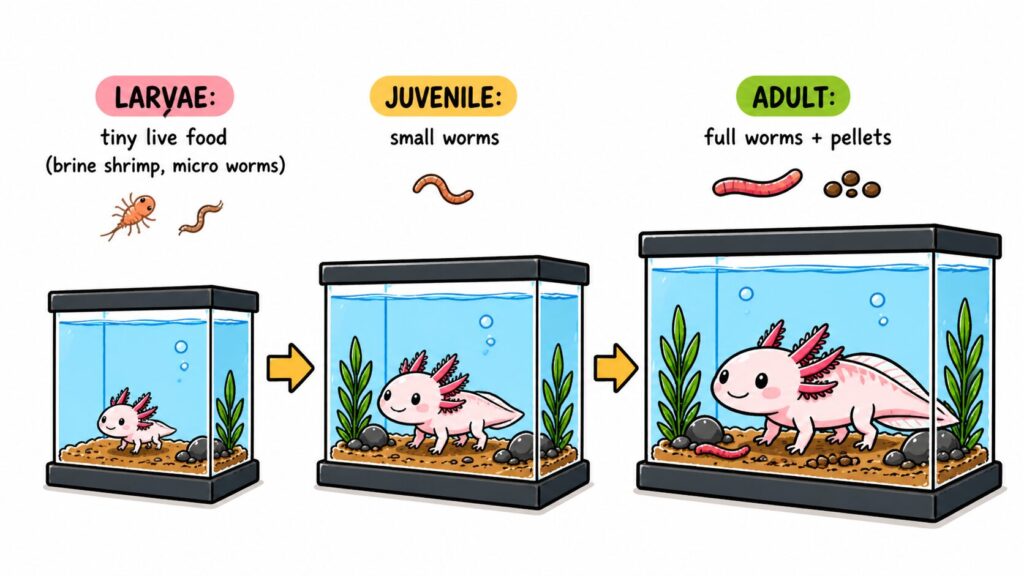
The carnivorous classification of axolotls does not change at any life stage — they are carnivores from hatching through old age. However, the specific foods offered and the feeding frequency do shift as axolotls develop.
Newly hatched larvae — tiny, translucent animals just a few millimeters long — start by feeding on microscopic aquatic organisms and very small live foods like baby brine shrimp, micro worms, and daphnia. They are too small for pellets or full-sized nightcrawlers in their first weeks of life. As they grow, progressively larger prey is introduced until they can handle the adult diet of nightcrawlers and pellets.
Adult axolotls maintain their carnivorous diet throughout their lives, though very old animals may show reduced appetite compared to their younger years. This is normal and does not indicate illness unless accompanied by other symptoms. Our article on axolotl lifespan covers age-related changes in behavior and health.
The transition from juvenile to adult feeding is also relevant for anyone involved in axolotl breeding, since managing the diet of larvae and juveniles is one of the more labor-intensive aspects of raising a clutch successfully.
The Link Between Carnivore Diet and Water Quality
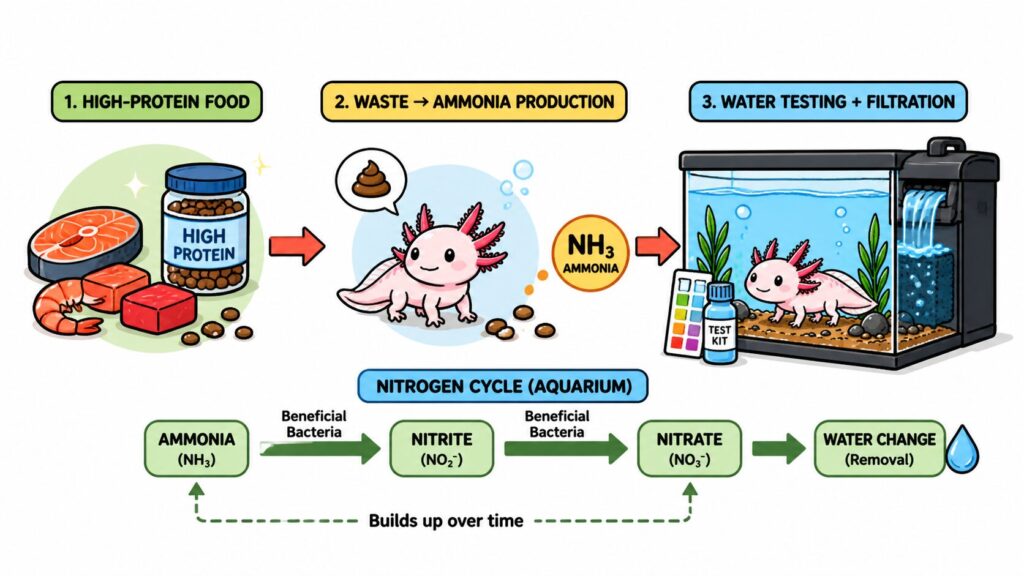
Because axolotls eat a high-protein diet and produce ammonia-rich waste as a result of metabolizing that protein, their carnivorous diet has a direct impact on water quality. Animal protein metabolism produces significantly more nitrogenous waste than plant-based diets, which is why axolotl tanks require robust filtration and regular water changes to stay clean.
A proper axolotl filter with strong biological filtration is essential for processing this waste load. Regular water changes — guided by consistent testing with a water test kit — are equally important. Our full guide on how to clean an axolotl tank covers the complete maintenance routine.
Uneaten food is a particularly important source of ammonia. A piece of nightcrawler or a pellet that sits on the tank floor and begins decomposing can spike ammonia rapidly, especially in smaller tanks. This reinforces the importance of removing uneaten food after every feeding — a turkey baster is the most practical tool for this job.
Common Feeding Mistakes Made by New Owners
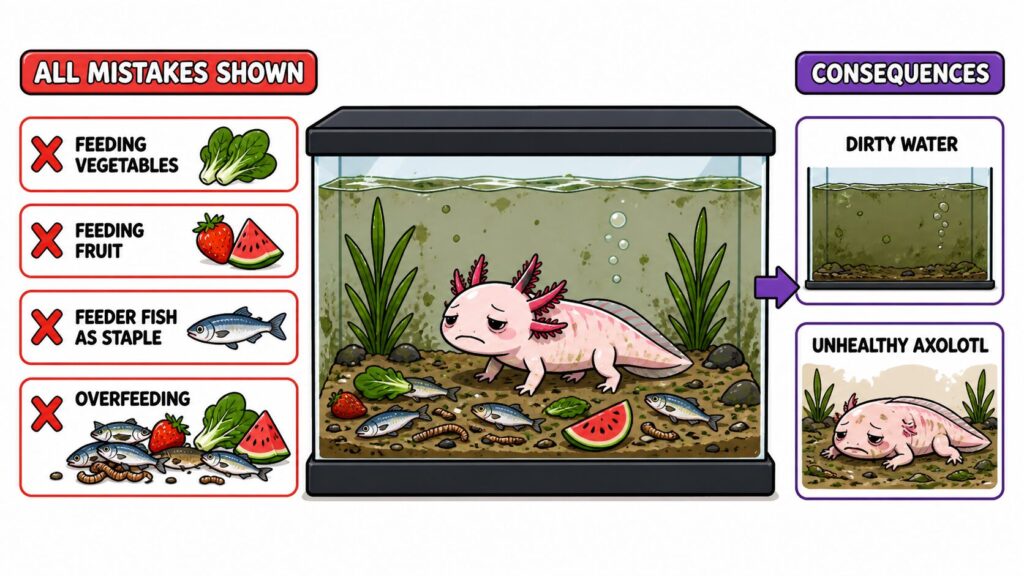
Offering plant-based foods is probably the most fundamental mistake, and it comes directly from not knowing that axolotls are carnivores. Pieces of fruit, vegetables, or plant-based fish foods are sometimes offered by well-meaning owners who assume axolotls have broader dietary needs. They do not. These foods will be ignored, will decompose in the tank, and will degrade water quality without providing any benefit.
Feeding live fish as a staple diet is another common error. While axolotls will readily eat small fish, feeder fish are a risky and nutritionally inconsistent food source. The disease and parasite risk alone makes them inadvisable as a regular feeding option, and the nutritional profile of most feeder fish — which are often poorly nourished themselves — is inferior to nightcrawlers or quality pellets.
Overfeeding is the third major mistake. New owners who see their axolotl enthusiastically accept food often interpret ongoing interest as ongoing hunger. Axolotls are motivated by movement and will often attempt to eat even when they are already full. Feed on a schedule rather than on demand, and always remove uneaten food promptly.
Frequently Asked Questions
Can axolotls eat vegetables or fruit? No. Axolotls are carnivores with no ability to meaningfully digest plant matter. Offering vegetables or fruit serves no nutritional purpose and will simply decompose in the tank, harming water quality.
Do axolotls eat algae? They will not deliberately eat algae and are not capable of digesting it effectively. Any algae an axolotl ingests is incidental and provides no nutritional benefit.
Can I feed my axolotl chicken or beef? This is occasionally suggested in older care guides but is not recommended by experienced keepers. Terrestrial mammal meat — particularly fatty cuts — is nutritionally mismatched to what axolotls have evolved to process and can cause digestive issues. Stick to aquatically appropriate protein sources like worms, pellets, and bloodworms.
How do I know if my axolotl is getting enough food? A healthy adult axolotl should have a gently rounded belly — not sunken and not bloated. Active behavior, normal gill coloration, and consistent interest in food at feeding time are all good signs. Weight loss, a concave belly, and lethargy can indicate underfeeding, though they can also indicate health issues unrelated to diet.
Is it normal for my axolotl to ignore food sometimes? Yes. Axolotls that are too warm, stressed by poor water quality, or simply not hungry will refuse food. A refusal here and there is not alarming. Consistent refusal over several days is worth investigating — check temperature first, then water parameters. Our guide on what temperature axolotls need is a good starting point since temperature is the most common cause of appetite loss.
Final Thoughts: Are Axolotls Carnivores, Herbivores, or Omnivores?
Are axolotls carnivores, herbivores, or omnivores? Carnivores — completely, biologically, and without exception. Every aspect of their anatomy, digestive physiology, and feeding behavior is built around consuming animal protein. Feeding them accordingly, with high-quality protein sources like nightcrawlers, pellets, and bloodworms, on a proper schedule, with diligent removal of uneaten food, is one of the most important things you can do for their health and longevity.
Feeding your axolotl right starts with knowing what it needs — and so does every other part of caring for it. Whether you need the right food, the right tank, or the right water care products, it is all waiting for you at the Herdurbia Best Axolotl Products hub, where great axolotl keeping is always within reach.