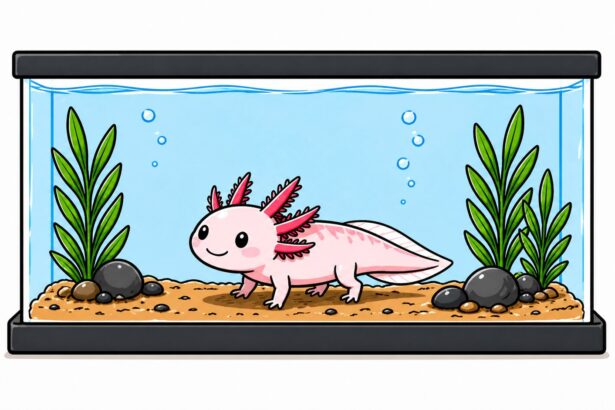

Are axolotls freshwater or saltwater animals? The answer is clear and unambiguous: axolotls are freshwater animals, exclusively. They cannot survive in saltwater, they did not evolve in brackish conditions, and their bodies are entirely adapted to the cool, soft-to-moderately-hard freshwater of their native Mexican lake habitat. Understanding this — and what it means for how you set up and maintain a captive tank — is foundational to keeping axolotls successfully. This article explains the biology behind that answer and what freshwater requirements actually look like in practice.
- The Definitive Answer: Axolotls Are Freshwater Animals
- Why Some People Ask About Saltwater
- The Biology of Why Axolotls Cannot Tolerate Saltwater
- What Water Parameters Do Axolotls Actually Need?
- The Role of Aquarium Salt in Axolotl Care
- Does Being a Freshwater Animal Affect What Lives With an Axolotl?
- Setting Up a Proper Freshwater Tank for an Axolotl
- The Freshwater Environment and Axolotl Health
- Axolotls in the Wild: A Freshwater Ecosystem Under Threat
- Frequently Asked Questions
- Final Thoughts on Whether Axolotls Are Freshwater or Saltwater Animals
Image suggestion: An axolotl resting on a sandy freshwater tank floor with plants visible in the background. Alt text: “are axolotls freshwater or saltwater animals — axolotl in freshwater planted tank”
The Definitive Answer: Axolotls Are Freshwater Animals
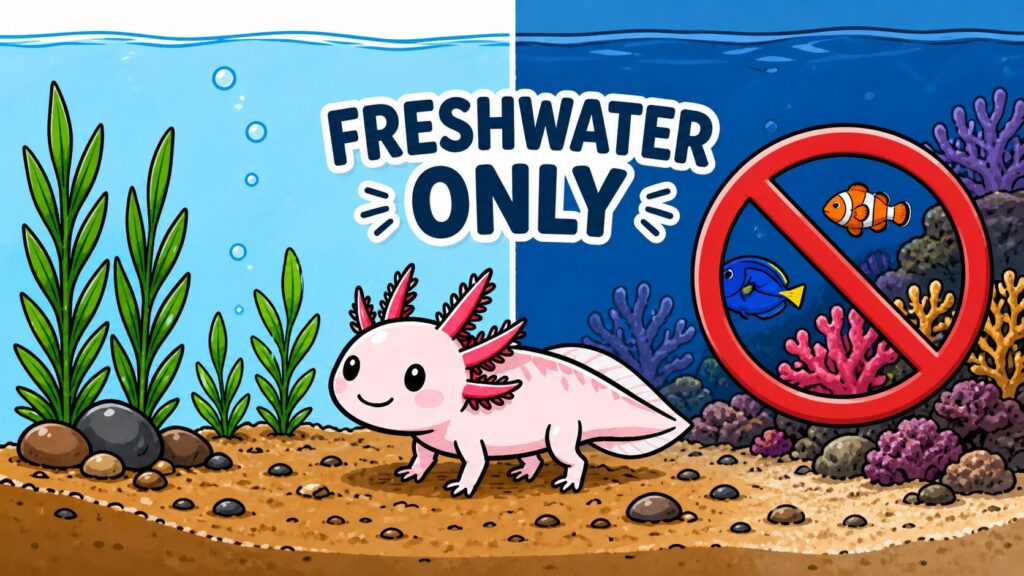
Axolotls (Ambystoma mexicanum) are native to a single freshwater lake system — Lake Xochimilco and the surrounding canal network near Mexico City. This high-altitude lake, sitting approximately 7,200 feet above sea level, is entirely freshwater. There is no tidal influence, no salt intrusion, and no brackish zone. The axolotl evolved entirely within this environment over millions of years, and every aspect of its physiology is calibrated to freshwater conditions.
According to the IUCN Red List species account for Ambystoma mexicanum, the species is endemic to the lake complex of Xochimilco, which is a landlocked, freshwater system. The wild population is now critically endangered, primarily due to habitat degradation, pollution, and the introduction of invasive species — but even as that habitat has changed, the water has remained freshwater. Axolotls have no evolutionary history with salt or marine environments whatsoever.
Why Some People Ask About Saltwater
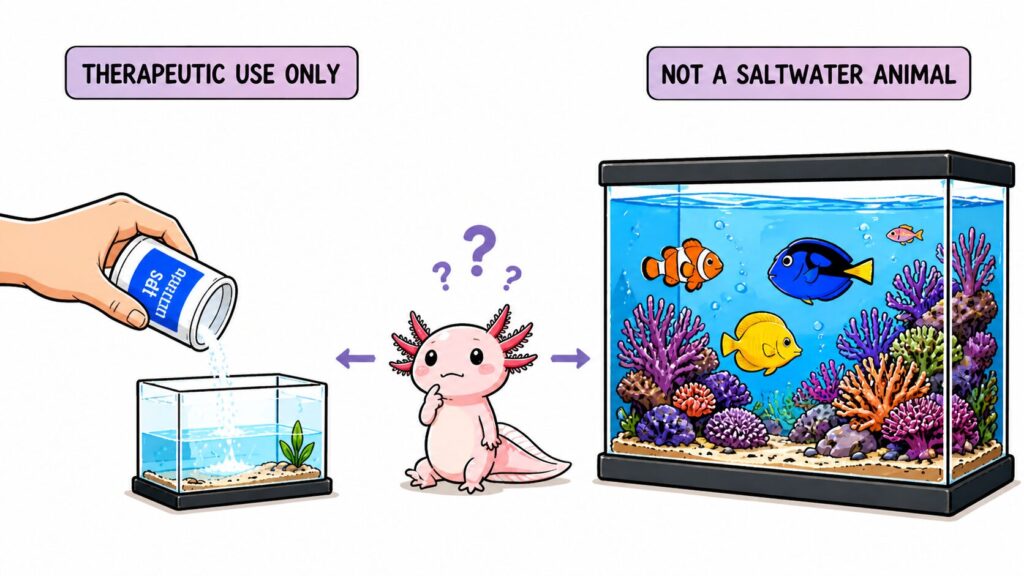
The confusion around whether axolotls are freshwater or saltwater animals typically arises from two sources. The first is that axolotl keepers sometimes use aquarium salt as a treatment tool — adding small amounts of salt to the water during illness or after injury. The second is that some new owners see salt used in aquarium keeping generally and wonder whether it applies to axolotls too.
Both points are worth addressing directly. The use of small, carefully measured amounts of aquarium salt as a short-term therapeutic treatment does not make axolotls saltwater animals any more than a human taking an electrolyte drink makes them a saltwater organism. The salt concentrations used therapeutically are a tiny fraction of what exists in marine environments and are used for specific, short-term purposes — not as an ongoing water condition. We cover this in more detail later in this article.
The second source of confusion is simply that the aquarium hobby involves both freshwater and marine tanks, and new hobbyists sometimes assume that all aquatic animals require some salt. Axolotls do not. They are as strictly freshwater as any river fish.
Image suggestion: A close-up of an axolotl’s feathery gills in clear freshwater. Alt text: “freshwater axolotl — close up of axolotl gills in clean freshwater tank”
The Biology of Why Axolotls Cannot Tolerate Saltwater
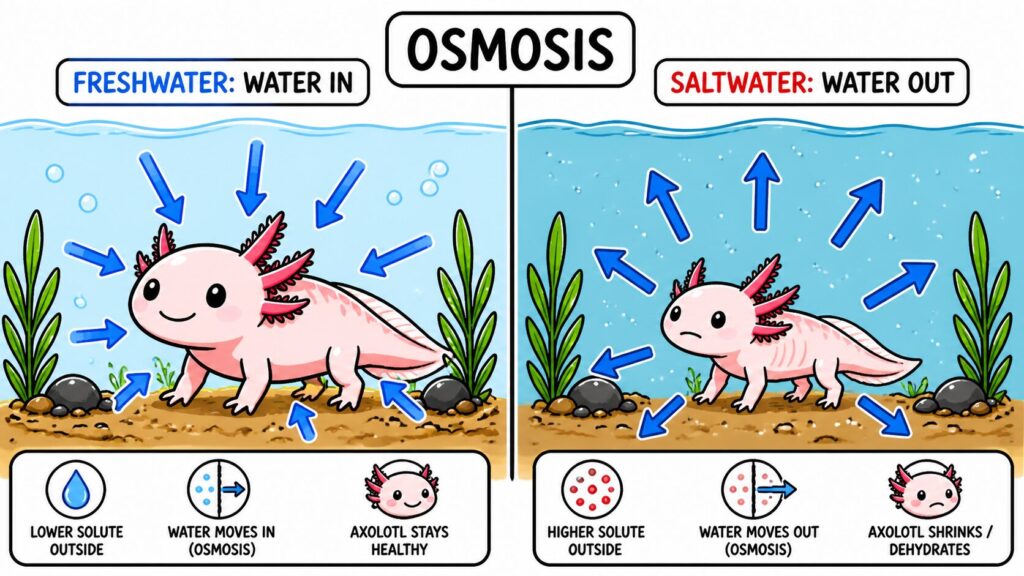
Understanding why saltwater is fatal to axolotls requires a brief look at how amphibian physiology works. Axolotls, like all amphibians, have highly permeable skin — meaning water and dissolved substances pass through it relatively freely. This permeability is actually one of the axolotl’s most important physiological features, as it allows for cutaneous respiration (absorbing oxygen through the skin) in addition to gill breathing.
In freshwater, this permeability works in the axolotl’s favor. The water around them has a lower solute concentration than their body fluids, so water tends to move into their tissues by osmosis, and their kidneys work to excrete the excess. In saltwater, the opposite happens. Saltwater has a much higher solute concentration than the axolotl’s body fluids, which means water is drawn out of the axolotl’s tissues by osmosis — the same process that dehydrates a slug when salt is poured on it. The axolotl would rapidly dehydrate, its cells would shrivel, and death would follow quickly.
Research published through the National Center for Biotechnology Information on amphibian osmoregulation consistently shows that freshwater amphibians are entirely dependent on low-salinity environments to maintain cellular water balance. Axolotls have no physiological mechanisms to cope with marine salinity levels.
What Water Parameters Do Axolotls Actually Need?
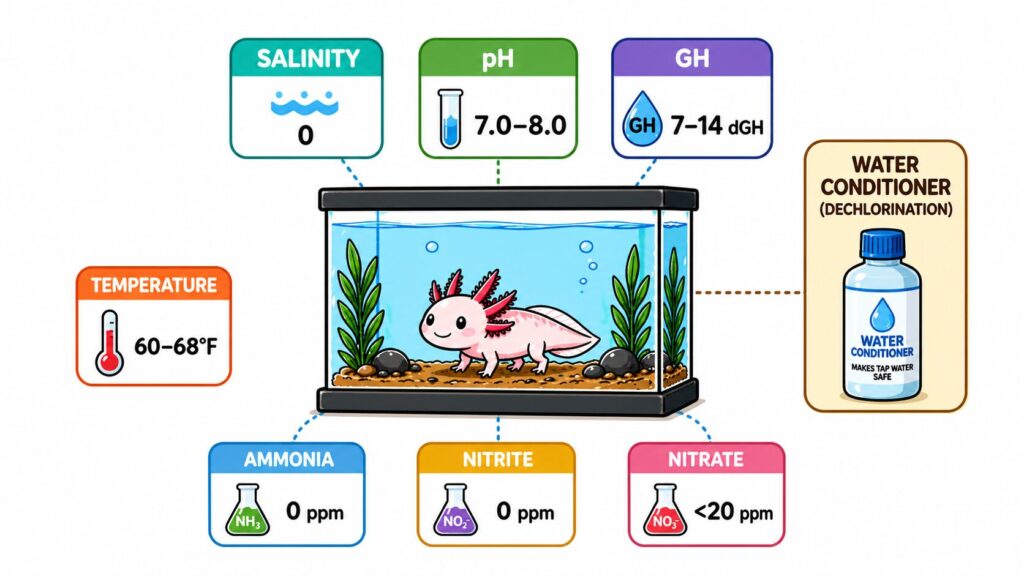
Since axolotls are strictly freshwater animals, their water needs to replicate the conditions of their native lake habitat as closely as practical. The key parameters are as follows.
Salinity should be zero or near-zero in a normal axolotl tank. No salt should be added to the water as a routine condition. The one exception is therapeutic use of aquarium salt at very low concentrations, discussed below.
pH should sit between 7.0 and 8.0 — slightly alkaline to neutral, which reflects the naturally mineral-rich water of Lake Xochimilco. Highly acidic water is harmful to axolotls and should be avoided.
General hardness (GH) should be between 7–14 dGH. Axolotls do best in moderately hard water, as the minerals in harder water support their mucus coat, gill function, and overall health. Extremely soft water — which is very low in dissolved minerals — can actually cause problems for axolotls over time.
Temperature must stay between 60°F and 68°F (16°C and 20°C). This is one of the most critical parameters in axolotl keeping and is covered in full detail in our article on what temperature axolotls need. The cool temperature of their native lake is part of what makes axolotls so different from tropical aquarium fish.
Ammonia and nitrite must be at 0 ppm, and nitrate should stay below 20 ppm. These parameters are managed through regular water changes, proper filtration, and an established nitrogen cycle. Our article on how to clean an axolotl tank walks through the full maintenance process.
All tap water added to the tank must be treated with a water conditioner before use. Tap water in most municipalities contains chlorine and chloramine, both of which are toxic to axolotls. A quality water conditioner neutralizes these chemicals instantly, making the water safe to add. Test your water regularly with a reliable water test kit to stay on top of all these parameters.
The Role of Aquarium Salt in Axolotl Care
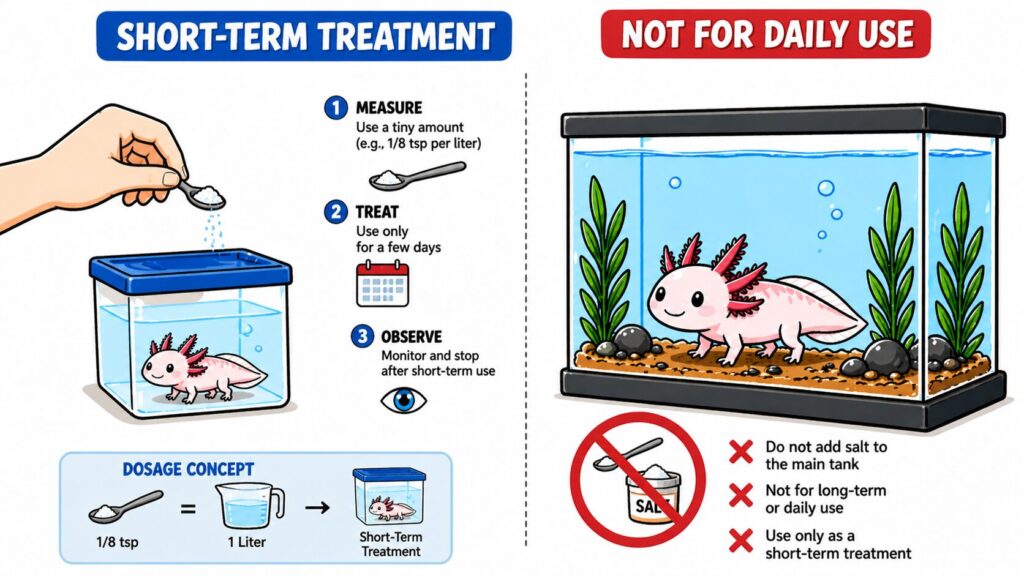
Now that we have established that axolotls are freshwater animals, it is worth addressing the specific context in which salt does appear in axolotl husbandry — as a therapeutic treatment, not a routine water additive.
Very dilute aquarium salt baths — typically around 1–2 teaspoons of non-iodized salt per liter of water — are sometimes used by experienced keepers to help treat mild fungal infections, bacterial wounds, and gill irritation. The slightly elevated salinity creates conditions that are inhospitable to certain pathogens while remaining tolerable to the axolotl for short periods. This is always a short-term, targeted treatment — not something axolotls should live in continuously.
Our guide to the best axolotl aquarium salt covers the specific products suitable for this purpose and how to use them safely. It is important to use non-iodized salt — iodized table salt contains additives that can harm axolotls — and to never use marine salt mixes designed for reef tanks, which contain far too many minerals and additives at the wrong concentrations.
The existence of this therapeutic application is one of the reasons the freshwater-versus-saltwater question comes up among new owners. To be completely clear: axolotls live in freshwater, require freshwater, and should only ever be exposed to salt under specific therapeutic circumstances and at extremely low concentrations.
Image suggestion: A bottle of aquarium salt next to an axolotl tank, illustrating therapeutic use. Alt text: “axolotl freshwater care — aquarium salt for therapeutic use not regular tank water”
Does Being a Freshwater Animal Affect What Lives With an Axolotl?
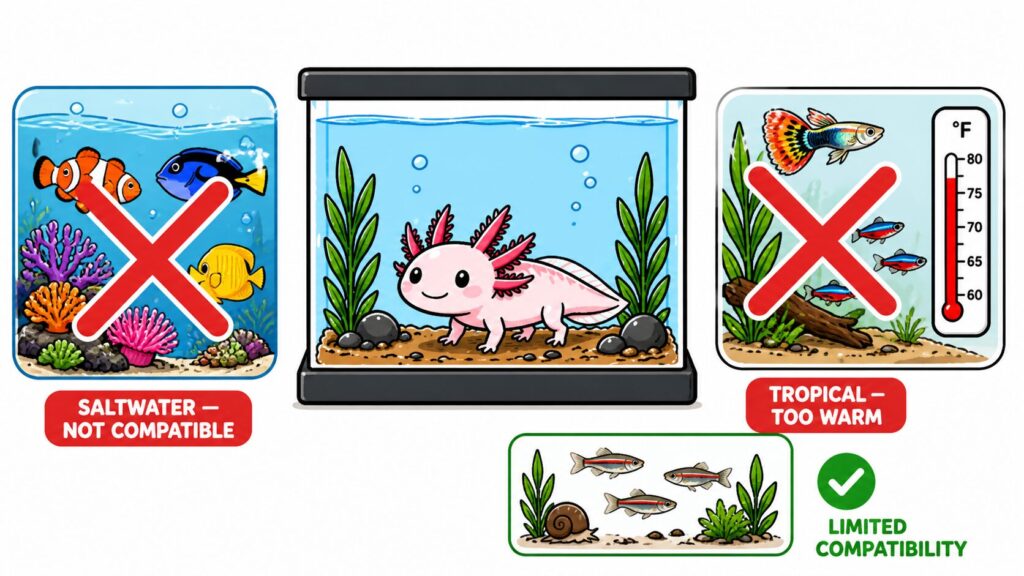
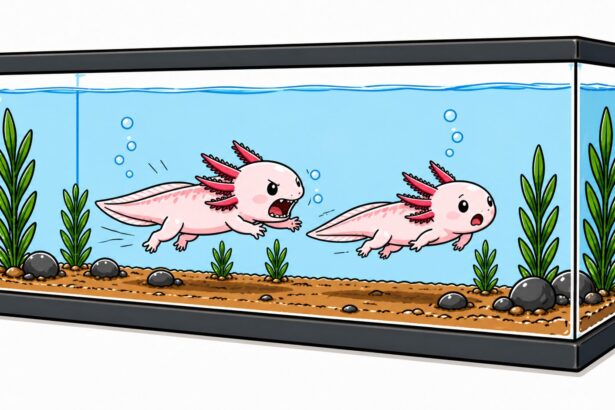
Yes, and significantly. Because axolotls require cool, soft-to-moderately-hard freshwater with zero salt, the range of animals that can share their tank is already narrow. This is one of the reasons marine fish, reef invertebrates, and saltwater species of any kind are completely unsuitable as tank mates. But even within the freshwater hobby, the cool temperature requirement rules out the vast majority of tropical freshwater fish.
Our detailed guide on whether axolotls can have tank mates covers which freshwater species are potentially lower risk and which are definitely off the table. The short version is that very few fish meet the combined requirements of cold water tolerance, non-nippy behavior, and an inability to fit in an axolotl’s mouth — and axolotls are themselves a risk to most small fish due to their carnivorous feeding instincts.
Setting Up a Proper Freshwater Tank for an Axolotl
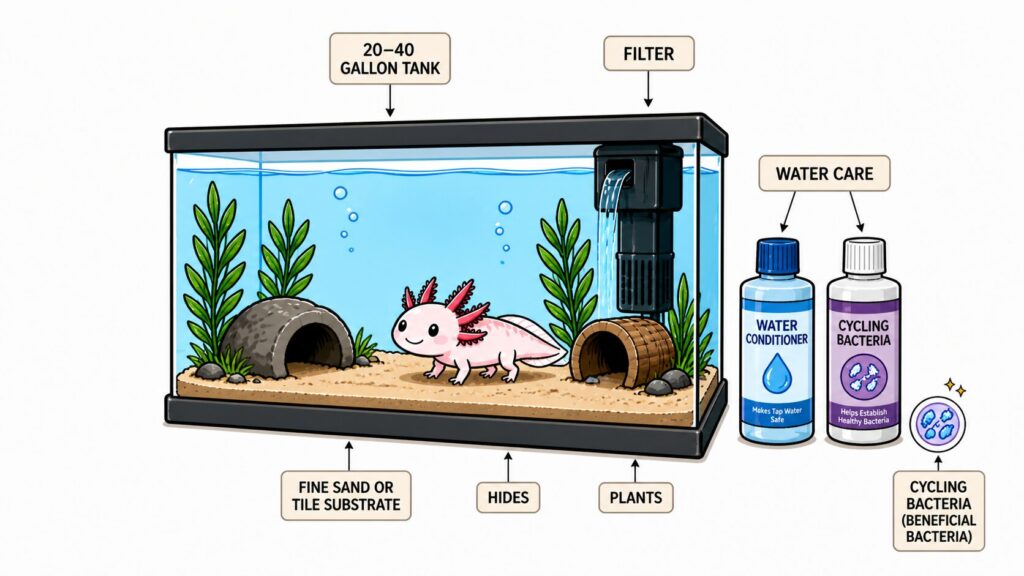
Understanding that axolotls are freshwater animals is the starting point. Translating that into a correctly set-up tank is the next step, and it involves more than just filling a tank with tap water.
The tank itself should be a minimum of 20 gallons for a single adult axolotl, though 40 gallons is more comfortable and provides better water stability. A good axolotl tank gives them the floor space they need as bottom-dwellers. A full tank kit can be a practical starting point for new owners.
Filtration is essential for maintaining the water quality that freshwater axolotls depend on. A powerful biological filter processes ammonia from waste into less harmful compounds, and without it, water quality degrades rapidly. Our guide to the best axolotl filter covers the options that provide strong filtration without creating the high flow that stresses axolotls.
Substrate should be either fine sand or smooth tiles — never standard-sized gravel, which axolotls can accidentally ingest. Our articles on whether axolotls need substrate, axolotl tank sand, and axolotl tank tiles explain the options in detail.
Hides and plants round out the environment. Axolotl caves, hides, and tank plants provide shelter and enrichment, reducing stress and encouraging natural behaviors. Keeping the tank biologically established with cycling bacteria before introducing an axolotl is also essential — cycling can take four to six weeks and ensures the nitrogen cycle is functioning before the animal moves in.
The Freshwater Environment and Axolotl Health
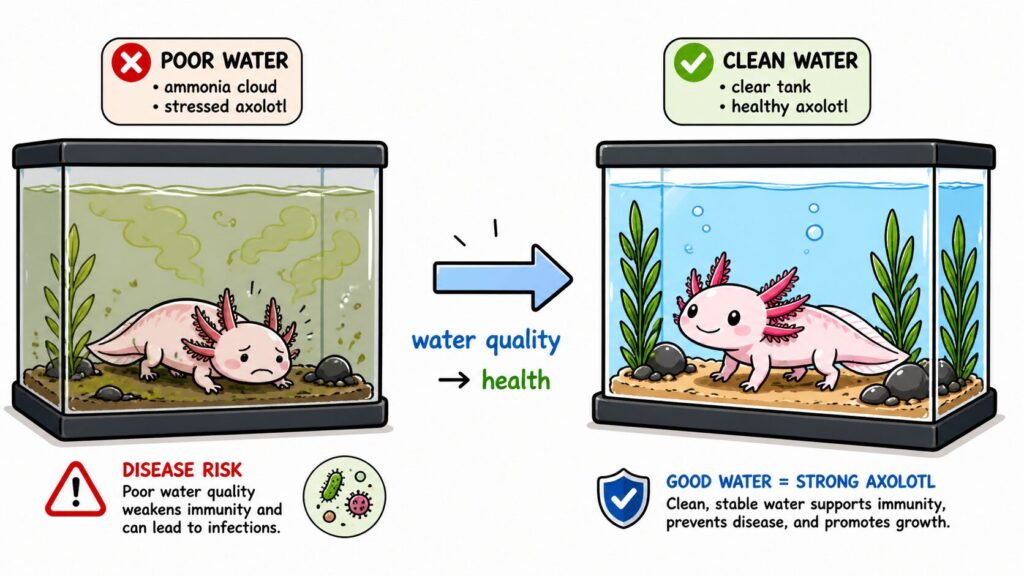
The connection between proper freshwater conditions and axolotl health is direct and well-documented. Virtually every common health problem in captive axolotls traces back to water quality or temperature — both of which are functions of maintaining a correct freshwater environment.
Ammonia burn is one of the most frequent health issues new owners encounter, caused by elevated ammonia in insufficiently filtered or inadequately maintained freshwater. Fungal and bacterial infections are also largely opportunistic — they take hold when the freshwater environment is compromised by poor water quality or incorrect temperature. Our axolotl care guide brings all of these elements together into a complete picture of what good freshwater husbandry looks like in practice.
The diseases axolotls are vulnerable to are also worth understanding, since many of them are directly related to water quality issues in their freshwater environment. Our article on whether axolotls carry diseases covers the main health risks and what to watch for.
Axolotls in the Wild: A Freshwater Ecosystem Under Threat
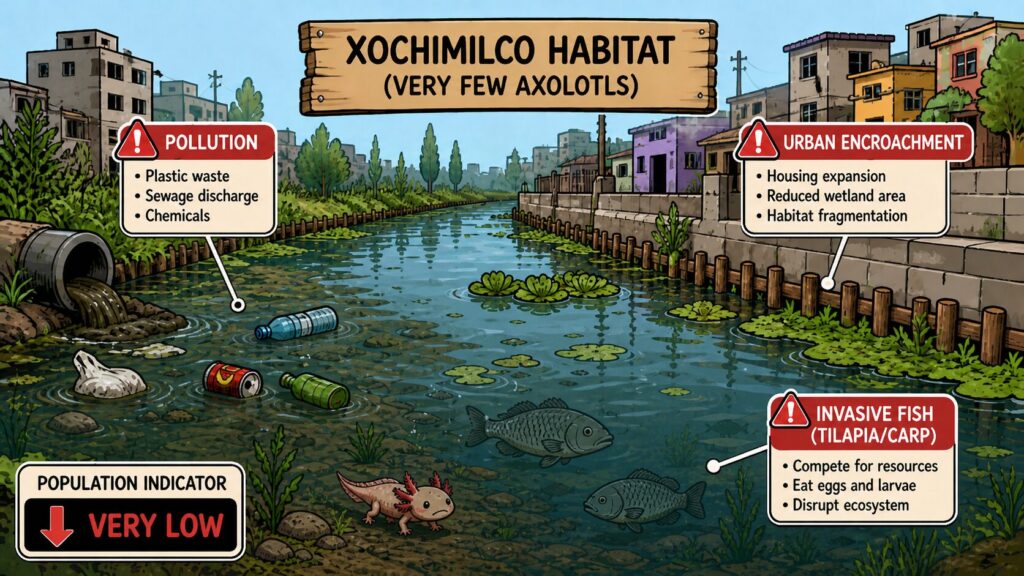
The story of the axolotl as a freshwater animal does not end at the tank. In the wild, axolotls depend on a specific freshwater ecosystem that is now in critical danger. Lake Xochimilco — once a vast network of freshwater canals and lake beds surrounding Mexico City — has been dramatically reduced by urban expansion, water extraction, and pollution. The IUCN Red List currently lists the wild axolotl population as Critically Endangered, with fewer than 1,000 individuals estimated to remain in the wild.
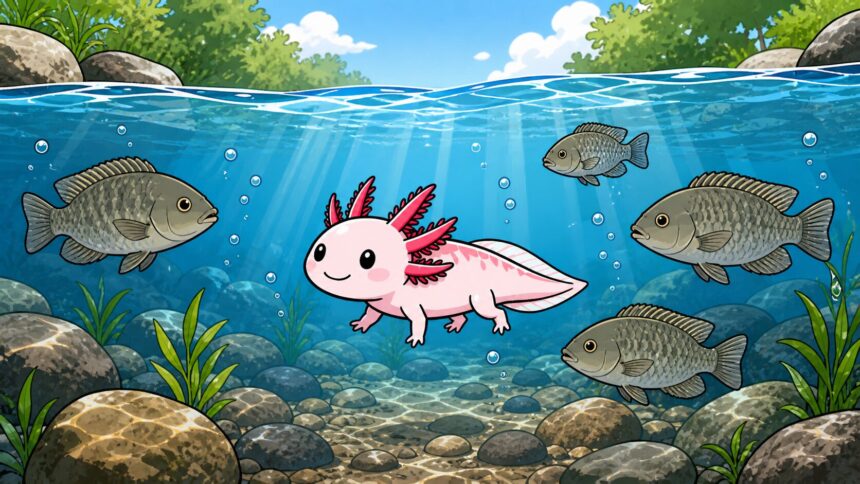
Invasive species introduced to Xochimilco — including African carp and tilapia — compete with axolotls for food and directly prey on axolotl eggs and juveniles, adding pressure on top of the habitat degradation. Conservation efforts are underway, including work by organizations like the Amphibian Survival Alliance, but the wild population faces severe challenges. The captive population, descended from animals brought to Europe for scientific research in the 1860s, now far outnumbers wild individuals and represents the species’ best chance of long-term survival. This gives axolotl keepers a real, if indirect, role in the species’ story — one that starts with understanding exactly what kind of water these animals need and providing it correctly.
You can read more about the conservation status of axolotls and what it means in our article on whether axolotls are endangered, and if you are considering ownership, our articles on why axolotls are illegal in some places and whether it is legal to own an axolotl are important reading before you buy.
Frequently Asked Questions
Can I put an axolotl in a saltwater tank? No, never. Saltwater would kill an axolotl rapidly through osmotic dehydration. Axolotls are strictly freshwater animals with no tolerance for marine salinity levels.
Do I need to add anything to the water for my axolotl? You need to dechlorinate all tap water with a water conditioner before adding it to the tank. Beyond that, no additives are needed in a normally functioning, properly cycled freshwater tank. Salt is only used therapeutically and at very low concentrations for specific health issues.
Can axolotls live in brackish water? No. Brackish water — a mix of fresh and saltwater — is still far too saline for axolotls. They have no osmoregulatory capacity to handle elevated salinity levels of any kind on a sustained basis.
Is hard water or soft water better for axolotls? Moderately hard water — around 7–14 dGH — is ideal. Axolotls do not do well in extremely soft water, which lacks the dissolved minerals that support their skin, mucus coat, and overall physiology. The naturally mineral-rich water of Lake Xochimilco reflects this preference.
What pH does axolotl water need to be? Between 7.0 and 8.0. Slightly alkaline to neutral is the target. Highly acidic water — below 6.5 — causes stress and health problems. Test your pH regularly with a quality water test kit and adjust if needed.
Final Thoughts on Whether Axolotls Are Freshwater or Saltwater Animals
Are axolotls freshwater or saltwater animals? Freshwater, completely and without exception. They evolved in a cool, clean, landlocked freshwater lake and every aspect of their care in captivity must reflect that. Get the water right — dechlorinated, properly cycled, correctly tempered, and free of salt — and you have solved the single most important challenge in axolotl keeping. Everything else builds from there.
Giving your axolotl the right water is the foundation. Giving them the right equipment is what makes that possible every day. Explore the full range of carefully selected products — from filters and water conditioners to food, decor, and beyond — at the Herdurbia Best Axolotl Products hub, where everything is chosen with your axolotl’s freshwater world in mind.