
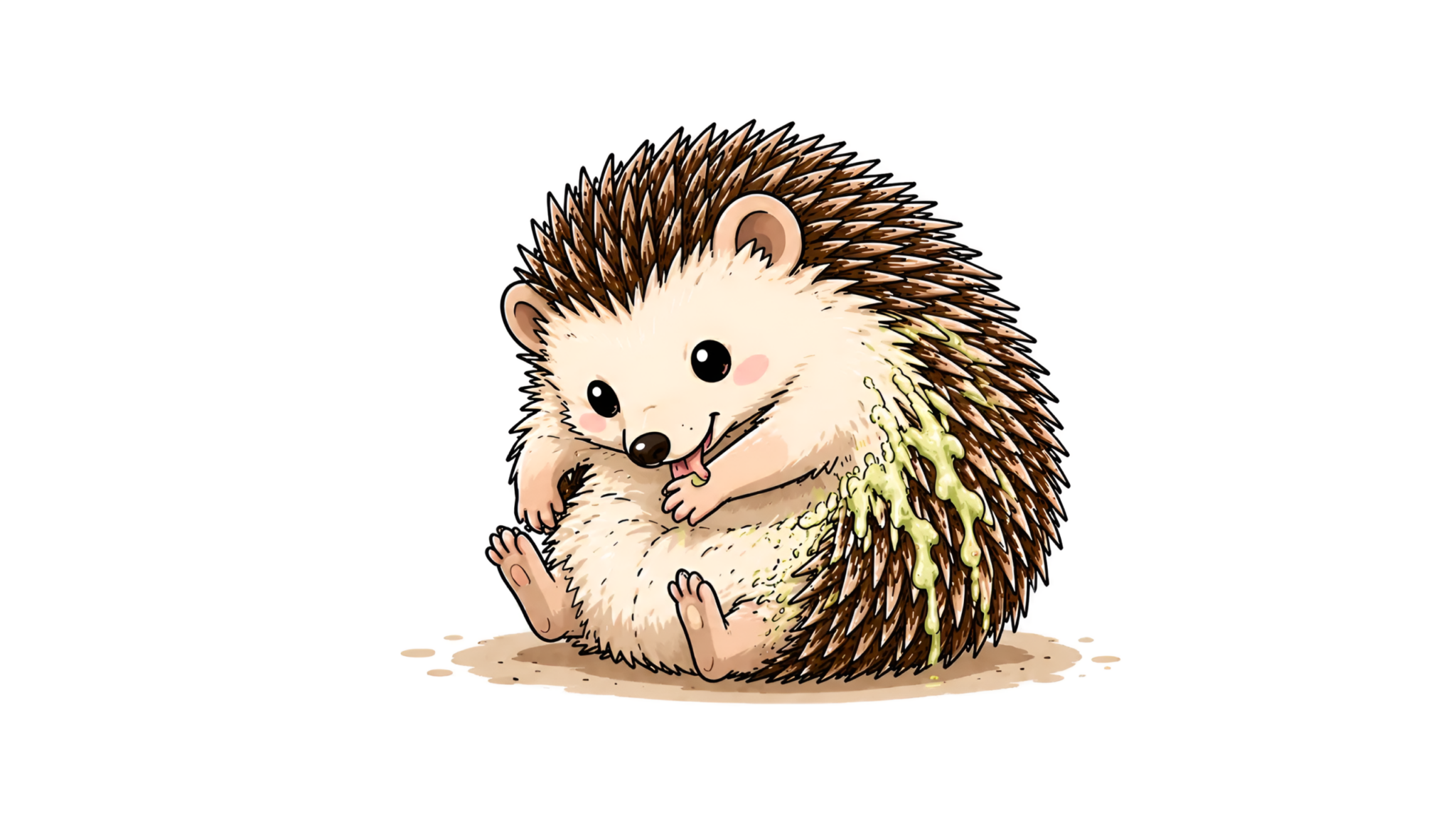
The first time most hedgehog owners witness hedgehog self-anointing, the immediate reaction is alarm. Their hedgehog stops dead, starts foaming at the mouth, contorts itself into a shape that seems physically impossible for something so round, and begins furiously licking frothy saliva all over its own quills. It looks, depending on your frame of reference, like a small seizure or the opening scene of a nature documentary about rabies. It is neither. It is one of the most fascinating and least understood behaviours in the mammal world — and after millions of years of hedgehog evolution, scientists still can’t fully agree on why it happens.
What Hedgehog Self-Anointing Actually Looks Like
The process follows a fairly consistent pattern every time. A hedgehog encounters a new smell or taste — this could be a piece of food, a chemical, an object, or sometimes apparently nothing obvious at all. It sniffs, licks, and often chews whatever has caught its attention. Then the foaming begins: thick, frothy saliva builds up in the mouth as the hedgehog chews, and the animal begins the acrobatic work of applying it to its quills.
This is where the contortion comes in. Hedgehogs are surprisingly flexible for their shape, and they need to be — reaching the quills on their back with their tongue requires bending in ways that look genuinely uncomfortable. They use the underside of the tongue to flick and spread the foam, rotating and twisting to achieve maximum coverage. According to Wildlife Online’s detailed behavioural analysis, the process can last anywhere from a few minutes to several hours, during which the hedgehog becomes almost completely absorbed in the task, largely oblivious to what’s happening around it.
The end result is a hedgehog with patches of wet, foamy saliva on its quills — usually concentrated on the shoulders and sides — and an owner wondering what on earth just happened. If you want to understand what’s normal hedgehog behaviour more broadly, our guide on are hedgehogs intelligent and smart gives useful context on how hedgehogs process and respond to their environment.
What Triggers It
The list of substances documented to trigger self-anointing is one of the more remarkable catalogues in behavioural biology. In his book Hedgehogs, naturalist Nigel Reeve lists 34 recorded triggers — including fox fur, human sweat, carpet, varnish, creosote, tobacco, newsprint, and even tortoises. Home & Roost’s hedgehog behaviour guide adds whisky, cigarette butts, paint, and leather to the list, while owners have reported hedgehogs anointing in response to dog faeces, their owner’s hand lotion, and new food items.
The common thread most researchers have identified is that triggers tend to be novel, pungent, or acrid — new smells that the hedgehog hasn’t encountered before. This is why new pet hedgehogs often self-anoint shortly after arriving home: the entire environment is unfamiliar, and everything smells new. It’s also why baby hedgehogs anoint more frequently than adults — the world is considerably more novel when you’re a few weeks old.
That said, the behaviour is highly individual. Some hedgehogs anoint readily and at the slightest provocation. Others rarely do it at all, or respond strongly to certain triggers while ignoring others entirely. As The Hedgehog Program notes, the same substance can trigger anointing on one occasion and produce no response at all on another from the same animal. This inconsistency is part of why the behaviour has been so difficult to study systematically.
The Theories — What Science Actually Thinks
Here is where things get genuinely interesting. Hedgehog self-anointing has been studied, debated, and theorised about for decades, and no single explanation has been proven to account for all observed cases. What we have instead is a collection of compelling theories, each supported by some evidence and undermined by some counterexample.
The Chemical Defence Theory
This is the most scientifically documented explanation, and it has a landmark study behind it. In 1977, biologist Edmund Brodie Jr. published a paper in Nature titled “Hedgehogs use toad venom in their own defence” — one of the most quoted studies in hedgehog research. Brodie observed hedgehogs chewing on the skin of cane toads (Bufo marinus), which contain potent toxic secretions, and then anointing their quills with the resulting foam. He then took the anointed spines and jabbed them into the arms of human volunteers. The result: immediate and intense burning, with splotchy red areas developing around the puncture sites. Spines treated with ordinary hedgehog saliva or washed in alcohol produced no such reaction.
You can read the original abstract at Nature and a detailed review at Wildlife Online. The implication is striking: hedgehogs may be deliberately borrowing the chemical defences of other organisms — toads, toxic plants, even venom — and applying them to their own quills to make themselves more dangerous to bite. Hedgehogs are famously resistant to many toxins and venoms that would harm other animals, which makes them uniquely suited to handle toxic substances in their mouth without ill effect.
The limitation of this theory is that self-anointing is also triggered by entirely harmless substances — distilled water and mother’s milk have both been documented as triggers. It’s hard to argue that anointing with carpet or tobacco serves the same defensive purpose as anointing with toad venom.
The Scent Masking Theory
This theory proposes that hedgehogs anoint to disguise their own smell — either from predators trying to locate them by scent, or from other hedgehogs competing for territory or mates. By coating themselves in whatever the local environment smells like, they effectively blend chemically into their surroundings.
Several patterns in the data support this idea. A peer-reviewed study in Mammal Research found that self-anointing in European hedgehogs is significantly more common in males than females, peaks during summer — the breeding season — and is more frequent in first-year juveniles than adults. Males range widely and encounter competitors frequently; juveniles are young and vulnerable. Both groups have strong reasons to mask their scent. Wildlife naturalist Marc Baldwin at Wildlife Online suggests the large surface area of the quills may also function as an evaporation platform for pheromones or chemical signals, potentially serving a communication role rather than a concealment one.
A separate field study published in Animal Behaviour found that nestling hedgehogs anointed when removed from their nests — possibly as a signal to their mothers — and that adult hedgehogs sometimes anointed in the presence of the opposite sex, suggesting a possible reproductive signalling function.
The Parasite Control Theory
Some researchers have suggested that the substances applied during self-anointing may have antimicrobial or antiparasitic properties that help control external parasites like ticks, mites, and fleas. This is a plausible idea — many of the substances hedgehogs anoint with do have documented antiseptic or insecticidal properties. However, Wildlife Online’s analysis points out that there is no evidence the anointing behaviour is directed toward areas where parasites are actually present, and hedgehogs — which are notoriously prone to mite infestations — don’t appear to have lower parasite loads as a result. The theory remains possible but unproven.
The Sensory Enrichment Theory
For pet hedgehogs in particular, some behaviourists suggest that self-anointing may simply be a form of sensory stimulation — a response to novelty that hedgehogs find engaging in the same way they engage with new toys or environments. As Prickles & Paws Hedgehog Rescue notes, hedgehogs are often observed anointing after introduction to a new environment, new food, or new object, which supports the idea of a novelty-seeking component. This doesn’t explain the behaviour in wild hedgehogs with evolutionary pressure, but it may partly explain patterns in captive animals.
The honest answer is that it’s probably not one thing. Multiple functions may overlap depending on context — a wild hedgehog anointing with toad venom has different stakes than a pet hedgehog anointing with its owner’s hand cream, and the underlying drivers may differ accordingly. Our article on hedgehog sounds explores another aspect of hedgehog communication that is similarly complex and only partially understood.
Does It Happen in Other Animals?
It does — and the company hedgehogs keep is interesting. PangoVet’s self-anointing overview notes that rice-field rats in Southeast Asia anoint when they detect weasel scent; spider monkeys in Central and South America anoint with leaves from specific plant species; capuchin monkeys, Siberian chipmunks, and lemurs have all been observed doing variations of the same thing. In birds, a similar behaviour called “anting” has been documented across many species. Each appears to serve somewhat different functions, but the convergent evolution of this behaviour across such unrelated animals suggests it has genuine adaptive value — even if that value isn’t identical across every species that does it.
What to Do When You See It
Nothing, mostly. Hedgehog self-anointing is entirely normal, completely harmless, and not a sign of illness or distress. The hedgehog is absorbed in what it’s doing and doesn’t need intervention. Watch if you want to — it’s genuinely one of the more remarkable things you’ll see a hedgehog do — but don’t interrupt or try to clean off the saliva. The process will end on its own when the hedgehog is satisfied.
The one scenario worth attention is if your hedgehog anoints with something genuinely hazardous — certain cleaning products, pesticides, or toxic plants. If you suspect your hedgehog has been chewing on something potentially dangerous, contact an exotic vet promptly. For everyday substances like food, your own hand products, or household materials, there’s nothing to be concerned about. Our article on are hedgehogs poisonous covers hedgehog toxin resistance in more detail if you’re curious about the broader picture.
The behaviour can leave the hedgehog looking a bit dishevelled and damp. This is normal. It also can leave them temporarily exhausted — the full anointing process is physically demanding — so don’t be concerned if your hedgehog retreats to sleep immediately afterwards. Given that hedgehogs are nocturnal animals who are already active primarily at night, a post-anointing rest is entirely in keeping with their usual routine.
A Behaviour That Still Has Secrets
What makes hedgehog self-anointing genuinely compelling beyond the spectacle is how much it reveals about the limits of what we understand. Hedgehogs have existed in essentially their modern form for an extraordinary length of evolutionary time — far longer than most familiar mammals. That longevity means they carry behaviours and adaptations that evolved in contexts we can only partially reconstruct. Self-anointing may be one of them: a behaviour so ancient and multi-layered that our modern tools for studying it haven’t yet caught up.
The Brodie study proved that it can weaponise hedgehog quills under the right conditions. The Mammal Research population study proved it is shaped by age, sex, and season in ways consistent with adaptive function. What remains is the question of what, exactly, the hedgehog is doing in its own internal experience when it encounters that pungent new smell and decides — instinctively, immediately — that the correct response is to foam at the mouth and rub itself with it. That answer is still out there.
Conclusion
Hedgehog self-anointing is harmless, normal, and one of the most compelling unresolved mysteries in small mammal behaviour. It’s triggered by novelty and pungent smells, it involves frothy saliva applied methodically to the quills, and it may serve any one of several functions — or several at once. The science, while incomplete, is genuinely fascinating, and the 1977 Brodie experiment alone is one of the more memorable moments in animal behaviour research. If your hedgehog does it, consider yourself fortunate to have witnessed something that has puzzled researchers for decades and still hasn’t been fully explained.
For everything else you need to understand and care for your hedgehog — from their diet and habitat to their more unusual behaviours and best products on the market — our best hedgehog products page is the best place to start building a setup worthy of such a fascinating animal.