

Your thermostat controls the heat. Your thermometer tells you whether any of it is actually working. Those are two completely different jobs, and they require two different tools — a point that trips up a surprising number of new hedgehog owners who assume the thermostat’s built-in sensor is enough. It isn’t. The thermostat probe reads the temperature at the probe’s location and cycles the CHE accordingly — but it doesn’t tell you what the temperature is at cage floor level where your hedgehog actually lives, it doesn’t show you the overnight low, and it gives you no warning if the CHE bulb fails silently while you’re asleep. A separate thermometer does all of that.
Hamor Hollow Hedgehogs keeps multiple thermometers in every room where hedgehogs are housed specifically so they know immediately if the temperature dips below safe levels. That level of attention to temperature monitoring is exactly what this guide is designed to help you replicate in your own setup, practically and affordably.
Why a Separate Thermometer Is Not Optional
The thermostat’s probe is positioned to regulate the CHE. Your thermometer’s probe is positioned to tell you the truth about what your hedgehog is experiencing. Those two locations are not the same, and the readings they produce are not the same either.
Temperature stratifies in an enclosed space — warm air rises, cooler air settles at the bottom. If the thermostat probe is positioned higher in the cage than your hedgehog’s sleeping and activity zone, it may read several degrees warmer than what your hedgehog actually experiences at floor level. A thermometer placed correctly — at cage floor level, near the hideout — gives you the number that actually matters.
Beyond accurate readings, the most critical function a cage thermometer provides is overnight visibility. A failed CHE produces no light, no noise, and no other indication that it has stopped working. Unless you happen to check the thermostat display at the right moment, you won’t know until the cage has already cooled — potentially to dangerous temperatures. A thermometer with a minimum temperature memory shows you the lowest temperature recorded since you last checked. If the overnight low reads 65°F when your target is 75°F, you know immediately that something failed during the night, and you can act before your hedgehog’s condition deteriorates.
What to Look For
A wired probe for cage-level readings. The most practical thermometer setup for a hedgehog cage has the display unit sitting outside the cage — where you can read it easily — while a thin probe cable runs inside and sits at floor level near the hideout. This keeps the electronics outside the cage away from your hedgehog, while the probe itself — usually just a thin rubber or metal tip — can be secured unobtrusively inside. Hedgehog Central users consistently recommend indoor/outdoor probe thermometers for exactly this configuration: indoor reading shows room temperature, outdoor reading shows cage temperature, both visible on the same display.
Minimum and maximum temperature memory. This is the feature that makes a thermometer genuinely useful for hedgehog care rather than just interesting. Min/max memory records the lowest and highest temperatures since the last reset, giving you a clear picture of overnight conditions without having to be awake to monitor them. If your min reading is consistently within the safe range, your setup is working. If it dips below 72°F overnight, something needs adjusting.
Accuracy within ±1°F. The safe temperature range for a hedgehog is 72°F to 80°F — a window of only 8 degrees. A thermometer with ±2°F or more accuracy is simply too imprecise to be relied upon in that context. Look for stated accuracy of ±1°F or better, and verify it against a second thermometer when you first set up the cage.
No requirement to check manually at a specific time. Any thermometer that only shows the current temperature without memory means you have to check it at the exact moment a temperature problem occurs to catch it. That’s not realistic. Memory of the overnight low is what makes a thermometer a genuine safety tool.
Thermometer Types Worth Knowing
Wired probe digital thermometers sit outside the cage with a probe cable running inside. Clean setup, easy to read, keep the display accessible. The most practical everyday option for a hedgehog cage.
Standalone compact units sit inside or clip to the cage, displaying temperature directly. These work well as a quick visual check during daily care, though the display can be harder to read without opening the cage. Some models also record min/max.
WiFi smart sensors connect to a phone app, log temperature data continuously, and send push notifications when temperature drifts outside a set range. The most powerful monitoring option for owners who work long hours or travel, though they require WiFi and a charged phone to receive alerts.
Stick-on strip thermometers — the adhesive strips designed for fish tanks or reptile enclosures — are too imprecise for hedgehog use. They read surface temperature rather than ambient air temperature, lack any memory function, and typically only cover a narrow range with poor accuracy. They’re not worth considering.
Probe Placement
Position the thermometer probe at cage floor level, near the hideout or sleeping area — this is where your hedgehog spends most of its time and where the temperature reading matters most. Keep it away from the CHE itself, which would give an artificially high reading, and away from the cage walls where drafts can skew readings low.
Secure the probe so your hedgehog can’t move it during nightly activity. Running it under the edge of a cage liner, clipping it to a bar, or tucking it behind the hideout are all effective approaches. A probe that ends up across the cage by morning is no longer reading what you think it’s reading.
If you also use the thermostat probe inside the cage, position your thermometer probe near it but not directly alongside it — placing them close together allows you to cross-check both readings and confirm they broadly agree. Significant disagreement between the two is a signal that one of the probes has shifted or that there’s a temperature gradient worth investigating.
Our Top Hedgehog Thermometer Picks
Best Overall: AcuRite Digital Thermometer with 10-Foot Wired Probe
The AcuRite indoor/outdoor digital thermometer with wired probe is the most practical everyday thermometer for a hedgehog cage and consistently recommended in the hedgehog keeper community. The setup is clean and purpose-built for exactly this use case: the display unit sits outside the cage showing both the indoor temperature (room ambient) and the probe temperature (cage interior) simultaneously, so you can read both with a glance without opening the cage or disturbing your hedgehog during the day.
The 10-foot wired probe is weatherproof and water-resistant, which means it handles the humidity and occasional bedding contact inside a hedgehog cage without degrading. Min/max temperature memory shows the highest and lowest readings recorded, giving you overnight visibility into whether the cage temperature stayed within the safe range. The display is easy to read from across a room, stands upright on a tabletop or mounts to the wall, and runs on standard batteries with no WiFi or setup required. Accuracy is reliable for the 72–80°F range a hedgehog requires.
Best for: Any hedgehog owner as the primary cage thermometer. The combination of outside display, inside probe, and min/max memory covers every monitoring need in a single affordable unit.
Watch out for: The min/max memory resets manually — make it part of your daily routine to check and reset it each morning so you have a clean overnight record each night. Also confirm the probe is still in position each time you spot-clean the cage, as your hedgehog may have moved it during the night.
Best Compact Option: ThermoPro TP50 Digital Thermometer and Hygrometer
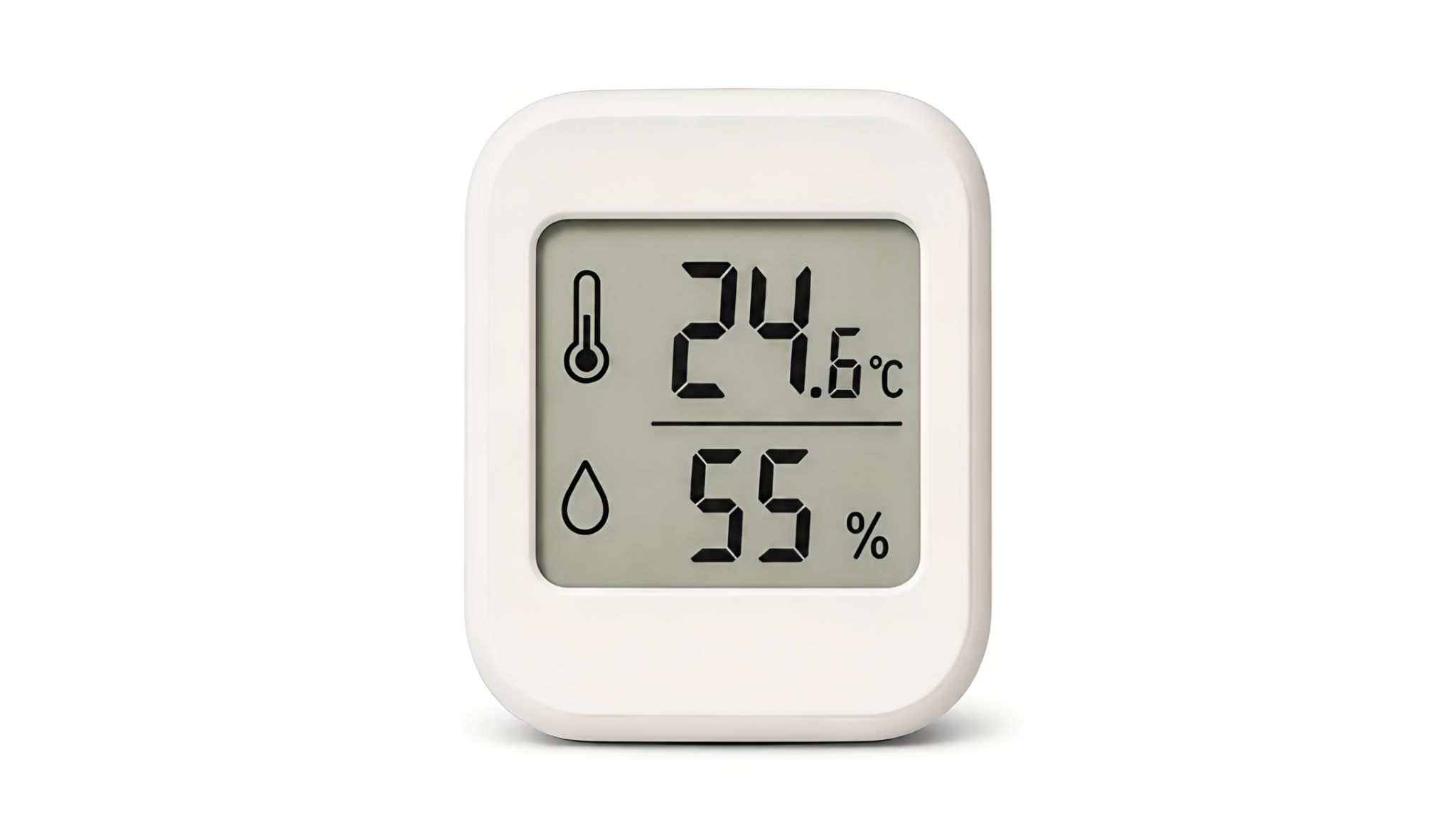
The ThermoPro TP50 (now sold under the TempPro brand — same product, same quality) is a small standalone unit that displays temperature and humidity simultaneously, tracks daily high and low records, and updates every 10 seconds. At ±1°F temperature accuracy it’s precise enough for hedgehog care, and the compact form factor means it can sit inside the cage on a flat surface or clip to a bar without taking up meaningful space.
The humidity reading is a bonus for hedgehog owners — while hedgehogs don’t require specific humidity levels the way reptiles do, unusually high humidity inside a cage can contribute to respiratory irritation and bacterial growth in bedding. Having a humidity reading alongside temperature lets you spot ventilation issues before they become health problems. The TP50 is also sold in multipacks, making it an affordable way to monitor more than one cage — or to place one inside the cage and one outside for comparison.
Best for: Owners who want a simple, affordable, no-setup compact thermometer with humidity monitoring, or anyone who wants a second unit to cross-check against a probe thermometer.
Watch out for: The TP50 doesn’t have a wired probe — it reads the temperature of the air immediately around the unit, so it needs to be positioned at floor level inside the cage to give an accurate reading of your hedgehog’s environment. Don’t place it near the CHE or on an elevated shelf.
Best for Remote Monitoring: Govee WiFi Thermometer and Hygrometer Sensor
The Govee WiFi thermometer is the option for owners who want to monitor their hedgehog’s cage temperature from anywhere via their phone. Once connected to the Govee Home app via 2.4GHz WiFi, it logs temperature and humidity data continuously — updated every two seconds — and sends push notifications to your phone if either reading drifts outside the range you’ve configured. Temperature accuracy sits at ±0.54°F using a Swiss-made sensor, which is tighter than most wired probe units. Data is logged graphically by the hour, day, week, and month, so you can review whether temperature patterns are consistent across seasons or identify nights where the cage ran cooler than expected.
For owners who work long shifts, travel, or simply want the reassurance of a push notification if something goes wrong overnight, the Govee makes hedgehog temperature monitoring genuinely effortless. If the CHE fails at 3am and the cage temperature drops to 68°F, your phone alerts you before your hedgehog reaches a dangerous state — giving you time to intervene with an emergency heat source. Reptile keepers have found it particularly valuable for exactly this reason, and the same logic applies directly to hedgehog setups.
Best for: Owners who want remote monitoring and instant temperature alerts, particularly those who work long hours or spend time away from home.
Watch out for: The Govee requires a stable 2.4GHz WiFi connection — it doesn’t work on 5GHz networks. If your router drops connection or the unit loses WiFi, push notifications stop reaching your phone. Treat it as a powerful primary monitor, but keep a wired probe thermometer in the cage as a backup that doesn’t depend on WiFi to function.
Conclusion
A thermometer is the part of your hedgehog’s heating setup that doesn’t control anything — it just tells you what’s actually happening inside the cage. That information is what makes every other part of the temperature management system trustworthy. Without it, you’re relying on your thermostat alone and hoping it’s accurate, hoping the CHE hasn’t failed, and hoping the overnight temperature stayed where you set it. With a good thermometer in place, you don’t have to hope — you can check.
For everything else your hedgehog’s setup needs, our best hedgehog products page covers heat lamps, thermostats, heating pads, cages, bedding, and beyond — all in one place.