
A litter box is one of those cage accessories that pays for itself in cleaner bedding, fewer full cage changes, and a noticeably more manageable daily routine. A litter-trained hedgehog will save you cage cleaning time, decrease the amount of bedding needed, and increase the freedom you have with your pet — and the training itself often requires nothing more than placing the box in the right spot and being patient. Not every hedgehog will take to a litter box — some never will, no matter how well it’s set up — but for those that do, it’s one of the most practical improvements you can make to your cage setup.
This guide covers what to look for in a hedgehog litter box, what litter to put in it, what to avoid, and our top picks for every setup. For the full picture on litter training itself, our hedgehog litter training guide walks through the process step by step.
What Makes a Good Hedgehog Litter Box
The requirements for a hedgehog litter box are straightforward, but getting them right is what determines whether your hedgehog actually uses it.
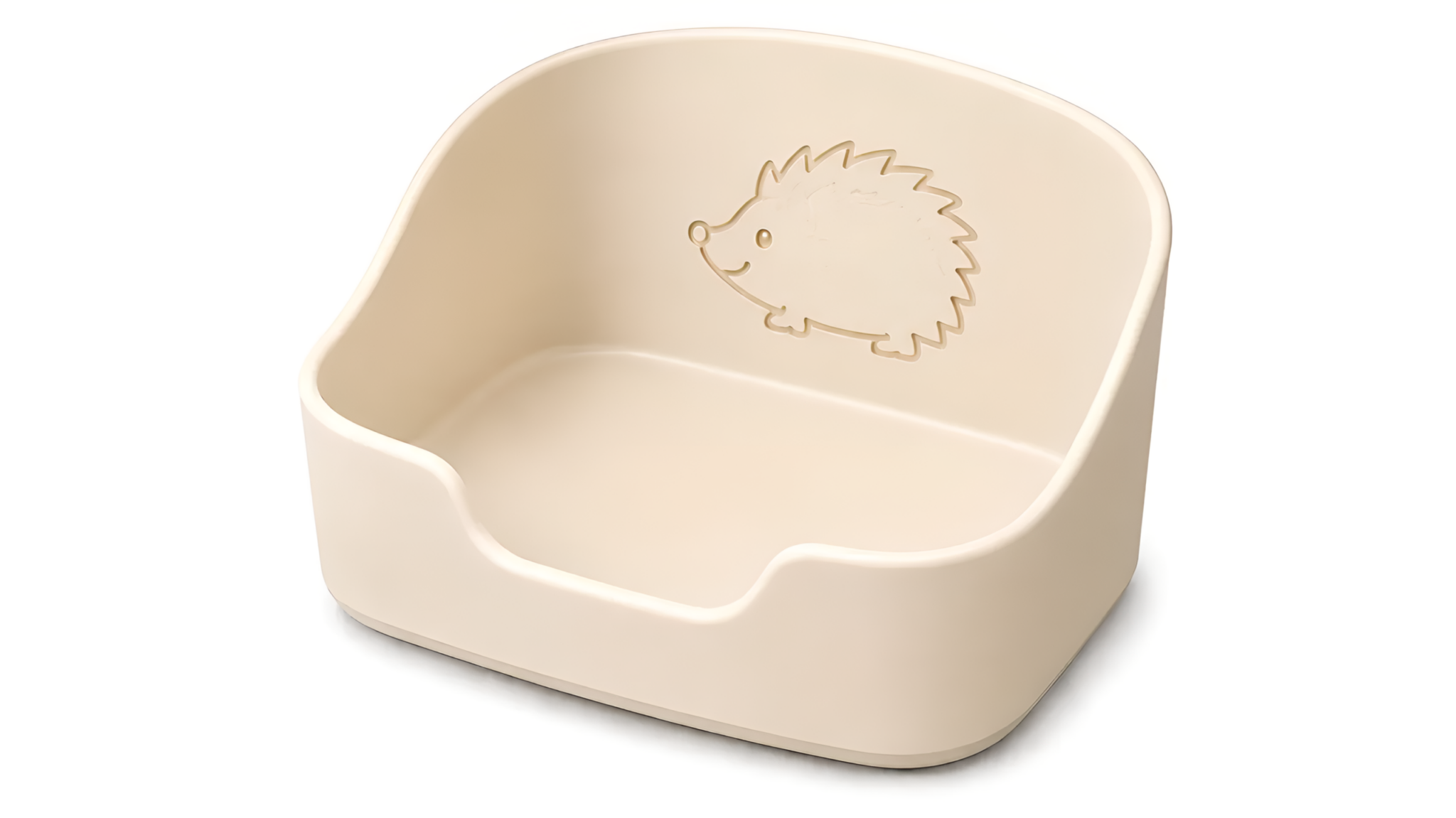
Low entry point. This is the single most important physical feature. A box with too high a rim at the entrance will simply be ignored, particularly as a hedgehog ages and mobility becomes a consideration. The front entry must be low enough for your hedgehog to step in comfortably without having to climb or jump. The sides and back can be higher — to contain litter and prevent splash-back — but the entrance itself needs to be close to cage floor level.
Large enough to step in and turn around. The litter pan should be large enough for the hedgehog to climb in and turn around. Hedgehogs strongly prefer to turn around rather than back out of enclosed spaces, and a box too small to allow turning will often be avoided. A footprint of at least 7 by 9 inches is the practical minimum for most adult hedgehogs.
Easy to clean. You’ll be rinsing this box daily or every couple of days. A smooth, non-porous plastic interior that wipes clean without residue or retained odour is what you want. Avoid rough surfaces that absorb waste.
Stays in place. A hedgehog that pushes the litter box around the cage during nightly activity is a hedgehog that won’t consistently use it. Options that hook to wire cage bars, or that are heavy enough to resist being moved, keep the setup consistent — which is what litter training depends on.
Right size for the cage. A corner litter pan takes up less floor space than a flat rectangular tray and works particularly well in wire cages where it can hook directly to the bars. A flat tray works better in bin cages or under the wheel, where corner attachment isn’t possible.
What Litter to Use — and What to Avoid
The litter inside the box matters as much as the box itself, and there are several products widely sold for small animals that are actively inappropriate for hedgehogs.
Clay litter of any kind — avoid completely. Both clumping and non-clumping clay litters are unsafe for hedgehogs. Clumping litter is the more immediately dangerous of the two — it can stick to a hedgehog’s quills, skin, feet, and in the case of male hedgehogs, get pulled up into the penile sheath where it causes serious injury and blockage. Clumping litter can cause blockage of poop and urine in male hedgehogs and be deadly if not removed. Non-clumping clay isn’t reliably safer — the fine particles can still stick and irritate, and the dust poses a respiratory risk. Skip all clay litters entirely.
Scented litters of any kind. Hedgehogs have a highly developed sense of smell and are easily put off by artificial fragrances. A scented litter box will often be ignored entirely, undoing all of your litter training work. Always choose unscented.
Wood shavings. Loose wood shavings — even aspen — are not ideal litter box material. They don’t allow you to distinguish soiled from clean substrate at a glance, scatter easily, and don’t perform as well for odour control in the confined space of a litter box as paper pellets do.
What works: Paper pellets — either small animal-specific or pelleted pine — are the most consistently recommended litter for hedgehog boxes by both the community and veterinary sources. PetMD specifically recommends paper-based litter and advises against clay or clumping litter. Paper pellets are large enough not to stick to sensitive areas, non-clumping, virtually dust-free, highly absorbent, and easy to spot-clean by scooping solids from the top while soaked pellets fall to the bottom. A thin to moderate layer — enough to cover the bottom of the box without being deep enough to destabilise — is all you need.
Placement: Where the Box Goes Determines Whether It Gets Used
Placement is where most litter training succeeds or fails. The most effective approach is simple: observe where your hedgehog already eliminates in the cage and place the box exactly there. Hedgehogs tend to choose a specific corner or area for elimination, and placing the litter box in that favoured spot removes the need for your hedgehog to learn a new location.
The box should be placed as far as possible from the food and water station — hedgehogs instinctively avoid eliminating where they eat, and keeping these areas separated works with that instinct rather than against it. Positioning the box near the wheel also makes practical sense, since many hedgehogs defecate while running and will naturally begin using a conveniently placed box nearby.
Once placed, don’t move it. Consistency in location is what reinforces litter box use. Moving the box — even slightly — can disrupt the habit entirely.
Our Top Hedgehog Litter Box Picks
Best Corner Litter Box: Kaytee Hi-Corner Litter Pan
The Kaytee Hi-Corner Litter Pan is the most widely recommended litter box in the hedgehog and small animal community, and it earns that position through a combination of practical design decisions that genuinely suit hedgehog use. The corner design maximises floor space efficiency — fitting neatly into the corner of a wire cage without taking up unnecessary footprint — while the elevated back corners prevent splash-back and keep litter contained inside the box rather than scattered across the cage floor. Built-in hooks attach directly to wire cage bars, keeping the box firmly in place even during active nightly use. The front entry is lower than the sides and back, allowing easy access, and the stain and odour-resistant plastic wipes clean quickly during daily spot-cleaning.
At 13.75 inches long, 9 inches wide, and 8 inches tall at the back with a lower front entry, it provides ample space for an adult hedgehog to enter and turn around comfortably — one of the key requirements Millermeade Farm’s Critter Connection specifically highlights for effective litter pan use. It’s widely available at pet stores and online, making replacements easy.
Best for: Wire cage setups where the built-in hooks can attach to the bars. Also works well in any cage with a true corner available.
Watch out for: The hooks are designed for wire cages — they don’t have a practical attachment point in bin cages or C&C setups with solid coroplast walls. Also confirm your cage has enough corner space to accommodate the footprint before ordering.
Best Flat Rectangular Pan: TEYOUYI Small Animal Litter Tray
For hedgehog setups where a corner pan either doesn’t fit or won’t stay in place — bin cages, C&C enclosures, or owners who want to place the box under or alongside the wheel — a flat rectangular tray is the more practical option. The TEYOUYI small animal litter tray comes in a 3-pack of different colours, measuring 13.8 by 10 inches with a 1.6-inch rim — a low profile that allows easy entry while still containing a reasonable litter layer. The smooth plastic surface wipes clean easily, the flat design sits stably on any surface, and the generous footprint accommodates most adult hedgehogs without crowding.
The shallow rim is both this tray’s strength and its limitation. Easy entry is exactly what a hedgehog needs, but the low sides mean litter can scatter more readily than in a higher-sided corner pan. Using a slightly thinner litter layer — just enough to cover the base — and placing the tray in a cage corner naturally addresses most of the scatter. The 3-pack also means you have replacements on hand when one needs a thorough clean.
Best for: Bin cages, C&C setups, or any configuration where a corner pan with hooks isn’t practical. Also useful placed directly under the wheel.
Watch out for: The low sides mean your hedgehog can push the tray around during the night. Placing it against two cage walls or weighting it with the wheel positioned over it helps keep it in place.
Best Paper Pellet Litter: Small Pet Select Premium Paper Pellet Litter
For litter, Small Pet Select’s premium paper pellet litter is among the most practical options currently available for hedgehog litter boxes. Made from recycled paper compressed into pellets, it’s non-clumping, 99% dust-free, and highly absorbent — ticking every safety requirement for hedgehog use. The pellet size is large enough not to cling to quills, skin, or sensitive areas, addressing the primary safety concern that makes clay and small-particle litters inappropriate. Liquid absorbs into the pellets and sinks to the bottom of the box, while solid waste sits on top where it can be scooped out daily — making spot-cleaning fast and genuinely effective. An unscented formula with no additives means no fragrance to put your hedgehog off using the box.
Used at a thin to moderate depth — one to two inches maximum — a bag lasts considerably longer than it appears it will, since you’re scooping solids daily and only fully replacing the litter every few days.
Best for: Any hedgehog litter box setup. The gold standard litter type for hedgehog use, consistently recommended by veterinary and owner communities alike.
Watch out for: Don’t fill the box too deeply. A thick layer of pellets is unstable underfoot and can discourage use. A thin, even layer that just covers the bottom of the tray is the practical target.
Best Budget Litter: Pelleted Pine Horse Bedding (Small Animal Use)
For owners who want the odour-neutralising performance of kiln-dried pine pellets at a fraction of the cost of small animal-branded litter, pelleted pine horse bedding — available at farm supply stores and increasingly online — is an established choice in the hedgehog community. Millermeade Farm’s Critter Connection recommends pelleted pine as among the best litter options for hedgehogs, specifically because the kiln-drying process removes the aromatic oils that make loose pine shavings hazardous, leaving behind dense, highly absorbent pellets that bond with ammonia from urine and neutralise odour at the source.
The key is confirming the product is 100% kiln-dried pine with no additives, binders, or chemical treatments — check the label carefully. Products sold at Tractor Supply and similar farm stores are often the most economical source and meet these requirements. The large pellet size means no sticking concerns, and the odour performance typically exceeds paper pellet options for hedgehog owners who find their cage smells quickly between changes.
Best for: Budget-conscious owners, or anyone who prioritises maximum odour control and has a farm supply store nearby.
Watch out for: Confirm the product is 100% kiln-dried pine with no additives before use. Some compressed wood pellets intended for wood stoves or heating contain binding agents that are not safe for animal use — stove pellets and horse bedding pellets are not interchangeable.
Maintenance: What the Daily Routine Actually Looks Like
Once the box is in place and in use, maintaining it is quick. Scoop or remove solid waste daily — this takes less than a minute and is the single most important maintenance step for keeping the box appealing to your hedgehog. Replace soiled pellets that have expanded with absorbed liquid every two to three days, or when the box begins to smell. A full litter replacement and tray wash with mild soap and warm water should happen at least weekly.
A box that smells strongly before you’ve even opened the cage is being changed too infrequently. A box that always looks clean and smells neutral is one your hedgehog will keep using.
Conclusion
A hedgehog litter box is a small investment that makes daily care significantly more manageable — but only if the box is the right size, in the right location, filled with the right litter, and kept consistently clean. Get those four things right and the litter box handles itself quietly in the background while you spend less time cleaning the cage and more time actually enjoying your hedgehog.
When you’re ready to complete your hedgehog’s setup, our best hedgehog products page has everything from litter boxes and bedding to cages, wheels, and heating — all in one place.