
Origin And Natural Habitat
Brazil and Uruguay define the confirmed range of Grammostola pulchra — specifically the grasslands and pampas along the border region of the two countries, where the open grass-covered terrain, forest edges, and the low, dense vegetation of the subtropical grassland biome provide the burrowing habitat this species exploits. Native to the border region between Brazil and Uruguay, these areas are dry and temperate with seasonal rainfall — not the hot tropical rainforest that many people associate with Brazilian wildlife, but the cool, seasonal pampas grassland that gives the care profile its temperate, low-humidity character.
A taxonomic note worth understanding before acquisition: many specimens are identified as G. pulchra while others are labelled Grammostola quirogai — G. pulchra being primarily from Brazil and G. quirogai from Uruguay, with both populations separated by a large river and nearly identical in appearance. The essential care and behaviour of both populations are consistent regardless of which side of the river the lineage originates from, and the hobby convention of calling both the Brazilian Black is practically acceptable even when the taxonomic status remains under discussion. The species also has a historical issue with hybridisation and misidentification with the similarly black G. alticeps — making provenance verification with the seller worth doing.
In the wild, G. pulchra lives in deep burrows under low vegetation and around rocks in the open grasslands — emerging at night to ambush prey near the burrow entrance in the manner characteristic of large South American terrestrials, and spending the majority of time underground in the thermal and moisture stability of its silk-lined burrow.
Scientific Classification
Grammostola pulchra Mello-Leitão, 1921 belongs to the genus Grammostola — the South American genus that includes the Chaco Golden Knee (G. pulchipes), Chilean Rose Hair (G. rosea), Brazilian Greysmoke (G. alticeps), Entre Rios Tarantula (G. iheringi), and Pink Zebra Beauty (E. campestratus) among other southern South American terrestrials. The World Spider Catalog and iNaturalist confirm G. pulchra Mello-Leitão, 1921 as the current valid name.
Species Overview
The Brazilian Black holds a position in the hobby that very few tarantulas achieve — sometimes referred to as the “Black Lab of Tarantulas”, a species that earns loyal following among both new and experienced keepers through a combination of extraordinary visual impact, legendary docility, and genuine hardiness. Renowed for its stunning, velvety black coloration that deepens with each molt — a progressive deepening of the black through successive moults until the settled adult’s coat achieves the matte-velvet quality that makes this species immediately recognisable and consistently spectacular. If you’re looking for a relaxed, low-maintenance tarantula with lasting appeal, the Brazilian Black is an excellent choice. The practical caveat — the only practical caveat — is the notoriously slow growth rate that makes the journey from sling to the full adult black coat a multi-year exercise in patience.
Appearance And Size
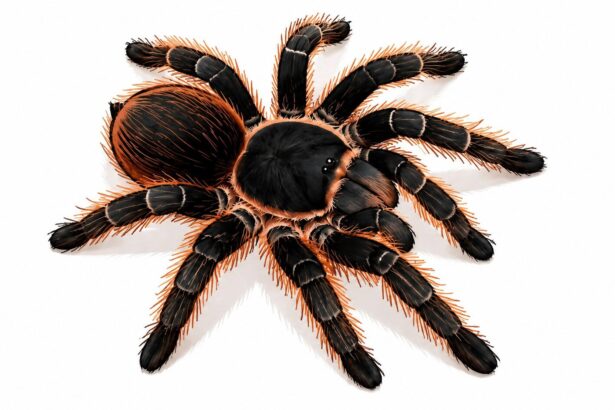
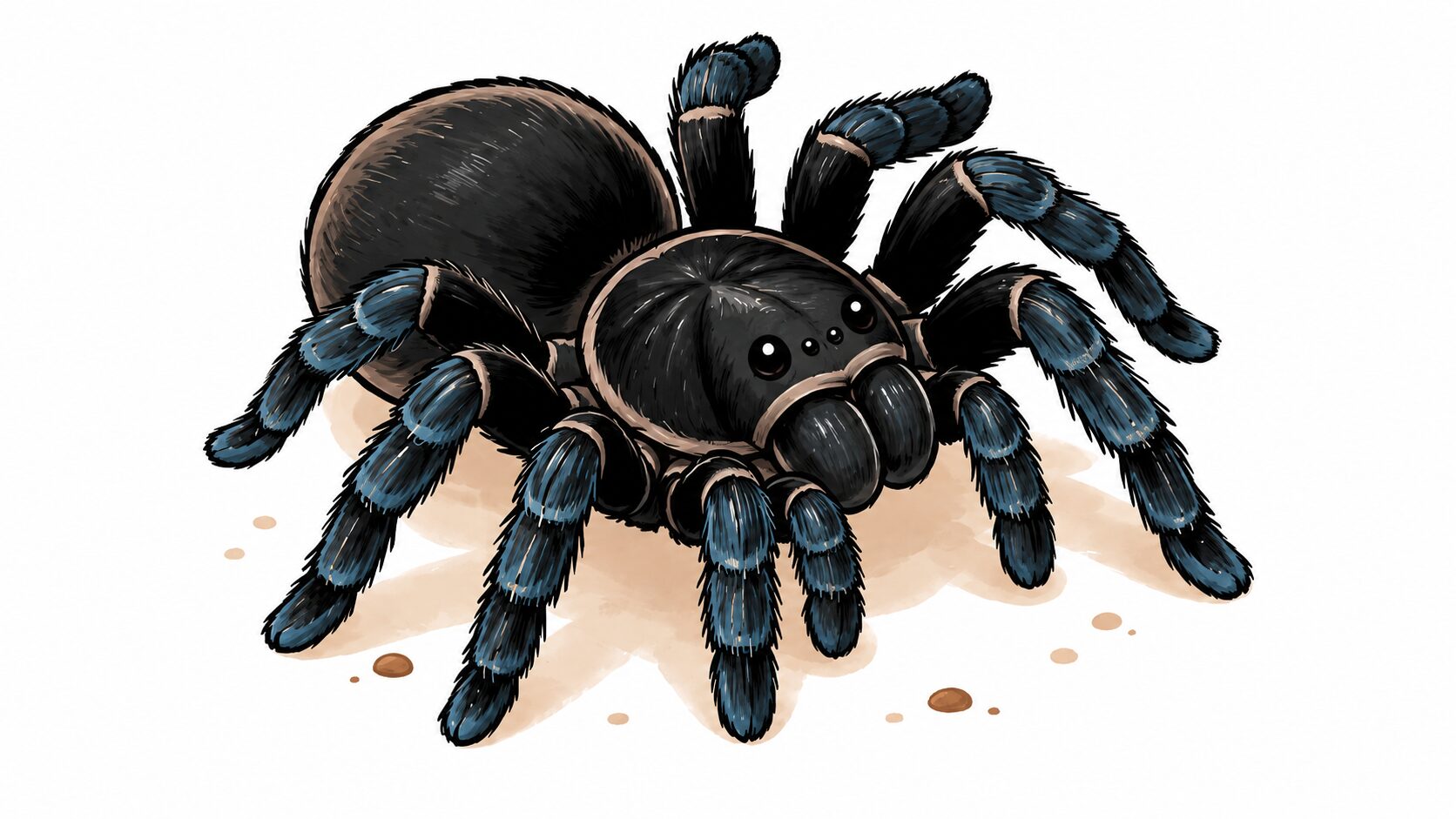
The adult colouration is the reason this species has the most loyal following of any tarantula in the hobby. Deep, velvety black coloration that is especially vibrant after a fresh molt — a quality of black that is matte rather than shiny, velvet rather than lacquered, and that deepens progressively through each successive moult in a developmental journey that makes every ecdysis a visual event. As juveniles, they often exhibit a brown or charcoal grey coloration that gradually transitions to a deep, rich black as they mature — the colour development being one of the most anticipated grow-out journeys in the hobby. Unlike many species, they retain their deep black sheen throughout their life — once the adult black is achieved, it persists through all subsequent moults without fading. The species gets its common name from its thick black coloration with a hint of blue — the subtle iridescence visible in good light that shifts the black toward a deep blue-black quality.
Adult legspan reaches 6 to 8 inches, with 6 to 7 inches being the most common adult size and exceptional individuals reaching 8 inches. Females can live 20 to 40 years — among the longest documented lifespans of any commonly kept tarantula. Males live 6 to 8 years. Growth rate is notoriously slow — can reach approximately 4 inches in the first year of life, slow after that under good feeding and warm conditions.
Housing
A terrestrial enclosure with floor space as the priority — this terrestrial species prefers more floor space than height, making a low and wide enclosure format appropriate. A 5-10 gallon tank is ideal for adults, with floor space of 25 by 30 centimetres or larger for females reaching 6 to 7 inches. Five to six inches of substrate allows meaningful burrowing, and a hide or starter burrow gives the spider immediate security. Height above substrate must be kept to twice the legspan maximum. A latching lid is standard. Our best tarantula enclosure guide covers terrestrial formats appropriate for large South American grassland terrestrial species, and our best tarantula sling enclosure covers the smaller formats needed through the slow juvenile phase.
Enclosure’s Decorations
Cork bark or a hide at one end with a pre-formed burrow beneath or alongside. A shallow water dish at the opposite end. The overflowed water dish approach — a cup of water overflowed every other week — provides appropriate substrate moisture cycling without maintaining chronic high humidity. Minimal additional decoration leaves the generous floor space accessible for a species that will use it as it settles into adult surface-retreating behaviour. Our best tarantula hide and best tarantula cork bark guides cover appropriate pieces for large South American grassland terrestrial species.
Substrate
Five to six inches of substrate — coconut fibre, peat moss, or topsoil give appropriate structure. The dry and temperate grassland habitat of the Brazil-Uruguay border region suggests moderate rather than high substrate moisture — a cup of water overflowed every other week provides the moisture cycling character of the pampas seasonal rainfall more accurately than maintaining consistently damp substrate. Our best tarantula substrate guide covers appropriate organic blends for dry temperate South American pampas grassland terrestrial species.
Water And Humidity
A shallow water dish at all times, refreshed every two to three days, combined with the overflowed dish approach for periodic substrate moisture. Humidity of 55 to 65 percent is appropriate — low to medium humidity with good ventilation, reflecting the dry, temperate grassland character of the natural habitat. This is lower humidity than most tropical species and should be treated as such. A hygrometer confirms actual conditions.
Heating And Temperature
The dry, temperate grasslands of the Brazil-Uruguay border region maintain seasonal temperature variation — warm summers, cooler winters. Temperature between 70 and 80°F (21 to 27°C) suits this species well — room temperature is often sufficient, making this one of the few large tarantulas that does not require supplemental heat in most temperate homes. A side-mounted heat mat controlled by a thermostat handles periods when ambient temperatures drop consistently below 68°F. A thermometer at substrate level confirms actual enclosure conditions.
Diet And Nutrition
Crickets, dubia roaches, and other appropriately sized invertebrates — an enthusiastic eater that readily accepts any prey item it can overpower. Adults once a week or once every other week. The slow growth rate means consistent feeding through the juvenile phase is the best strategy for achieving adult size in a reasonable timeframe. Extended pre-moult fasting is entirely normal. Remove uneaten prey within 24 hours. Our best tarantula food guide covers feeder options and sizing for large slow-growing temperate South American pampas terrestrial species.
Compatibility
Solitary only. Attempts at cohabitation can result in cannibalism. Captive breeding has become better established with the growing hobby demand, though the slow growth rate and long female maturation timeline make it logistically challenging. A well-fed female and supervised introduction are essential.
Behavior And Temperament
Docile yet skittish describes the temperament precisely — the remarkable docility of a settled adult combined with the flight-first defensive preference that makes juveniles bolt rather than stand and defend. Usually a species that is reluctant to flick urticating hairs and tolerates handling well — the reluctance to flick hairs is one of the most keeper-friendly qualities of the Brazilian Black specifically, and distinguishes it from species that kick at mild disturbance. They are relatively inactive compared to some other species, often sitting calmly in their enclosure — the slow, heavy-bodied, calm character that has earned the Black Lab comparison and made it the recommendation for nervous beginners around the world.
Handling
Tolerates handling well with its calm demeanour — considered one of the calmest tarantulas in the hobby and an excellent candidate for handling. Standard floor-level protocol with slow movements. The jet-black velvet coat at close range is genuinely breathtaking in a way that justifies the species’ reputation. Venom is medically insignificant to healthy humans as a New World species.
Health And Lifespan
Females live 20 to 40 years in documented captive records — among the longest lifespans of any commonly kept tarantula. Males live 6 to 8 years. The species is described as hardy and adaptable to a wide range of conditions. The slow growth rate means health monitoring through abdomen condition and moult regularity provides data across a development timeline that can stretch many years. Our tarantula dehydration article covers identification and recovery for dehydration concerns in slow-growing temperate South American grassland terrestrial species.
Price
The slow growth rate makes them rarer and more valuable in the pet trade — consistently one of the more expensive commonly available tarantulas. Fear Not Tarantulas and Josh’s Frogs are among vendors stocking this species. Slings typically sell for $50 to $100 USD. Juveniles range from $100 to $200. Confirmed large adult females command $200 to $400 or more depending on size and source. The price reflects genuine value — a 20 to 40 year companion animal with the most beautiful black coat in the hobby justifies the premium. Source captive-bred specimens only — poaching and wild collection remain documented concerns for this species, making responsible captive sourcing both legally and ethically essential. Everything needed to keep this most beloved of the Grammostola genus correctly across its extraordinary lifespan is on our best tarantula products page.