
Origin And History
The Romanian Mioritic Shepherd Dog, known in its native Romania as the Ciobănesc Românesc Mioritic — with ciobănesc meaning shepherd’s dog and mioritic deriving from the Romanian word mioară, meaning young sheep, making the breed name literally the Shepherd’s Dog of the Young Sheep — is a large, imposing, profusely long-coated, white or pale grey livestock guardian dog from the Carpathian Mountains of Romania, one of four recognized Romanian shepherd dog breeds alongside the Carpathian Shepherd Dog, the Bucovina Shepherd Dog, and the Romanian Raven Shepherd Dog — formerly known by its old name Barac before formal breed standardization distinguished the four types — a breed recognized by the FCI in 2002 and admitted to the AKC Foundation Stock Service in May 2018, a breed that features in Romanian folk legends and pastoral poetry as the emblematic guardian of the mountain shepherd’s existence, and a breed whose most specifically and the most personally legally unusual individual working requirement is the jujău — a stick or stave hung from a chain around the dog’s neck in front of the legs, required by Romanian law for all free-ranging working Mioritics, simultaneously identifying the dog as owned by a shepherd rather than feral, and discouraging it from pursuing wildlife by limiting its running capability while still allowing it to function as an effective livestock guardian — the most specifically legally mandated individual working equipment requirement of any breed in this series.
The breed’s origin is among the most consistently described as ancient of any Eastern European livestock guardian breed, though the precise dating is debated with the scholarly caution appropriate to any pre-documentary-record breed history. The Romanian Mioritic Shepherd Dog is believed to date back to the Roman era, and the most specifically compelling visual evidence for this antiquity comes from murals depicting battle scenes between the Romans and the Dacians — the indigenous people of the Carpathian region — which show large, burly, shaggy dogs specifically resembling the Mioritic accompanying the Dacian fighters. Some historians and breed enthusiasts make the specific and specifically ambitious claim that the breed’s ancestry can be traced to the dogs that defended against Roman invasions, though this places the breed’s history in the specific political context of the Dacian-Roman wars of the 1st and 2nd centuries CE.
Whether the Mioritic’s ancestry extends to the Dacian period or developed during the medieval centuries that followed, the breed evolved as a natural landrace selected by the Romanian shepherd communities of the Carpathian Mountains for the most specifically demanding individual working brief of any livestock guardian in this series: protecting flocks of sheep and cattle from the three major large predators that coexist with pastoral farming in the Carpathians — wolves, brown bears, and lynxes — while enduring the most extreme mountain weather conditions of any European livestock guardian breed’s home environment. Medieval kings likely kept these dogs in their armies, as they could defend against massive predators like bears and lynx, suggesting a dual military and pastoral application consistent with the large, powerful, courageous character that the breed developed.
The breed was developed from an existing natural breed that existed in the Carpathians, selected for its vigor and utility, and the selection process reflected the most practically demanding individual criteria: endurance in extreme cold, the courage to confront large predators, the size to physically deter or defeat a wolf or bear attack, and the temperament stability to remain effective guardians without becoming unmanageable through excessive aggression. The breed’s long-coated appearance — which led to the specific comparison with the Old English Sheepdog noted by international observers — reflects the specific climatic adaptation needed for year-round outdoor work in the Carpathians where winters are severe and the coat’s insulation is a survival requirement rather than an aesthetic choice.
The breed’s formal standardization is a relatively recent institutional process despite its ancient working heritage. The Romanian Kennel Club created the first official breed standard in 1981, establishing the specific physical requirements that distinguish the Mioritic from the three other Romanian shepherd breeds. The FCI recognized the breed internationally in 2002, classifying it in Group 1 (Sheepdogs and Cattle Dogs), Section 1 (Sheepdogs). The AKC added the breed to its Foundation Stock Service Program in May 2018 — the preparatory stage for breeds working toward full AKC recognition.
The Mioritic’s cultural embedded-ness in Romanian pastoral life is reflected in its appearance in Romanian folk legend, folklore songs, and the specific national poem Miorița — one of the most celebrated individual works of Romanian oral literature, a pastoral ballad about a lamb (mioară) that prophesizes its shepherd’s death, told by the same mioară that gives the breed its name — creating the most specifically intimate individual connection between a breed’s name and a national literary masterpiece of any breed in this series.
Breed Overview
| Trait | Details |
|---|---|
| Origin | Carpathian Mountains, Romania |
| Romanian Name | Ciobănesc Românesc Mioritic |
| Name Meaning | Ciobănesc = shepherd’s dog; Mioritic = of the young sheep (from mioară = young sheep) |
| Old Breed Name | Barac (before formal standardization) |
| One of Four Romanian Shepherd Breeds | With Carpathian Shepherd Dog; Bucovina Shepherd Dog; Romanian Raven Shepherd Dog |
| First Romanian Kennel Club Standard | 1981 |
| FCI Recognition | 2002 (Group 1, Section 1, Sheepdogs) |
| AKC Status | Foundation Stock Service (since May 2018) |
| Historical References | Dacian-Roman battle murals showing similar shaggy dogs; medieval army use reported |
| Folk Literature | Featured in Romanian legends and folk songs; name connected to the national poem Miorița |
| Legal Working Requirement | Jujău (stick hung from neck chain) required by Romanian law for all free-ranging working Mioritics |
| Predators Confronted | Wolves; brown bears; lynxes |
| Transhumance Role | Allows flocks to coexist with wolves, bears, and lynx during seasonal migrations |
| Cultural Status | Celebrated breed in Romanian pastoral heritage |
| Height | Males 70–75 cm minimum (28–30 inches) / Females 65–70 cm minimum (26–28 inches) |
| Weight | 55–70 kg (121–154 pounds); males up to 130 pounds |
| Body Proportion | Slightly longer than tall (11:10 ratio) |
| Lifespan | 12–14 years |
| Coat | Long (minimum 10 cm), harsh, straight; dense undercoat |
| Colors | White with or without pale grey or cream patches; pale grey or cream overall |
| Eyes | Hazel, dark brown, or light brown; calm, intelligent expression |
| Ears | V-shaped; somewhat rounded at tip; pendant |
| Tail | High-set |
| Discipline | One of the breed’s main characteristics per breed standard |
| Misconception | Often mistaken for Old English Sheepdog |
The Jujău: The World’s Most Legally Unusual Working Collar
Before discussing care, the Romanian Mioritic Shepherd Dog’s most specifically unusual and the most personally legally embedded individual working requirement deserves dedicated acknowledgment, because no other breed in this series is legally required to wear a specific piece of equipment under national law while performing its working function.
Working Mioritics are required by Romanian law to wear a jujău — a stick or stave hung from a chain around the neck in front of the legs — which serves two specific simultaneously practical purposes. First, the jujău identifies the dog as belonging to a shepherd rather than being a stray or feral animal, allowing law enforcement and wildlife authorities to distinguish owned working livestock guardian dogs from unowned dogs that might be more problematic in rural Romanian landscapes. Second, the jujău limits the dog’s running speed enough to discourage it from pursuing and hunting wildlife in the mountain forests and pastures — a specifically important conservation management tool in a country where the Carpathian wolf and brown bear populations are among the most significant in Europe, and where the Romanian government’s commitment to large predator conservation requires that livestock guardian dogs do not themselves become a threat to the predators they are employed to deter. This dual-function legal requirement is the most specifically elegant individual conservation management tool associated with any breed’s working use in this series.
The Four Romanian Shepherd Breeds
Because the Romanian Mioritic Shepherd Dog is most specifically understood in the context of its three sibling breeds — all developing in the Carpathian Mountains of Romania under broadly similar pastoral selection pressures — a brief orientation serves any reader encountering these breeds for the first time.
The Carpathian Shepherd Dog is the most closely related sibling — a shorter-coated, more wolf-like in coloring breed from the same mountain pastoral tradition. The Bucovina Shepherd Dog comes from Bucovina, the northeastern region of Romania, and is closely related to the Greek Shepherd, Tornjak, and Šarplaninac of the broader Balkan pastoral tradition. The Romanian Raven Shepherd Dog is the most specifically unusual of the four. The Mioritic is distinguished from the other three by the most immediately individually recognizable characteristic of any Romanian shepherd breed: the profuse, long, harsh, uniformly white or pale grey coat that most specifically resembles the sheep the breed was born to guard, and that provides the most complete thermal protection of any Romanian shepherd breed’s coat.
Appearance And Size
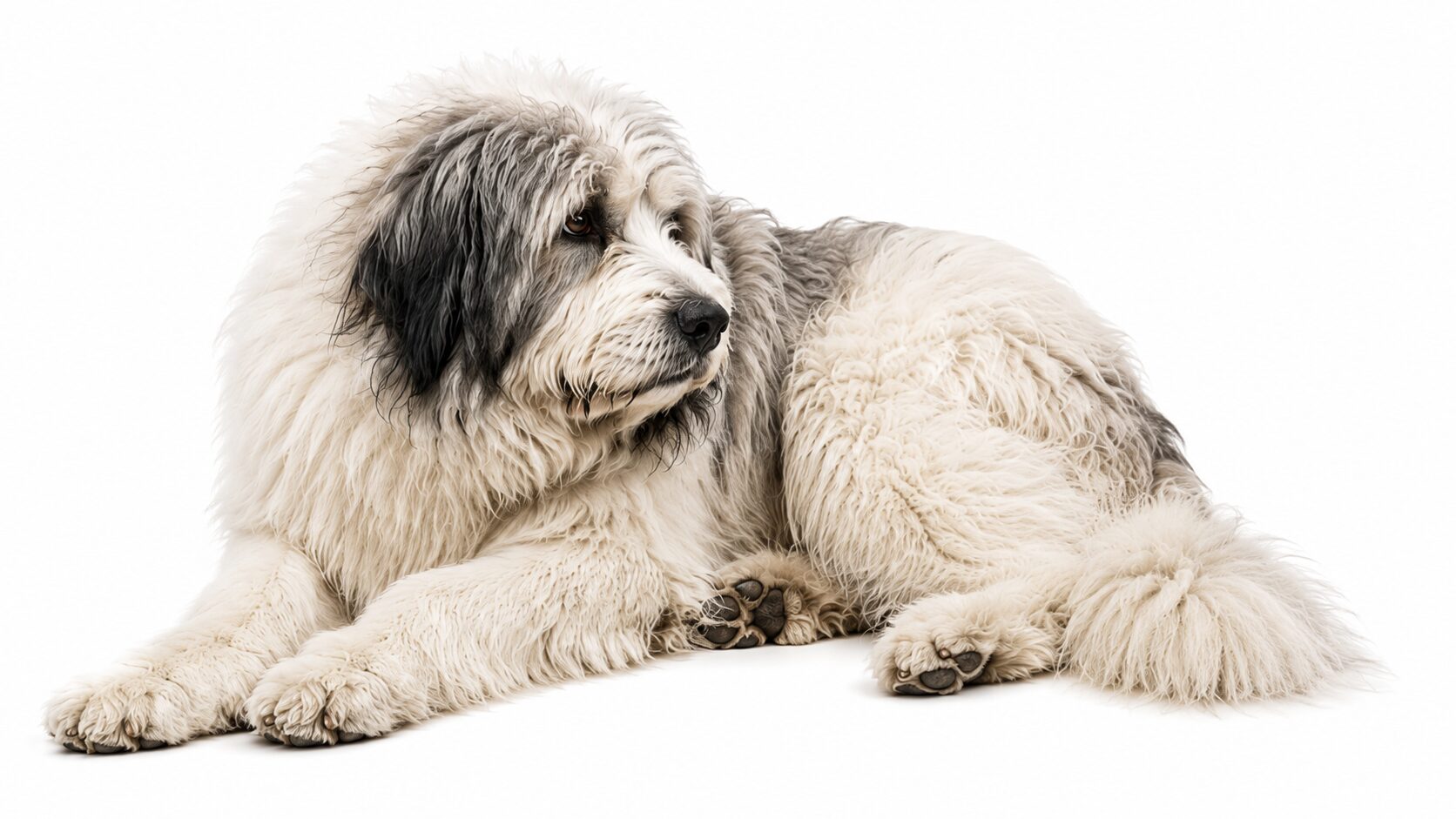
The Romanian Mioritic Shepherd Dog is a large to very large, powerfully built, and profusely coated livestock guardian that presents with the most immediately striking individual combination of the massive, shaggy white or pale grey coat and the calm, intelligent expression that together create the impression of a benevolent and deeply settled guardian rather than an aggressive or anxious one.
Males stand 70 to 75 centimeters or more and weigh 55 to 70 kilograms; females are somewhat smaller. The body is slightly longer than tall in the 11:10 proportion that provides balanced power for the sustained mountain terrain work the breed was developed for. The coat is long — a minimum of 10 centimeters at the midline — harsh, and straight with a dense undercoat, providing the thermal protection for Carpathian winters that working outdoors year-round specifically required. Colors are white with or without pale grey or cream patches, or pale grey or cream overall — the white coat that serves as camouflage among white-wooled sheep herds and that connects the breed visually to the broader family of white mountain livestock guardian breeds including the Great Pyrenees, Kuvász, Maremma Sheepdog, and Akbash.
Sexual dimorphism is significantly evident in this breed — males are meaningfully larger than females, a physical differentiation that reflects the predator confrontation demands that created specific selection pressure for maximum size in the male individuals who were the primary bear and wolf confronters.
Housing And Living Requirements
The Romanian Mioritic Shepherd Dog is among the most specifically and the most honestly rural-only in terms of appropriate housing context of any breed in this series — this is a giant working livestock guardian developed for mountain pasture life in the Carpathians, and no amount of breed adaptability extends this dog’s appropriate housing context to apartment or small-space urban living. These dogs require substantial outdoor space — rural properties with meaningful acreage or farm settings provide the most genuinely appropriate context for a breed this large with this guardian working heritage.
The profuse white coat provides extraordinary cold-weather tolerance — the Carpathian Mountain winters where this breed developed are among the most severe in Europe, and the coat is specifically adapted to those conditions. Heat management in warm climates is the most specifically important individual welfare consideration — the dense coat creates meaningful heat stress risk in warm conditions, and all outdoor activity must be managed with specific attention to temperature and shade availability.
Secure fencing of substantial height and substantial physical strength is a non-negotiable housing requirement for a breed this large with this guardian territorial instinct — not because these dogs are escape artists in the conventional sense, but because a 130-pound dog that decides to investigate a perceived threat beyond its perimeter will not be contained by inadequate fencing.
An orthopedic dog bed is specifically and urgently important for a breed this large given the significant joint disease risk that very heavy body weight creates. A comfortable dog bed in a social area suits the breed’s devoted family character.
Exercise Requirements
The Romanian Mioritic Shepherd Dog requires moderate daily exercise of 45 to 60 minutes appropriate to its large size — the livestock guardian’s working style involves sustained alertness and territorial patrol rather than high-intensity athletic output, producing a breed that is calm and settled indoors after exercise while remaining vigilant outdoors. Extended daily walks and free roaming in secured outdoor space provide the most appropriate exercise context.
The most critically important exercise management consideration is the growth period. Giant breed puppies whose skeletal development must not be rushed by high-impact activity require carefully controlled exercise through the first 18 to 24 months — the long-term orthopedic health investment of appropriate puppy exercise management is the most specifically meaningful individual lifetime health protection available for a breed this large.
Scent work and tracking activities engage the breed’s exceptional environmental awareness in purposeful organized sport. The breed’s most natural and most personally fulfilling individual activity is the free outdoor territorial patrol that its guardian nature makes constant and that its working heritage makes genuinely satisfying. Puzzle toys and enrichment activities provide cognitive engagement appropriate to a breed that historically made independent guardian decisions without handler supervision. A GPS tracker is a practical safety investment for outdoor exercise given the guardian breed’s tendency to expand its patrol range.
Grooming Requirements
The Romanian Mioritic Shepherd Dog’s long, harsh, dense double coat requires the most substantial and the most consistently maintained individual grooming investment of any Romanian shepherd breed — a coat specifically evolved for Carpathian Mountain winters requires significant regular attention to prevent the matting that develops in the long outer coat and the dense undercoat when brushing is inconsistent.
Thorough brushing two to three times weekly with a pin brush, slicker brush, and metal comb is the minimum appropriate maintenance. The coat areas most specifically prone to matting — behind the ears, in the leg feathering, and under the belly where friction and moisture are most concentrated — require the most specific and the most sustained individual brushing attention. The coat sheds moderately throughout the year with more substantial seasonal shedding periods.
Bathing a giant-breed dog with a coat this dense is among the most logistically challenging individual grooming events — professional grooming every six to eight weeks between home maintenance sessions is genuinely practical for most owners. Complete drying after bathing is specifically important — a partially dried Mioritic coat can develop moisture-related skin issues in the underdried portions nearest to the skin.
Dental care should be established as a consistent routine from puppyhood — the large jaw requires consistent dental hygiene. Ears should be checked and cleaned weekly given the pendant V-shaped ear conformation that reduces airflow. Nails should be trimmed regularly — the specific challenge of nail trimming in a 130-pound dog that does not wish to cooperate is most manageably addressed through consistent handling conditioning from puppyhood. Discussing joint supplements with your veterinarian from early adulthood is specifically warranted.
Diet And Nutrition
The Romanian Mioritic Shepherd Dog’s dietary management is directly proportional to its size — a 130-pound giant breed with the dense coat and working energy output of a mountain livestock guardian requires significantly more food than most large breeds, managed with the specific nutritional awareness that giant breed growth demands.
Giant breed puppy formulas that promote slow, steady growth are the most specifically appropriate dietary choice through the first 18 to 24 months. High-calorie puppy formulas that accelerate growth in giant breeds produce skeletal development that outpaces structural maturation, dramatically increasing the orthopedic disease risk that this breed’s large size already predisposes.
Most adults do well on two measured meals per day. The deep chest creates meaningful GDV risk — two smaller meals, slow-feeder bowls, and avoiding vigorous exercise for at least one hour before and after meals are permanent preventive practices. Training treats are effective motivators in training sessions and should be selected appropriately for a large breed.
Compatibility
The Romanian Mioritic Shepherd Dog is one of the most genuinely warmly family-integrated of any giant livestock guardian breed — the specific characterization as discipline and devotion to family is central to the breed’s character — combined with the specifically guardian-appropriate wariness of strangers that the livestock guardian’s protective role constitutionally produces.
With its own established family, the breed is completely devoted. These loyal pups are devoted to their family members and like to spend time surrounded by their pack — a pack-bonding quality that reflects the working shepherd’s integration of dog and family into a single social unit. With children, the breed is consistently protective and gentle — Mioritics love children very much is the most specifically personal individual statement about any breed in this breed’s information resources.
With strangers, the breed is characteristically and specifically wary — suspicious with strangers in the most directly documented individual breed characterization, reflecting the guardian tradition of a breed that must independently assess whether an approaching person represents a threat to the flock and the shepherd. Early socialization from puppyhood is the most critically important behavioral investment for managing this wariness in domestic settings with regular visitor contact. With other dogs, the breed is typically accepting within the established pack but may be dominant with unfamiliar individuals. A dog crate is a useful management tool during puppyhood.
Behavior And Temperament
The Romanian Mioritic Shepherd Dog is vivid and balanced; alert and vigilant, disciplined and very attached to its owner, but suspicious with strangers. Fearless and very courageous, it is the perfect protector of its owner and the herds — the most concisely and the most personally accurate individual characterization of the breed’s behavioral truth, and one whose inclusion of discipline as a central characteristic reflects the breed’s most specifically and the most commonly noted individual working quality: the ability to respond to guardian threats with decisive courage without becoming uncontrollably aggressive, to return to calm behavioral equilibrium once the threat is resolved, and to distinguish between the genuine predator confrontation that requires maximum response and the routine environmental stimulus that requires simple vigilance.
Discipline is one of the breed’s main characteristics. This specific standard language captures the Mioritic’s most practically valuable individual domestic behavioral quality — an extremely large, extremely powerful guardian dog that can fight off a bear but exercises this capability only when genuinely required, that remains settled and calm in the home environment, and that can distinguish genuine from perceived threats, is the most specifically complete expression of the livestock guardian’s ideal behavioral profile. The breed obeys its owner with calm and discipline — not the eager-to-please obedience of a sporting or herding breed but the settled cooperation of a dog that has already decided to accept its owner’s authority.
Training And Handling
The Romanian Mioritic Shepherd Dog requires the most experienced, the most patient, and the most specifically confident handling of any giant livestock guardian breed — not because the breed is aggressive or difficult by nature, but because a 130-pound dog with the independent guardian intelligence of a breed that has always made its own predator confrontation decisions will not be effectively managed by handlers who lack the consistent confident leadership that the breed genuinely respects.
The objective in training this dog is to achieve pack leader status — a characterization from experienced breed owners that reflects the most critically important individual training foundation for any Mioritic owner. Early socialization and consistent training are critical. The breed is vivid and balanced in temperament, making it relatively trainable for an experienced owner who understands livestock guardian breed psychology.
Positive reinforcement methods are the most effective approach. Training treats are effective motivators in patient, consistent, genuinely engaging sessions. The breed is not recommended for first-time dog owners — the combination of giant size, independent guardian intelligence, and the confident dominant character of a predator-confronting mountain dog requires specifically experienced handling throughout the dog’s life.
Health And Lifespan
The Romanian Mioritic Shepherd Dog has a lifespan of 12 to 14 years — remarkably long for a breed of this size and reflecting the constitutional soundness maintained through centuries of natural selection in the demanding Carpathian Mountain working environment. Several conditions warrant awareness.
Hip and Elbow Dysplasia Hip dysplasia and other joint issues are the most consistently documented health concerns due to the breed’s significant size. OFA hip and elbow evaluation of breeding animals is non-negotiable. Giant breed puppy nutrition management from the earliest weeks and lean body condition maintenance throughout adult life are the most practically meaningful protective investments.
Bloat (Gastric Dilatation-Volvulus) The deep chest creates very significant GDV risk. Two smaller meals daily, slow-feeder bowls, and avoiding vigorous activity for at least one hour before and after meals are permanent preventive practices. Prophylactic gastropexy surgery should be discussed with your veterinarian.
Skin Conditions The dense, long coat creates conditions where moisture, debris, and parasites can accumulate against the skin. Regular thorough brushing, complete drying after bathing, and weekly skin inspection are the most consistently important preventive practices.
General Robustness The breed’s centuries of natural selection in challenging mountain conditions maintained a constitutionally sound baseline. Routine preventive care including regular vet checks, OFA hip and elbow evaluation for breeding animals, consistent dental hygiene, up-to-date vaccinations appropriate for an active outdoor breed in the tick-rich environment of the Carpathian Mountains, year-round tick and parasite prevention, and regular grooming skin inspections provides the foundation for a healthy Romanian Mioritic Shepherd Dog.
Price And Availability
The Romanian Mioritic Shepherd Dog is rare outside Romania, where it remains a working livestock guardian in mountain pastoral communities and an increasingly popular companion and estate guardian in Romanian cities. In Western Europe, a small community of breed enthusiasts — particularly in France and Germany — maintain breeding programs. In the United States, the breed is extremely rare outside the small community working toward AKC recognition through the Foundation Stock Service. Finding a well-bred Mioritic in North America requires direct engagement with the breed’s Foundation Stock Service community.
Conclusion
The Romanian Mioritic Shepherd Dog has guarded sheep and cattle from wolves, brown bears, and lynxes in the Carpathian Mountains of Romania for centuries, possibly since the Dacian-Roman era when battle murals show shaggy dogs resembling the modern breed alongside Dacian warriors, developed from a natural Carpathian landrace selected for vigor and utility by Romanian shepherd communities, was formerly known as the Barac before formal standardization established it as one of four recognized Romanian shepherd breeds, features in Romanian folk legends and pastoral songs and takes its name from the word mioară connecting it to the most celebrated Romanian folk poem Miorița, requires its working individuals to wear a jujău — a legally mandated stick hung from the neck — to identify them as shepherd’s dogs and discourage wildlife hunting under Romanian conservation law, had its first breed standard created by the Romanian Kennel Club in 1981, received FCI international recognition in Group 1 Section 1 in 2002, was admitted to the AKC Foundation Stock Service in May 2018, has discipline listed as one of the breed’s main individual characteristics in the breed standard, is described as an incorruptible guard that loves children very much while being suspicious of strangers, and stands today as the most specifically jujău-legally-required-working-neck-stick, the most specifically Dacian-Roman-battle-mural-ancient-ancestor, the most specifically miorița-folk-poem-name-connected, the most specifically one-of-four-Romanian-shepherd-breeds, the most specifically wolves-bears-and-lynxes-specifically-all-three, the most specifically 12-to-14-year-lifespan-giant-breed-longevity, and the most specifically discipline-as-main-characteristic-in-standard of all the Eastern European livestock guardian breed partnerships available. Get properly set up before bringing one home. Our Best Dog Products page has everything you need for long-harsh-white-or-pale-grey-coated, V-shaped-pendant-eared, calm-intelligent-eyed, disciplined-yet-devoted, whole-heartedly devoted Carpathian Mountain livestock guardian dogs that carry the full heritage of the Dacian-era shaggy dogs, the medieval Romanian shepherd pastoral tradition, the jujău legal conservation tool, the mioară young sheep folk poem name connection, the 1981 Romanian Kennel Club standard, the 2002 FCI recognition, the 2018 AKC Foundation Stock Service admission, and the specific vivid-and-balanced, alert-and-vigilant, disciplined-and-attached-to-owner, suspicious-of-strangers-but-loves-children-very-much, incorruptible-guard, bear-and-wolf-and-lynx-confronting intelligence of the most profusely coated and the most legally work-equipped guardian that the Carpathian Mountains ever produced.