
Origin And History
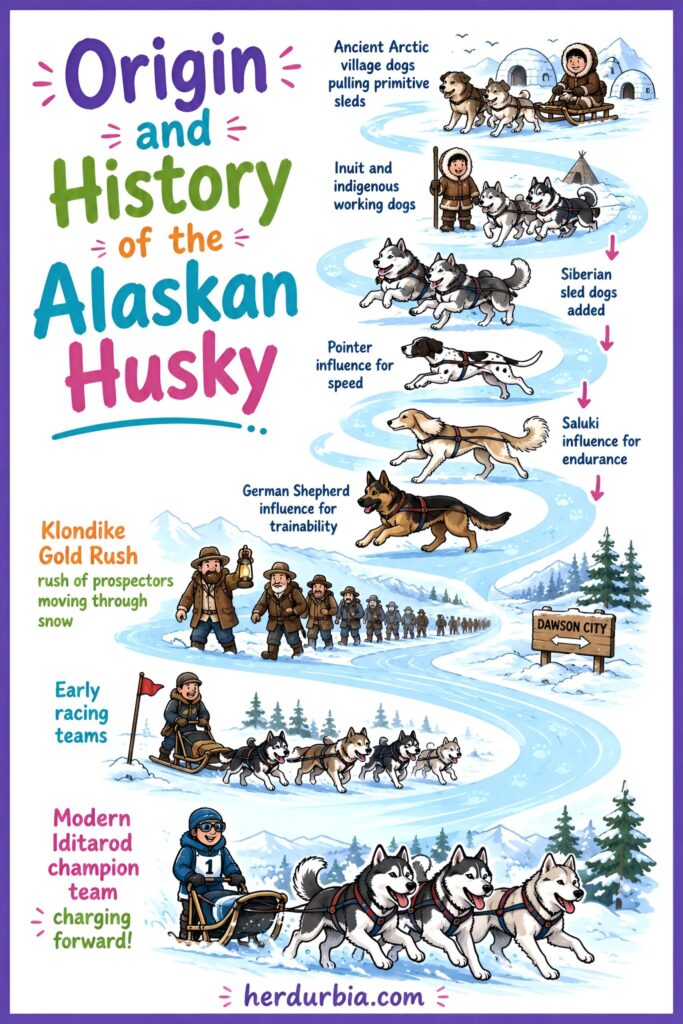
The Alaskan Husky does not fit neatly into the category of a breed, and understanding that distinction is the first step to understanding the dog. It is not a breed in the conventional sense of the word. It is a type, a purpose-built working animal defined entirely by what it can do rather than by how it looks, and it is not recognized by the AKC, the FCI, or any major kennel club. What it is, beyond any technical classification debate, is the most successful sled dog ever developed and the dominant competitor in virtually every serious sled dog race on earth.
The roots of the Alaskan Husky stretch back thousands of years into the indigenous working dogs of Alaska and the broader Arctic. The Inuit and interior village dogs of pre-colonial North America were the foundation stock, powerful and endurance-capable animals that had been shaped by the demands of Arctic survival over generations. When European traders and settlers arrived in Alaska, they encountered these dogs and recognized their utility, and they also recognized that those dogs, while strong and durable, lacked the speed that competitive use and increasingly demanding transportation needs required.
The crossbreeding that followed was pragmatic and performance-driven. Genetic studies confirm that the Alaskan Husky’s lineage includes pre-colonial North American Arctic village dogs, Siberian imports that were precursors to the modern Siberian Husky, and European breeds including Pointers, German Shepherd Dogs, and Salukis, all introduced to improve specific performance characteristics. The Pointer and Saluki crosses brought speed. The Siberian Husky crosses brought cold tolerance and endurance. The German Shepherd crosses brought trainability and drive. The result was a dog that combined qualities no single purebred line could offer.
The Klondike Gold Rush of the late 1800s and early 1900s accelerated the development of the Alaskan Husky dramatically. With an estimated 100,000 prospectors flooding into western Canada and Alaska, the demand for capable sled dogs to transport people and supplies across frozen terrain was enormous and urgent. Mushers assembled teams from whatever working dogs performed best, and performance rather than pedigree became the only currency that mattered. That principle has defined the Alaskan Husky ever since.
Today the Alaskan Husky is the dog that dominates the Iditarod Trail Sled Dog Race and the Yukon Quest, the two most demanding long-distance sled dog races in the world. It is bred in two primary lines: sprint dogs, which are leaner, shorter-coated, and optimized for speed over shorter distances, and distance dogs, which carry a heavier coat and are built for sustained endurance across hundreds of miles of Alaskan wilderness. Both lines share the same fundamental qualities of exceptional drive, trainability, and an enthusiasm for running that is unlike almost anything in the domestic dog world.
Breed Overview
| Trait | Details |
|---|---|
| Breed Group | Working / Sled Dog Type |
| Height | 20–26 inches |
| Weight | 35–75 pounds |
| Lifespan | 10–15 years |
| Coat | Double coat, short to medium length |
| Colors | Any color or pattern |
| Temperament | Energetic, intelligent, friendly, driven, hardworking |
| Recognition | Not recognized by any major kennel club |
Appearance And Size
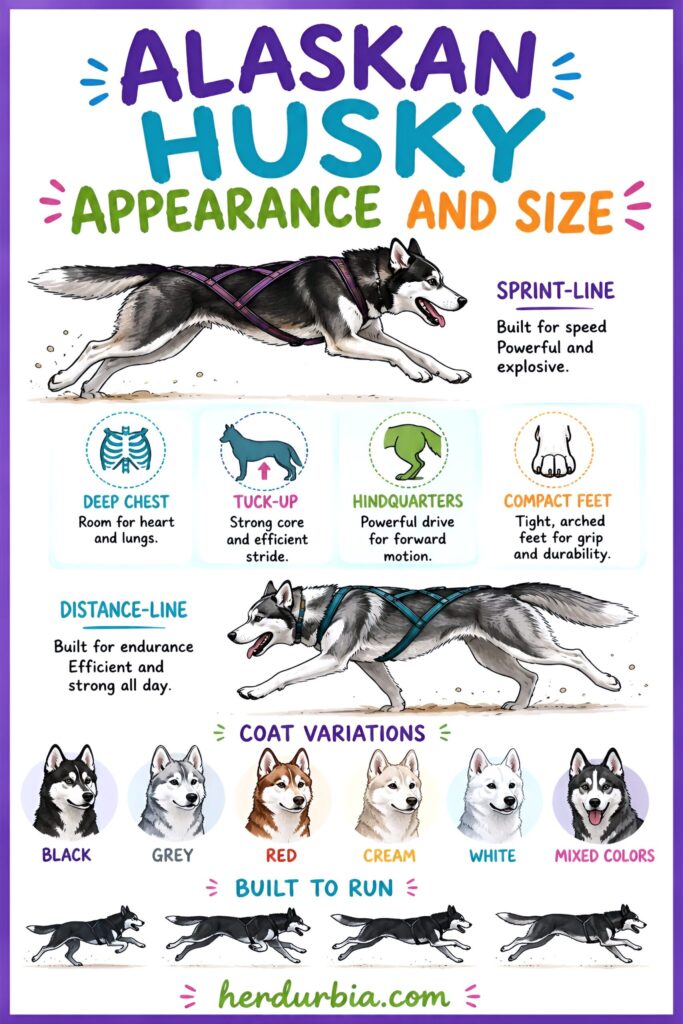
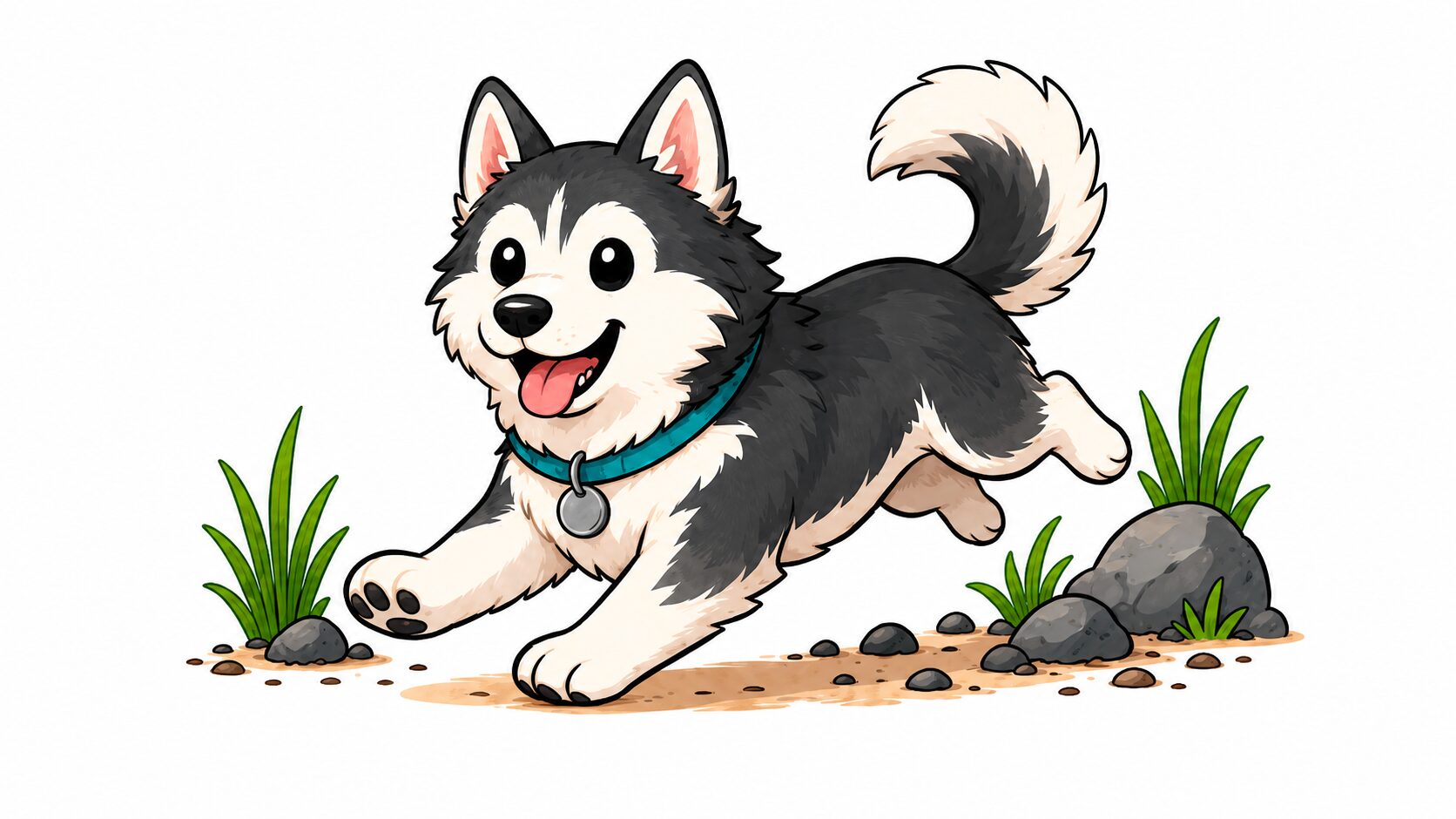
Because the Alaskan Husky is defined by performance rather than appearance, there is considerably more physical variation within this type than within any recognized breed. Height ranges from 20 to 26 inches at the shoulder, and weight runs from 35 to 75 pounds depending on whether the individual dog comes from sprint lines or distance lines and what specific crosses have gone into its lineage. Males tend to be larger and heavier than females, but even within the same litter, the size variation can be significant.
The coat is perhaps the most variable aspect of the Alaskan Husky’s appearance. Sprint dogs typically carry shorter, thinner coats that allow them to shed heat more efficiently during high-intensity effort over shorter distances. Distance dogs carry longer, denser coats with a thicker undercoat designed to protect them across multi-day races in temperatures that can drop to extreme lows. Both coat types are double-coated, with a water-resistant outer layer and an insulating undercoat. The color and pattern of the coat can be absolutely anything, which is one of the more immediately striking things about encountering a group of Alaskan Huskies together. Black, grey, red, cream, white, and every combination and pattern in between is present in the type.
The body build reflects athletic function clearly. Alaskan Huskies are lean and muscular, with a deep chest, a pronounced tuck-up behind the ribcage, and long, powerful hindquarters built for sustained forward drive. The feet are tough and compact with well-arched toes designed for grip and durability on frozen terrain. The overall impression is of an athlete in its working prime, and the ease and fluidity of the Alaskan Husky’s movement at all gaits reflects a dog that was designed from the ground up to cover miles of difficult terrain efficiently and without tiring.
Housing And Living Requirements
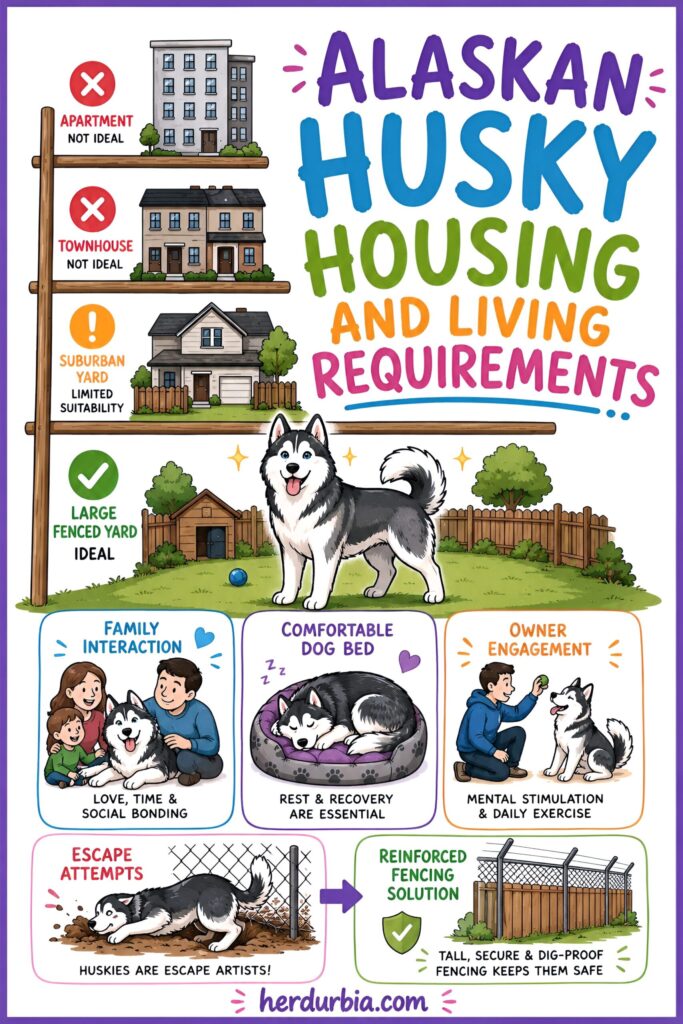
The Alaskan Husky is an athletic working dog with energy levels that do not have an obvious domestic equivalent, and its housing requirements reflect that honestly. A home with a large, securely fenced yard is the practical minimum for a dog of this drive and this capacity for sustained physical activity. Rural environments where the dog has room to move and access to outdoor space throughout the day suit it considerably better than urban or suburban settings where exercise must be scheduled and contained.
The fence is not optional and not a formality. The Alaskan Husky has a powerful drive to run, and a dog that finds an opportunity to pursue that instinct through an inadequate fence will do exactly that, without hesitation and without a reliable sense of traffic or other hazards. Tall, solid fencing is the practical requirement, and the fence should be regularly inspected for integrity.
Inside the home, an Alaskan Husky whose exercise needs are genuinely met is notably calm and manageable. This is a dog that transitions from extraordinary athletic output to genuine rest with an efficiency that working dogs develop over generations of hard use. The problem is getting it to that point of genuine tiredness in the first place. A large, comfortable dog bed in a position where the dog can observe household activity suits the breed’s alert, engaged nature.
The Alaskan Husky does not handle isolation well. It is a working dog that was bred for sustained social engagement with a mushing team and a handler, and removing that social context consistently produces a dog that expresses its frustration through destructive behavior, escape attempts, and vocal complaints that neighbors rarely appreciate. This breed needs people, activity, and purpose.
The thick double coat means the Alaskan Husky handles cold extremely well and manages heat considerably less comfortably. In warmer climates, exercise should be scheduled for early morning or evening when temperatures are lower, and access to shade and fresh water at all times is essential during any warm weather period.
Exercise Requirements
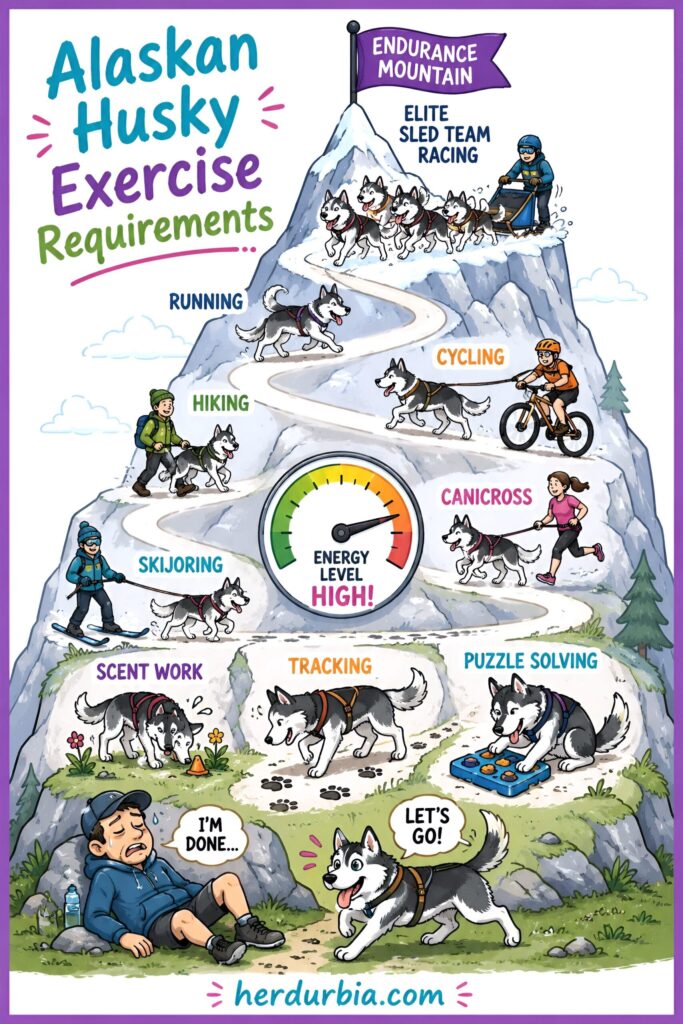
There is no equivalent in the domestic dog world to the Alaskan Husky’s exercise requirement, and any prospective owner should understand that before committing. A competitive sled dog in active training can cover 100 miles in a day. The domestic Alaskan Husky is not working at that level, but it carries the same genetics and the same drive, and it needs significantly more exercise than almost any other breed to stay physically and mentally settled.
A minimum of two hours of vigorous daily exercise is the baseline for an Alaskan Husky kept as a companion. One hour is not enough. Two short walks and a garden session is not enough. This breed needs to run, to cover ground, and to use its body at genuine speed on a daily basis. Running alongside a bicycle, hiking over varied terrain, skijoring in winter, and organized canicross are all appropriate and well-suited activities. Dog agility equipment can supplement structured exercise, giving the dog a physical and mental challenge in a controlled environment.
Mental stimulation is as important as physical exercise for a breed this intelligent. Scent work, tracking, and problem-solving activities engage the Alaskan Husky’s considerable intelligence and provide the kind of mental tiredness that physical exercise alone cannot fully replicate. An Alaskan Husky that is physically exercised but mentally bored will still be difficult to manage indoors.
The ideal owner for this breed is someone who runs, hikes, cycles, or participates in winter dog sports and who is prepared to bring their dog into those activities as a partner rather than an afterthought. Without that level of commitment, the Alaskan Husky’s enormous energy surplus will find expression in ways that are rarely convenient or welcome.
Grooming Requirements
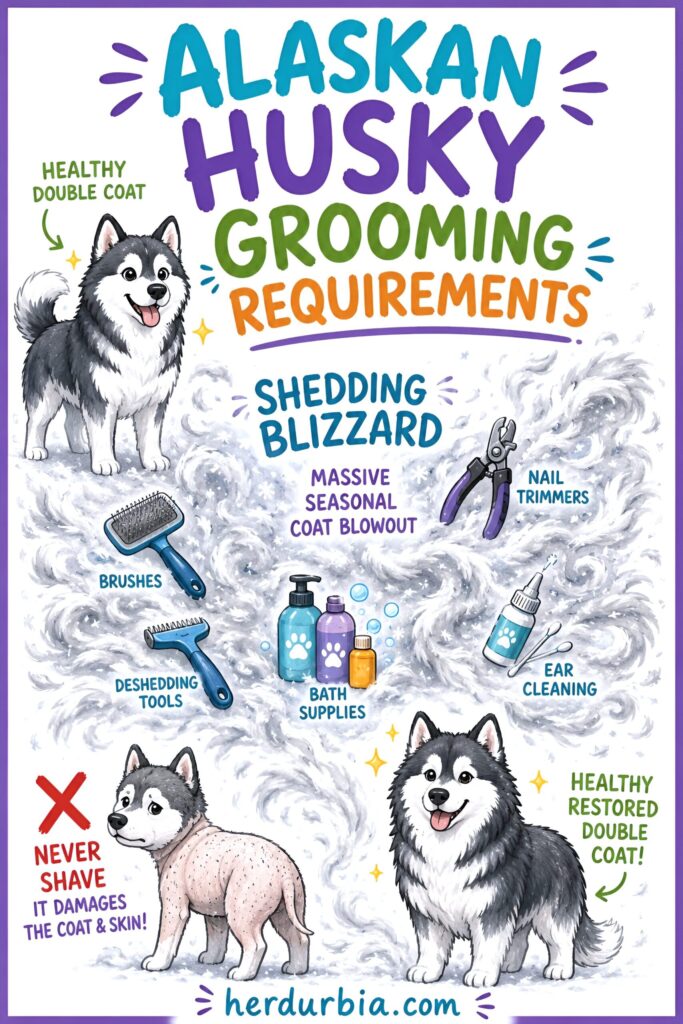
The Alaskan Husky’s double coat is a practical working coat designed for performance, and its grooming needs are manageable but consistent. Brushing once or twice a week under normal conditions removes loose hair, prevents matting, and keeps the coat functioning as the insulating and weather-resistant system it was designed to be. During the two heavy seasonal shedding periods in spring and fall, daily brushing becomes necessary to stay ahead of the volume of undercoat being released. These shedding seasons are significant, and owners should have realistic expectations about the amount of hair involved.
The double coat should never be shaved. The undercoat is not just insulation against cold. It also provides protection from sun and heat, and removing it disrupts the coat’s ability to regulate body temperature in either direction. This is a documented and important point for owners in warmer climates who may be tempted to shave a heavily-coated dog for summer comfort.
Bathing every six to eight weeks is appropriate under normal circumstances, more frequently if the dog has been working in wet or muddy conditions. The thick undercoat holds moisture and takes considerable time to dry fully, so thorough drying after every bath is important to prevent skin issues from developing underneath.
Standard maintenance rounds out the routine. Nails should be trimmed monthly, and this is particularly important for working dogs whose foot health is critical to their performance. Ears should be checked and cleaned weekly. Dental care should be established early as a consistent habit, since dental disease is among the most common preventable health problems in adult dogs regardless of breed.
Diet And Nutrition
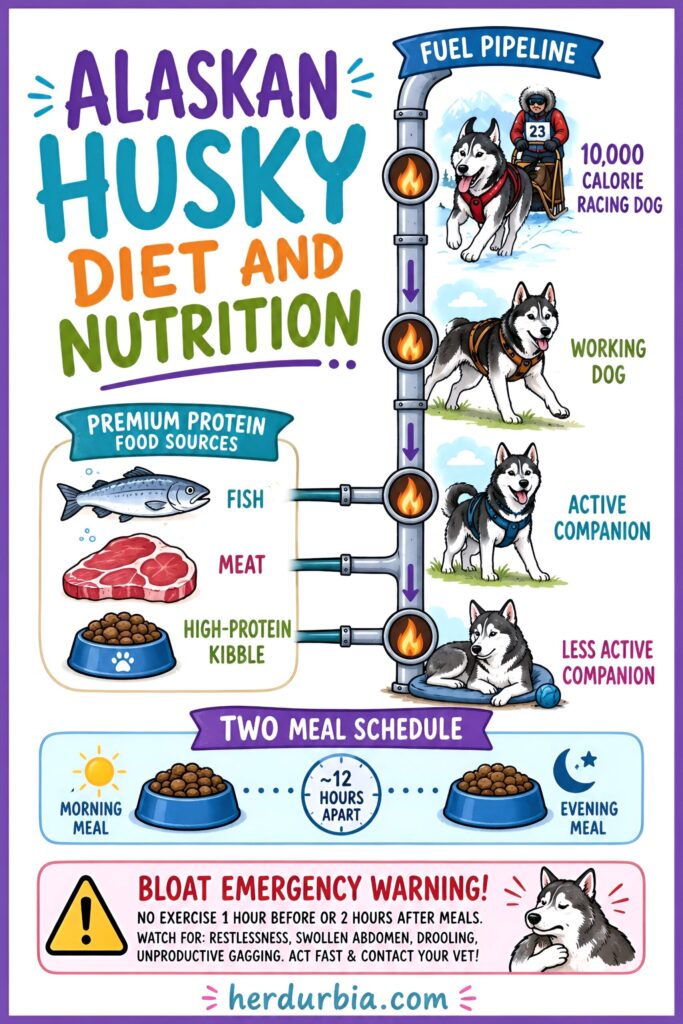
Feeding an Alaskan Husky correctly requires more attention to context and activity level than feeding most other breeds, because the difference in caloric requirement between a working sled dog in active competition and a companion dog with standard exercise is genuinely enormous. A competitive Alaskan Husky racing the Iditarod can require upwards of 10,000 calories per day, typically fed a high-fat, high-protein performance diet including raw meat, fish, and fat during the racing season. A companion dog on a standard active-owner exercise program requires nothing close to that, but still needs a high-quality active-breed formula with real protein as the first ingredient to support its lean, muscular build and high daily energy output.
Most adult Alaskan Huskies kept as companions do well on two measured meals per day. Portion control matters and should be calibrated to actual activity levels rather than to a fixed daily amount. A dog that is exercising two hours daily in winter needs more food than the same dog in a quieter summer period, and adjusting portions seasonally is worth the attention.
The deep chest of the Alaskan Husky creates susceptibility to gastric dilatation-volvulus, the life-threatening stomach twist that requires emergency surgery. Feeding two smaller meals rather than one large serving, avoiding vigorous exercise for at least an hour before and after eating, and using a slow-feeder bowl to reduce eating speed are all practical preventive measures. Learn the warning signs, which include unproductive retching, a visibly distended abdomen, and restlessness after eating, and treat any suspicion as an immediate veterinary emergency.
Training treats are effective motivators during sessions but should be counted into the daily calorie total, particularly during periods of lower activity when caloric balance matters more.
Compatibility
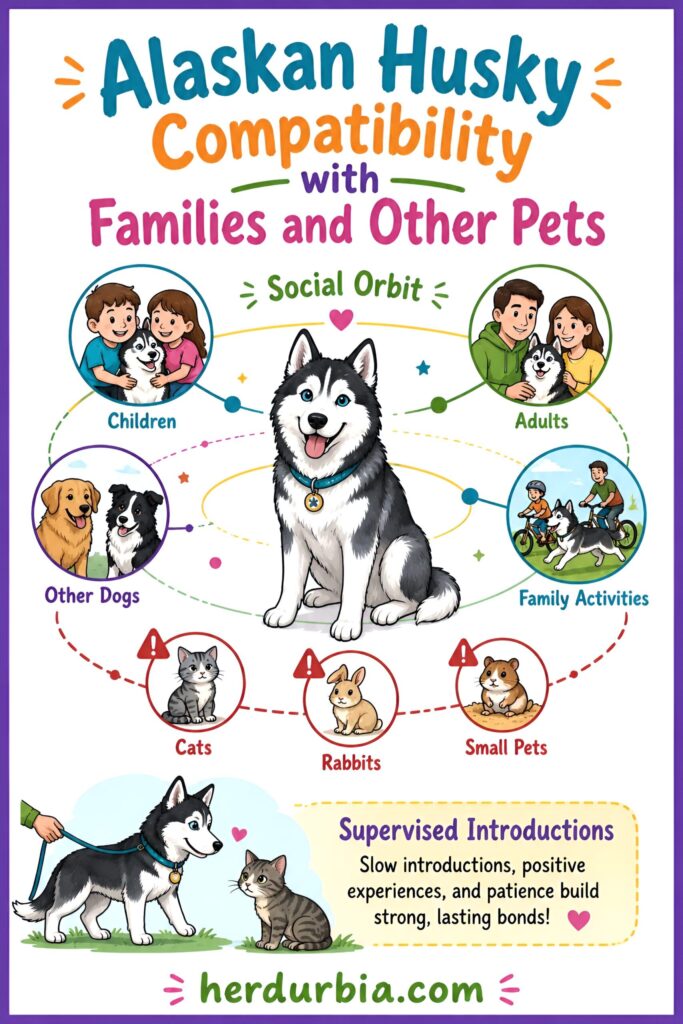
The Alaskan Husky is a genuinely friendly and social breed that extends warmth to most people it encounters, which reflects its heritage as a working dog that spent its life in close contact with handlers, other dogs, and the rotating cast of people that mushing communities involve. It does not have the guarded wariness of guardian breeds or the aloofness of more independent working dogs. Most Alaskan Huskies are openly friendly with strangers once introduced, which makes them poor guard dogs but excellent companions for households with active social lives.
With children, the breed is typically patient and playful, with the kind of energy level that suits older, active children very well. The sheer physical enthusiasm of an Alaskan Husky in full play mode can overwhelm very young children, and interactions with toddlers should be supervised simply because of the dog’s size and exuberance rather than any aggressive tendency.
With other dogs, the Alaskan Husky is generally excellent. It spent its entire developmental history working in teams of multiple dogs under demanding conditions, and that sociability with other dogs is deeply ingrained. Multi-dog households are often a practical asset with this breed rather than a complication, since two or more Alaskan Huskies can exercise together and provide each other with the social engagement the breed craves.
With small animals, the prey drive that comes with sporting and sighthound ancestry in the bloodlines means caution and supervised introductions are warranted. Many Alaskan Huskies coexist with cats when raised alongside them from puppyhood, but this should not be assumed.
A dog crate is a genuinely useful management tool for puppies and newly arrived dogs, providing a secure space for the dog when unsupervised and preventing the destructive behavior that an under-exercised, under-stimulated Alaskan Husky puppy is entirely capable of.
Behavior And Temperament
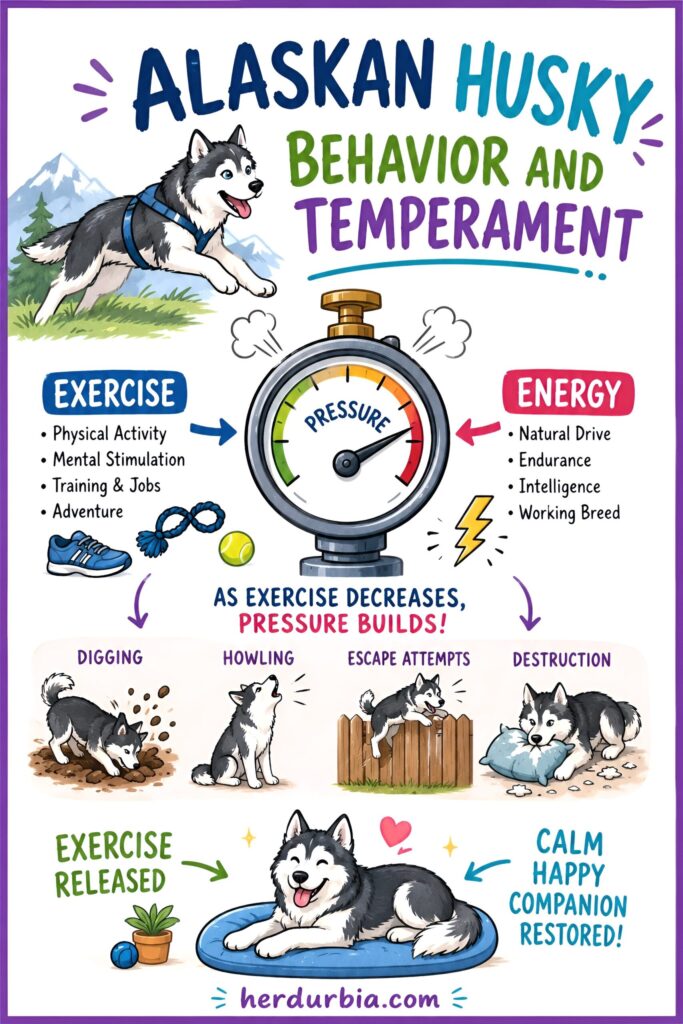
The defining behavioral characteristic of the Alaskan Husky is its relationship with running. This is a dog that does not merely enjoy physical activity. It is built for it, bred for it across countless generations, and oriented toward it in a way that shapes every other aspect of its domestic behavior. A dog that has run is calm, engaged, and genuinely pleasant to live with. A dog that has not run is restless, vocal, and inventive in ways that most owners find exhausting.
Beyond the exercise drive, the Alaskan Husky is an intelligent, curious, and socially engaged dog that pays genuine attention to its people and responds perceptively to emotional states within the household. It is not a dog that detaches or becomes independent when bored. It expresses its boredom actively and loudly, through howling, digging, escape attempts, and the systematic investigation and often destruction of anything within reach.
The breed is notably vocal. Alaskan Huskies howl, yodel, and communicate with a range of sounds that owners either find charming or deeply inconvenient depending on their living situation and the tolerance of their neighbors. This vocality is not aggression or distress in most cases. It is simply how this breed expresses itself, and it is worth understanding before committing to one.
The Alaskan Husky is not a guard dog by nature or temperament. Its friendliness with strangers, its lack of territorial wariness, and its general social orientation make it an ineffective deterrent despite its size. What it offers instead is companionship of an active, engaging, and energetically demanding kind that suits the right owner perfectly.
Training And Handling
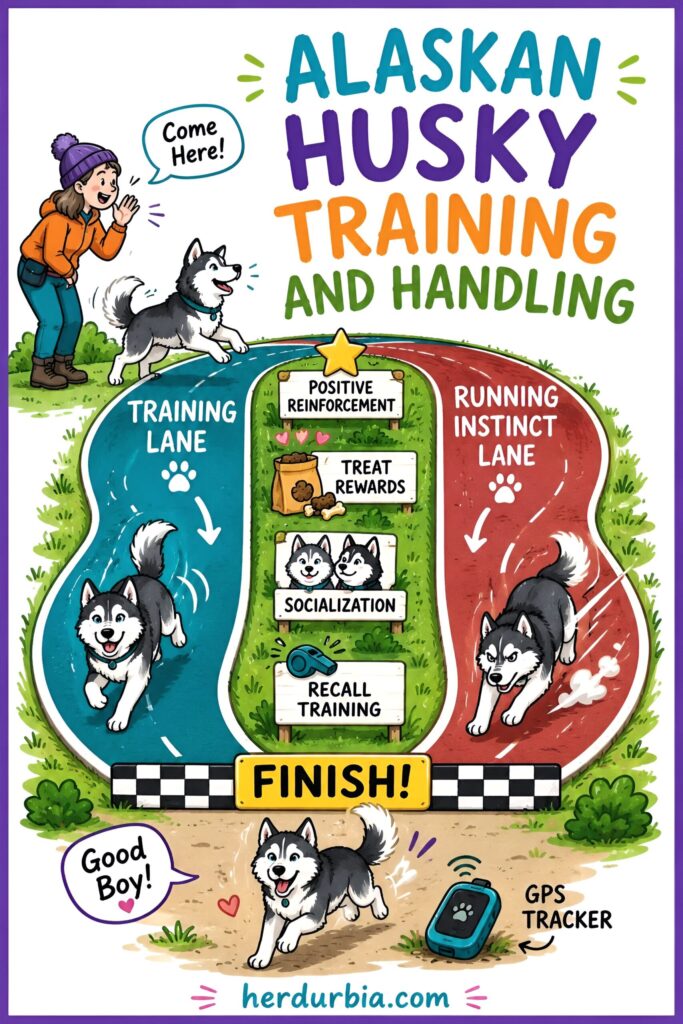
The Alaskan Husky is intelligent and highly trainable in contexts that align with its working instincts, and considerably more challenging in contexts that require it to override those instincts. It learns quickly, responds well to positive reinforcement, and forms strong working relationships with handlers who are consistent and genuinely engaged in the training process. The challenge is that this is a dog bred to run forward at full speed, and training it to stop, wait, and defer requires working against a drive that is extraordinarily powerful.
Positive reinforcement methods are the most effective approach by a significant margin. The Alaskan Husky responds to reward, to enthusiasm from its handler, and to training that feels like an extension of the active, engaged lifestyle it is built for. Harsh corrections, forceful handling, or repetitive drilling produce resentment and resistance rather than compliance. High-value training treats are particularly useful for recall work, where the competition with the dog’s running instinct requires maximum motivational input.
Recall training deserves sustained, consistent attention from the earliest possible age and should be reinforced throughout the dog’s life. An Alaskan Husky that is running has very little attention to spare for anything else, and off-leash reliability in any unfenced area is not a realistic expectation for most dogs of this type regardless of how much training has gone into it. A GPS tracker is worth serious consideration for any Alaskan Husky owner who spends time outdoors with their dog in areas without secure containment.
Early socialization from puppyhood, exposing the dog to a wide range of people, environments, sounds, and other animals, produces the well-adjusted adult dog that the breed’s friendly temperament is capable of becoming.
Health And Lifespan
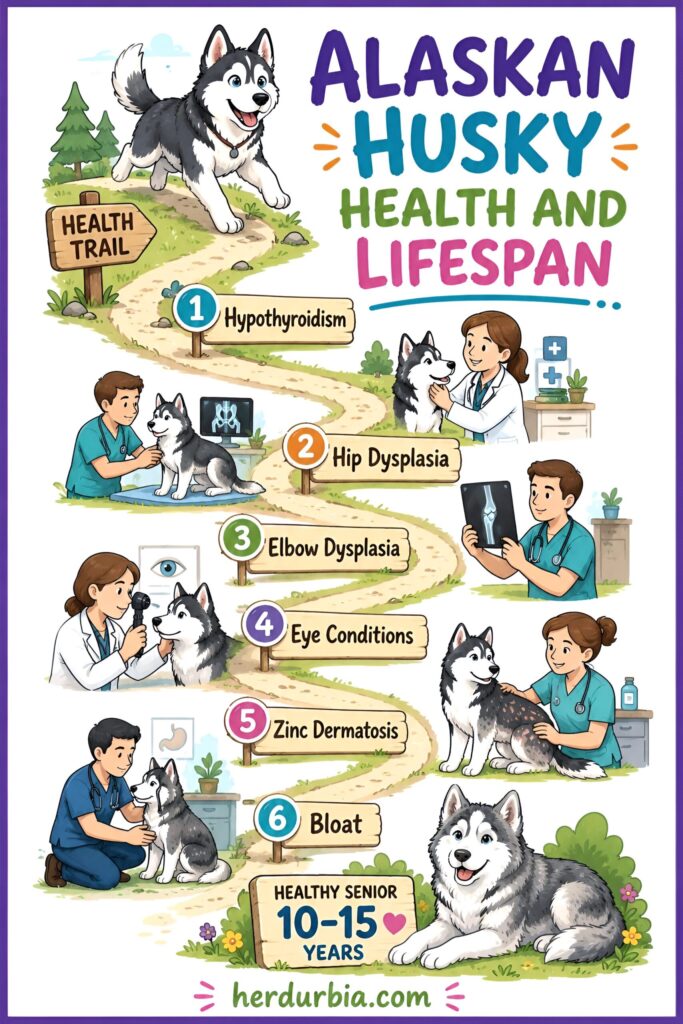
As a type developed through practical performance selection rather than closed studbook breeding, the Alaskan Husky generally benefits from the hybrid vigor that comes with its mixed heritage. It is overall a robust and healthy working dog with a lifespan of 10 to 15 years, which is notably long for a dog of its size and working intensity. That said, there are hereditary and size-related conditions that owners should understand and monitor.
Hypothyroidism An underactive thyroid is among the most commonly documented health concerns in the breed. Symptoms include weight gain, lethargy, coat changes, and reduced energy. It is diagnosed through blood testing and managed with daily hormone supplementation, which typically restores normal function and energy levels. It can be slow to diagnose accurately because its symptoms overlap with other conditions.
Hip and Elbow Dysplasia Abnormal joint development is a concern in active, athletic dogs of this size. It can range from mild to severe and causes pain, restricted movement, and progressive arthritis over time. Maintaining a healthy weight, keeping early exercise appropriate in intensity for the dog’s developmental stage, and sourcing dogs from working kennels that monitor their lines for joint health all meaningfully reduce risk. Joint supplements are worth discussing with your vet as the dog moves into middle age.
Bloat (Gastric Dilatation-Volvulus) The Alaskan Husky’s deep chest creates susceptibility to this life-threatening emergency, and the breed’s working lines that involve intense exercise around feeding times make practical feeding management particularly important.
Eye Conditions Progressive retinal atrophy and juvenile cataracts have been documented in some lines. Regular veterinary eye examinations allow for early detection and appropriate management.
Zinc-Responsive Dermatosis A skin condition related to zinc deficiency or metabolism occurs at a higher rate in northern breeds including the Alaskan Husky. It causes skin crusting and hair loss, particularly around the face and extremities, and responds well to appropriate zinc supplementation under veterinary guidance.
Routine preventive care, including regular vet check-ups, up-to-date vaccinations, consistent dental hygiene, and parasite prevention, provides the foundation for a working dog that can maintain its performance and quality of life across its full lifespan.
Price And Availability
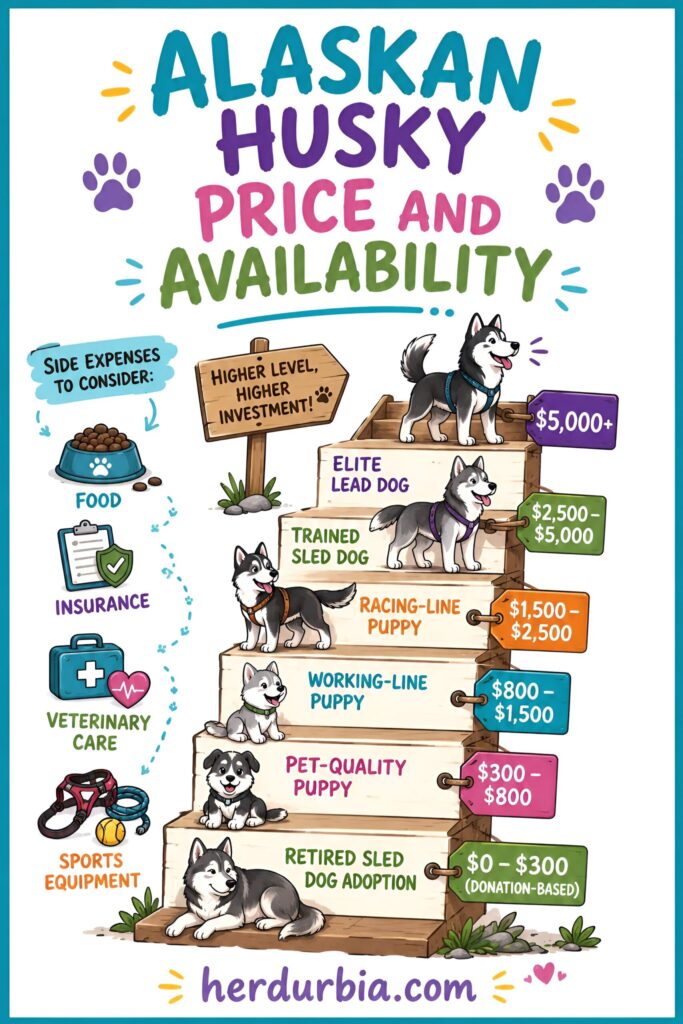
The Alaskan Husky occupies a genuinely unusual position in the dog market. From working racing kennels that produce dogs for competitive mushing, puppies from solid working lines typically cost between $500 and $1,500. Dogs from proven Iditarod or Yukon Quest racing lineages can command considerably more, and trained adult sled dogs with competitive records can reach $3,000 to $4,000 or higher. Lead dogs from top racing kennels represent an elite tier of working animal whose value reflects their proven performance rather than any conventional pet market pricing.
For owners seeking an Alaskan Husky as a companion rather than a competitive sled dog, the most important thing is sourcing from working kennels with documented bloodlines and a genuine understanding of the type’s temperament and health. The absence of AKC recognition means there is no registry to provide oversight, and the market for Alaskan Huskies sold as pets includes dogs of widely variable quality and background.
Adoption is a meaningful avenue worth exploring. Retired sled dogs from mushing kennels are regularly placed into companion homes, and these dogs often make excellent pets for active owners who can meet their exercise requirements. Connecting with local mushing communities and sled dog clubs is the most effective way to find adoptable retired working dogs.
Annual ownership costs beyond the purchase price depend heavily on the owner’s lifestyle and the dog’s exercise program. Food for an active medium-to-large dog runs $50 to $100 per month under normal companion conditions. Routine veterinary care, pet insurance, and standard supplies add to the total. For owners who pursue dog sports including skijoring or canicross, equipment costs are an additional consideration worth budgeting for in advance.
Conclusion
The Alaskan Husky is not a breed for someone who wants a dog that fits quietly into a conventional lifestyle. It is the world’s greatest sled dog, built for a purpose that demands more physical output and more sustained engagement than most domestic environments can provide. For the active owner who runs, hikes, cycles, or pursues winter dog sports, who has the space and the commitment to meet what this dog genuinely needs every single day, the Alaskan Husky is an extraordinary companion that will match every level of effort put into it and then ask for more. Set up properly before bringing one home. Our Best Dog Products page covers everything you need for high-drive, high-energy working breeds that live for the run and deserve the best from the people who run alongside them.