

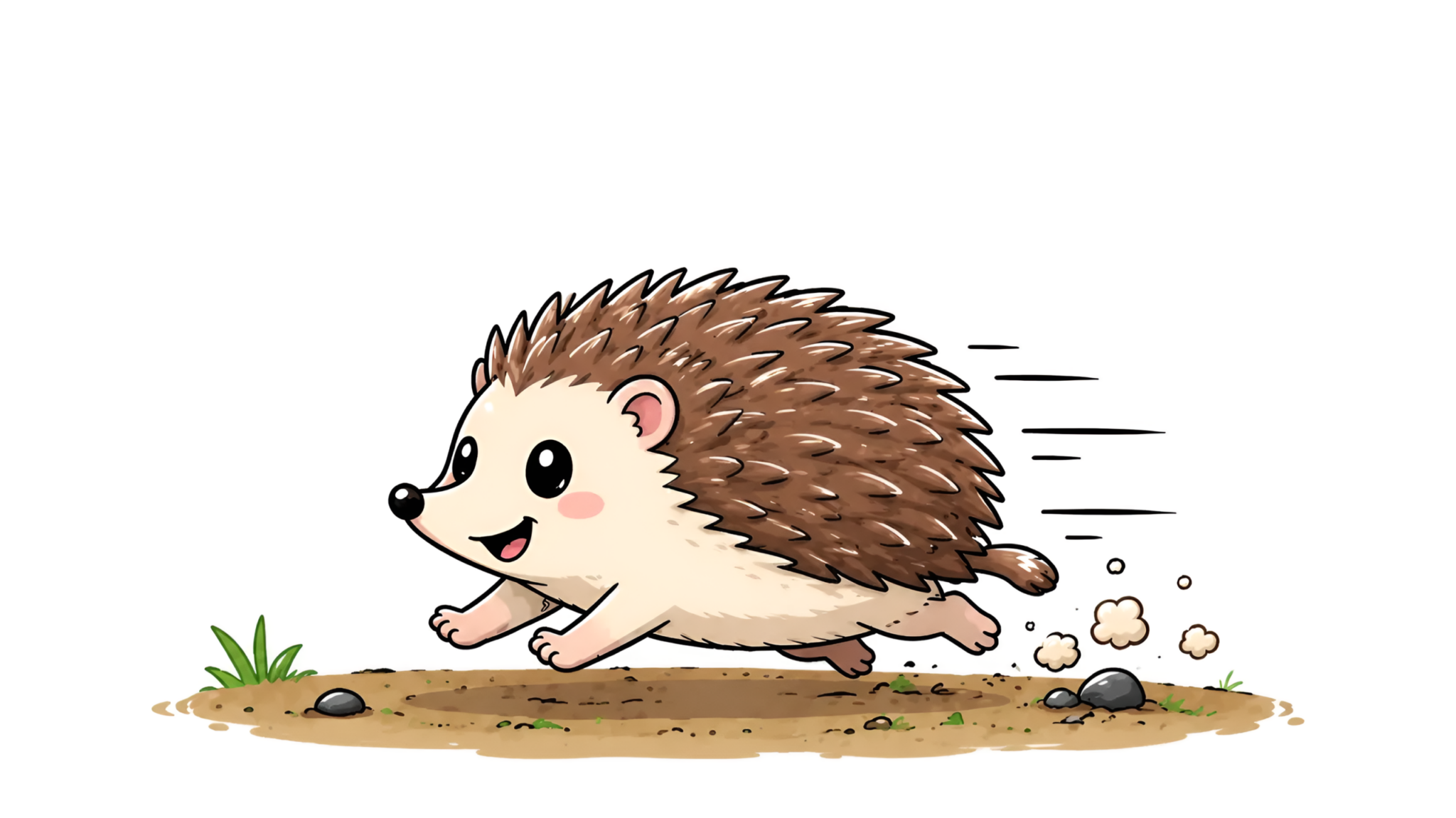
Are hedgehogs fast runners? Most people look at a hedgehog — round, spiny, and leisurely — and assume not. The reality is considerably more impressive. Hedgehogs are surprisingly capable runners that cover remarkable distances every night, and understanding their running behaviour is one of the most important things a pet keeper can know. It explains why a wheel is not optional for a pet hedgehog, why cage size matters so much, and why a hedgehog deprived of running opportunities develops health and behavioural problems. This article covers hedgehog running speed, how far they travel naturally, the mechanics behind their running ability, and exactly what this means for responsible hedgehog care.
How Fast Can Hedgehogs Run?
Hedgehogs are significantly faster than their appearance suggests. The African pygmy hedgehog (Atelerix albiventris), the species most commonly kept as a pet, can reach speeds of approximately 6–7 km/h (3.7–4.3 mph) when running. European hedgehogs (Erinaceus europaeus) have been recorded at similar speeds, with some sources noting bursts up to 9 km/h (5.6 mph) over very short distances.
To contextualise this: the average human walking pace is approximately 5 km/h (3.1 mph), meaning a motivated hedgehog moving at a brisk pace is outrunning a leisurely walking human. For an animal weighing between 250–600 grams (as detailed in our guide on hedgehog weight) and with legs so short they are barely visible beneath the body, this running speed is genuinely remarkable.
Their running gait is a rapid scurrying — all four short legs moving quickly in a coordinated alternating pattern, with the body held low to the ground. The characteristic sound of this scurrying on hard surfaces is one of the most recognisable hedgehog behaviours, and the sound of rapid wheel-running at 2am is familiar to any hedgehog keeper.
How Far Do Hedgehogs Run Each Night?
Speed is only part of the picture. The distance hedgehogs cover during a single night’s activity is extraordinary for an animal of their size. Research on European hedgehog ranging behaviour published in Acta Theriologica — a peer-reviewed mammalogy journal — documented hedgehogs covering 1–3 km per night as a routine baseline, with some individuals regularly exceeding 3 km during active foraging periods. Active male hedgehogs during breeding season have been recorded covering distances up to 4–5 km in a single night.
For an animal roughly the size of a large apple, travelling 2–3 km in a single night is the equivalent of a human walking or jogging approximately 20–30 km. This puts hedgehog endurance running into perspective: these are not occasional sprinters but sustained endurance athletes that have evolved to cover large territories nightly in search of food.
Pet hedgehogs retain this same biological drive to run regardless of whether the space to do so is available. A study by University of Wisconsin researchers measuring wheel use in captive hedgehogs found that hedgehogs in standard enclosures will run between 2 and 5 km per night on a wheel when one is available — consistent with their wild ranging behaviour — but that without a wheel, hedgehogs instead pace, become restless, and show elevated stress indicators. The running drive is not a nice-to-have behaviour; it is a fundamental biological need.
The Physiology Behind Hedgehog Running Ability
Hedgehog running capability derives from a physiology surprisingly well-suited to sustained locomotion. Despite their rotund appearance, hedgehogs have relatively long legs for their body width — the legs are simply concealed beneath the overhanging belly and quill mantle at rest, giving the appearance of being much shorter than they are. When running, the legs extend fully and the hedgehog adopts a more elongated running posture that is quite different from the hunched, rolled appearance of a resting animal.
Hedgehog cardiovascular physiology supports their endurance running demands. Heart rate in active European hedgehogs during foraging ranges from 190–280 beats per minute according to tracking research documented in Journal of Zoology, well-adapted to sustaining the metabolic demands of continuous overnight movement. Their respiratory rate similarly increases substantially during active running periods.
The hedgehog’s metabolic rate at night during activity is dramatically higher than during daytime rest — this is the energy expenditure that requires them to consume substantial quantities of invertebrates, worms, and insects during nightly foraging. Understanding this helps explain what hedgehogs eat and why a nutritionally complete diet is so important for captive hedgehogs whose energy expenditure — even on a wheel — may not be quite as high as their wild counterparts.
Are Hedgehogs Also Capable of Other Athletic Feats?
Running is not the only physical capability that surprises people familiar only with a resting hedgehog.
Climbing. Despite their rotund build, hedgehogs are capable climbers — as our article on whether hedgehogs can climb covers in detail. Wild hedgehogs scale tree roots, garden walls, and structural edges as part of their nightly ranging. This climbing ability means cage security is genuinely important — a hedgehog can escape from enclosures that do not have a properly secured lid.
Swimming. Hedgehogs can swim when necessary, as covered in our article on whether hedgehogs can swim. While not aquatic animals, they will enter water to cross obstacles during their nightly runs.
Burrowing. Wild hedgehogs dig nest chambers and push through dense leaf litter and soil as part of their habitat use. Their front feet are equipped with moderately strong digging capability suited to this purpose. Our article on whether hedgehogs burrow covers this behaviour.
These capabilities combined — running, climbing, swimming, burrowing — paint a picture of a remarkably athletic small mammal whose physical abilities are consistently underestimated.
What Hedgehog Running Behaviour Means for Pet Care
The single most important practical implication of hedgehog running behaviour is that a quality running wheel is not optional equipment for a pet hedgehog — it is a welfare necessity. A hedgehog without adequate running opportunity accumulates a significant unsatisfied biological drive that manifests as stress-related behaviour, weight gain from insufficient exercise, and potential health problems.
Wheel requirements. The wheel must be large enough for the hedgehog to run on without arching its back — the typical recommendation is a minimum of 28–30 cm (11–12 inches) in diameter for adult African pygmy hedgehogs. A wheel that is too small forces the spine into an upward arch during running, which causes musculoskeletal stress and potential spinal problems over time. Our guide to the best hedgehog wheel covers the correct size specifications and surface requirements in detail. The surface should be solid rather than barred or slatted — a barred surface creates leg and foot injury risk at running speeds.
Wheel cleanliness. Hedgehogs defecate while running — extensively, given how much time they spend on the wheel. The wheel must be cleaned every 1–2 days to prevent faecal accumulation that causes foot infection and odour. A quality hedgehog poop scoop makes the daily wheel cleaning routine quick and manageable.
Cage size implications. The wheel addresses the running need, but the cage itself must be large enough for normal movement, foraging behaviour, and the full suite of hedgehog activities. The British Hedgehog Preservation Society recommends a minimum cage footprint of 60 × 90 cm (roughly 2 × 3 feet) for a single hedgehog, with larger being better. Our guide to the best hedgehog cage covers the appropriate size and features.
Exercise outside the cage. Beyond wheel running, allowing your hedgehog supervised exercise time outside its cage in a secure play area provides enrichment and additional exercise opportunity. A secure hedgehog playpen creates a safe exploration space that supplements wheel time. Hedgehogs are nocturnal, so evening playtime aligned with their natural active period produces the most engaged, willing interaction.
Nail care from running. Hedgehogs that run on appropriate surfaces naturally wear their nails to some degree, but captive hedgehogs on soft wheel surfaces and cage liners may not experience sufficient natural wear. Regular nail checks and trimming — covered in our how to trim hedgehog nails guide — prevent nails from becoming overgrown and curling into the paw pads, which is both painful and a cause of running problems.
Obesity prevention. A hedgehog without adequate running opportunity is at high risk of obesity — a genuine and common health problem in captive hedgehogs. The natural caloric expenditure of nightly running is substantial, and a captive hedgehog that is fed normally but given no outlet for running will gain weight steadily. A well-exercised hedgehog on a quality wheel maintains a healthy body condition that a sedentary one cannot. Our guide on best hedgehog food covers appropriate diet alongside exercise for weight management.
Hedgehog Running and Hibernation Considerations
Wild European hedgehogs hibernate during winter months, during which their activity levels drop to near-zero and their metabolic rate decreases dramatically. African pygmy hedgehogs — the pet species — do not naturally hibernate but can enter a dangerous torpor state when exposed to temperatures below approximately 18°C (65°F). During torpor, running activity ceases completely and the hedgehog appears unresponsive.
This is why temperature management in hedgehog housing is so critical — a hedgehog that enters torpor due to cold is not resting normally, it is in physiological distress that can be fatal if the temperature drop is sustained. Appropriate heating via a hedgehog heat lamp or heating pad keeps the hedgehog’s environment in the correct 22–27°C (72–80°F) range where normal activity, including running, is maintained throughout the year. Our article on whether hedgehogs hibernate explains the difference between true hibernation and torpor in more detail.
If a hedgehog that normally runs actively on its wheel suddenly stops doing so, temperature is the first thing to check — a hedgehog that has gone into torpor needs immediate warming. Other reasons for reduced wheel activity include illness, injury, or significant stress, and a hedgehog that stops running without an obvious environmental cause should be assessed by a veterinarian.
Frequently Asked Questions
How fast can a hedgehog run? Approximately 6–7 km/h (3.7–4.3 mph) at a sustainable pace, with short bursts potentially reaching up to 9 km/h (5.6 mph). This is faster than a leisurely human walk.
How much does a hedgehog run per night? Wild hedgehogs cover 1–3 km per night routinely, with active individuals exceeding this. Pet hedgehogs with wheel access run 2–5 km per night on average.
Do hedgehogs need a wheel? Yes — a running wheel is a welfare necessity, not an optional accessory. Without adequate running opportunity, hedgehogs experience stress, weight gain, and behavioural problems. The wheel must be at least 28–30 cm (11–12 inches) in diameter for an adult.
Why does my hedgehog run so much at night? This is entirely normal behaviour driven by the same biological drive that propels wild hedgehogs across 2–3 km of territory per night. The running drive is deeply ingrained and does not diminish in captivity. Provide a quality wheel and embrace it — a hedgehog that runs enthusiastically is a healthy, engaged hedgehog.
Can hedgehogs run in the daytime? Hedgehogs are nocturnal and are usually resting during the day. Occasional brief activity during daylight hours is normal, but sustained daytime running is atypical and, if combined with other signs, may indicate that the hedgehog’s night-time environment is not comfortable enough for normal rest.
Built to Move — Give Them Room to Do It
A hedgehog’s running drive is one of the most fundamental expressions of its biology. It is the midnight wanderer, the indefatigable night-forager, the animal that has evolved over millions of years to cover ground efficiently in the dark. Providing your hedgehog with the right wheel, adequate space, and opportunities for nightly activity is not just good husbandry — it is honouring what the animal actually is. For keeper-tested recommendations on every product that supports excellent hedgehog health and an active life — from the right wheel and cage setup to nutrition, grooming, and enrichment — Best Hedgehog Products is your comprehensive guide to the best gear in every category of hedgehog care.