
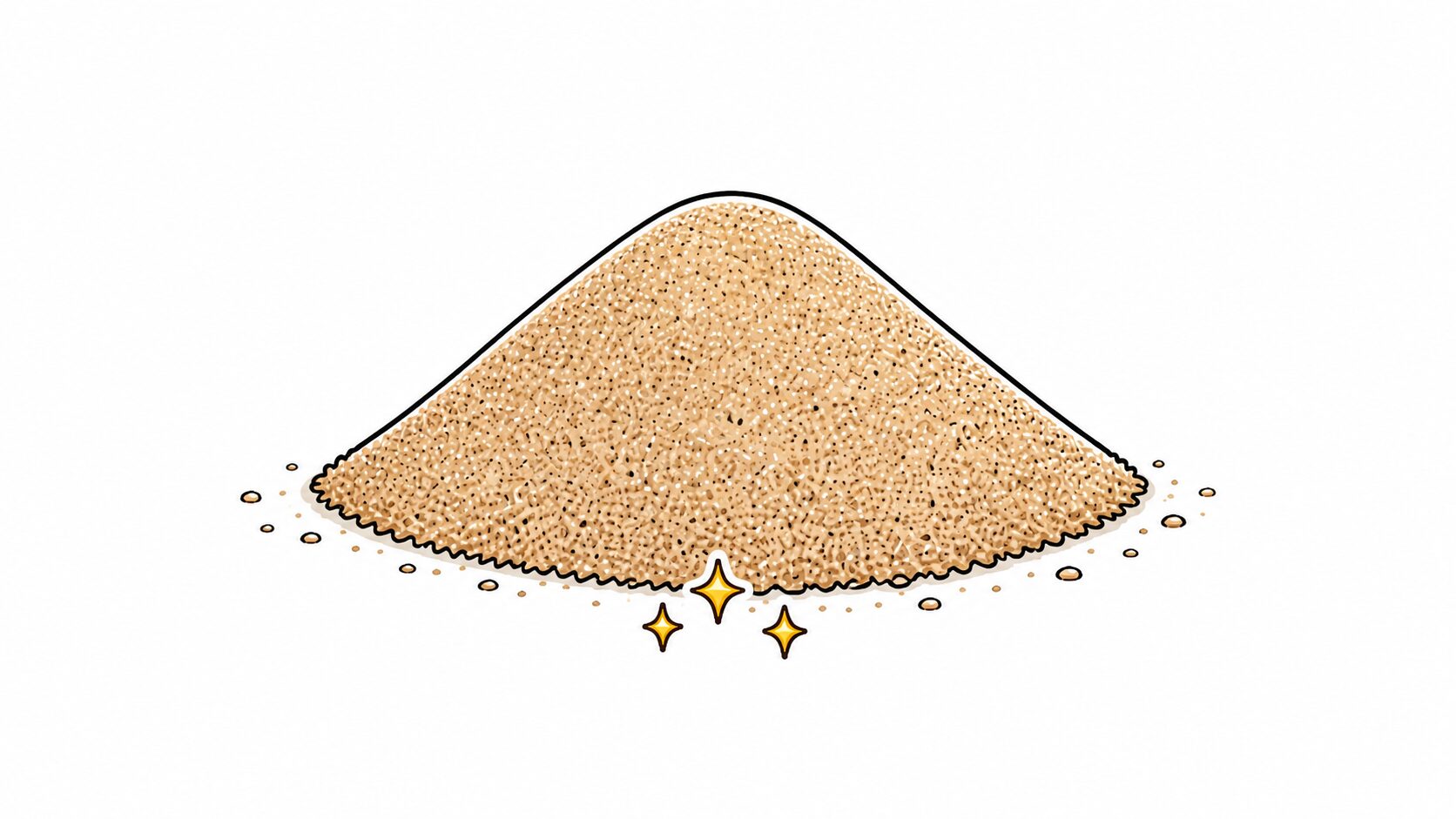
Choosing the best axolotl tank sand is one of the most important substrate decisions you will make for your axolotl’s health and comfort. Sand is the most popular substrate choice among experienced axolotl keepers — and for good reason. When chosen correctly, it is completely safe to ingest, closely mimics the natural lakebed environment of wild axolotls, gives their feet excellent traction, and creates a beautiful, natural-looking tank. When chosen incorrectly, it can be abrasive, dusty, or simply inappropriate for the cold freshwater conditions axolotls need. This guide covers everything about axolotl tank sand in detail — why it is the best substrate option, exactly what grain characteristics to look for, what to avoid, and our top Amazon picks for every type of keeper. For the broader substrate picture, also read our guides on whether axolotls need substrate, the best substrate for axolotls, and our full axolotl care guide.
Why Sand Is the Best Substrate Choice for Axolotls

Axolotls (Ambystoma mexicanum) are native to the high-altitude lake complex of Xochimilco near Mexico City, where the natural lakebed is composed of fine silt, mud, and soft organic material. Their feet, digestive systems, and behaviours have evolved in contact with exactly this type of fine, soft substrate. Sand in a captive axolotl tank is the closest practical approximation of that natural environment.
The primary safety advantage of fine sand over gravel or coarser substrate is its particle size. Axolotls are suction feeders — when they strike at prey, they inhale surrounding water and material along with the food. In a tank with fine sand, any particles accidentally ingested during feeding are small enough to pass harmlessly through the digestive tract without causing blockage. According to research published in Aquaculture, gastrointestinal foreign body ingestion is one of the most common and preventable causes of mortality in captive aquatic salamanders — and fine sand eliminates this risk that gravel creates.
Beyond safety, sand supports natural axolotl behaviour in a way that bare glass or tiles cannot. Axolotls sift through fine sand naturally during foraging, investigating the substrate with their sensitive mouths and feet in a way that reflects their wild behaviour. This enrichment matters for the psychological wellbeing of a captive animal. Sand also provides substantial surface area for the colonies of beneficial bacteria that process ammonia and nitrite in your tank — as covered in our best axolotl filter guide — which contributes to better water quality.
The wild axolotl population is critically endangered, with the species surviving in severely degraded conditions in Xochimilco. Providing a captive axolotl with a substrate that reflects its natural environment is part of responsible husbandry that honours that context.
What Makes the Best Axolotl Tank Sand?

Fine particle size of 1mm or smaller. This is the single most important specification. Particles of 1mm or less are definitively safe to pass through an axolotl’s digestive system if accidentally swallowed. Particles larger than 1mm — particularly anything approaching 2–3mm — begin to approach the dangerous range where impaction becomes a real risk. Always verify grain size before purchasing. Brands like CaribSea publish the grain size characteristics of their sands clearly, which is one reason they are widely trusted in the axolotl community.
Smooth, rounded particle shape. Sand particles should be smooth and rounded rather than angular and sharp. Angular silica particles — common in some pool filter sands and certain aquarium sands — can be mildly abrasive to the soft, permeable skin of axolotls that walk on the substrate constantly. The best axolotl tank sand options use naturally rounded particles that are gentle on axolotl skin and feel comfortable underfoot.
No dyes, paints, or coatings. Artificially coloured aquarium substrates — whether gravel or sand — use dye or paint coatings that can leach into the water over time. For a cold-water freshwater tank with a sensitive species like an axolotl, avoiding any chemical additives is important. Look for sands explicitly described as dye-free, paint-free, and coating-free. CaribSea’s Super Naturals line is a consistent example of this standard.
pH neutral formulation. Some aquarium sands — particularly crushed coral, aragonite, and certain marine sands — raise water pH significantly. Axolotls do best in neutral to slightly alkaline freshwater, and a sand that drives pH upward creates water chemistry problems you do not need. Choose a pH-neutral freshwater sand, and verify this on the product specifications.
Low dust and easy to rinse. All aquarium sand contains some fine dust and debris from processing that must be rinsed out before use. The best axolotl tank sands have relatively low dust content that clears within a reasonable number of rinse cycles — typically 5–8. Heavily dusty sands require many more rinse cycles and are more likely to cloud your tank if not thoroughly prepared.
Natural colour that complements your axolotl. This is aesthetic rather than functional, but it matters for the display quality of your tank. Pale, natural sand tones — cream, tan, light grey — create high visual contrast with the pale pinks and golds of leucistic and golden albino axolotls, making them pop beautifully. Dark sands create dramatic contrast for paler morphs and blend beautifully with planted aquascapes. Matching your sand colour to your specific axolotl’s morph and aesthetic preferences is worth thinking about before you buy.
What Sands to Avoid for Axolotls
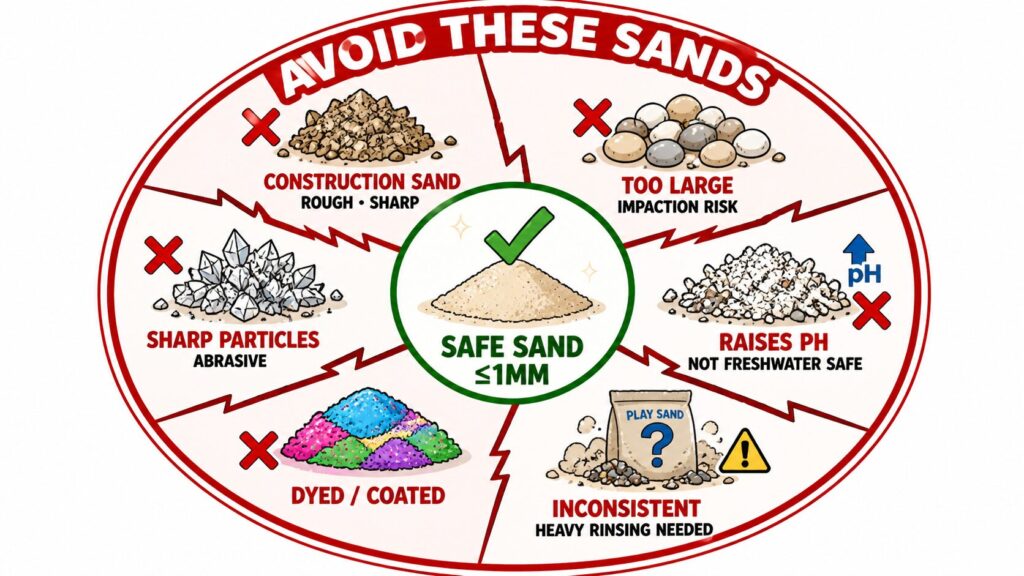
Coarse or builder’s sand. Construction sand and builder’s sand have angular, coarse particles unsuitable for axolotls. Angular particles can abrade skin, and the particle size is often too large to be safely ingested. Avoid any sand labelled for construction or building use.
Tropical fish aquarium sands with large grain sizes. Some sands sold for aquariums are sized for tropical fish and invertebrates that have different safety requirements than axolotls. Always check the grain size. Anything above 1–1.5mm deserves careful consideration before use with axolotls.
Marine and reef sands. Crushed coral, aragonite, and live sand products designed for saltwater reef tanks will raise your pH and hardness significantly. These are not appropriate for an axolotl freshwater setup.
Silica play sand from hardware stores. Plain play sand from hardware or garden stores is often cited as a budget option, and it can work — but it requires extensive rinsing, often has angular particles, and provides no guarantee of safe grain size. If you go this route, rinse extensively and research the specific brand and particle characteristics first. Purpose-made aquarium sands are generally the safer and more convenient choice.
Any coloured or coated decorative sand. Bright-coloured aquarium sands use artificial coatings that are not appropriate for axolotl tanks. Even if the particle size is correct, the coating risk makes these unsuitable.
How Much Sand Does an Axolotl Tank Need?

For a 1–2 inch depth of sand across the full floor of your tank — which is the recommended range for axolotl tanks — you need roughly the following quantities as a starting guide:
A 20-gallon long tank (30″ × 12″ footprint) needs approximately 20–25 pounds of sand for a 1.5 inch layer. The Aqueon 40-gallon breeder (36″ × 18″ footprint) — which we recommended as the best overall tank in our best axolotl tank article — needs approximately 40–50 pounds for a 1.5 inch layer. A 55-gallon tank (48″ × 13″ footprint) needs approximately 35–45 pounds.
These are approximate figures — actual quantities depend on exact tank dimensions and your preferred depth. When in doubt, buy slightly more than you think you need rather than slightly less. Leftover rinsed sand stores cleanly in a sealed bucket.
Our Top Axolotl Tank Sand Picks
Best Overall: CaribSea Super Naturals Torpedo Beach Aquarium Sand (20lb)
The CaribSea Super Naturals Torpedo Beach Aquarium Sand is our top overall pick for axolotl tank sand — consistent with our recommendation in the best axolotl tank substrate article. Its fine, smooth grain size is safe for axolotl ingestion, it contains no artificial dyes, paints, or coatings, it is pH neutral, and it is made in the USA. The warm, natural tan-cream colour is beautiful in any freshwater aquascape and shows off the colouration of most axolotl morphs superbly. It provides excellent traction for axolotl feet and colonises well with beneficial bacteria for your nitrogen cycle. According to CaribSea’s product documentation, the Super Naturals line is specifically formulated to maintain neutral pH in freshwater aquariums without altering chemistry — an important quality for axolotl setups. This is the sand the vast majority of experienced axolotl keepers recommend, and it is the one we would start with for almost any new setup.
Best for Dark Aesthetic Setups: CaribSea Super Naturals Moonlight Sand (20lb)
The CaribSea Super Naturals Moonlight Sand is the best choice for keepers who want a dark substrate. Its deep charcoal-black colour creates dramatic contrast against light-coloured axolotls — leucistic, golden albino, and white albino morphs in particular look absolutely stunning against a dark sand background. The grain structure, safety profile, and chemical properties are identical to the Torpedo Beach: fine, smooth, dye-free, pH-neutral, and safe for axolotl use. The Moonlight colour also works beautifully with planted tank aquascapes, making green plants and colourful decorations pop vividly against the dark floor. If aesthetics are a priority and you are keeping a pale-coloured axolotl, this is arguably the most visually impressive sand choice available.
Best Neutral White Option: CaribSea Super Naturals Crystal River Sand (5lb)
The CaribSea Super Naturals Crystal River Sand is a clean, natural white sand that gives a bright, open feel to the tank and works well for any axolotl morph. Its fine particle size and dye-free formulation make it fully safe for axolotl use, and its neutral pH means it will not affect your water chemistry. The 5lb format is most practical for smaller tanks or as a supplementary top-up; for a full 40-gallon breeder you would need multiple bags. The Crystal River colour particularly suits live plant aquascapes, where the bright white substrate creates a light, natural feel that complements green plant growth beautifully.
Best Budget Large Quantity Option: CaribSea Super Naturals Torpedo Beach (50lb)
For keepers setting up a 40-gallon or larger tank and wanting to cover the full floor to 1.5–2 inches in a single purchase, the CaribSea Super Naturals Torpedo Beach 50lb bag provides the best cost-per-pound ratio in the CaribSea Super Naturals line while maintaining the same fine grain, dye-free, pH-neutral quality. Buying in bulk also means you have extra sand on hand for topping up after cleaning removes some material, which is a practical advantage for long-term tank maintenance.
Best Pool Filter Sand Alternative: FairmountSantrol AquaQuartz Pool Filter Sand (50lb)
For keepers who want a large quantity of safe fine sand at the lowest possible per-pound cost, the FairmountSantrol AquaQuartz-50 Pool Filter Sand is a popular and well-established choice in the axolotl community. Pool filter sand is significantly less expensive than purpose-made aquarium sand and, when properly rinsed, is safe for axolotl use. The AquaQuartz uses natural silica sand that is pH neutral and free from chemical additives. The most important caveat is that this sand requires extremely thorough rinsing — plan for 8–12 rinse cycles until the water runs completely clear. The particle size is slightly larger and more variable than CaribSea’s products, so verify the product’s specific grain characteristics before purchasing. For keepers setting up a large tank or multiple tanks on a budget, the cost savings over branded aquarium sand are substantial.
How to Prepare and Add Sand to Your Axolotl Tank
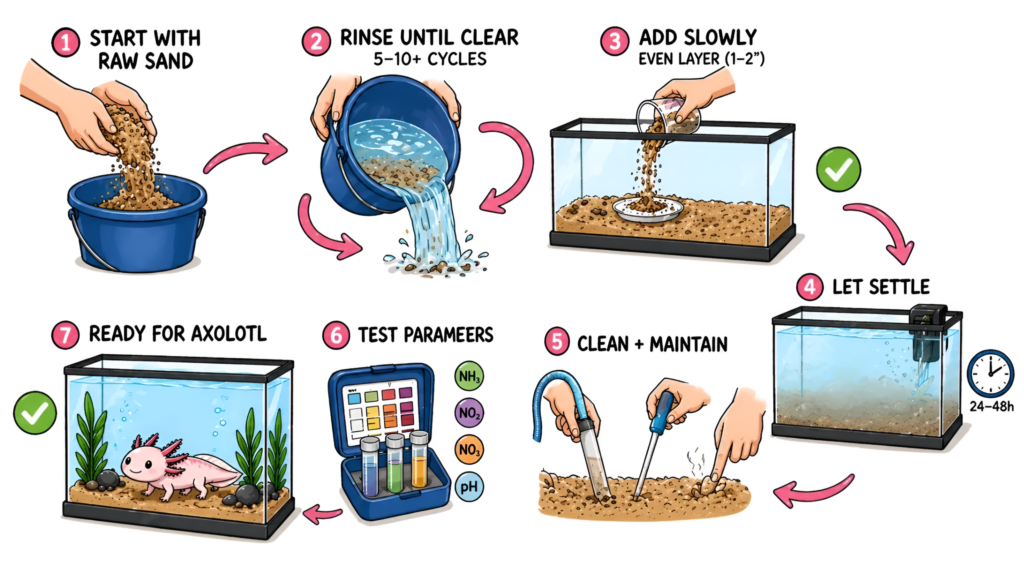
Rinse thoroughly before adding to the tank. This step is non-negotiable regardless of which sand you choose. Even pre-washed aquarium sands contain fine dust from processing and packaging that will cloud your tank badly if not rinsed out first. Place the sand in a clean bucket in manageable batches, fill with water, stir vigorously, and pour off the cloudy water. Repeat until the water you pour off runs completely clear. This typically takes 5–10 rinse cycles for CaribSea products and up to 12 or more for pool filter sand.
Add sand to the tank slowly and gently. Lower a clean cup or bowl to the tank floor and release sand in small amounts, building up the layer evenly across the full tank base. Avoid dumping large amounts at once — this stirs up fine particles that can take hours to settle and places excessive initial stress on your filter. If you have already added water, use a plate or bowl placed on the existing sand surface and pour new sand over it to diffuse the disturbance. Aim for an even layer of 1–2 inches across the full floor.
Allow sand to settle fully before adding your axolotl. Even well-rinsed sand will release some fine particles into the water column immediately after installation. Run your filter for 24–48 hours before introducing your axolotl to allow these particles to be captured by the filter and the water to clear completely.
Maintain sand correctly during routine cleaning. During weekly water changes, use a tank siphon to vacuum the sand surface, hovering the siphon just above the sand to draw up settled waste without removing the sand itself. Use a turkey baster for daily spot-cleaning of visible waste between water changes. Gently disturb the sand surface with a finger or aquarium tool every 2–3 weeks to prevent anaerobic pockets from forming in deeper layers. For a full cleaning guide, see our articles on how to clean an axolotl tank and how often to clean an axolotl tank.
Monitor water parameters after adding new sand. Any new substrate can cause minor temporary shifts in water chemistry as it settles and interacts with your tank’s established bacterial colony. Test ammonia, nitrite, nitrate, and pH with a reliable water test kit for the first week after adding new sand. Always treat replacement water with water conditioner before adding it to the tank during water changes.
Frequently Asked Questions
What is the safest sand grain size for axolotls? Particles of 1mm or smaller are definitively safe for axolotl use. At this size, any particles swallowed during feeding pass harmlessly through the digestive system. Fine aquarium sands from brands like CaribSea fall consistently within this range.
Can I use play sand from a hardware store for my axolotl tank? Technically some play sands are used by axolotl keepers with success, but they require extensive research and rinsing. Many play sands have angular particles, variable grain sizes, and no guarantee of chemical safety. Purpose-made aquarium sands like CaribSea are more reliable and safer for a beginner. The pool filter sand alternative is a better budget option than hardware store play sand.
How deep should axolotl tank sand be? A depth of 1–2 inches is ideal. Deeper than 2 inches increases the risk of anaerobic pockets forming in lower layers. Shallower than 1 inch is easily disturbed by axolotl activity and filter flow, creating a messy tank. The 1–2 inch range is the practical sweet spot.
Does sand affect water chemistry in an axolotl tank? pH-neutral sands like CaribSea Super Naturals have no meaningful effect on water chemistry. Some marine sands and calcareous sands raise pH — these are not appropriate for axolotl freshwater tanks. Always choose a sand explicitly described as pH neutral for freshwater aquariums.
How often should I replace the sand in my axolotl tank? Quality aquarium sand does not need regular replacement. With consistent maintenance — weekly siphoning and regular water changes — the same sand can remain in the tank for years. You may need to top it up occasionally as small amounts are removed during cleaning, but wholesale replacement is unnecessary unless the sand becomes contaminated or severely compacted.
Do I need to worry about the sand getting into my axolotl’s gills? Fine sand particles in the water column are not a significant concern for axolotl gill health — they settle quickly and are captured by filtration. The concern with sand is primarily gastrointestinal ingestion during feeding, which fine-grain sand handles safely. If you notice your axolotl actively disturbing the sand surface and creating a lot of particles in the water column, check that your filter flow is not too strong and causing excessive sand movement.
The Right Sand Makes a Real Difference
Sand is the substrate that sits beneath your axolotl every hour of every day — the surface they walk on, rest on, sift through, and interact with constantly. Getting it right is one of the most impactful foundational decisions in your axolotl’s care. If you want keeper-tested recommendations across every other product category your axolotl relies on — from filtration and cooling to food, hides, and health supplies — Best Axolotl Products has everything in one place.