

Choosing the best axolotl water test kit is one of the most important investments you will make as an axolotl keeper — and one of the most underrated. Water quality is invisible. Your tank can look perfectly clean and crystal clear while containing ammonia levels that are actively harming your axolotl. Without regular testing, you have no way of knowing what is actually in the water your axolotl is living in every hour of every day. A reliable axolotl water test kit gives you that visibility and allows you to act on real information rather than guesswork. This guide covers everything you need to know: which parameters matter for axolotls, why accuracy counts, what types of test kits exist, and our top Amazon picks for every type of keeper. Pair this guide with our full axolotl care guide and our guides on the best axolotl filter and best axolotl water conditioner for a complete approach to water quality management.
- Why Water Testing Is Non-Negotiable for Axolotl Keepers
- What Parameters to Test in an Axolotl Tank
- Liquid Test Kits vs. Test Strips — Why It Matters
- Our Top Axolotl Water Test Kit Picks
- How to Test Your Axolotl Tank Water Correctly
- When to Test Your Axolotl Tank
- Frequently Asked Questions
- Know Your Water, Know Your Axolotl
Why Water Testing Is Non-Negotiable for Axolotl Keepers

Axolotls are sensitive animals with permeable skin and external gill plumes that absorb substances directly from the water around them. Unlike fish, which have a degree of protective scaling, axolotls have minimal barrier between their bodies and their water. This means that whatever is in the water is in direct contact with their tissue at all times — and elevated ammonia, nitrite, or incorrect pH causes direct, measurable physiological harm rather than just background discomfort.
The three most dangerous water quality issues in axolotl tanks are ammonia toxicity, nitrite toxicity, and temperature elevation. According to research published in Aquaculture, even sub-lethal ammonia concentrations in aquatic salamanders suppress immune function, impair gill respiration, and reduce long-term survivability. Nitrite, produced as ammonia is processed by filter bacteria, is similarly toxic — it interferes with the ability of blood to carry oxygen, a condition that is acutely dangerous for an animal that relies heavily on its gills for respiration. Without a test kit, neither of these conditions is detectable until the symptoms appear in your axolotl — and by that point, real damage has already been done.
The nitrogen cycle — the biological process by which your filter converts ammonia to nitrite and then to the far less harmful nitrate — takes 4–6 weeks to establish in a new tank. During this entire period, ammonia and nitrite levels must be monitored constantly. This is the period when new keeper mistakes most commonly occur, and a good test kit is what allows you to cycle safely. Our guide to the best axolotl cycling bacteria covers how to accelerate this process, but it cannot replace regular testing during the cycle.
Testing also matters long after the initial cycle. Even established tanks experience ammonia spikes after large uneaten food incidents, after filter cleaning disrupts bacterial colonies, during hot periods when beneficial bacteria activity changes, or following illness in your axolotl. Regular testing catches these spikes early, when a water change and a dose of Seachem Prime can resolve the situation before it becomes dangerous. Monitoring consistently with a reliable tank thermometer alongside your water test kit gives you the full picture of your tank’s environment.
The wild Ambystoma mexicanum is critically endangered in its native Xochimilco lake system, which gives captive axolotl care genuine conservation significance. Part of that responsibility is maintaining water quality standards that support long-term health and potential breeding. Our article on how axolotls mate notes that water quality is one of the primary environmental triggers for successful breeding behaviour.
What Parameters to Test in an Axolotl Tank

Ammonia (NH3/NH4+). This is the most critical parameter to monitor. Ammonia is the primary waste product of axolotl metabolism, produced continuously by the breakdown of food and biological waste. In an uncycled or under-filtered tank, ammonia rises rapidly to dangerous levels. The safe level for axolotls is 0 ppm at all times. Even 0.25 ppm causes gill irritation; 1 ppm sustained over days causes serious harm. According to the U.S. Environmental Protection Agency’s aquatic life criteria, total ammonia nitrogen standards for aquatic life protection are extremely low — well below 1 mg/L for sensitive species. Test ammonia every day during the cycling period and at least weekly once your tank is established.
Nitrite (NO2-). Nitrite is produced by bacteria processing ammonia and is subsequently converted to nitrate. It is the second stage of the nitrogen cycle and is similarly toxic to axolotls. Safe level is 0 ppm in an established tank. During cycling, nitrite spikes typically follow the ammonia peak — this is the second major hurdle of the cycling process. Test alongside ammonia daily during cycling, and weekly in established tanks.
Nitrate (NO3-). Nitrate is the end product of the nitrogen cycle. It is far less acutely toxic than ammonia or nitrite but still harmful at high concentrations over time. For axolotls, a generally accepted safe level is below 20 ppm. Many experienced keepers aim for below 10 ppm. Nitrate is managed primarily through regular water changes — our guides on how to clean an axolotl tank and how often to clean an axolotl tank cover the right frequency and volume for keeping nitrate in check.
pH. Axolotls thrive in neutral to slightly alkaline water — pH 7.0 to 7.8 is the ideal range, with 7.2 to 7.6 being the sweet spot. Below 7.0, acidic conditions stress axolotls and impair gill function. Above 8.0, alkalinity begins to affect respiration and skin health. pH also affects how toxic ammonia is — at higher pH, more ammonia exists in the more toxic un-ionised form (NH3), which is why maintaining correct pH alongside ammonia testing is important. Many test kits test both low and high pH ranges.
General Hardness (GH) — Optional but Useful. Axolotls need moderately hard water — GH between 7–14 dGH (125–250 ppm) is appropriate. Very soft water lacks the mineral content axolotls need for proper gill function and bone development. This parameter changes slowly and does not need weekly monitoring, but testing when setting up a new tank or if you suspect mineral deficiency is valuable.
Carbonate Hardness (KH) — Optional but Useful. KH acts as a pH buffer — higher KH means your pH is more stable and less likely to crash. A KH of 70–140 ppm (4–8 dKH) helps maintain stable pH in an axolotl tank. Testing KH helps you understand whether your pH stability is robust or vulnerable.
Liquid Test Kits vs. Test Strips — Why It Matters

There are two main formats of water test kit: liquid reagent kits and test strips. For axolotl keeping, liquid reagent kits are unambiguously superior, and the difference in accuracy matters enough that using strips as your primary test method is genuinely risky.
Test strips dip into the water and change colour based on chemical reactions in the pad. They are fast, convenient, and inexpensive. They are also consistently less accurate than liquid tests — colour interpretation is subjective, strips degrade quickly once the tube is opened, and they struggle to distinguish between closely similar readings (such as 0 ppm vs 0.25 ppm ammonia, which is a meaningful difference for axolotls). According to testing comparisons published by Seachem Laboratories, liquid test kits provide significantly more consistent and accurate results than strip-based alternatives, particularly for ammonia and nitrite at low concentrations.
Liquid reagent test kits use precise volumes of liquid reagents added to a water sample in a test tube. The resulting colour change is compared to a printed colour card. With proper technique — good lighting, correct waiting time, clean test tubes — liquid tests reliably distinguish between 0, 0.25, 0.5, and 1.0 ppm ammonia, for example. This precision is critical for axolotl keepers who need to catch problems before they escalate.
For axolotl keeping, always use a liquid test kit as your primary monitoring tool. Test strips can be used for quick routine spot-checks between full tests, but they should never be your only line of defence for water quality assessment.
Our Top Axolotl Water Test Kit Picks
Best Overall: API Freshwater Master Test Kit
The API Freshwater Master Test Kit is the most consistently recommended water test kit in the aquarium hobby and the one we have recommended throughout all previous articles in this series. It is the industry standard for a reason: it covers all four essential parameters — ammonia, nitrite, nitrate, and pH — in a single comprehensive kit, it is accurate enough to detect the low-level ammonia and nitrite readings that matter most for axolotl safety, and it is extraordinarily cost-effective at over 800 tests per kit.
The API Master Kit includes large bottles of liquid reagent for each test (much larger than individual test kits), a laminated colour card with clear reference colours, four test tubes, a tube rack, and a full instruction booklet. The 800-test count means a single kit typically lasts an experienced axolotl keeper 2–3 years of weekly testing. According to API’s product documentation, the kit is manufactured with pharmaceutical-grade reagents that maintain consistent accuracy throughout the life of the bottle when stored correctly (capped, away from heat and light).
For the ammonia test specifically, the API Master Kit uses a two-part salicylate reagent system that is accurate down to 0.25 ppm — the level at which early gill irritation begins in axolotls. This is the resolution that matters for responsible axolotl keeping. The pH test covers the 6.0–7.6 range standard, and a separate high-range pH reagent tests up to 8.8, giving you full coverage for axolotl’s slightly alkaline requirements.
This is the kit we recommend for every axolotl keeper, from the very first day of cycling to ongoing weekly maintenance testing.
Best for Ammonia-Only Monitoring (Supplementary): API Ammonia Freshwater & Saltwater Aquarium Water Test Kit
For keepers who already have the API Master Test Kit but want a dedicated high-volume ammonia-only kit to use during cycling — when ammonia is tested daily and a separate kit extends the life of the Master Kit’s ammonia reagents — the API Ammonia Freshwater and Saltwater Aquarium Water Test Kit is a practical supplementary purchase. It provides 130 ammonia tests using the same salicylate two-part reagent system as the Master Kit and is ideal for the intensive daily testing period during the nitrogen cycle. Running this kit for the 4–6 week cycling period preserves your Master Kit’s reagents for the longer-term established tank monitoring period.
Best for High-Precision Individual Parameter Testing: Salifert Freshwater Ammonia and Nitrite Test Kits
For keepers who want the highest possible accuracy on specific parameters — particularly ammonia and nitrite — the Salifert Ammonia Test Kit and Salifert Nitrite Test Kit are the gold standard in precision liquid reagent testing. Salifert’s testing chemistry is designed to eliminate interference from other compounds that can produce false readings in lesser kits, which means the result you see in the test tube reflects the actual parameter concentration with minimal margin for error.
These kits are popular among experienced reef aquarium keepers where precision is essential, but they serve axolotl keepers equally well. For anyone who has had doubts about a reading from a standard kit — or who wants the most reliable possible data during a difficult cycling period or a water quality emergency — Salifert individual parameter kits provide a level of confidence that is hard to beat. They are more expensive per test than the API Master Kit and do not offer the all-in-one convenience, but for critical measurements they are the most trustworthy option available on Amazon.
Best Nitrate Test Supplement: Salifert Freshwater Nitrate Test Kit
The Salifert Freshwater Nitrate Test Kit is worth considering specifically for nitrate monitoring as a supplement to the API Master Kit. Nitrate test accuracy is particularly variable among different kits — many budget tests struggle to distinguish between 10 ppm, 20 ppm, and 40 ppm nitrate readings, which are all meaningfully different numbers for axolotl water quality management. The Salifert freshwater nitrate kit is specifically designed for freshwater aquariums and provides more granular resolution at the low nitrate concentrations that axolotl keepers should be maintaining. Using Salifert for nitrate alongside API for ammonia, nitrite, and pH gives you the best of both worlds — comprehensive coverage with precision where it counts most.
How to Test Your Axolotl Tank Water Correctly
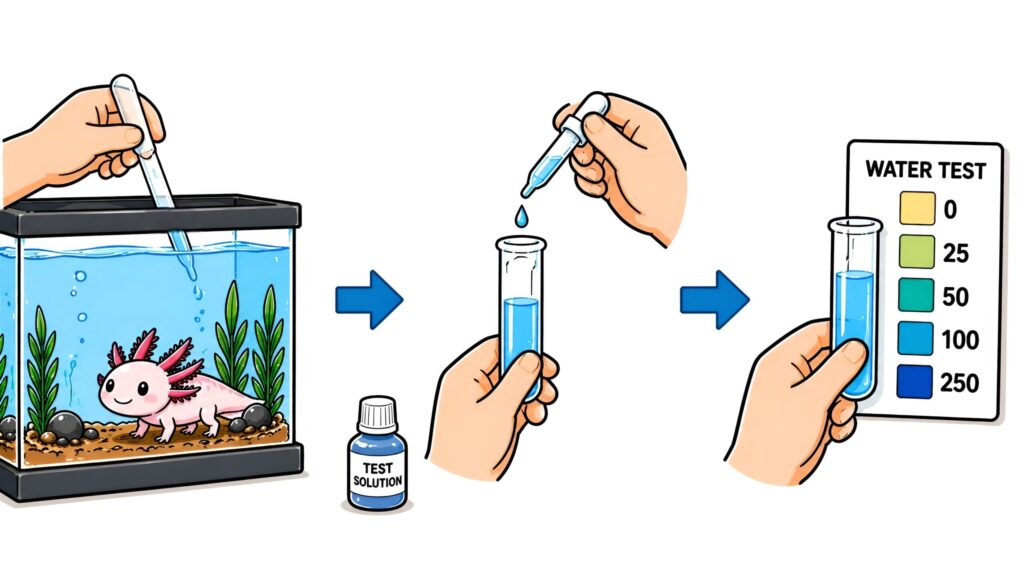
Testing technique matters as much as test kit quality. Even the best kit gives inaccurate results if used incorrectly.
Use clean, dry test tubes for every test. Residue from a previous test contaminates the next one. Rinse test tubes thoroughly with the tank water being tested (not tap water — tap water chlorine affects results) and allow them to drain before adding the fresh water sample. Better yet, use separate test tubes for each parameter rather than rinsing and reusing the same tube repeatedly.
Take samples from the correct location. Sample water from mid-tank, away from the filter output, substrate surface, and any direct light sources. Water chemistry varies slightly across different zones of the tank — sampling from a consistent mid-tank location gives you the most representative reading.
Use good lighting when reading colour comparisons. Natural daylight is ideal. Incandescent and LED light sources can shift the apparent colour of reagent results, making comparisons to the colour card less accurate. If testing indoors, use a bright white light source and hold the test tube against a white background when comparing to the colour card. Read the result immediately after the specified waiting time — colour continues to develop after the test period and comparisons made too late will read high.
Follow waiting times precisely. Each test has a specified development time during which the chemical reaction proceeds. Comparing colours before or significantly after the stated time produces unreliable results. Use a timer.
Test at the same time of day. Certain parameters — particularly pH — fluctuate naturally throughout the day due to photosynthesis in plants, CO2 fluctuations, and biological activity. Testing at a consistent time (e.g., first thing in the morning before lights on, or an hour after lights on) makes readings comparable across different testing sessions.
When to Test Your Axolotl Tank

During cycling: Test ammonia and nitrite daily. This is not optional — the cycle produces rapidly changing conditions and you need daily data to know where you are in the process. The cycle is complete when both ammonia and nitrite consistently read 0 ppm and nitrate is detectable. Our guide to the best axolotl cycling bacteria and best axolotl ammonia solution covers how to run a proper fishless cycle.
In an established tank: Test ammonia, nitrite, nitrate, and pH at minimum once per week. Many experienced keepers test every 3–4 days. Test immediately any time your axolotl shows unusual behaviour — lethargy, rapid gill movement, loss of appetite, floating, or unusual body posture are all potential signs of water quality problems.
After any significant event: Test after any large uneaten food incident, after filter cleaning or media replacement, after introducing new decor or substrate, and any time water temperature spikes significantly. Heat accelerates biological processes in your tank and can cause temporary ammonia surges.
Before every water change: Testing before your water change tells you whether the change is keeping up with waste production. If nitrate is climbing above 20 ppm between weekly changes, your change volume or frequency needs to increase. If ammonia or nitrite is ever above 0 at a routine weekly test, treat immediately with Seachem Prime and perform an emergency water change.
Frequently Asked Questions
How often should I test my axolotl tank water? Daily during cycling, weekly minimum in an established tank. Any time your axolotl shows signs of stress, test immediately rather than waiting for your next scheduled test.
Are test strips accurate enough for axolotl tanks? Not reliably. Test strips have accuracy limitations that make them insufficient as a sole monitoring tool for axolotl tanks, where the difference between 0 ppm and 0.25 ppm ammonia is meaningful. Use liquid reagent kits as your primary testing method.
What are safe water parameters for axolotls? Ammonia: 0 ppm. Nitrite: 0 ppm. Nitrate: below 20 ppm (ideally below 10 ppm). pH: 7.0–7.8. Temperature: 60–68°F (16–20°C). For full temperature guidance, see our article on what temperature axolotls need.
How long do liquid test kits last? API reagents typically have a shelf life of 2–3 years from manufacture when stored correctly — capped, at room temperature, away from direct light. Always check the expiry date on the bottle and replace reagents when they expire, as expired reagents give inaccurate readings that could be dangerously misleading.
Can I use a freshwater test kit for an axolotl tank? Yes — axolotls live in freshwater, so freshwater test kits are exactly what you need. Do not use marine or saltwater test kits, which are calibrated for different parameter ranges.
What if my ammonia reads above 0 in an established tank? Act immediately. Dose with Seachem Prime at the recommended rate to temporarily detoxify the ammonia, perform a 25–30% water change, check for uneaten food in the tank, and investigate potential filter issues. If ammonia continues to read above 0 after 48 hours and a water change, your filter may be under-performing — see our best axolotl filter guide for upgrading options. Consider moving your axolotl to a quarantine tub with clean, conditioned water while you resolve the issue.
Know Your Water, Know Your Axolotl
Water testing is not paperwork — it is the most direct window into your axolotl’s health. The numbers in your test tubes tell you whether the environment you have created is truly safe, or whether something needs attention before your axolotl starts showing symptoms. If you want a complete, keeper-tested guide to every product that goes into excellent axolotl care — from the tank and filtration to food, hides, and health supplies — Best Axolotl Products has everything you need in one place.