
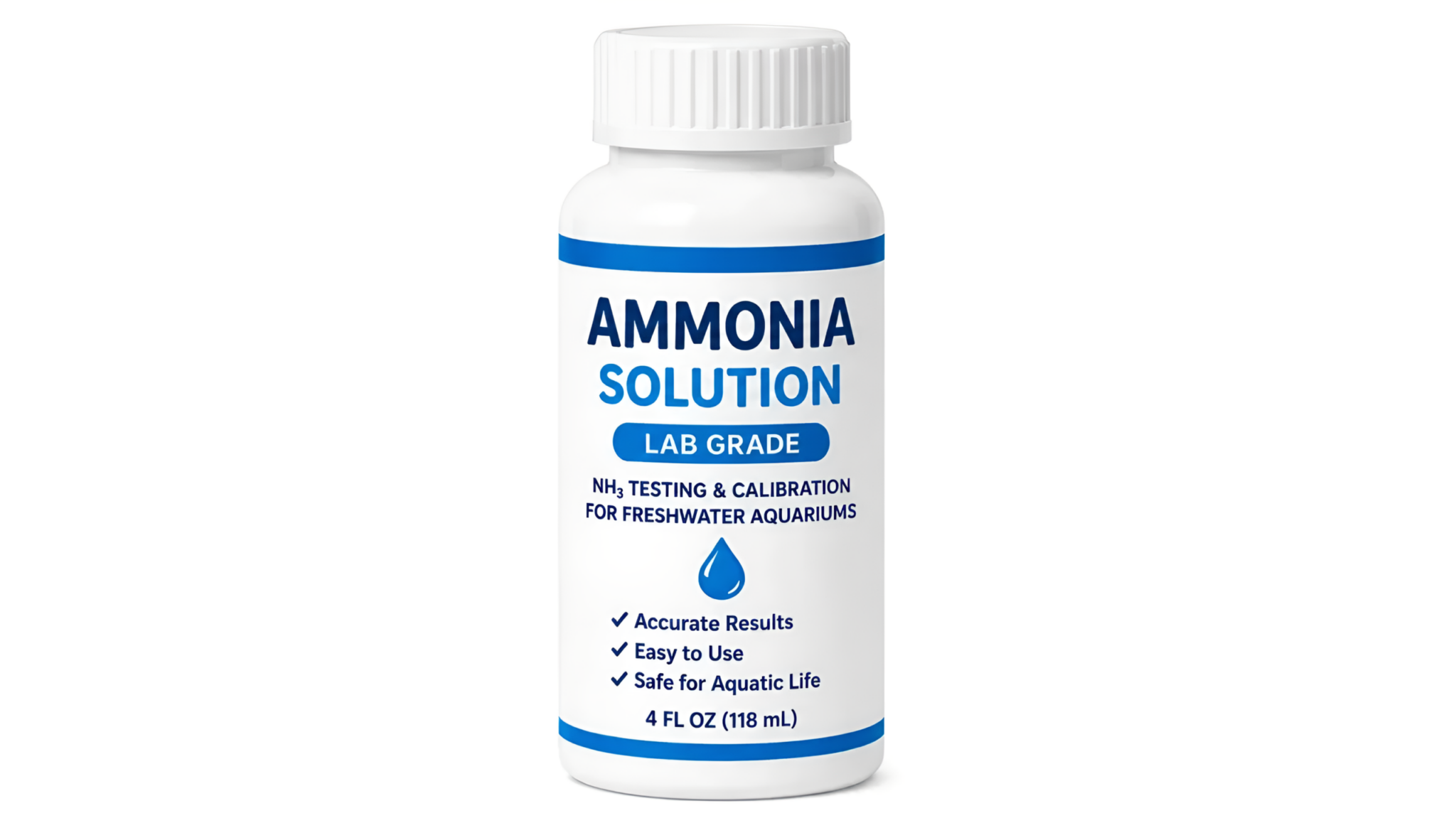
Finding the best axolotl ammonia solution is an essential part of setting up your axolotl tank correctly before your axolotl ever moves in. A pure ammonia solution is the food source that feeds the beneficial bacteria you are trying to establish during the nitrogen cycle — without it, the bacteria you add to your tank have nothing to consume and will die before they can colonise your filter. This guide covers everything you need to know about axolotl ammonia solutions: why they are needed, exactly what makes a product safe to use, which products to avoid, how to dose correctly, and our top verified Amazon picks. Pair this guide with our full axolotl care guide and our guides on the best axolotl cycling bacteria, best axolotl water test kit, and best axolotl water conditioner for the complete cycling picture.
Why You Need an Ammonia Solution to Cycle an Axolotl Tank
The nitrogen cycle — the biological process that makes an aquarium safe to house any animal — depends on colonies of nitrifying bacteria establishing themselves in your filter media. These bacteria convert toxic ammonia (from axolotl waste) into nitrite, and then into the far less harmful nitrate. Without an established bacterial colony, ammonia accumulates to dangerous levels rapidly in any axolotl tank.
The problem is that bacteria need ammonia to survive and multiply. When you set up a brand-new tank with no ammonia source, the bacteria you add — whether from a product like Seachem Stability or Fritz TurboStart 700 (covered in our best axolotl cycling bacteria guide) — have nothing to eat. They will die back within days, and your cycling attempt will stall or fail entirely.
The solution is a fishless cycling approach: you add a pure ammonia solution to the empty tank as an artificial food source for the bacteria, allowing you to build a full biological colony in the filter without exposing any living animal to the ammonia and nitrite spikes that occur during the process. According to research published by DrTim’s Aquatics, whose founder Dr. Timothy Hovanec conducted the seminal research on nitrifying bacteria in aquariums that has been cited in peer-reviewed aquatic science literature, fishless cycling with pure ammonia is the most reliable and humane method for establishing aquarium biological filtration.
This approach is particularly important for axolotls for several reasons. Axolotls are far more sensitive to ammonia and nitrite than most fish — their permeable skin absorbs water chemistry compounds directly, and their external gill plumes are exposed and vulnerable to chemical irritation. According to research published in Aquaculture, even sub-lethal ammonia concentrations suppress immune function in aquatic salamanders significantly. The wild Ambystoma mexicanum is critically endangered, which gives captive care genuine conservation significance — cycling correctly before introducing your axolotl is part of that responsibility.
What Makes a Safe Axolotl Ammonia Solution?
Not every product containing ammonia is appropriate for cycling an axolotl tank. Using the wrong type of ammonia is one of the most common cycling mistakes new keepers make, and it can contaminate the tank with chemicals that harm your axolotl and interfere with bacterial establishment. Here is exactly what to look for and what to avoid.
Pure ammonium chloride with no surfactants. The most important safety test for any ammonia product is the shake test: fill a clean bottle partway with the product, cap it, and shake vigorously. If the liquid foams like soap, it contains surfactants — detergent compounds added to many household cleaning ammonia products. Surfactants are toxic to the beneficial bacteria you are trying to grow and will harm axolotls. Any ammonia solution that foams fails this test and should never be used in an aquarium.
No additives, dyes, perfumes, or preservatives. Household ammonia cleaners — even those labelled “pure” or “clear” — often contain small amounts of dye, fragrance, or other additives that are harmful in an aquarium. These additives are designed for cleaning applications, not aquatic life. Only use products specifically formulated and labelled for aquarium use.
Known concentration for accurate dosing. Aquarium-specific ammonia solutions have a known, consistent concentration — typically 10% ammonium chloride liquid or a measured concentration in dry powder form — that allows you to dose accurately to a target ppm. Hardware store ammonia cleaners have variable and often unlabelled concentrations that make precise dosing difficult and unreliable.
Liquid solution or dry powder — both work. There are two formats of aquarium ammonia source: liquid ammonium chloride solutions and dry ammonium chloride powder. Both are effective. Liquid solutions are convenient and easy to measure with drops. Dry powder gives you much more ammonia per dollar spent and is excellent for large tanks or multiple tank setups. The key with dry powder is precision — a small kitchen scale accurate to 0.1g is useful for measured dosing.
Compatible with Seachem Prime. During cycling, you will be using Seachem Prime to dechlorinate all replacement water. Prime temporarily binds ammonia into a non-toxic form but does not eliminate it — bacteria can still process Prime-treated ammonia. Aquarium ammonia solutions are compatible with Prime-treated water. However, the ammonia test kit you use matters: Prime-treated ammonia reads differently on Nessler reagent test kits (giving false high readings) than on salicylate-based kits. The API Freshwater Master Test Kit uses a salicylate system that accurately reflects the bioavailable ammonia even in Prime-treated water — this is the correct test to pair with Prime and ammonia solution during cycling.
How to Dose Ammonia Solution During Axolotl Tank Cycling
The goal during cycling is to maintain ammonia in your tank at approximately 2–4 ppm — high enough to feed the bacteria without being so high (above 6–8 ppm) that it inhibits bacterial growth. Here is the general dosing process.
Step 1: Add your cycling bacteria first. Before adding ammonia, dose your cycling bacteria product — Seachem Stability, Fritz TurboStart 700, or DrTim’s One & Only. This seeds your filter with live bacteria that will then feed on the ammonia you add.
Step 2: Add ammonia to reach 2–4 ppm. For DrTim’s liquid ammonium chloride solution, the starting dose is 4 drops per gallon of tank water. For a 40-gallon Aqueon breeder — the tank we recommended in our best axolotl tank article — that is approximately 160 drops (about 8mL). Test the ammonia level after 30 minutes. If it reads below 2 ppm, add a few more drops and test again. Adjust from there.
Step 3: Test daily. Use your water test kit to measure ammonia and nitrite every day. As bacteria establish and begin processing ammonia, you will see ammonia levels begin to fall. When ammonia drops below 1–2 ppm, add more ammonia solution to bring it back to 2–4 ppm. Do this every time ammonia drops, throughout the entire cycle.
Step 4: Watch for the nitrite spike. As ammonia-processing bacteria establish, they convert ammonia to nitrite. You will see nitrite climb — often dramatically, to 5 ppm or higher — while ammonia is being controlled. This is normal and expected. Eventually, the second group of bacteria establishes and begins converting nitrite to nitrate, and nitrite will fall to 0.
Step 5: Confirm completion. Your cycle is complete when ammonia drops from 2–4 ppm to 0 within 24 hours after dosing, AND nitrite simultaneously reads 0. Both must be confirmed simultaneously. Test several days in a row to confirm stability before adding your axolotl.
Step 6: Large water change before introducing your axolotl. Before adding your axolotl, perform a 50% water change to dilute accumulated nitrate. Treat all replacement water with water conditioner. Then introduce your axolotl once ammonia and nitrite both confirm at 0. Set your tank temperature appropriately — see our guide on what temperature axolotls need — and have your filter and air pump running correctly before transfer.
Our Top Axolotl Ammonia Solution Picks
Best Overall: DrTim’s Aquatics Ammonium Chloride Solution (2oz, Treats 100 Gallons)
The DrTim’s Aquatics Ammonium Chloride Solution (2oz) is our top overall recommendation for axolotl cycling. It is developed by Dr. Timothy Hovanec — the researcher whose doctoral work on nitrifying bacteria in closed aquatic systems became foundational to modern understanding of aquarium cycling — and it contains reagent-grade pure ammonium chloride with no surfactants, dyes, fragrances, or additives. The concentration is precisely stated (40 mg/mL total ammonia nitrogen), enabling accurate, repeatable dosing at 4 drops per gallon of tank water. It is specifically recommended on the product page for freshwater aquariums, turtles, amphibians, and axolotl tanks, making it one of the few ammonia cycling products that explicitly confirms axolotl safety.
The 2oz bottle treats up to 100 gallons of tank water at the initial dose, making it appropriate for cycling the Aqueon 40-gallon breeder with ammonia to spare for multiple re-doses throughout the cycle. It pairs most naturally with DrTim’s One & Only Live Nitrifying Bacteria — the bacteria product covered in our best axolotl cycling bacteria guide — which was developed by the same researcher to work synergistically with this ammonium chloride formula.
Best for Larger Tanks: DrTim’s Aquatics Ammonium Chloride Solution (8oz, Treats 400 Gallons)
For keepers setting up a larger tank — a 55-gallon setup for two axolotls as recommended in our best axolotl tank article, or any tank above 40 gallons — the DrTim’s Aquatics Ammonium Chloride Solution (8oz) provides the same reagent-grade formula in a larger volume that covers a 400-gallon tank at initial dose. Given that a full fishless cycle requires multiple re-doses of ammonia over 2–6 weeks, having 400 gallons’ worth of dosing capacity from a single bottle ensures you will not run out partway through the process.
Best Value Dry Powder Option: Gingerbread Pet Supply Ammonium Chloride Powder (300g)
For keepers who want the maximum ammonia supply at the best cost-per-dose ratio — particularly those setting up multiple tanks, running a quarantine setup alongside their main tank, or wanting a long-term stock of ammonia on hand — the Gingerbread Pet Supply Ammonium Chloride Powder (300g) is an excellent option. It is pure ammonium chloride powder with no bacteria, enzymes, or fillers — just the pure ammonia source. The precise dosing of 2.25g (half a teaspoon) per 100 gallons to achieve approximately 2 ppm makes dosing consistent and measurable with a small kitchen scale or a measuring spoon. At 300g, this amount of powder will cycle multiple large tanks many times over, making it the most economical ammonia source available on Amazon for serious cycling use.
Best All-in-One Bundle: DrTim’s Aquatics Ammonium Chloride + One & Only Bundle for Freshwater (8oz Ammonia + 16oz Bacteria)
For keepers who want a complete, matched cycling solution in a single purchase, the DrTim’s Aquatics Ammonium Chloride and One & Only Live Nitrifying Bacteria Bundle for Freshwater (8oz Ammonia + 16oz Bacteria) provides everything you need to run a complete fishless cycle: the ammonia source and the live bacteria to consume it, in volumes sized for tanks up to 240 gallons. This is the most straightforward option for a new keeper who wants a single purchase that covers the entire cycling setup without needing to research and assemble products separately. The two products are developed by the same researcher to work together, and the bundle pricing makes it more economical than buying them individually.
Best Ammonia-Free Alternative for Emergency Cycling Situations: Fritz Aquatics Fishless Fuel (2oz)
The Fritz Aquatics Fishless Fuel (2oz) is Fritz Aquatics’ dedicated ammonia source for fishless cycling. It is a pure liquid ammonia solution free of surfactants and additives, compatible with freshwater aquariums, and designed to be used alongside Fritz’s TurboStart 700 cycling bacteria that we covered in our best axolotl cycling bacteria article. If you are already using Fritz TurboStart 700 as your cycling bacteria, pairing it with Fritz Fishless Fuel from the same brand provides a fully compatible, brand-matched cycling system. The 2oz format is sized for tanks up to approximately 30–40 gallons at the initial dose.
How to Check If an Ammonia Product Is Safe for Aquarium Use
Before using any ammonia product in an axolotl tank — including products you may already have at home — perform these two checks.
The shake test. Fill a clean clear bottle or container with a small amount of the product. Cap it and shake vigorously for 15 seconds. Observe immediately. If you see foam that persists for more than a second or two, the product contains surfactants and must not be used in an aquarium. If the liquid returns to clear with no foam, it passes this test.
The ingredients check. Read the label or product description carefully. The product should list only ammonium chloride (NH4Cl) or ammonia (NH3) as an active ingredient. Any mention of surfactants, soaps, dyes, fragrances, or cleaning agents disqualifies it.
Hardware store ammonia cleaners — including many marketed as “clear” or “unscented” — frequently fail one or both of these checks and should never be used in an axolotl tank. Purpose-made aquarium cycling ammonia products are formulated and tested specifically for aquarium use and eliminate this uncertainty entirely.
Common Ammonia Solution Mistakes to Avoid
Using household cleaning ammonia. Even if it passes the shake test, household ammonia cleaners are formulated for cleaning surfaces, not aquatic systems. Variable concentrations, inconsistent formulations, and unknown additives make them unreliable for precise cycling work. Stick to products specifically made for aquarium use.
Letting ammonia drop to 0 without re-dosing. When ammonia falls to 0, the bacteria that process it begin to die back from starvation. Always re-dose ammonia back to 2–4 ppm when it drops below 1 ppm. Consistent feeding throughout the cycle is what builds a large, stable bacterial colony.
Overdosing ammonia above 8 ppm. Very high ammonia concentrations actually inhibit the growth of nitrifying bacteria, slowing the cycle paradoxically. Keep ammonia at 2–4 ppm throughout — test and adjust carefully rather than adding large amounts at once.
Using a Nessler-type test kit with Seachem Prime. Nessler test kits — recognisable by their yellow-to-green colour change — give false high ammonia readings in water treated with Seachem Prime, because Prime reacts with the Nessler reagent. Always use a salicylate-based test kit (like the API Freshwater Master Test Kit we recommended in our best axolotl water test kit article) when cycling with Prime and ammonia solution.
Adding ammonia to a tank with an active axolotl. Ammonia solution is for fishless cycling only — cycling a tank before your axolotl is introduced. Never add ammonia solution to a tank containing any living animal.
Maintaining Good Water Quality After Cycling
Once your cycle is established and your axolotl is in the tank, ammonia solution has done its job. Ongoing ammonia management in the established tank is handled by consistent maintenance — regular water changes using water conditioner, proper feeding practices to minimise uneaten food, and keeping the filter running effectively. Use your water test kit weekly to verify ammonia is consistently at 0 ppm.
Maintain a clean tank environment to keep ammonia production under control. Use a turkey baster to remove uneaten food daily and a tank siphon during weekly water changes. Our guides on how to clean an axolotl tank and how often to clean an axolotl tank cover the full maintenance routine that keeps ammonia in check long-term.
Frequently Asked Questions
What is ammonia solution used for in axolotl keeping? Ammonia solution is used exclusively during the fishless cycling process — before your axolotl is introduced to the tank. It provides a food source for the nitrifying bacteria you are establishing in the filter, allowing those bacteria to grow and colonise filter media without needing a living animal to produce waste.
Can I use household ammonia to cycle my axolotl tank? No. Household ammonia cleaners often contain surfactants, dyes, fragrances, or other additives that are harmful to aquarium bacteria and toxic to axolotls. Only use products specifically formulated for aquarium cycling use that have been confirmed surfactant-free.
How much ammonia solution do I need for a 40-gallon axolotl tank? A 2oz bottle of DrTim’s Ammonium Chloride Solution treats 100 gallons at the initial dose (4 drops per gallon). For a 40-gallon tank, the initial dose is approximately 160 drops (about 8mL). Since you will re-dose multiple times throughout the 2–4 week cycle, a 2oz bottle is the minimum — the 8oz bottle provides comfortable headroom for a full cycle on a 40-gallon tank.
How long does fishless cycling take with ammonia solution and cycling bacteria? With Fritz TurboStart 700 or DrTim’s One & Only bacteria paired with a pure ammonia solution and daily testing, most keepers achieve a confirmed cycle within 7–21 days. Without bottled bacteria, cycling from scratch typically takes 4–6 weeks.
Is ammonia solution safe if I already have plants in the tank? Live aquatic plants can tolerate the ammonia levels used in fishless cycling (2–4 ppm). In fact, plants can help accelerate cycling by absorbing some ammonia directly and providing surface area for bacterial colonisation. Some plant-safe fertilisers can be added during cycling. See our guide on best axolotl tank plants for the best species to include in a cold axolotl tank.
Can ammonia solution ever go in a tank with an axolotl in it? No. Ammonia solution is only for fishless cycling — adding ammonia solution to a tank containing an axolotl would rapidly create life-threatening ammonia levels. Never add ammonia solution to any occupied tank.
The Right Start Leads to a Long, Healthy Life
Cycling your tank correctly before your axolotl arrives is one of the most meaningful things you will ever do for your animal’s long-term health. A tank that is properly established from day one stays safer, more stable, and more forgiving for the decade or more your axolotl can live. If you want keeper-tested guidance on every product that goes into excellent axolotl care — from the tank and filtration to food, hides, health supplies, and everything in between — Best Axolotl Products is your complete, one-stop resource for the best gear in every category.