
Origin And Natural Habitat
Northern Brazil’s Amazon basin is where Acanthoscurria geniculata makes its home, in one of the most consistently wet and warm environments on earth. Temperatures across this equatorial zone average around 25 to 26°C year-round, with variation between day and night rather than between seasons, and annual rainfall in the region reaches approximately 2,200mm with little to no genuine dry season. On the forest floor of this lowland tropical rainforest, beneath logs, within root systems, and under the deep accumulation of leaf litter, this species lives a largely terrestrial and at least partially fossorial life, opportunistically burrowing when the substrate and conditions allow. The near-constant warmth and humidity of the Amazon basin shapes the spider’s requirements in captivity in straightforward ways: consistent warmth, moderate to high humidity, and a substrate that never completely dries out.
Beyond its biology, A. geniculata holds a distinction unique in the tarantula world. In 2014, scientists published a draft assembly of its complete genome in the journal Nature, making it the first tarantula species to have its DNA fully sequenced. That data has since contributed meaningfully to broader research on spider biology, venom evolution, and silk protein structure.
Scientific Classification
First described by C. L. Koch in 1841 as Mygale geniculata, the species was renamed Scurria geniculata by Koch in 1850 before being placed in its current genus by Ausserer in 1871. The genus name Acanthoscurria derives from the Greek akanthos (thorn or spine) and scurria (a jester), though the practical reference is to the spiny morphology of the chelicerae and leg structures characteristic of the genus. The species name geniculata comes from the Latin for “having little knees,” a direct reference to the distinctive banding. Full classification: Kingdom Animalia, Phylum Arthropoda, Class Arachnida, Order Araneae, Infraorder Mygalomorphae, Family Theraphosidae, Subfamily Theraphosinae, Genus Acanthoscurria, Species A. geniculata (C. L. Koch, 1841).
Species Overview
One of the most consistently recommended large tarantulas for beginners and intermediate keepers alike, the Brazilian White Knee has earned its place as a genuine hobby staple. Also sold as the Giant White Knee and the Whitebanded Tarantula, it combines impressive adult size, a feeding response that is among the most dramatic of any species in the hobby, fast growth relative to its eventual size, hardy constitution, and an appearance that photographs and displays exceptionally well. Care requirements are straightforward by any standard. The main things to understand going in are that the urticating hairs of this species are described as among the more irritating of any New World tarantula, it is food-aggressive enough that enclosure maintenance requires attentiveness, and slings are tiny and somewhat delicate at the earliest stages before they hit their growth stride.
Appearance And Size
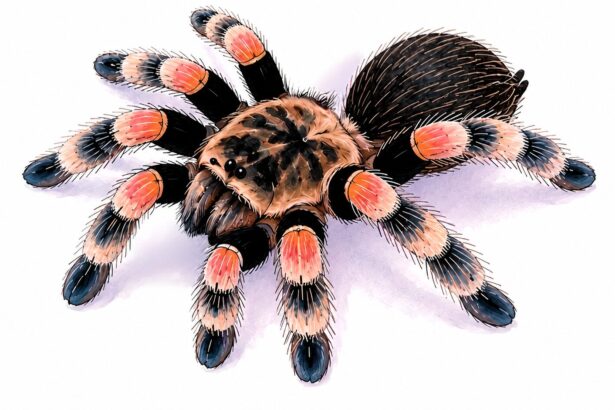
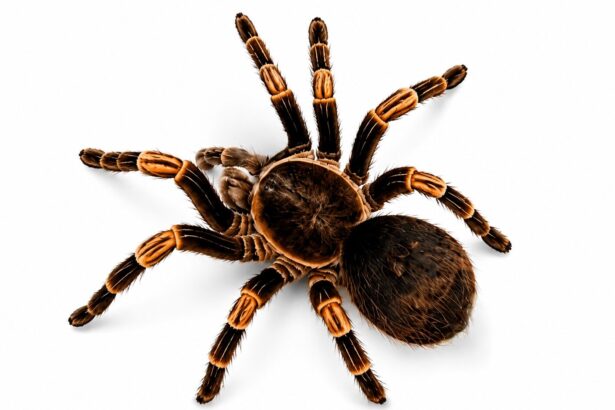
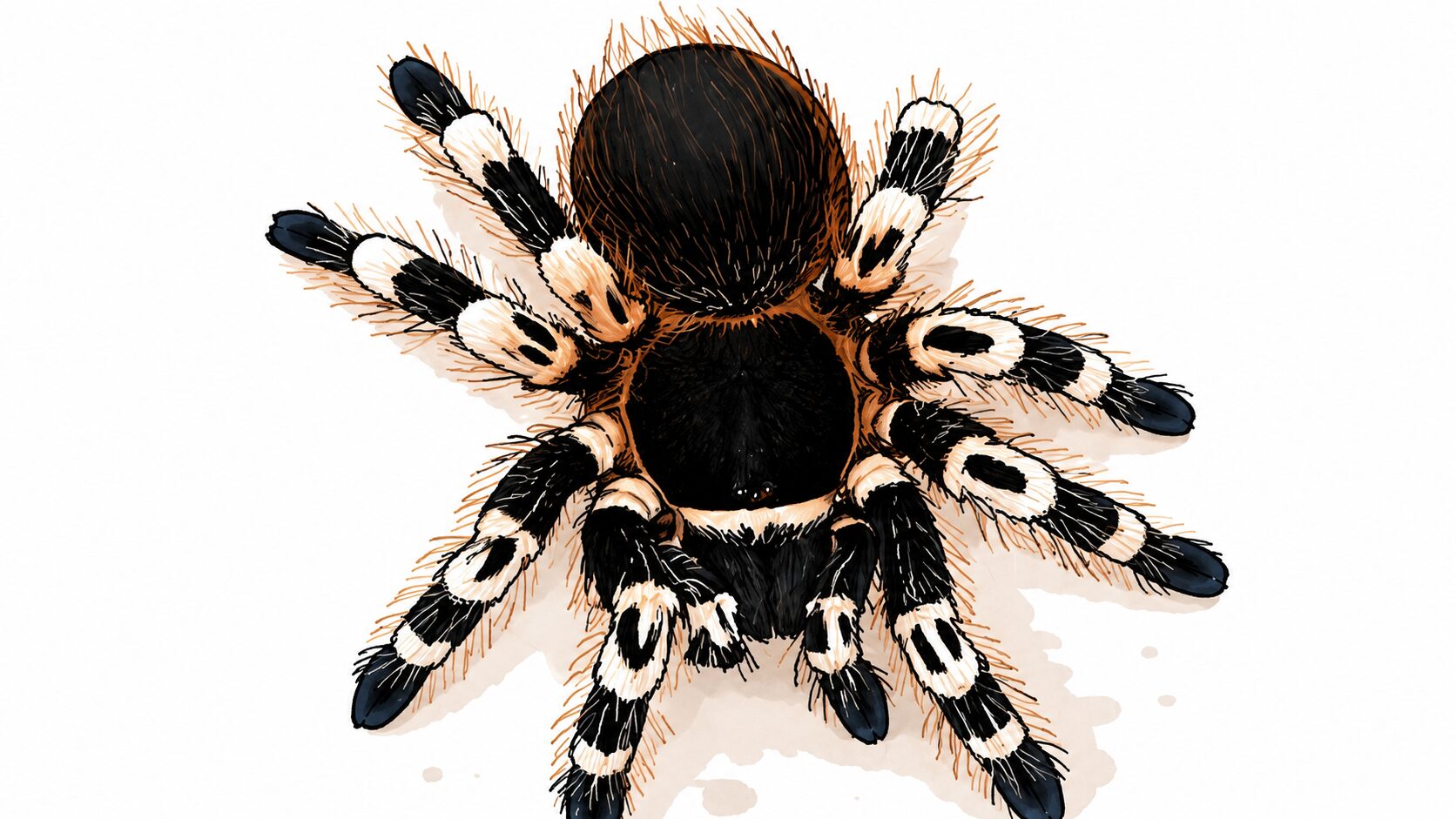
The white knee banding is what defines this species visually, and on a fully adult female it is genuinely striking. Broad, clean white bands mark each leg at the patella, contrasting sharply against the deep velvet black of the legs and carapace. The abdomen is covered in reddish-orange setae that give the posterior half of the spider a distinctly warm, coppery tone against the darker front half. The overall effect at full size is bold and high-contrast in a way that reads as impressive from across the room. Slings start cryptically and develop their adult colouration gradually through successive moults, with the white banding becoming progressively more defined around the three-quarter to one-inch legspan mark and fully saturated by the time the spider reaches one and a quarter to two inches.
Adult females reach a diagonal legspan of 7.5 to 8.5 inches, with body length of around 9 centimetres, putting them firmly in the large category alongside species like the Goliath Birdeater. The growth rate to reach that size is fast for a terrestrial species of this scale, with some individuals reaching nearly four inches in legspan within their first year under good conditions. Males mature smaller and considerably shorter-lived at around 4 years post-maturity versus the female’s potential 15 to 20 years.
Housing
Floor space is the priority here, not height. A footprint of 18 by 12 inches is appropriate for juvenile specimens and works for many adults; a 30 by 30 centimetre or larger floor area gives adults room to move, position a burrow, and be seen. Height above substrate should be kept modest — this is a large, heavy spider and a fall from height can cause serious abdominal injury. Front-opening enclosures are strongly preferred for two reasons specific to this species. First, the food-aggressive response means an open top lid creates a genuine lunge risk during feeding. Second, the urticating hair tendency means minimising disturbance from above reduces the chance of a hair-kicking incident directed toward the keeper’s face. A tight-fitting lid with secure locking is non-negotiable. Our best tarantula enclosure guide covers terrestrial formats with front access and appropriate security for large, active species.
Enclosure’s Decorations
Cork bark positioned at substrate level provides both a surface hide option and an anchor for burrow entrance webbing. Many individuals will use a cork bark hide as a retreat when they are not actively hunting rather than digging a full burrow, though some will excavate. A shallow water dish at ground level is essential. Beyond those two items, decoration can be kept minimal — this species is not shy about using open floor space and is actually one of the better terrestrial display tarantulas precisely because it tends to be visible rather than hiding. Adding a piece of cork tube partially buried at an angle gives the spider the option of a semi-covered retreat that is still visible to the keeper. Our best tarantula hide and best tarantula cork bark guides cover appropriately sized pieces for a large terrestrial enclosure.
Substrate
Four to six inches minimum for adults, with moisture retention as the key quality to look for in whatever blend is used. Coconut coir and peat moss in equal parts is the standard reliable choice, with optional additions of topsoil for firmness or vermiculite for improved moisture distribution. The substrate should be maintained with a moisture gradient — lightly damp in the lower half where the spider sits and burrows, drier toward the surface. This species does not tolerate completely dry conditions well, and keepers have noted that females will sometimes splash water from their dish onto the surrounding substrate themselves to create a damp patch, a behaviour that points clearly to what conditions they prefer. Our best tarantula substrate guide covers moisture-retaining tropical blends appropriate for a large fossorial terrestrial species.
Water And Humidity
A shallow water dish large enough for the spider to comfortably drink from should be available at all times and refreshed every two to three days. Ambient humidity between 65 and 80 percent suits this species well, maintained through the substrate moisture gradient, the evaporation from the water dish, and periodic light misting. The Amazon basin provides year-round humidity with little seasonal variation, so consistent mid-range humidity rather than alternating wet and dry cycles is the appropriate approach. A hygrometer inside the enclosure takes the uncertainty out of monitoring, and a misting bottle with a fine-mist setting avoids drenching the substrate with each application.
Heating And Temperature
The equatorial Amazon basin where this species lives maintains temperatures around 24 to 27°C year-round, and replicating that consistent warmth in captivity is straightforward for most keepers. A range of 75 to 82°F is the target, and many keepers in temperate climates maintain this species at room temperature for most of the year without supplemental heat. If ambient room temperature drops below 68°F consistently, a low-wattage heat mat on the side of the enclosure controlled by a thermostat is the appropriate solution. A thermometer positioned at substrate level, not just at room level, confirms actual conditions inside the enclosure and is worth the minimal cost for the certainty it provides.
Diet And Nutrition
Watch a well-conditioned adult A. geniculata take a large roach and you will understand immediately why this species has such a devoted following. The feeding response is one of the fastest and most committed of any terrestrial tarantula in the hobby, with prey contacted and subdued in a strike so rapid it barely registers. Adults take large crickets, dubia roaches, and other appropriately sized feeders readily, typically every seven to ten days, though some individuals eat more frequently without ill effect. Prey should be sized no longer than the spider’s abdomen. Juveniles can be fed every five to seven days and show the same aggressive feeding enthusiasm at smaller scale. Remove uneaten prey within 24 hours, and be particularly attentive to this during feeding sessions — a food-aggressive spider and a loose cricket or roach in a shared space is an invitation for problems if the spider later moults and becomes vulnerable. Our best tarantula food guide covers feeder insect options, gut loading, and sizing relevant to a large, fast-growing species.
Compatibility
Solitary only. No exceptions and no tank-mate experiments. For breeding, the male should be introduced to a well-fed female with the keeper present throughout. Food aggression can make females unpredictable during introductions, so the female should have eaten recently and the keeper should be ready to separate the pair quickly.
Behavior And Temperament
Generally described as bold rather than aggressive, and that distinction matters. A. geniculata is not a species that reliably threatens or charges at the keeper during maintenance. What it does do is react with speed to movement inside the enclosure, particularly during feeding, and kick urticating hairs with less provocation than many keepers expect for a species often categorised as beginner-friendly. The hairs of this species are considered notably irritating — Type I and III urticating hairs, with the III being among the most problematic to human skin and mucous membranes. Eye protection during enclosure maintenance is genuinely recommended, not as an excess of caution but as a practical precaution when working with a large, hair-kicking spider that has considerable range. Outside of feeding and disturbance, the species is often visible and active, which contributes to its display value and is one of the reasons it remains consistently among the best-selling tarantulas in the hobby. Our article on how do tarantulas protect themselves covers urticating hair types and their effects in detail.
Handling
Possible with care and some experience, but not essential and not without risk. The combination of food aggression, urticating hair propensity, and the sheer size and weight of an adult female means handling sessions require attentiveness and appropriate respect. Bites are genuinely rare, and venom is considered medically insignificant to healthy adults, but a startled large tarantula moving quickly on a hand is an experience that rewards preparation. Keepers who do handle this species do so at floor level, never directly after feeding, and always with a slow, deliberate approach that avoids triggering the rapid defensive response. Many keepers choose not to handle at all and find the species thoroughly rewarding as a display animal without it.
Health And Lifespan
Females can live 15 to 20 years with proper care, making this one of the longer-lived large terrestrial species in the hobby. Males survive 3 to 5 years after maturity. Hardiness in captivity is genuinely good — this is a robust species that tolerates normal variations in keeper conditions without the fragility of more specialist tarantulas. The primary health concerns are the same as for most high-humidity terrestrials: mould in the substrate driven by excess moisture combined with poor ventilation, and dehydration from chronically dry conditions. A well-maintained enclosure with a consistent water dish, appropriate substrate moisture, and adequate airflow keeps both risks well managed. Our tarantula dehydration article covers identification and recovery for any situation where those conditions slip.
Price
One of the more accessible large tarantulas in the hobby in terms of price, partly because females produce large egg sacs and captive-breeding is well-established. Slings typically sell for $15 to $30 USD. Juveniles range from $30 to $60 depending on size. Confirmed adult females are less commonly available but typically command $80 to $150 when found. Males are variably priced and less sought after. This price accessibility, combined with fast growth and excellent display quality, is a significant part of why the species has been one of the top-selling tarantulas in the American hobby for years running. Everything needed to set up and maintain a proper enclosure for this species is covered on our best tarantula products page.