



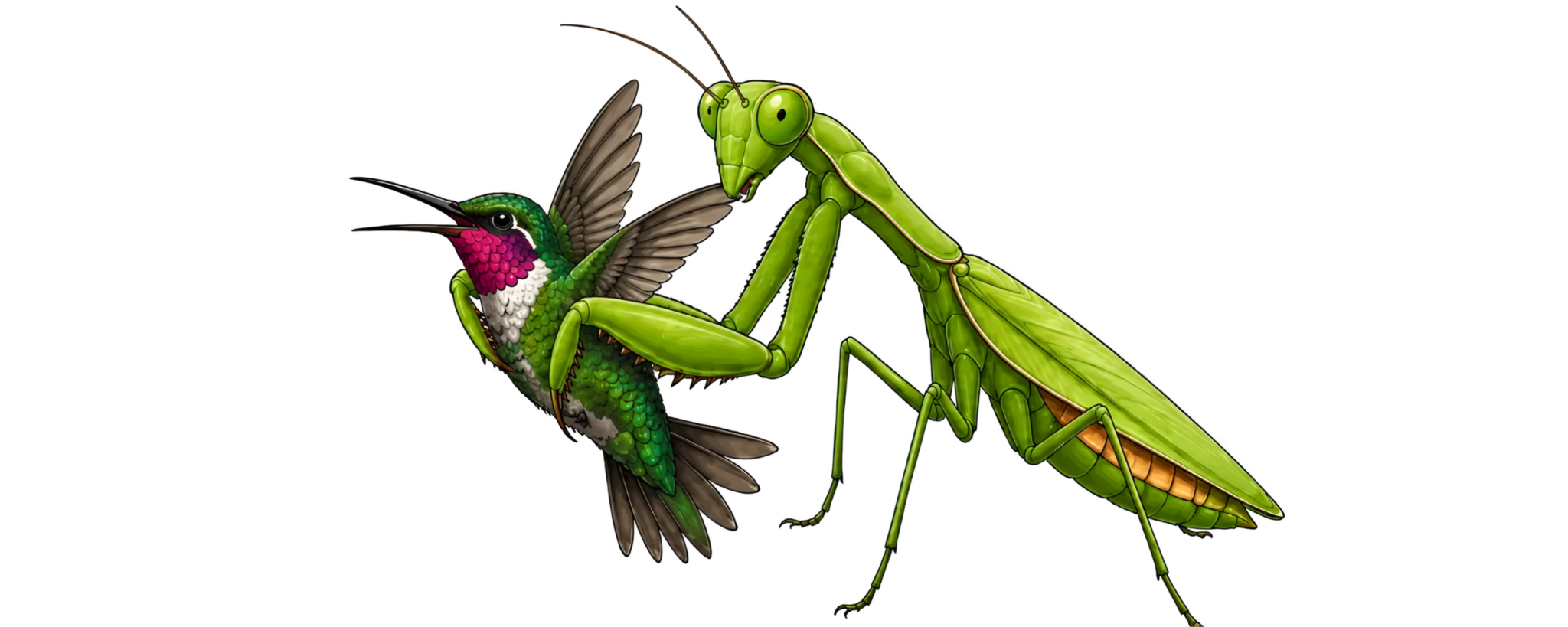
If you’ve ever had a hummingbird feeder in your garden and spotted a praying mantis lurking nearby, you might have wondered whether that mantis poses any real threat to your birds. It sounds almost unbelievable at first — how could an insect take down a bird? But the answer is yes, it can happen, and the science behind it is genuinely jaw-dropping. Read on to find out more.
Can A Praying Mantis Really Eat A Hummingbird?
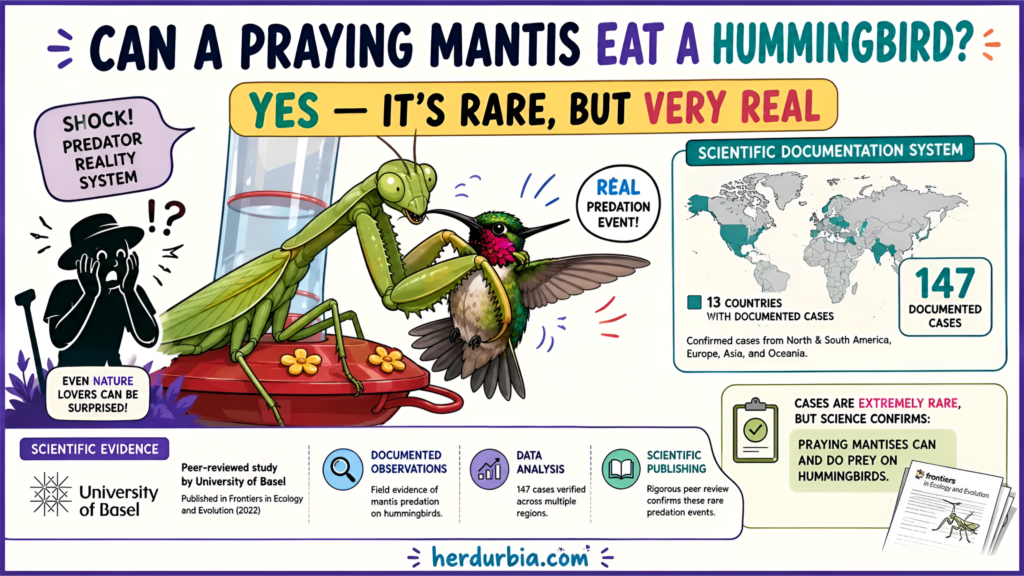
Yes, praying mantises can and do eat hummingbirds. It’s rare, but it’s very real and very well documented. Researchers from the University of Basel conducted a landmark study published in the Wilson Journal of Ornithology that found 147 documented cases of this feeding behavior from all over the world, with praying mantises from twelve species and nine genera observed preying on small birds. This remarkable feeding behavior has been documented in 13 different countries, on all continents except Antarctica, with birds from 24 different species and 14 families found to be prey.
Lead researcher Martin Nyffeler called it a spectacular discovery, and it’s easy to see why. The idea of an insect successfully hunting and eating a bird challenges everything most people assume about the natural order of things. But praying mantises are not most insects — their hunting ability is extraordinary, and we cover just how formidable they are as predators in our article on what do praying mantises eat.
How Does A Praying Mantis Catch A Hummingbird?
This is the part that really makes people stop and stare. Hummingbirds are tiny, weighing around five or six grams — less than a nickel — and mantises are about the same size, which makes hummingbirds likely the only birds that a mantis would be able to catch.
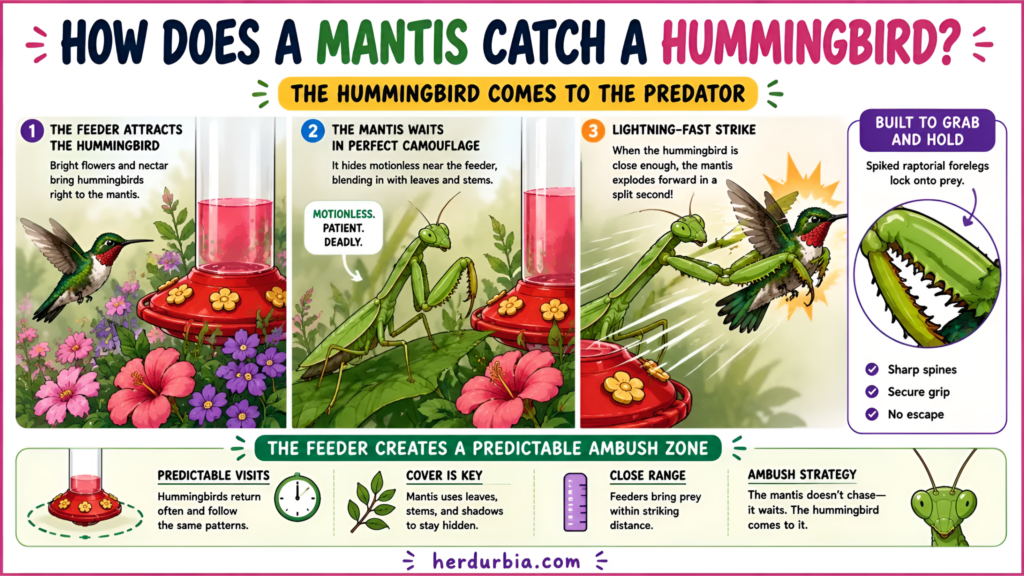
The attack itself is all about patience and positioning. Mantises use specialized raptorial forelegs lined with sharp spikes to snatch and pin prey with lightning speed. A mantis can remain completely motionless for long periods, blending into its surroundings, then strike in a fraction of a second when prey is within reach. Their excellent vision and precise timing enable them to catch prey even larger than themselves.
Hummingbird feeders make the whole thing far easier for the mantis. Feeders provide a predictable location where birds slow down, hover, or perch, giving a mantis the perfect chance to strike. The mantis doesn’t need to chase anything down — it just needs to wait in the right spot, and the hummingbird comes to it. You can read more about the mantis’s extraordinary ambush hunting strategy in our article on are praying mantises venomous.
Why Would A Praying Mantis Go After Something As Big As A Hummingbird?
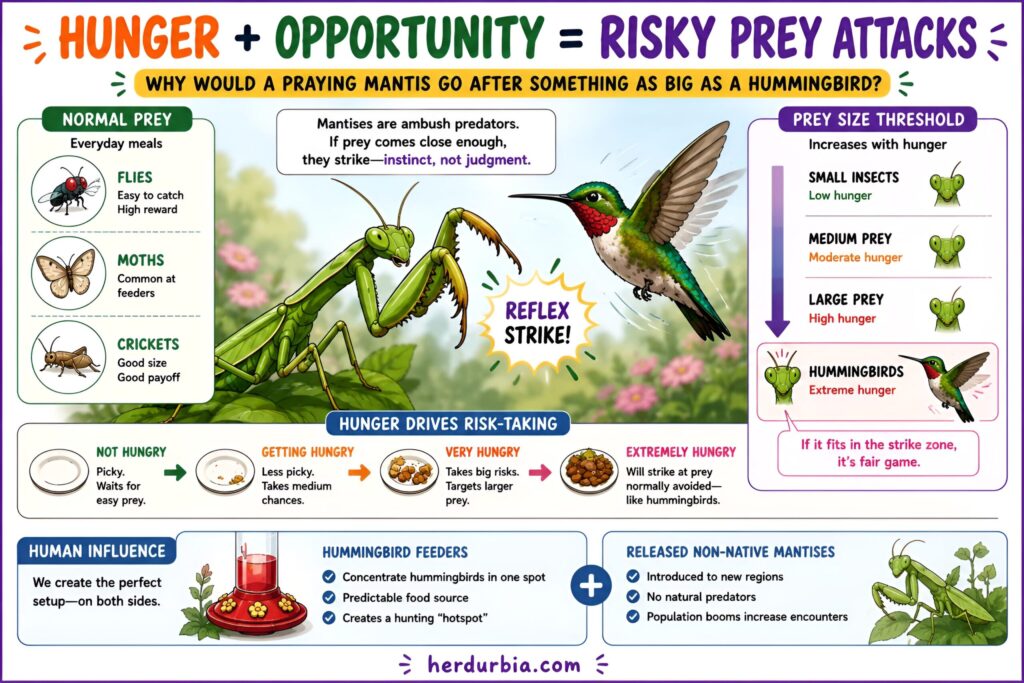
This is a great question, because hummingbirds are significantly larger than what a mantis normally eats. A mantis has to be very hungry to go after a meal as large as a hummingbird, especially since the mantis will not be able to eat the whole thing. As a mantis gets hungry and the time from its last meal gets longer, this idea of what constitutes prey gets broader and broader, and it will strike at larger targets.
Speed also plays a role. Mantises use the size of the prey and its speed relative to its size to decide whether to strike. Hummingbirds are fast, so a mantis might react before discerning what it caught. In other words, the mantis’s lightning-fast reflexes can trigger a strike before its brain has fully registered what it’s actually going after.
Humans have also inadvertently made this problem worse. Decades ago, several alien species of large mantises were released across North America as biological pest control agents. These imported species now constitute a new potential threat to hummingbirds and small passerine birds. By planting nectar sources to attract hummingbirds and simultaneously releasing mantises for pest control, people have been bringing these two species together in a way that wouldn’t naturally happen. This is also something worth considering if you’re thinking about buying mantis eggs for your garden — our article on where can I buy praying mantis eggs covers what you need to know.
Which Mantis Species Are Most Likely To Attack Hummingbirds?

Not every mantis species poses the same level of threat. Smaller mantis species such as the native Carolina mantis are generally too small to pose a threat to hummingbirds. In contrast, larger mantids have the strength and reach to grip and kill a bird, and species like the Chinese mantis and European mantis were the primary culprits in documented cases.
Size is really the deciding factor here. Praying mantises of around 4 inches or more in length — as large or larger than the hummingbirds you are likely to see — are large enough to kill hummingbirds. Smaller individuals are unlikely to be able to do so. So the Chinese praying mantis and European praying mantis are the ones to watch out for if you have hummingbird feeders in your garden.
What Does A Praying Mantis Actually Do To A Hummingbird?
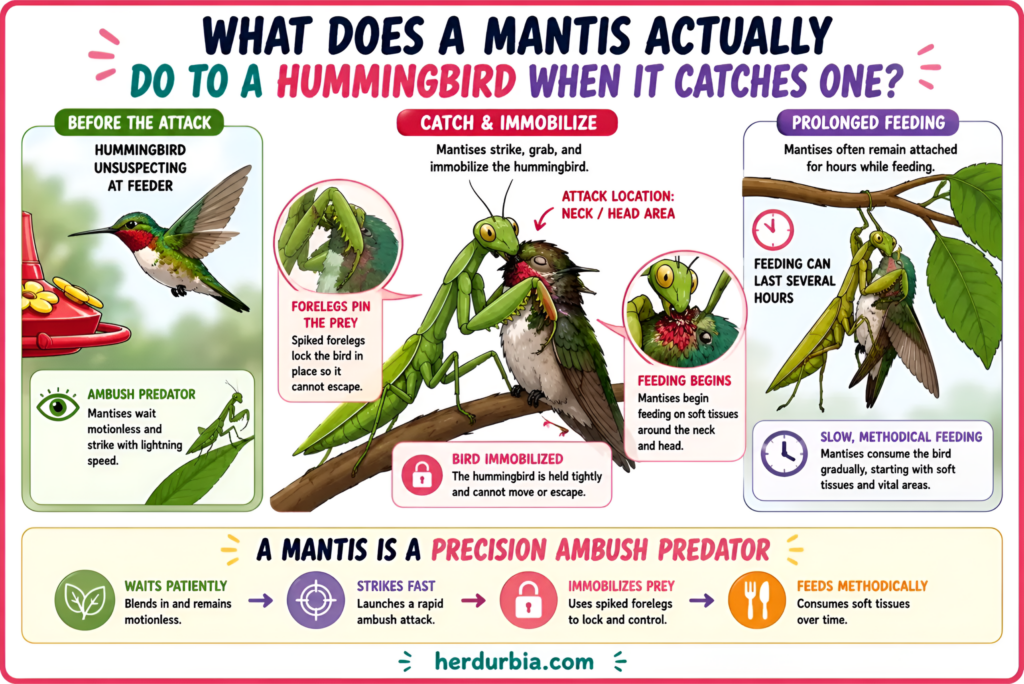
This is where it gets genuinely gruesome. Anecdotal accounts of these insects devouring hummingbirds are brutal — mantises have been seen impaling the chest of the bird, dangling it by its legs, or grabbing it by the skull and feeding on its head. Descriptions of mantises eating hummingbirds note that the insect usually starts by grabbing the bird at the neck, surprising it while it is feeding on a flower or at a feeder. Once the bird is subdued, the mantis slowly nibbles along the neckline and keeps at it for hours until most of the flesh is gone.
CBC News reported on the University of Basel study and noted that about two-thirds of the birds were bitten into the head, neck or throat, and in several cases a mantid had chewed a hole in the victim’s head and was extracting its brains. Occasionally birds were scalped or decapitated, and in some cases they were de-feathered by their captors. It’s one of the more disturbing things the insect world has to offer, but it’s a completely natural predatory behavior. The mantis isn’t being cruel — it’s just doing exactly what it was built to do, and it does it extraordinarily well. This relentless hunting ability with no venom involved is something we explore further in our article on are praying mantises venomous.
How Can You Protect Hummingbirds?
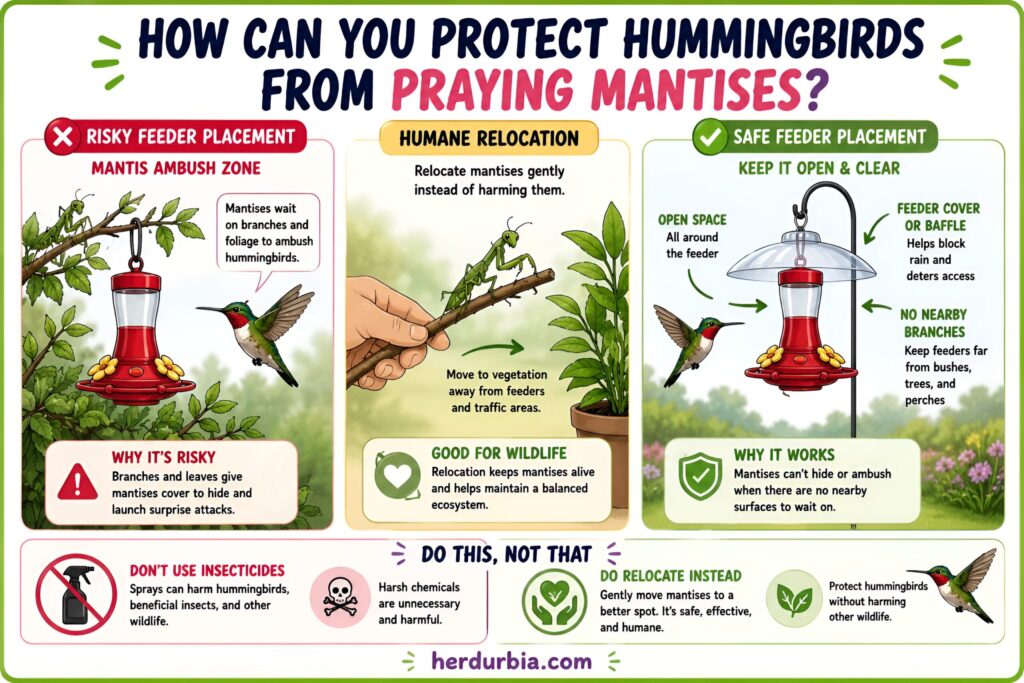
The good news is that attacks are rare, and there are some straightforward things you can do to reduce the risk even further. The National Audubon Society recommends placing hummingbird feeders away from shrubbery or trees where mantises can disguise themselves, and placing a wide bird feeder cover above the feeder as a deterrent. The easiest method though is simply to gently remove any mantis you spot near a feeder using a stick and relocate it somewhere else well away from your garden.
Insecticides aren’t a great idea since mantises are probably eating far more pestiferous insects than hummingbirds while also being eaten themselves by other birds. So removing the mantis rather than killing it is always the better call — it’s a genuinely valuable garden predator and keeping it alive elsewhere benefits your garden more than eliminating it entirely. Our article on are praying mantises invasive also gives some useful context on the introduced species most commonly involved in these incidents.
Conclusion
Praying mantises can eat hummingbirds, and it’s backed up by nearly 150 documented cases spanning over 100 years and 13 countries. It’s rare, it’s shocking, and it’s a reminder of just how incredibly effective these insects are as predators. For most garden owners the risk to hummingbirds is low, but if you spot a large mantis lurking near your feeder it’s worth moving it on before it gets the chance to settle in. If you want to keep learning about the more surprising side of mantis behavior, our articles on can praying mantises eat birds and praying mantis cannibalism are great next reads.