
Origin And History
The Rough Collie, known to most of the world simply as Lassie — the most specifically and the most personally famous individual fictional dog in the history of cinema, television, radio, and literature — and known formally to the AKC and FCI as the Collie (Rough) to distinguish it from the Smooth Collie, the Border Collie, the Bearded Collie, and other breeds within the collie family, is a large, elegant, magnificently coated, wedge-headed Scottish herding breed whose natural home in the 18th century was the highlands of Scotland where it had been used for centuries as a sheepdog, whose most specifically historically documented individual moment in the transition from working dog to companion and show dog came in the 1860s when Queen Victoria encountered the breed at Balmoral Castle in the Scottish Highlands and became so enchanted that she became its most specifically royal and the most specifically publicly influential individual patron, whose most widely celebrated single cultural contribution is the fictional Rough Collie Lassie — created by Eric Knight in the 1940 novel Lassie Come Home and immortalized through multiple films, a two-decade television series from 1954 to 1973, radio programs, and novels, making Lassie one of the few animal characters to have a star on the Hollywood Walk of Fame — and a breed recognized by the AKC since the founding of that organization’s recognition system, with the Collie Club of America — founded in 1886 — being one of the oldest breed-specific clubs in existence in the United States and the second parent club association to join the AKC.
The breed’s most ancient origins trace to the herding dogs of the Scottish Highlands and Wales, with the word collie first appearing in Geoffrey Chaucer’s Canterbury Tales written between 1387 and 1400 — Ran Colle oure dogge — making the breed name’s first literary appearance one of the most specifically and the most personally precise individual medieval references in any breed’s etymology. The name is most broadly believed to derive from the Scottish colley sheep — a black-faced highland sheep that early Collies were bred to manage — though this etymology is not universally agreed upon. The breed’s primitive ancestors may have arrived in Britain as early as the Bronze Age before 1200 BCE, with Roman cattle dogs that accompanied the legion invasions potentially contributing to the indigenous British herding dogs, creating through centuries of isolation on the British Isles the specific herding dog type that eventually evolved into the multiple Collie family breeds recognized today.
The two founding regional varieties are the most specifically documented individual founding distinction in the breed’s early history. The Scottish Highland variety was a large, strong, somewhat aggressive dog bred to herd hardy highland sheep across demanding mountain terrain — the ancestor of the modern Rough Collie. The Welsh variety was smaller, nimble, domesticated, and friendly, herding goats rather than sheep — contributing a temperament quality to the Welsh working dog tradition. It was in the mid-19th century that English breeders began crossing the two types and developing the specifically show-oriented conformation that produced the Collie familiar to the world today.
The breed was first exhibited in 1860 at the Birmingham, England dog show in the generic class Scotch Sheep-Dogs — the most specifically modest individual debut of any breed that would subsequently achieve global recognition. The royal transformation came in the 1860s when Queen Victoria visited Balmoral Castle in Scotland and encountered the Rough Collie — becoming so enchanted that she made herself a patron of the breed from that point forward, giving Collies as gifts to diplomats and aristocrats across the whole of Europe, and allowing her beloved Collie named Gypsy to be buried in the park of Windsor Castle in 1868. The royal seal of approval immediately caused demand for the breed to boom, and by 1877 Collies were being shown at the Westminster Kennel Club show where wealthy American dog lovers including J.P. Morgan acquired them. The youngest dog ever to win Westminster Kennel Club Dog Show Best in Show was Ch. Laund Loyalty of Bellhaven — a nine-month-old Rough Collie.
The Rough Collie is progenitor of both the Australian Cattle Dog and the Australian Kelpie — when Rough Collies reached Australia with British migrants in the 19th century, they were crossed with indigenous Australian dingo-derived stock to produce the specifically Australian herding breeds adapted to the continent’s specific working conditions.
The breed was written into American cultural permanence by two writers. Albert Payson Terhune — whose 1919 publication of Lad, a Dog about his own Rough Collies at Sunnybank, his New Jersey home, launched approximately 30 books about the breed — did more for popularizing the breed than any other single individual before or since. Eric Knight’s 1940 novel Lassie Come Home created the most famous individual dog in the history of English-language storytelling, and when the 1943 film adaptation cast Pal — a problem pup transformed into a superstar by trainer Rudd Weatherwax — the Rough Collie’s public identity was permanently and specifically fixed as the most specifically loyal, the most specifically intelligent, and the most specifically heroic breed in popular American culture. The television series Lassie from 1954 to 1973, featuring successive descendants of Pal owned by Weatherwax, produced the single most sustained individual breed promotion campaign in the history of American television.
Breed Overview
| Trait | Details |
|---|---|
| Origin | Scottish Highlands and Wales (herding breed; centuries of documented history) |
| AKC Name | Collie (Rough) |
| FCI Name | Collie Rough (Standard No. 156, Group 1, Section 1) |
| AKC Recognition | Early recognition; Herding Group |
| Collie Club of America | Founded 1886 — one of oldest breed-specific clubs in USA; second parent club to join AKC |
| First Exhibition | 1860 — Birmingham, England dog show (“Scotch Sheep-Dogs” class) |
| Royal Patron | Queen Victoria — encountered at Balmoral Castle 1860s; gave Collies to European diplomats |
| Queen Victoria’s Collie | Gypsy — buried in Windsor Castle park (1868) |
| Westminster Record | Ch. Laund Loyalty of Bellhaven — youngest dog to win Westminster Best in Show |
| Literary Fame | Albert Payson Terhune (Lad, a Dog, 1919; ~30 books); Eric Knight (Lassie Come Home, 1940) |
| Cinematic Fame | Pal — first dog to play Lassie (1943); trained by Rudd Weatherwax |
| TV Fame | Lassie (1954–1973); one of few animal actors with Hollywood Walk of Fame star |
| Sunnybank | Terhune’s New Jersey home; now a memorial park with gravesites of his Collies |
| Australian Contribution | Progenitor of Australian Cattle Dog and Australian Kelpie |
| Texas A&M Mascot | Reveille — has been a Rough Collie since Reveille III in 1966; current mascot is Reveille X |
| J.P. Morgan | Among early wealthy American Collie fanciers (Westminster 1877) |
| Two National Standards | British (FCI-recognized) and American (AKC) — similar but US type slightly larger |
| Height | Males 61–66 cm (24–26 inches) / Females 56–61 cm (22–24 inches) |
| Weight | Males 27–34 kg (60–75 pounds) / Females 23–29 kg (50–65 pounds) |
| Lifespan | 12–14 years |
| Coat | Long double coat; rough, straight outer coat; soft dense undercoat; mane-like ruff at neck |
| Colors | Sable and white; tricolor (black/white/tan); blue merle; white |
| Drug Sensitivity (MDR1) | Specific mutation causes fatal reactions to common drugs including ivermectin; testing essential |
| Collie Eye Anomaly (CEA) | Specific inherited eye condition; DNA testing available |
Lassie: The Most Famous Dog in the World
Before discussing care, the Rough Collie’s most specifically and the most universally culturally recognized individual identity deserves its own acknowledgment — not because Lassie is the breed, but because for generations of children and families worldwide, Lassie was the specific and personal way they first encountered what a Rough Collie was, and because the character’s qualities — loyalty, intelligence, courage, and an almost supernatural awareness of human need — were not invented by Hollywood but accurately observed from the breed’s actual character.
Eric Knight’s 1940 novel about a Rough Collie’s determination to return to her boy despite being sold away created one of literature’s most powerful individual explorations of the bond between dog and human. When the 1943 film adaptation cast Pal as Lassie and Roddy McDowall as the boy, the screen chemistry between an extraordinary dog and a gifted young actor produced something that transcended conventional animal entertainment. Pal’s descendants, all owned by trainer Rudd Weatherwax, continued the Lassie role across the long-running television series, and the Lassie brand has never stopped representing Rough Collies specifically in public consciousness. The live Lassie stories are true — the real character of the breed makes these stories feel like accurate reporting rather than sentimental embellishment.
Appearance And Size
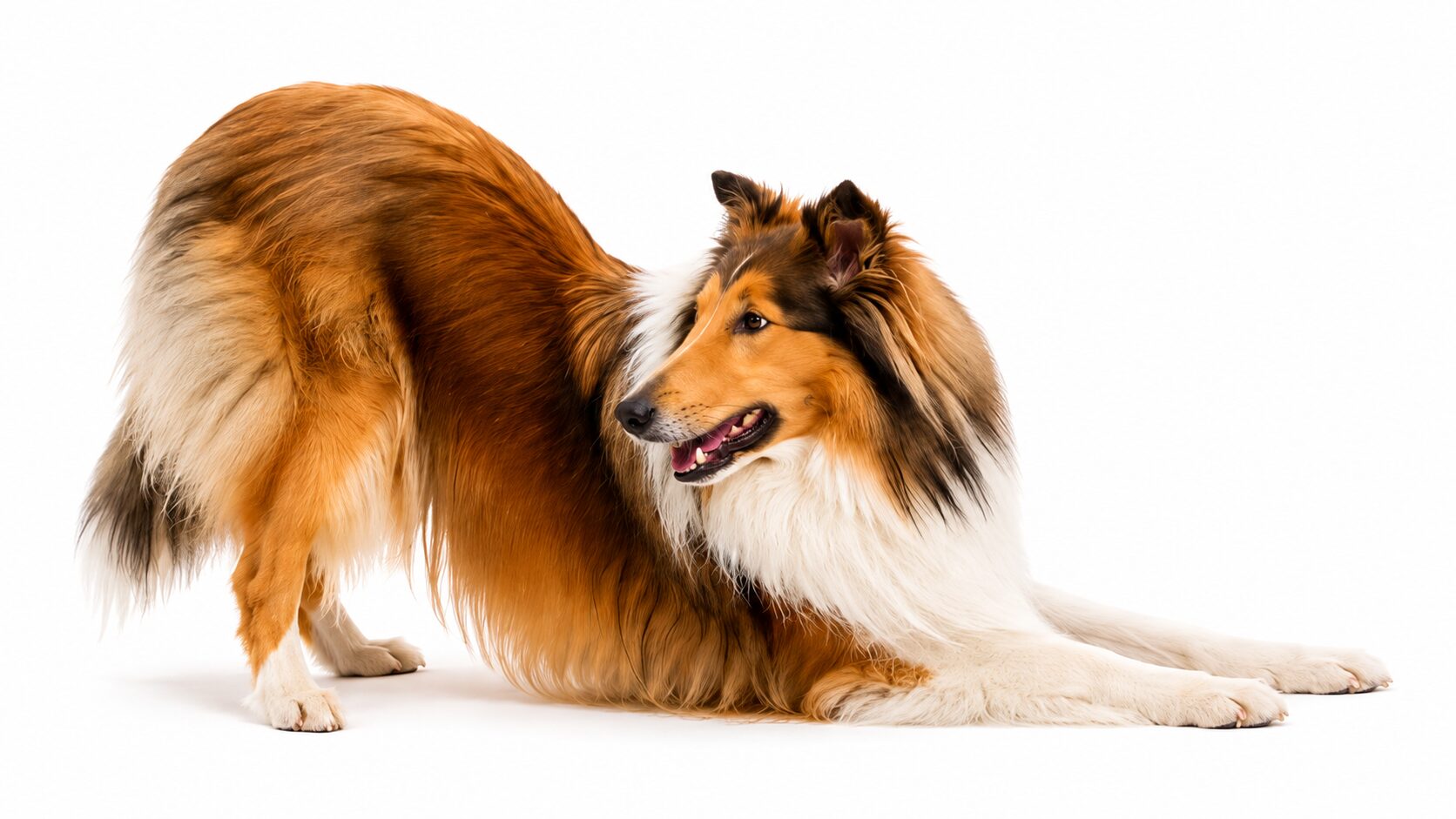
The Rough Collie is a large, elegantly built, magnificently coated herding breed that presents with the most immediately and the most universally recognizable silhouette of any herding dog — the long, narrow, wedge-shaped head tapering to a refined muzzle, the semi-pricked ears carried forward in alert attention, the abundant mane-like ruff framing the face, and the flowing full coat that moves in a way that even non-dog-owners describe as beautiful.
Males stand 61 to 66 centimeters and weigh 27 to 34 kilograms; females are somewhat smaller. The double coat consists of the soft, dense undercoat and the rough, straight outer coat — the combination that produced the mane-like ruff around the neck and chest, the full brush of the tail, and the abundant feathering on the hindquarters that make the breed look both regal and slightly impractical for the demanding Highland sheep herding work from which it emerged. Colors are sable and white (the classic Lassie coloring from warm golden-tan to deep mahogany with white collar and markings), tricolor (black, white, and tan), blue merle, and white.
The characteristic typical Collie color developed through breeders’ wish to make the dogs visible from far away and easier to spot in the Highlands and moors — a functional origin for what became the breed’s most aesthetically celebrated individual quality.
Housing And Living Requirements
The Rough Collie is among the most broadly adaptable of any herding breed in terms of living environment — rough Collies can do well in the country or the city — but the most specifically important welfare consideration that urbanizes readily but requires consistent management is the breed’s specific and deeply embedded need for human companionship. These dogs are so clingy that an isolated Collie can certainly suffer from separation anxiety that leads to incessant barking and destructive behavior despite the gentleness of the Rough Collie’s temperament.
The mane and full coat provide excellent cold-weather insulation — the breed was developed for Scottish Highland conditions where weather is reliably severe and unpredictable — while creating specific heat management requirements in warm climates. The coat should never be shaved in summer; the coat insulates from heat as well as cold, and air circulation through the double coat provides passive cooling that shaving eliminates while increasing sunburn risk.
An orthopedic dog bed provides appropriate joint support given the hip dysplasia documented in the breed. A comfortable dog bed in a social area of the home suits the breed’s specifically people-integrated domestic character — a Collie that cannot be near its family will express the frustration with vocal persistence.
Exercise Requirements
The Rough Collie requires at least 45 to 60 minutes of vigorous daily outdoor exercise — generally two half-hour sessions daily that include running and aerobic engagement beyond casual walking. While less intensively driven than the Border Collie, the Rough Collie is still essentially a working dog that needs to channel its energy purposefully. A bored Collie who doesn’t get enough exercise can be prone to barking and indulging in destructive behavior.
Dog agility is the most specifically celebrated competitive sport for the breed, engaging the intelligence, athleticism, and handler-focused cooperation that herding selection specifically produced. Herding trials authentically engage the breed’s working heritage — herding instincts and trainability can be measured at noncompetitive herding tests, and Rough Collies exhibiting basic herding instincts can be trained to compete in herding trials. Flyball, tracking, and obedience trials all suit the breed’s training intelligence and genuine working capability.
Puzzle toys and enrichment activities are genuinely important for mental engagement between outdoor sessions — a breed this intelligent requires cognitive challenge alongside physical exercise. A GPS tracker is a practical safety investment for outdoor exercise in open areas where the herding drive might take the breed after anything that moves.
Grooming Requirements
The Rough Collie’s magnificent double coat requires the most consistent and the most specifically technique-appropriate individual grooming investment of any herding breed in this series — the mane, ruff, and abundant body coat that make the breed so immediately beautiful are also the coat that mats most specifically and most persistently when brushing is inadequate or inconsistent.
Thorough brushing two to three times weekly with a pin brush, slicker brush, and metal comb maintains the coat in the condition that prevents mat formation. The areas most specifically vulnerable to mat formation — behind the ears, in the mane where the longer hair tangles against itself, in the pants (the longer hair on the hindquarters), and under the front legs — require the most specific and the most sustained individual brushing attention. The coat sheds moderately throughout the year with two more significant seasonal shedding periods requiring daily brushing during the heaviest periods.
Bathing every six to eight weeks maintains coat and skin health. Professional grooming several times yearly supplements home maintenance effectively. Dental care should be established as a consistent routine from puppyhood. Ears should be checked and cleaned weekly. Nails should be trimmed regularly.
Diet And Nutrition
The Rough Collie is a medium-to-large, moderately active herding breed with daily caloric needs calibrated to its actual size and genuine working output. A high-quality medium-large breed formula with a named protein source as the first ingredient provides the nutritional foundation.
Most adults do well on two measured meals per day. The long coat can make weight assessment by eye unreliable — regular hands-on rib assessment beneath the coat is the most practically reliable ongoing body condition monitoring practice. Training treats are highly effective motivators given the breed’s food engagement and genuine desire to please. Discussing joint supplements with your veterinarian from the dog’s early adult years is worthwhile given the hip dysplasia documented in the breed.
Compatibility
The Rough Collie is one of the most specifically and the most broadly family-compatible of any herding breed — the specifically warm, gentle, child-responsive character is not Lassie-created mythology but the authentic expression of a breed whose working tradition alongside Scottish shepherds and their families in isolated Highland communities produced the most family-integrated working dog temperament in the herding group.
If you have ever known a Collie, then you know what it means to have the kindest, most gentle, most caring soul in your midst — a characterization from the breed community that reflects generations of Collie owners’ experiences rather than promotional language.
With its own established family, the breed is completely devoted. With children, the breed is specifically celebrated and specifically gentle — the nurturing side often shines around children, where this gentle dog acts like a four-legged babysitter. The Collie’s tendency to herd children by nipping at heels is a herding instinct that requires specific consistent training management rather than aggression correction. With strangers, the breed is friendly and alert rather than aggressive — a watchdog that barks to warn rather than a guardian that threatens.
With other dogs and pets, the breed is consistently appropriate when properly socialized. With moving objects — anything that moves is fair game for herding, including children, other dogs, chickens — the herding instinct requires consistent management. A dog crate is a useful management tool during puppyhood.
Behavior And Temperament
The Rough Collie is smart, quick to learn, and very in tune to people — the most specific and the most personally accurate individual temperament characterization, identifying the three qualities that have made the breed the most specifically family-appropriate herding dog in American popular culture. These qualities that make a good herding dog — trainability, adaptability, loyalty, soundness of body and character, agility, grace — contribute so much toward making the dog an outstanding companion.
The sensitivity is the most specifically important individual behavioral characteristic for any Rough Collie owner to understand before acquisition. These are good-natured but sensitive dogs, meaning they can easily become afraid with negative training approaches. The Collie is among the most specifically sensitive of any herding breed to harsh correction — praise and encouragement are the best training tools, and shouting and physical punishment should be completely avoided.
The vocalness is the breed’s most consistently discussed individual domestic management challenge. Rough Collies can be very vocal, and a bored Collie that needs attention expresses this with persistent barking that neighbors notice before the owner realizes the pattern has established itself. Bark management from puppyhood is the most critically important individual training investment for any Collie owner in a residential setting.
Training And Handling
The Rough Collie is among the easiest breeds to train of any herding breed available — the combination of genuine intelligence, trainability, and genuine eagerness to please produces a dog that responds to training with the most specifically cooperative and the most personally rewarding individual engagement of any breed in the herding group.
Positive reinforcement methods are the most effective and the most specifically required approach given the breed’s documented sensitivity to harsh correction. Training treats are highly effective motivators in patient, varied, genuinely engaging sessions. Collies love the attention that comes with performing, whether doing tricks or competing in agility, obedience, or herding events — a characterization that captures the breed’s most specifically cooperative and most personally enthusiastic training quality.
Once they have learned what you want them to do, their very good memories ensure that the learning stays with them. The most practically important early training investments are bark management, recall training before the herding drive is fully established, and consistent leash manners.
Health And Lifespan
The Rough Collie has a lifespan of 12 to 14 years, though the breed has several specific hereditary conditions that require DNA testing and veterinary awareness. Several of the most important are among the most specifically breed-identified conditions in any herding breed.
Collie Eye Anomaly (CEA) CEA — a group of hereditary eye defects ranging from mild to severe that affects the choroid, retina, and optic nerve — is the most specifically breed-associated hereditary eye condition of any breed in this series. DNA testing identifies affected, carrier, and normal individuals. All breeding animals should be DNA tested and CAER ophthalmologically examined annually.
MDR1 Drug Sensitivity (Multidrug Resistance Mutation) The MDR1 gene mutation that causes potentially fatal sensitivity to numerous common drugs — including ivermectin (a common parasite treatment), loperamide (Imodium), and various chemotherapy drugs — is the most specifically and the most urgently important individual health fact for any Rough Collie owner. Dogs with this mutation can suffer potentially fatal reactions to drugs that are safe and routine in other breeds. DNA testing identifies affected individuals, and every veterinarian treating a Rough Collie must be informed of the potential MDR1 status before any drug treatment. Always have your puppy checked for this condition as one of the first veterinary actions after acquisition.
Progressive Retinal Atrophy (PRA) Progressive retinal atrophy causing gradual vision loss to blindness is documented. DNA testing is available. Annual CAER ophthalmological examination from the dog’s first year provides clinical monitoring.
Hip Dysplasia Hip dysplasia is documented in the breed. OFA hip evaluation of breeding animals is the most important orthopedic screening. Maintaining lean body condition is the most practically meaningful protective measure.
Epilepsy Epilepsy is documented in the breed. Dogs with epilepsy should be excluded from breeding programs.
Routine preventive care including regular vet checks, MDR1 DNA testing as the most urgent individual priority, CEA DNA testing, OFA hip evaluation, CAER ophthalmological examination, consistent dental hygiene, up-to-date vaccinations — specifically avoiding ivermectin-containing heartworm preventatives in MDR1-affected individuals, up-to-date non-ivermectin parasite prevention, and regular grooming skin inspection provides the foundation for a healthy Rough Collie.
Price And Availability
The Rough Collie is moderately available in the United States through a community of breeders connected to the Collie Club of America and AKC breeder referral. The breed ranks consistently among the top 40 to 50 most popular AKC breeds. From reputable breeders with MDR1 DNA testing, CEA DNA testing, OFA hip evaluation, and CAER ophthalmological documentation, expect to pay between $1,200 and $2,500 for a well-bred Rough Collie puppy.
Conclusion
The Rough Collie has herded sheep in the Scottish Highlands since the 13th century with the breed name appearing first in Chaucer’s Canterbury Tales between 1387 and 1400, was first exhibited in 1860 at the Birmingham England dog show in the class of Scotch Sheep-Dogs, was transformed from a working shepherd’s partner into a royal and aristocratic fashion statement when Queen Victoria encountered the breed at Balmoral Castle and began giving Collies to European diplomats — even having her beloved Gypsy buried in Windsor Castle park in 1868, was winning Westminster Kennel Club shows by 1877 with wealthy Americans including J.P. Morgan as advocates, had the Collie Club of America — the second parent club to join the AKC — founded in 1886, was popularized in American literature by Albert Payson Terhune’s 1919 Lad a Dog and approximately 30 subsequent books, became the most famous individual fictional dog in history through Eric Knight’s 1940 Lassie Come Home and its subsequent film and television adaptations including the 1954-1973 TV series whose principal animal actor Pal and his descendants earned one of the few Hollywood Walk of Fame stars given to animals, contributed to founding the Australian Cattle Dog and Australian Kelpie when exported to Australia with British migrants, has been the Texas A&M University Reveille mascot since Reveille III in 1966, and stands today as the most specifically Chaucer-Canterbury-Tales-first-mentioned, the most specifically Queen-Victoria-Balmoral-Castle-discovered, the most specifically Gypsy-buried-Windsor-Castle-park, the most specifically Terhune-30-books-then-Lassie-Come-Home-globally-famous, the most specifically Pal-first-Lassie-Hollywood-Walk-of-Fame-star, the most specifically MDR1-drug-sensitivity-potentially-fatal-reactions-most-urgently-tested, the most specifically CEA-breed-specific-eye-condition, and the most specifically youngest-Westminster-Best-in-Show-winner-ever of all the Herding Group breed partnerships available. Get properly set up before bringing one home. Our Best Dog Products page has everything you need for long-rough-double-coated, sable-and-white-or-tricolor-or-blue-merle, mane-ruffed, wedge-headed, whole-heartedly devoted Scottish Highland herding dogs that carry the full heritage of the Chaucer-era Collie, Queen Victoria’s Balmoral Castle discovery, the Windsor Castle park burial of Gypsy, J.P. Morgan’s Westminster fascination, the 1886 Collie Club of America founding, Terhune’s Sunnybank stories, Eric Knight’s Lassie Come Home, Pal’s Hollywood stardom, the long-running Lassie TV series, the MDR1 testing priority, and the specific kind, gentle, caring, intelligent, sensitive-to-harsh-correction, barks-when-bored, herds-the-children, Lassie-stories-are-all-true spirit of the most famous herding dog the Scottish Highlands ever sent to Hollywood.