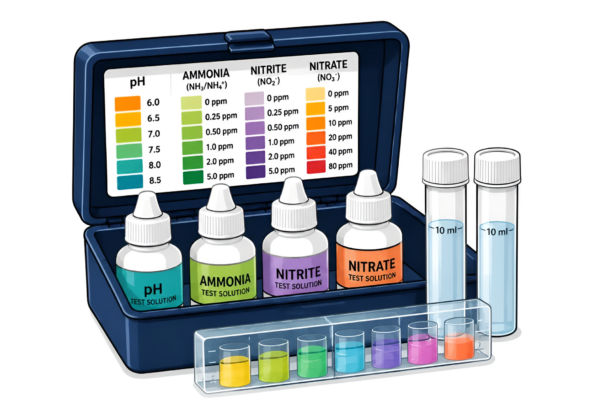


Choosing the best axolotl water chiller could genuinely be the difference between a thriving axolotl and a very sick one. Temperature management is not optional for axolotl keeping — it is a non-negotiable part of responsible care. Axolotls are cold-water animals that need consistent temperatures between 60–68°F (16–20°C), and anything above 74°F (23°C) causes heat stress, immune suppression, and ultimately death. For keepers in warm climates, in homes without air conditioning, or during summer months, a dedicated axolotl water chiller is the most reliable way to hold that temperature range consistently. This guide covers everything you need to know about axolotl water chillers — why they matter, what types exist, what features to look for, and our top Amazon picks at different price points. Pair this guide with our full axolotl care guide and our article on what temperature axolotls need for the complete picture on thermal management.
Why Temperature Matters So Much for Axolotls
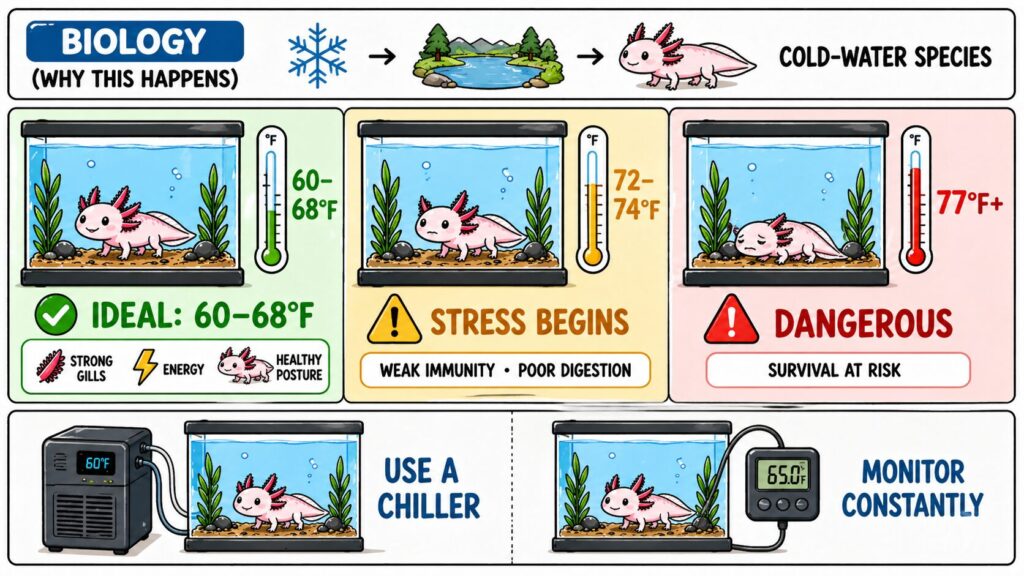
Axolotls (Ambystoma mexicanum) are native to the high-altitude lake complex of Xochimilco in Mexico City, where water temperatures are naturally cool year-round. Their entire physiology — metabolism, immune function, digestion, gill respiration, and the extraordinary regenerative ability that makes them scientifically remarkable — is calibrated to work within a narrow cold-water temperature band.
When water temperature rises above 72°F (22°C), axolotls begin to experience heat stress. According to research published in Comparative Biochemistry and Physiology, elevated temperature in aquatic salamanders directly suppresses immune responses, increases susceptibility to bacterial and fungal infection, and impairs normal digestive function. Above 74°F (23°C), the damage accelerates rapidly. Above 77°F (25°C), survival time is measured in days rather than weeks. These are not cautionary exaggerations — they are well-documented physiological realities for Ambystoma mexicanum in captive settings.
The wild axolotl population is already critically endangered, surviving in increasingly degraded habitat in Xochimilco. Responsible captive husbandry matters, and getting temperature right is one of the most fundamental aspects of that responsibility. A water chiller is the most reliable single tool for ensuring your axolotl’s temperature stays within its safe range regardless of the season, your ambient room temperature, or how much heat your filter and lighting generate.
Water Chiller vs. Cooling Fan — Which Do You Need?
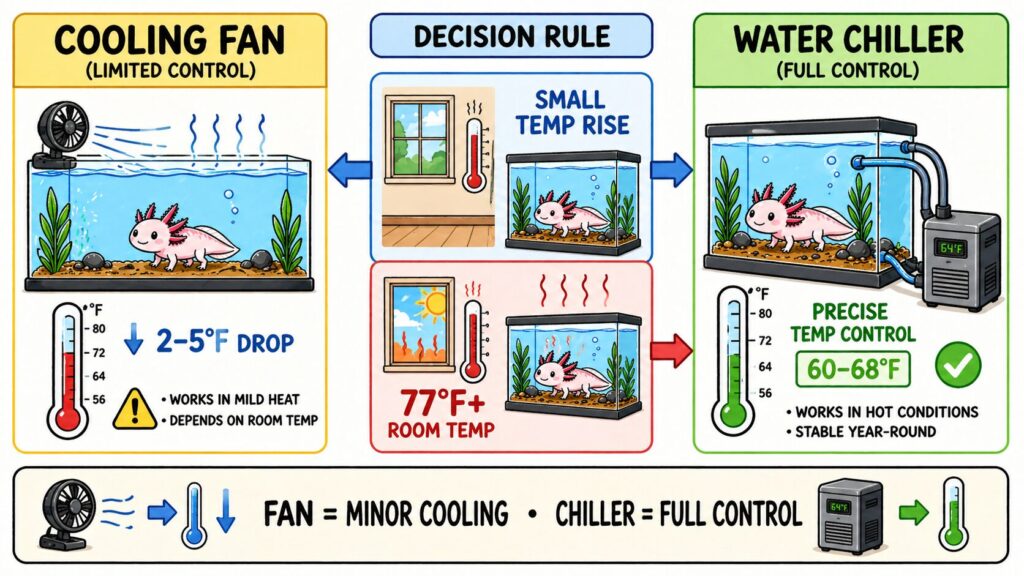
Before choosing a chiller, it is worth understanding the difference between a full compressor-based water chiller and a simpler cooling fan, since the right choice depends on your situation.
A cooling fan works by increasing evaporative cooling from the water surface — it blows air across the water, accelerating evaporation, which removes heat. Fans can drop water temperature by 2–5°F depending on ambient humidity and room temperature. They are inexpensive, easy to use, and effective in mild climates or during cooler seasons. See our guide to the best axolotl cooling fan for more detail on this approach.
A compressor-based water chiller uses refrigeration technology — the same principle as your refrigerator — to actively remove heat from the water regardless of ambient room temperature. A chiller can hold a precise target temperature in hot conditions where a fan simply cannot keep up. Chillers are more expensive, larger, and require proper ventilation around the unit to dissipate the heat they remove from the water. However, for keepers in warm climates, those without consistent air conditioning, or anyone who has experienced summer temperature problems in their tank, a chiller is the only truly reliable solution.
As a general rule: if your room temperature regularly exceeds 77°F (25°C) during summer, if you live in a hot climate, or if you have previously struggled to keep your tank below 68°F (20°C) with fans alone, a compressor chiller is what you need. If you live in a mild climate and your tank temperature only creeps up by 3–5°F during summer, a fan may be sufficient.
What Makes the Best Axolotl Water Chiller?
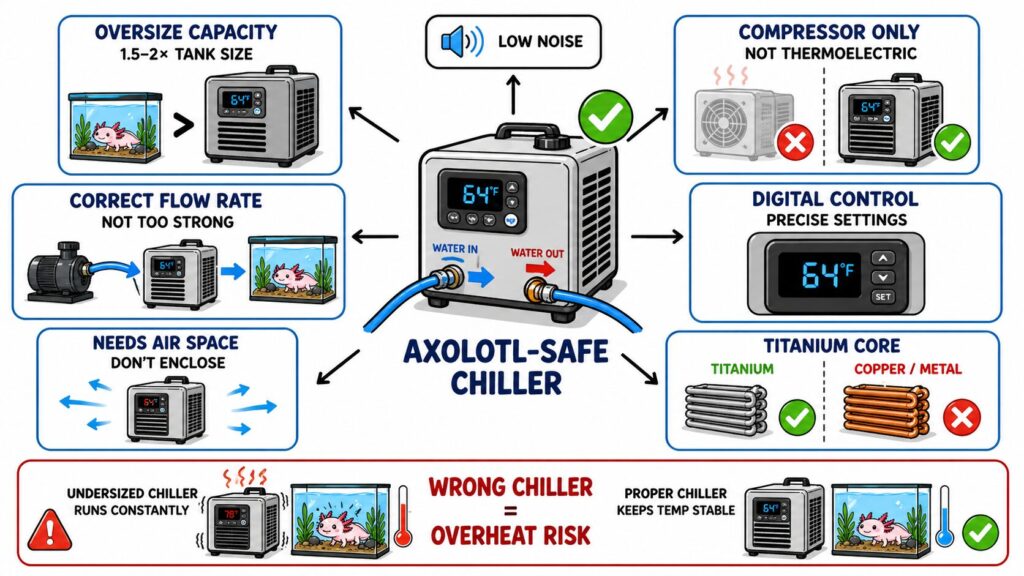
Adequate capacity for your tank size. The single most important specification of any chiller is whether it is rated for a tank volume equal to or larger than yours. A chiller working at its absolute maximum capacity will run constantly, wear out faster, and still struggle to hold temperature in hot conditions. Choose a chiller rated for at least 1.5 to 2 times your actual tank volume for comfortable headroom. For a 40-gallon axolotl tank, a chiller rated for 40–55 gallons is the minimum; a chiller rated for 55–80 gallons gives you real margin.
Compressor refrigeration, not thermoelectric. There are two main technology types on the aquarium chiller market: compressor-based and thermoelectric (Peltier) chillers. Thermoelectric chillers are cheaper and quieter but are only capable of dropping water temperature by a few degrees below ambient room temperature — which is often not enough for axolotl keeping in warm conditions. Compressor-based chillers are true refrigeration units that can hold a set temperature regardless of ambient conditions. For axolotls, compressor-based is the clear choice.
Accurate digital temperature control. The best axolotl water chillers have a digital thermostat that allows you to set a precise target temperature and will cycle on and off automatically to maintain it. This eliminates guesswork and removes the need for constant manual monitoring. Look for models with a clear digital display and fine temperature adjustment — ideally in 1°F or 0.5°C increments.
A corrosion-resistant evaporator. The evaporator is the component inside the chiller that the water flows through to be cooled. Titanium evaporators are the gold standard — they are fully corrosion-resistant in both freshwater and saltwater environments and do not leach any materials into the water. Cheaper evaporators made from copper or standard steel can corrode and introduce harmful metals into your axolotl’s water. Always verify the evaporator material before purchasing.
Low noise level. Chillers run their compressor motor cyclically throughout the day. A loud, rattling chiller in a living room or bedroom is genuinely disruptive. Quality chillers from reputable brands operate at noise levels comparable to a refrigerator — present but unobtrusive. Check reviews specifically for noise feedback before purchasing.
Sufficient ventilation clearance. All compressor-based chillers expel the heat they remove from the water as warm air through a fan vent. This vent must have clear space around it — typically at least 12–24 inches — for the heat to dissipate. A chiller pressed against a wall or inside a cabinet will overheat, reduce cooling efficiency, and potentially damage the compressor. Plan your space before purchasing.
A circulation pump included or compatible. Chillers work inline — water from your tank is pumped through the chiller unit and returned cooled. Most quality chillers either include a pump or clearly specify the flow rate requirements so you can choose a compatible pump. For your axolotl tank, the pump flow rate matters — too fast and it creates significant current return to the tank, which axolotls dislike. Diffuse the return flow appropriately as you would with any pump-driven equipment. This pairs naturally with your filter setup, since the chiller return can be integrated into your filtration circuit.
How to Size an Axolotl Water Chiller
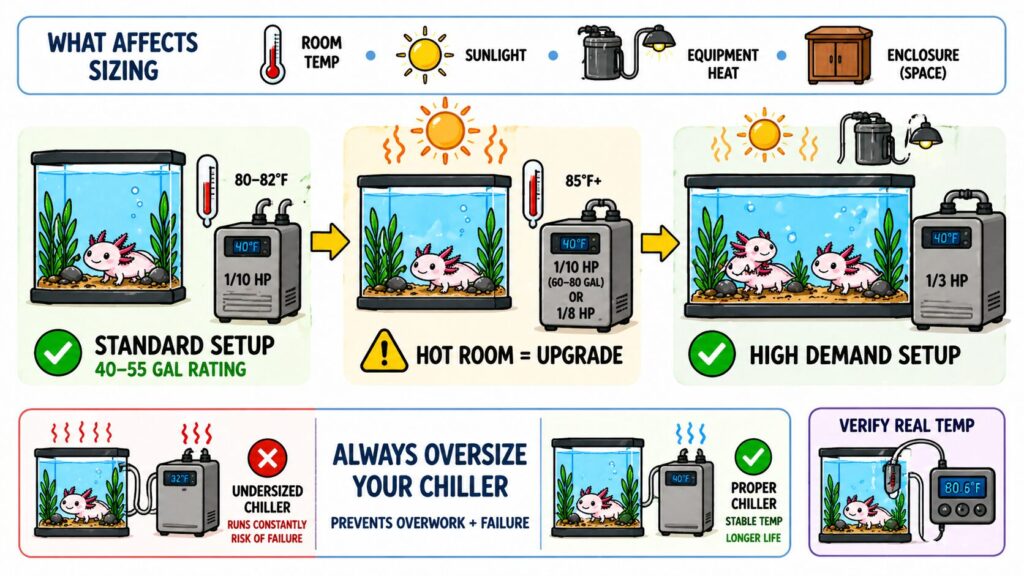
Chiller sizing is more nuanced than simply matching the stated capacity to your tank volume. Several factors affect how hard a chiller has to work in your specific situation. These include the ambient room temperature in your space, how much heat your filter motor and lighting generate, whether the tank is in direct sunlight, and how well insulated your tank cabinet is.
As a practical starting point for the Aqueon 40-gallon breeder — which we recommended as the best overall tank in our best axolotl tank article — a 1/10 HP chiller rated for 40–55 gallons is appropriate for rooms that reach up to approximately 80–82°F (27–28°C) in summer. If your room regularly reaches 85°F (29°C) or above, consider stepping up to a 1/10 HP chiller rated for 60–80 gallons or a 1/8 HP unit. For two-axolotl setups in a 55-gallon tank, a 1/10 HP unit at the top of its range or a 1/3 HP unit at the bottom of its range is more appropriate.
Always pair your chiller with a reliable tank thermometer so you can verify the actual water temperature against the chiller’s display — some budget units have display calibration errors of a degree or two, and knowing your actual water temperature is what matters.
Our Top Axolotl Water Chiller Picks
Best Overall: BAOSHISHAN 2024 Upgrade 42-Gallon 1/10 HP Aquarium Chiller
The BAOSHISHAN 2024 Upgrade 42-Gallon 1/10 HP Aquarium Chiller is our top overall recommendation for keepers running the Aqueon 40-gallon breeder — the tank we recommend in our best axolotl tank article. The 2024 upgrade version features a touch screen control panel, a high-efficiency freon-free R290 refrigerant compressor, a removable side panel for easy internal maintenance access, and a stainless-shaft water pump with 1000L/H circulation capacity. The special quiet design compressor operates at a noise level that experienced keepers consistently describe as comparable to a running refrigerator — present but unintrusive. The complete accessory kit includes the pump, hoses, hose clamps, and suction cups for a clean installation. BAOSHISHAN is one of the most consistently recommended brands in axolotl-keeping communities, and this updated model addresses the minor calibration issues that affected earlier versions. Rated for 42 gallons (160L), it is a solid match for a 40-gallon breeder tank in rooms that reach up to around 80–82°F in summer.
Best Value: VEVOR 52-Gallon 1/10 HP Aquarium Chiller with Titanium Evaporator
For keepers who want a well-built compressor chiller with a titanium evaporator at a competitive price, the VEVOR 52-Gallon 1/10 HP Aquarium Chiller is an excellent choice. Its corrosion-resistant titanium evaporator is a genuine differentiator at this price point — many budget chillers use cheaper materials that degrade over time and can introduce harmful elements into the water. VEVOR’s chiller also comes with a circulation pump and hose, runs quietly, and uses R134a refrigerant for clean, efficient cooling. At 52 gallons rated capacity, it has slightly more headroom than the BAOSHISHAN 42-gallon unit for a 40-gallon setup, which means the compressor cycles less frequently and experiences less wear over time. This is a strong option for anyone who wants titanium evaporator protection without paying a premium.
Best for 55-Gallon Two-Axolotl Setups: BAOSHISHAN 79-Gallon 1/3 HP Aquarium Chiller
For keepers running a 55-gallon tank for two axolotls — as recommended in our best axolotl tank article — the BAOSHISHAN 79-Gallon 1/3 HP Aquarium Chiller steps up appropriately. At 1/3 HP it has genuine cooling power for larger volumes in warm environments, it uses R290 refrigerant, and its special quiet design keeps noise manageable. The 79-gallon rating gives comfortable headroom above a 55-gallon tank, meaning the unit does not have to work at maximum capacity constantly. Before housing two axolotls together, make sure you have read our articles on axolotl cannibalism and tank mate compatibility to understand the behavioural risks involved.
Best Budget Option: IceProbe Thermoelectric Aquarium Chiller for Small or Temporary Setups
For keepers on a very tight budget, those with small juvenile tanks (10–15 gallons), or those who need a temporary cooling solution while waiting for a compressor chiller to arrive, the IceProbe Thermoelectric Aquarium Chiller is worth considering with important caveats. It uses thermoelectric (Peltier) technology rather than compressor refrigeration, which means its cooling capacity is limited — it can drop a small tank’s temperature by 3–6°F below ambient room temperature, which may not be sufficient in very warm conditions. However, for a 10–15 gallon juvenile tank in a room that stays below 77°F, it can be effective and is virtually silent. It mounts through a hole in the tank lid rather than inline like a compressor chiller, which makes installation simpler. Understand its limitations clearly before purchasing — it is not a substitute for a compressor chiller in warm climates.
How to Install and Run Your Axolotl Water Chiller
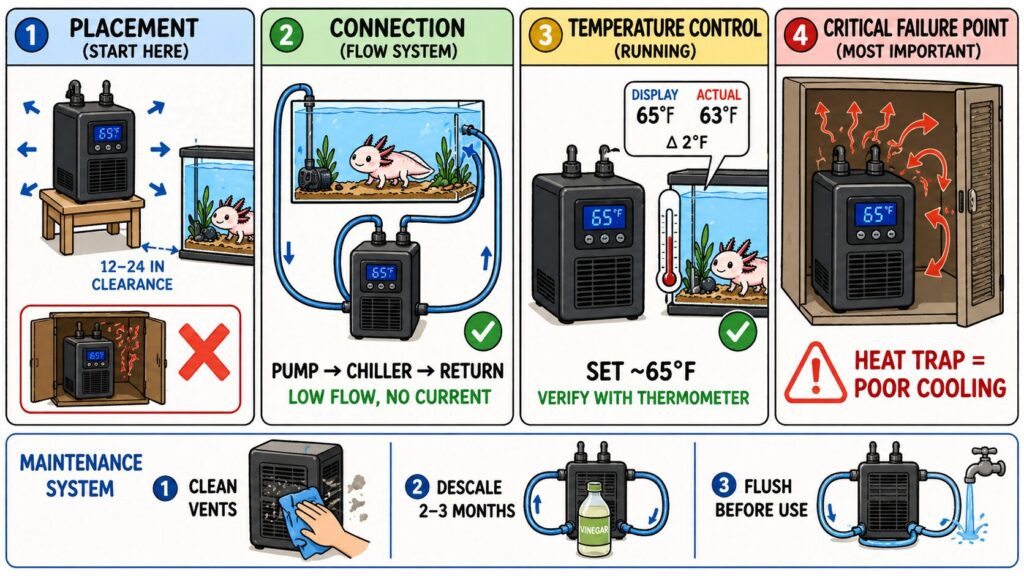
Setting up an inline compressor chiller correctly from the start prevents most of the problems that new chiller owners encounter.
Choose the right location. Position the chiller near your tank stand with clear space on all sides for ventilation — at minimum 12 inches, and ideally 18–24 inches. The chiller expels warm air through its fan vents, and if that air cannot escape the immediate area, the unit will work harder and cool less effectively. Do not place the chiller inside an enclosed cabinet unless it has good ventilation. Our guide to the best axolotl tank stand covers stands with open shelving configurations that can work well alongside a chiller placed underneath.
Connect the circulation pump. The pump either sits inside the tank (submersible) or inline in the tubing between the tank and the chiller (external). The most common setup for axolotl tanks is a submersible pump in the tank that draws water out, passes it through the chiller, and returns cooled water via the outlet tube. Position the outlet return tube so it enters the tank gently — pointing at the tank glass or at a baffle rather than directly across the tank — to avoid creating a current that stresses your axolotl. You may want to integrate this with your sponge filter or main filter return for efficient water circulation.
Set your target temperature. Using your tank thermometer, verify the actual water temperature and set the chiller’s thermostat accordingly. Many budget chillers have a display calibration offset of 1–2°C, so use your external thermometer as the reference rather than the chiller’s display. Set your target to 65°F (18°C) as a good midpoint in the safe range — this gives you buffer against both the lower and upper limits. The chiller will cycle on when the water temperature rises above the set point and off when it returns to target.
Allow ventilation around the exhaust. This bears repeating because it is the most common installation mistake. The warm air the chiller expels must be able to escape into a larger open space. In summer, if your chiller is in a small enclosed area, it will reheat the same air it just expelled, reducing its effective cooling capacity significantly.
Maintain the chiller periodically. Compressor chillers need occasional cleaning of the exterior ventilation grilles to prevent dust build-up from reducing airflow. Every 3–6 months, wipe the grilles with a dry cloth. According to BAOSHISHAN’s maintenance guidelines, a solution of diluted white vinegar run through the water circuit every 2–3 months helps remove calcium deposits from the evaporator coil, maintaining peak heat exchange efficiency. Always flush thoroughly with clean water after any vinegar treatment before reconnecting to your axolotl’s tank.
Frequently Asked Questions
Do all axolotl keepers need a water chiller? Not necessarily. Keepers in cool climates, those with well air-conditioned homes, or those keeping their tank in a consistently cool basement may be able to maintain safe temperatures with a cooling fan alone. A chiller becomes essential when ambient room temperature regularly exceeds 77–80°F (25–27°C) or when fan-based cooling has proven insufficient to keep the tank below 68°F (20°C).
How much electricity does an axolotl water chiller use? A 1/10 HP compressor chiller uses approximately 70–100 watts when the compressor is running. Because the unit cycles on and off to maintain the set temperature rather than running continuously, actual power consumption depends on ambient conditions. In moderate summer temperatures, a chiller may run 40–60% of the time, resulting in an average draw of 30–50 watts — comparable to a standard light bulb.
Can I use my chiller with a canister filter? Yes. Many keepers integrate the chiller into the same water circuit as their canister filter, with the filter outlet connecting to the chiller inlet and the chiller return going back to the tank. This eliminates the need for a separate circulation pump and keeps the setup clean and efficient. Ensure the canister filter’s flow rate falls within the chiller’s recommended flow range.
How long does an axolotl water chiller last? A quality compressor chiller from a reputable brand should last 3–7 years with proper maintenance and adequate ventilation. The most common causes of early failure are insufficient ventilation around the unit causing the compressor to overheat, and calcium build-up in the evaporator from untreated hard water.
What temperature should I set my axolotl chiller to? Set your chiller to maintain between 64–68°F (18–20°C) as a safe midpoint. This keeps your axolotl comfortably within its optimal range while providing a buffer against brief temperature excursions. Use a separate thermometer to verify actual water temperature independently of the chiller’s display.
Is a chiller safe to use with my existing filter? Yes. The chiller operates independently of your filter — it simply adds or removes heat from the water circuit. Whether you are running a canister filter, a HOB, or a sponge filter with an air pump, the chiller integrates without interfering with filtration. The only thing to watch is the combined flow rate and return current — ensure the chiller’s outlet does not add excessive current on top of your filter return.
Temperature Solved — Now Cover Everything Else
A water chiller is one of the most impactful investments you will make in your axolotl’s long-term health. Once temperature is stable and well within range, you can focus on every other aspect of excellent care. If you want a single destination for trusted, keeper-tested product recommendations across every category of axolotl keeping — from food and filtration to substrate, hides, and health supplies — Best Axolotl Products has everything you need in one place.