
Finding the best axolotl air pump is a step many new axolotl owners overlook — until they run into problems. An air pump is not always a strict requirement for every axolotl setup, but for keepers running a sponge filter, it is absolutely essential, and for anyone who wants to maintain high dissolved oxygen levels in a cold-water tank, it is one of the most valuable pieces of equipment you can add. This guide covers everything you need to know: why air pumps matter for axolotls specifically, what to look for when choosing one, and our top verified Amazon picks for every type of setup. If you are still putting together your full tank, pair this guide with our articles on the best axolotl tank, best axolotl filter, and our full axolotl care guide to build the complete picture.
Why Axolotls Need Good Oxygenation

Axolotls breathe through a combination of their feathery external gill plumes and their rudimentary lungs, which they occasionally use to gulp air at the surface. Their gills absorb dissolved oxygen directly from the water, which means the oxygen content of your tank water has a direct impact on your axolotl’s ability to breathe comfortably.
Cold water holds significantly more dissolved oxygen than warm water — which is one of several biological reasons why axolotls need to be kept cool. According to the United States Geological Survey, water at 60°F (16°C) holds roughly 50% more dissolved oxygen than water at 86°F (30°C). Keeping your axolotl’s tank in the correct temperature range of 60–68°F (16–20°C) — as covered in our guide on what temperature axolotls need — naturally supports higher dissolved oxygen levels. But even cold water benefits from surface agitation and aeration to maximise oxygen exchange at the water surface.
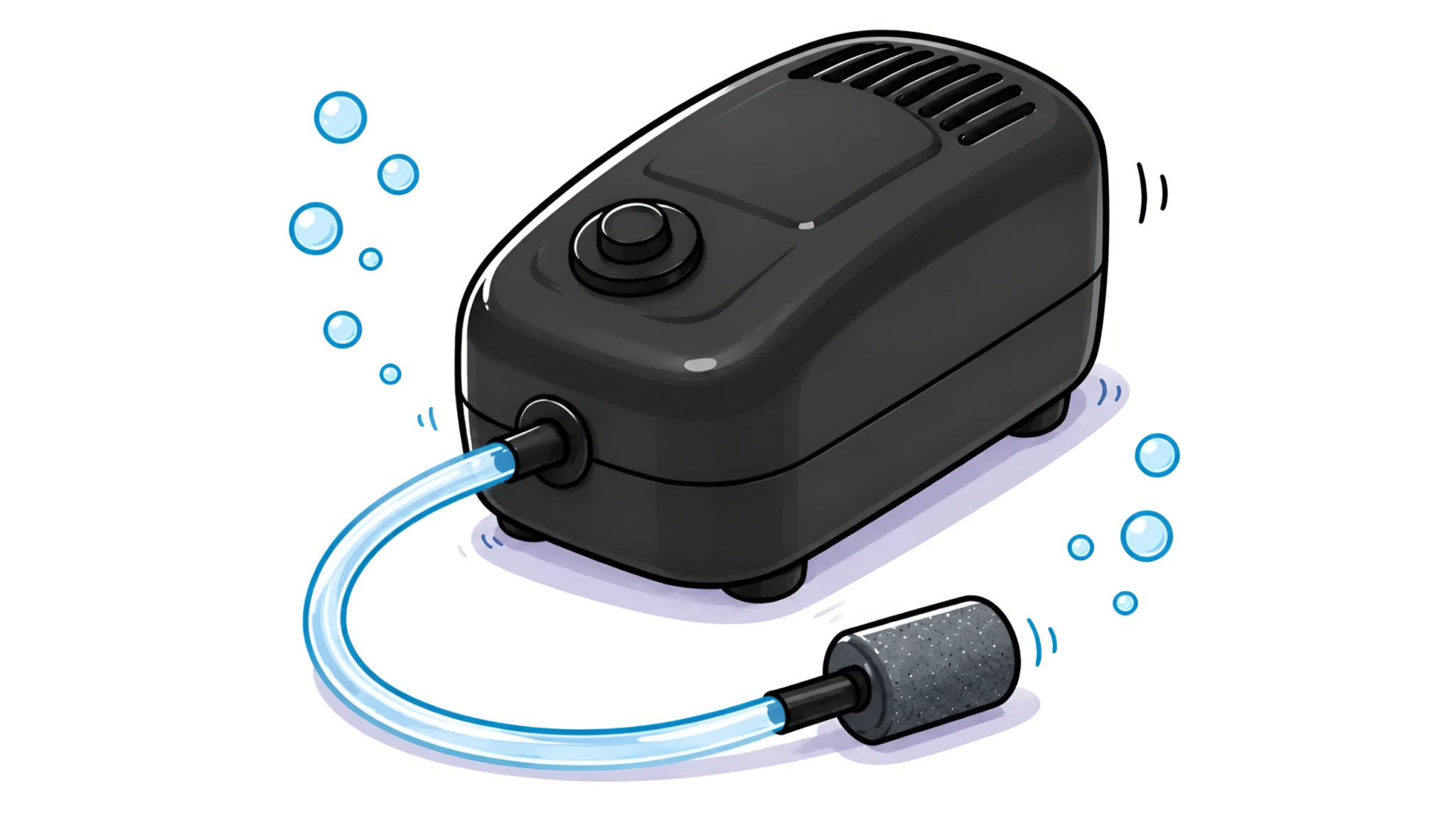
This is where an axolotl air pump comes in. By driving an air stone or powering a sponge filter, an air pump creates rising bubbles that agitate the water surface, break surface tension, and facilitate the exchange of oxygen into the water and carbon dioxide out of it. Research published in Aquaculture consistently shows that adequate dissolved oxygen is one of the most important environmental factors in the health and longevity of captive aquatic salamanders, including Ambystoma mexicanum. Poor oxygenation stresses axolotls, suppresses immune function, and over time contributes to gill degeneration.
Beyond oxygenation, an air pump is the power source for sponge filters — the gentlest and most axolotl-friendly filtration method available. If you are running a sponge filter as your primary or supplementary filter, which our best axolotl filter guide strongly recommends considering, you cannot run it without an air pump. For dedicated sponge filter guidance, also see our best axolotl sponge filter article.
What Makes the Best Axolotl Air Pump?
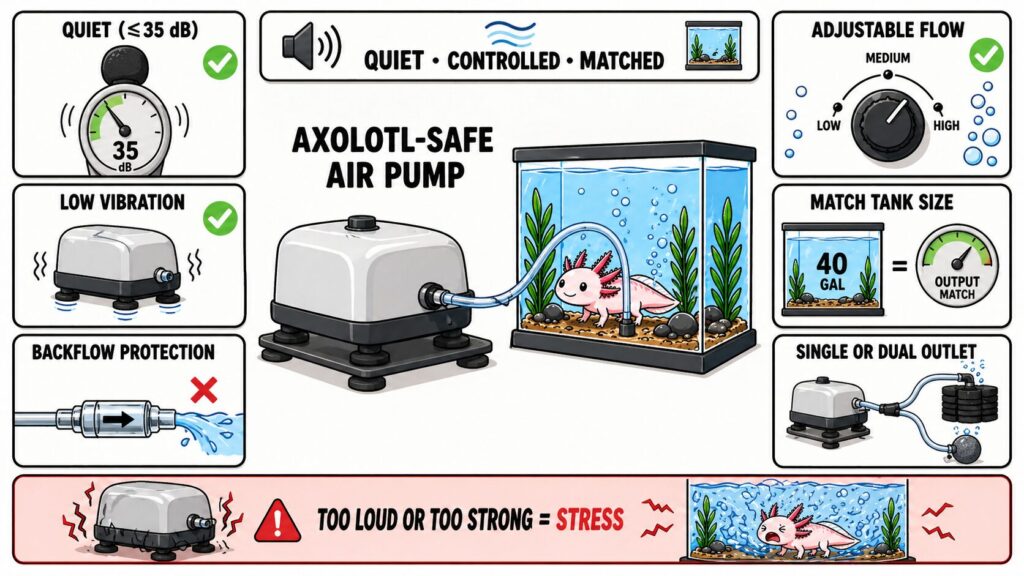
Not every air pump is equally suitable for an axolotl setup. Here is what to look for specifically.
Quiet operation. Axolotls are sensitive to vibration and sound. A noisy, rattling air pump causes ongoing low-level stress that compounds over time. The best axolotl air pumps use sound-dampening chambers, rubber feet, and suspended motor designs to minimise vibration and audible noise. Look for models rated at 35 decibels or below — the quieter, the better.
Adjustable airflow. Being able to dial the output up or down matters for axolotl setups. If you are running a sponge filter, you want enough airflow to keep bubbles rising consistently through the sponge but not so much that the bubbling creates turbulence at the surface. If you are using an air stone for supplementary oxygenation, the ideal output produces a steady stream of fine bubbles without creating significant water movement. Adjustable pumps give you that control.
Appropriate output for your tank size. Matching your pump to your tank is important. A pump rated for up to 40 gallons is ideal for the Aqueon 40-gallon breeder — which we recommended as the best overall tank in our best axolotl tank article. Running an oversized pump on a small tank creates excessive turbulence, while an undersized pump may not provide enough airflow to drive a sponge filter effectively at depth.
Single or dual outlets. Many air pumps offer two air outlets, which allows you to run two sponge filters, two air stones, or one of each simultaneously with a single pump. For a 40-gallon tank running a dual sponge filter setup — a common and effective approach for axolotl keepers — a dual-outlet pump is particularly useful. For a single sponge filter, a single-outlet pump is sufficient.
Check valves included or available. A check valve is a small one-way valve installed in the airline tubing between the pump and the filter or air stone. It prevents water from siphoning back through the tubing and into the pump if power is cut unexpectedly, which can damage the pump motor. Any air pump placed at the same level as or below the water surface should always be used with a check valve. Many quality pumps include them, but if yours does not, they are inexpensive to buy separately.
Low vibration and rubber feet. The physical vibration of an air pump running on a tank stand can transmit directly into the tank structure and water, creating stress for your axolotl. Pumps with rubber feet and suspended motor designs isolate vibration significantly compared to cheaper models that sit directly on hard surfaces.
Do All Axolotl Tanks Need an Air Pump?
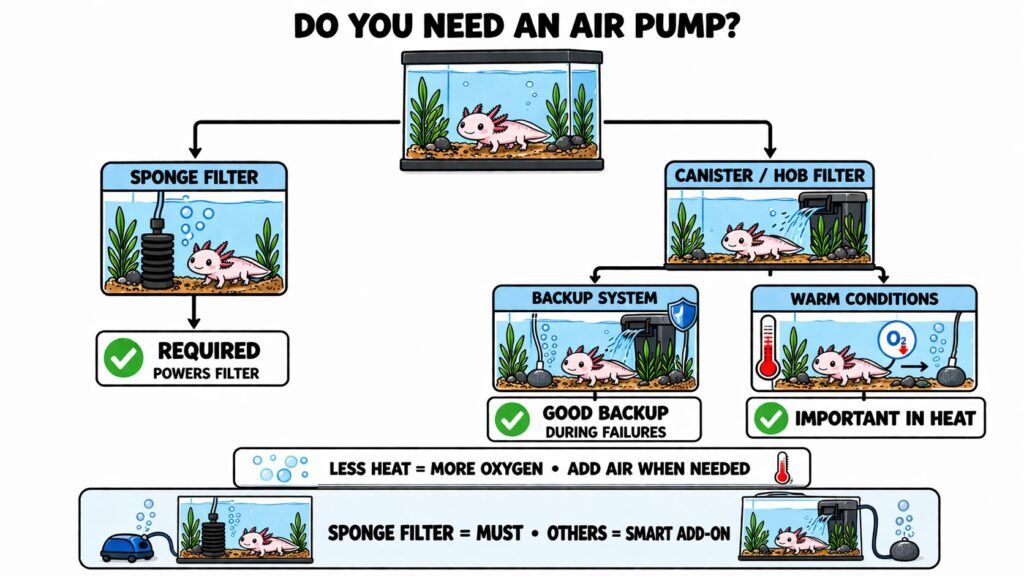
Not necessarily — but the answer depends on your filtration setup and tank configuration. If you are running a canister filter or a hang-on-back (HOB) filter with surface agitation, the filter’s output may already be providing adequate surface gas exchange and oxygenation without a dedicated air pump. However, if you are running a sponge filter, an air pump is the power source and is not optional.
Even in tanks with canister or HOB filtration, many experienced axolotl keepers add an air pump and air stone as a safety measure — it maintains oxygenation during filter maintenance or if the filter ever malfunctions unexpectedly. Given how inexpensive a quality air pump is relative to the rest of an axolotl setup, it is one of the easiest backup systems you can add.
Running an air pump is also particularly important during warm weather when water temperatures creep up. Warmer water holds less dissolved oxygen, and during summer months — when you may be working your water chiller or cooling fan hard — the additional oxygenation from an air pump provides a meaningful buffer. Monitoring temperature consistently with a reliable tank thermometer alongside your air pump gives you full situational awareness of your tank’s oxygen environment.
Our Top Axolotl Air Pump Picks
Best Overall: Tetra Whisper Air Pump (40-Gallon)
The Tetra Whisper Air Pump for 40-Gallon Aquariums is the most consistently recommended air pump for axolotl setups running a 40-gallon tank, and it earns that reputation through decades of proven reliability. Its patented dome shape and sound-dampening chambers are specifically engineered to minimise vibration-related noise. Rubber feet prevent the pump from transmitting vibration to the surface it sits on, and the suspended motor design prevents internal sound from resonating outward.
The Whisper 40 produces enough airflow to comfortably power a medium sponge filter or a dual-outlet air stone setup in a 40-gallon tank. Per Tetra’s own product documentation, the Whisper series is available from 10-gallon to 100-gallon ratings, so you can size it precisely to your tank. For the Aqueon 40-gallon breeder, the 40-gallon Whisper is the right match. This is the pump we recommend pairing with the Hygger Double Sponge Filter for a fully axolotl-optimised filtration and aeration setup.
Best Adjustable Option: Hygger Aquarium Air Pump with Dual Outlets (5W/8W)
For keepers who want precise airflow control, the Hygger Quiet Adjustable Aquarium Air Pump with Dual Outlets is an excellent choice. It operates at a rated noise level of 35 dB or below, features a simple adjustment knob for fine-tuning output, and includes dual stainless steel outlets that let you run two sponge filters or two air stones from a single unit. The complete accessory kit includes air stones, check valves, and airline tubing, so you have everything you need out of the box.
The adjustable flow is particularly useful for axolotl setups where you need to dial in exactly the right output for your filter or air stone without creating surface turbulence. At 5W, it provides ample airflow for a 40-gallon setup running dual sponge filters, and the dual outlet design means you can run two independent filtration lines simultaneously — a great setup for maintaining redundant biological filtration.
Best Premium Quiet Option: Fluval Q2 Air Pump
For keepers who prioritise absolute silence above all else — particularly those whose axolotl tank sits in a bedroom, living room, or home office — the Fluval Q2 Air Pump is the quietest option we recommend. Its double-wall outer casing, integrated pump well, and engineered noise-suppressing baffle chamber make it one of the least audible air pumps available at any price point. According to Fluval’s product specifications, the Q series uses a swing-arm and diaphragm design that produces consistent, pressure-stable airflow while generating minimal mechanical noise.
The Q2 is rated for tanks up to 160 gallons, which means running it on a 40-gallon axolotl setup places it well within its comfortable operating range — the pump is barely working, which further reduces noise and vibration. The tradeoff compared to the Tetra Whisper and Hygger options is price — the Fluval Q2 is a premium product — but for noise-sensitive locations, it is worth the investment.
Best Budget Option: Tetra Whisper Air Pump (20-Gallon) for Starter Setups
For keepers running a 20-gallon long tank as a juvenile or starter setup — consistent with our recommendation in the best axolotl tank and best tank size for axolotl articles — the Tetra Whisper 20-Gallon Air Pump is the appropriately sized, budget-friendly option. The same dome shape and sound-dampening design as the 40-gallon version makes this one of the quietest options in its price range. It is sufficient to power a small sponge filter in a 20-gallon tank and provides reliable, consistent airflow without fuss. As with all the Tetra Whisper range, check valve installation is recommended since the pump is often placed at or below water level.
Best for Running Two Sponge Filters on a 55-Gallon Setup: Hygger 10W Dual-Outlet Air Pump
For keepers running a 55-gallon tank for two axolotls — as we recommended in our best axolotl tank article for housing a pair — the Hygger 10W Powerful Dual-Outlet Aquarium Air Pump provides the airflow needed to run two sponge filters simultaneously with headroom to spare. Rated for tanks up to 600 gallons, it handles a 55-gallon setup effortlessly, and its baffle chamber design keeps noise at a maximum of 30 decibels according to the product listing. The adjustable knob lets you control output precisely, and the dual outlets allow independent filtration lines for each axolotl’s territory. Before housing two axolotls together, read our articles on axolotl cannibalism and tank mate compatibility to understand the risks involved.
How to Set Up Your Axolotl Air Pump
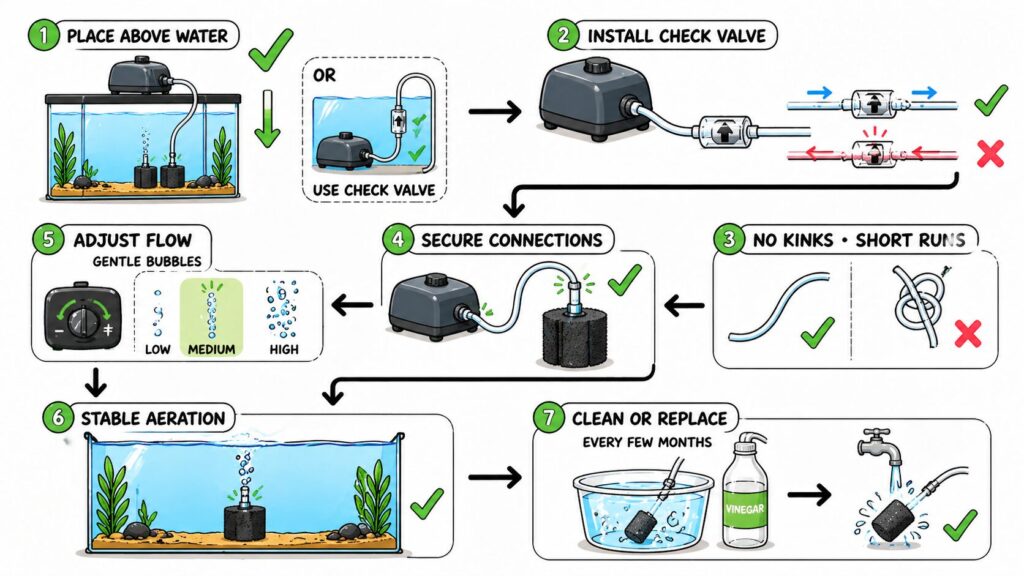
Setting up an air pump correctly is straightforward, but a few details matter.
Use a check valve. If your pump is placed at or below the water level, install a check valve in the airline tubing close to the pump. The check valve prevents water from siphoning backward into the pump motor during a power cut. It is a small accessory that prevents a disproportionately large problem.
Position the pump above the water if possible. The simplest way to avoid siphon risk is to position the pump above the water level — on top of the tank stand or on a nearby shelf. If the pump is higher than the water surface, gravity prevents backflow even without a check valve, though check valves are still good practice.
Use quality airline tubing. Cheap vinyl tubing kinks easily and can block airflow. Use flexible silicone tubing or quality vinyl airline tubing. Keep runs as short as practical — longer tubing creates more back pressure on the pump, reducing effective output.
Connect to your sponge filter or air stone. Push the tubing firmly onto the outlet of the pump and the inlet of your sponge filter or air stone. For a dual-outlet pump, connect one line to each device. Ensure all connections are secure — a loose connection reduces airflow and can cause the pump to work harder, increasing noise.
Adjust output. If your pump has a flow control dial, start at a medium setting and observe the bubble output at your filter or air stone. For a sponge filter, you want a steady stream of bubbles rising through the sponge that creates gentle circulation — not a violent churning that disturbs the water surface significantly. Adjust until you find the right balance.
Clean your air stone periodically. Air stones clog over time with mineral deposits and algae. A clogged air stone creates back pressure that stresses the pump and reduces airflow. Soak used air stones in white vinegar for 20–30 minutes and rinse thoroughly before reinstalling, or replace them every few months. They are inexpensive and are worth replacing regularly.
Frequently Asked Questions
Does an axolotl tank always need an air pump? Not always. If you are running a canister or HOB filter that produces adequate surface agitation and gas exchange, an air pump is not strictly required. However, if you are running a sponge filter — which is the most axolotl-friendly filtration method — an air pump is essential since sponge filters are air-driven. Adding an air pump to any axolotl setup is a low-cost safety measure that provides oxygenation backup.
What size air pump do I need for a 40-gallon axolotl tank? A pump rated for 40 gallons is the right starting point. If you are running a dual sponge filter setup, a slightly larger pump rated for 60–80 gallons gives you enough airflow for both filters with comfortable headroom. The Tetra Whisper 40 or Hygger dual-outlet 5W are both solid matches for a standard 40-gallon breeder.
Can an air pump cause too much current for my axolotl? Air pumps themselves do not create water current — they push air through tubing to an air stone or sponge filter. The rising bubbles create minimal surface agitation but not the kind of directional current that stresses axolotl gills. The main risk of current in an axolotl tank comes from filter output, not from air pump operation. This is why sponge filters (air-driven) are the most axolotl-safe filtration option.
How do I stop my air pump from being noisy? First, ensure the pump is on a soft surface — not directly on glass or a hard stand top. A folded cloth or rubber mat beneath the pump absorbs vibration. Second, ensure all connections are secure — loose tubing rattles. Third, check for blockages in the airline or air stone — back pressure from a clogged air stone forces the pump to work harder and louder. If the pump is simply old, diaphragm wear causes increasing noise over time; replacement diaphragm kits are available for most major brands.
Do I need two air pumps for a tank running two sponge filters? No. A dual-outlet air pump handles two sponge filters from a single unit. This is simpler and more economical than running two separate pumps, and quality dual-outlet pumps like the Hygger options listed above are more than capable of the task.
Should I leave my air pump running all the time? Yes. Air pumps are designed for continuous 24/7 operation and are most effective when running constantly. Turning your pump off at night reduces oxygenation during the hours when you are not monitoring the tank, which is not worth the minimal electricity saving. Quality air pumps are quiet enough that continuous operation should not be an issue.
Small Pump, Big Difference
An air pump is one of the least expensive pieces of equipment in an axolotl setup, but the oxygenation and filtration support it provides makes a genuine difference to your axolotl’s long-term health. It is the kind of product that works quietly in the background, doing its job every hour of every day — exactly the way the best axolotl equipment should. For every product your axolotl relies on — from the food it eats to the water it breathes — head over to Best Axolotl Products for our complete, keeper-tested guide to the best options in every category.