
Here’s something I wish someone had told me before I set up my first axolotl tank: the stand is not an afterthought. It’s arguably the most safety-critical purchase you’ll make for your entire setup. Get it wrong and you’re not dealing with a broken decoration or a malfunctioning pump — you’re dealing with 400+ pounds of water, glass, and substrate hitting your floor all at once.
This guide covers everything you need to know about axolotl tank stands: why they matter more than most people realise, what to actually look for when you’re shopping, and my top picks from Amazon for different setups and budgets. If you’re still putting the rest of your tank together, this guide pairs directly with our articles on the best axolotl tank, best axolotl tank lid, and best axolotl tank kit.
Why Your Axolotl Tank Stand Matters So Much
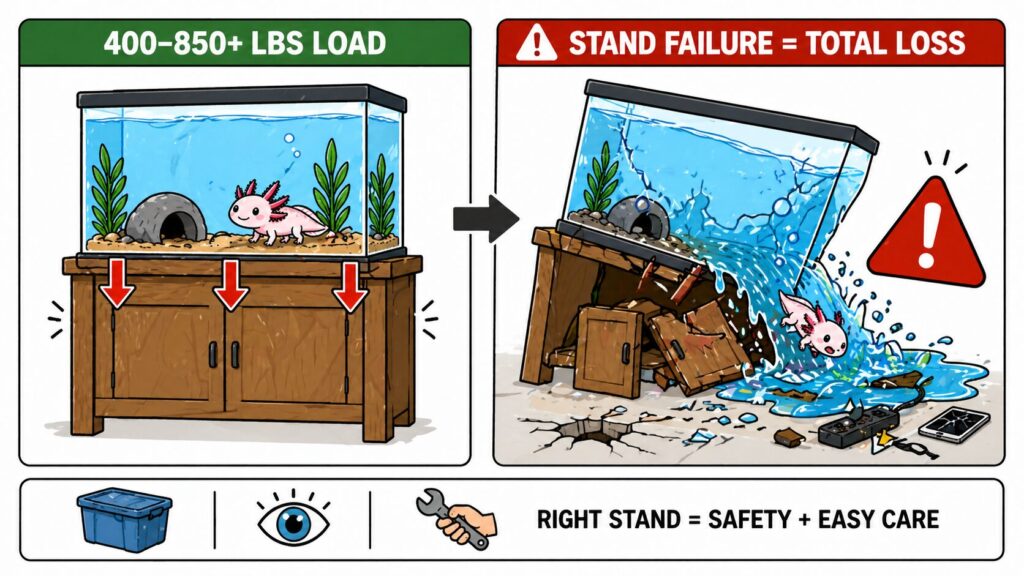
People tend to think of a tank stand as furniture. Something to hold the tank at a comfortable height so you’re not crouching on the floor to watch your axolotl. And sure, that’s part of it — but the stakes here are nothing like picking a bookshelf or a side table.
A filled 40-gallon breeder tank weighs roughly 400–450 pounds. A 55-gallon setup? You’re over 600 pounds. A 75-gallon can push past 850. These are loads that would destroy most household furniture within weeks, not years. The United States Geological Survey has a handy aquarium water weight calculator that makes it easy to understand just how heavy water gets at scale — fresh water weighs approximately 8.34 pounds per gallon, and that adds up fast.
And the consequences of stand failure aren’t just expensive — they’re instant and catastrophic. A stand that buckles or breaks means the tank falls. A falling aquarium releases hundreds of pounds of water, glass, and substrate in seconds. Your floors, your walls, your electronics — all wrecked. More importantly, your axolotl has zero chance of surviving that. This is genuinely not a place to cut corners.
Beyond safety, a well-designed stand also just makes your day-to-day life easier. Good storage, a comfortable viewing height, and easy access for water changes and feeding all come down to stand design. A bad stand makes every single maintenance task harder than it needs to be. For a full overview of what axolotl care actually involves day-to-day, our axolotl care guide is the best place to start — and for the specific task of tank maintenance, see our guide on how to clean an axolotl tank.
What Makes the Best Axolotl Tank Stand?
Weight Capacity — Don’t Just Meet It, Exceed It
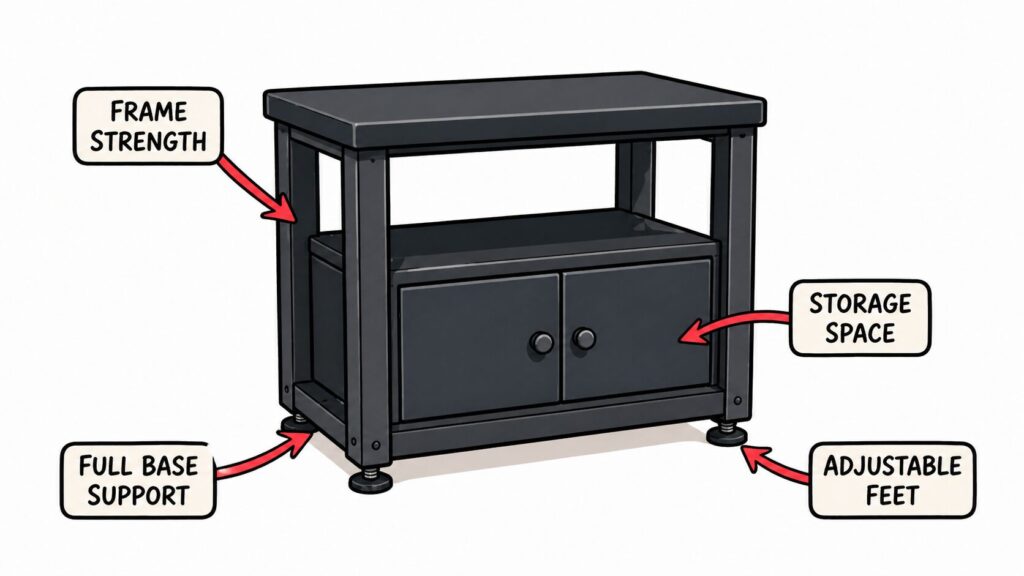
This is the spec that matters most, full stop. And the key word is margin. A stand rated for exactly 400 pounds holding a 400-pound tank is running at its absolute limit with no buffer. That’s not safe. For a 40-gallon setup, look for stands rated to at least 660 pounds. For larger tanks, you want significantly more.
Structural engineers have a concept called a safety factor — the ratio of a structure’s maximum load capacity to the actual load it will carry. For most static load applications, a safety factor of at least 1.5 to 2.0 is considered the minimum acceptable. Applied to a 450-pound tank, that means you want a stand rated for at least 675–900 pounds. All of the stands we recommend in this guide meet or exceed that standard.
Correct Footprint — The Whole Base Needs Support
Your stand’s tabletop needs to match your tank’s footprint. Not approximately match — actually match. The Aqueon 40-gallon breeder (our top pick in the best axolotl tank guide) has a 36″ × 18″ base. Your stand needs to support every inch of that. A stand that’s too small leaves glass edges hanging unsupported, and uneven stress on glass — especially over months and years — can cause it to crack. Aqueon’s own guidance on this is explicit: aquariums must be placed on stands that support the entire base evenly.
Moisture Resistance — More Important Than It Sounds
Axolotl tanks create a lot of moisture. Evaporation, splashing during water changes, condensation from the cold water axolotls require — it all adds up. A stand made from untreated wood or standard MDF will swell, warp, and quietly lose structural integrity over time. You often won’t notice until it’s too late.
The best stands use powder-coated steel frames, P2-grade moisture-resistant MDF panels, or both. It’s worth knowing that P2-grade MDF is classified specifically for interior dry conditions with improved moisture resistance — it’s not fully waterproof, but it handles the humidity of an aquarium environment far better than standard particleboard. If I had to choose between a beautiful solid wood stand and a less attractive steel-frame stand, I’d take the steel every time.
Storage — You’ll Need More Than You Think
You’re going to be reaching under or into that stand regularly. Stands with cabinets, drawers, or open shelving keep everything within arm’s reach when you’re mid-water-change and your hands are already wet. It sounds minor. It isn’t.
Viewing Height
Most aquarium stands bring the tank base to around 28–32 inches from the floor. That’s the sweet spot for comfortable viewing when you’re standing or sitting nearby. For axolotls specifically, being able to see the bottom of the tank clearly is important — they’re bottom-dwellers, and you need a good view of the floor to spot uneaten food and monitor their health. A stand that’s too low makes that genuinely difficult.
Built-In Power Outlets
This one’s a bonus, not a requirement — but it’s a genuinely useful bonus. An axolotl setup runs a surprising amount of equipment. Having outlets built into the stand keeps cables tidy, reduces the chance of water getting near electrical connections, and makes the whole setup look a lot cleaner.
The National Electrical Code recommends keeping electrical connections away from water sources wherever possible — built-in stand outlets are designed with this in mind, which is another reason they’re worth having.
Adjustable Levelling Feet
Very few floors are perfectly level. Even a slight tilt puts uneven stress on the tank glass over time. Adjustable feet let you compensate for minor floor imperfections and keep everything stable. It’s a small feature that matters a lot for long-term glass health — and honestly, it’s reassuring to check your spirit level and see it perfectly centred.
Types of Axolotl Tank Stands
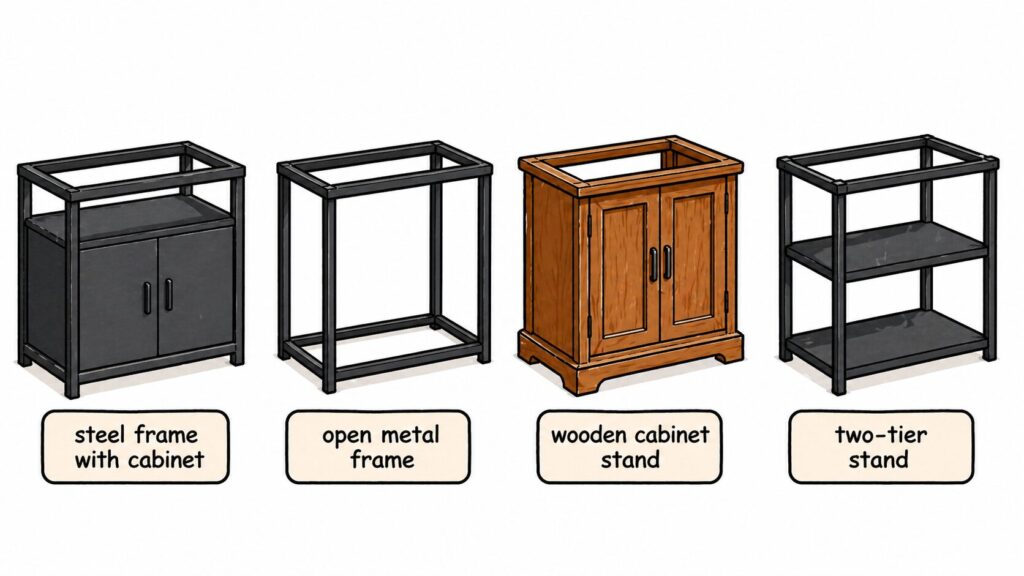
Steel frame stands with MDF cabinets are the most popular choice for home setups, and for good reason. The steel frame does the structural heavy lifting. The MDF panels add storage and a clean finished look. The best versions use P2-grade MDF that can handle the moisture environment without warping. These match most home decor and are what I’d recommend to most keepers starting out.
Solid steel open-frame stands are the most durable option, full stop. No wood to swell or warp, no panels to worry about — just pure structural steel. The tradeoff is that everything underneath the tank is visible. Equipment, supplies, cables — all on display. Serious hobbyists and breeders often prefer these for their reliability, but they’re not for everyone aesthetically.
Solid wood or oak stands look genuinely beautiful — more like furniture than fish tank equipment. They can be extremely sturdy when built well. The concern is moisture resistance. Solid wood doesn’t love repeated exposure to water, and a stand that warps quietly under your tank is a problem. If you go this route, quality construction and a good finish aren’t optional.
Two-tier stands let you run two tanks at once — a main display tank on top, a smaller quarantine tub or grow-out tank on the lower shelf. If you keep axolotls, having a quarantine setup on standby is genuinely smart, not optional. Several of the stands below (GDLF and VOWNER in particular) offer this configuration.
Our Top Axolotl Tank Stand Picks
Best Overall: GDLF Metal Aquarium Stand with Cabinet for 40-Gallon Tanks
If you’re running the Aqueon 40-gallon breeder — which is the tank we recommend in the best axolotl tank guide for most keepers — this is the stand to pair it with. The GDLF Metal Aquarium Stand with Cabinet hits every important spec: a 36.6″ × 18.9″ tabletop that closely matches the 40-gallon breeder’s footprint, a 660-pound weight rating, a powder-coated steel frame, and P2-grade MDF cabinet panels. The cabinet below gives you proper storage for all your supplies. The design is clean and modern without being flashy — it’ll blend into basically any living space without looking like aquarium equipment.
It also accommodates a small secondary tank (5–10 gallons) on the lower shelf, which makes it ideal if you want a quarantine tub close at hand. Assembly is straightforward — parts are labelled and the instructions are actually clear, which isn’t always the case with flat-pack furniture.
Best with Power Outlet for 40-Gallon Setups: VOWNER 40-Gallon Aquarium Stand with Power Outlet
Running a lot of equipment near your tank? The VOWNER 40-Gallon Aquarium Stand with Power Outlet solves the cable problem properly. Its 39.4″ × 18.9″ tabletop fits the Aqueon 40-gallon breeder well, it’s rated to 660 pounds, and the X-shape support with double reinforcement makes it one of the sturdier options in this size category.
The built-in power outlets mean your filter, air pump, thermometer, and chiller all connect in one organised spot — no power strip duct-taped to the side of the stand, no cables trailing across the floor to the nearest wall outlet. Adjustable feet handle uneven floors, and the two-tier design gives you both storage and room for a secondary small tank on the bottom.
Best Budget Option: GDLF 40–50 Gallon Fish Tank Stand with Plant Shelf and Cubby Storage
Not everyone needs or wants to spend top dollar on a stand, and that’s fine — this GDLF option delivers genuine quality at a lower price point. Its 36.6″ × 18.5″ tabletop fits the 40-gallon breeder precisely, it’s rated to 660 pounds, and the powder-coated steel frame with cubby storage gives you organised space for your axolotl supplies without paying for a full cabinet.
The top plant shelf is a nice touch — great for displaying tank plants, hides, caves, or other tank decor. If you want solid, practical, and affordable without sacrificing the specs that actually matter, this is your pick.
Best for 55-Gallon Two-Axolotl Setups: Bestier 55–75 Gallon Fish Tank Stand with Power Outlet and LED Light
For keepers running a 55-gallon tank for two axolotls — which is what we recommend in the best axolotl tank article when you’re housing a pair — the Bestier 55–75 Gallon Fish Tank Stand with Power Outlet and LED Light is the one I’d go with. It’s built on a thick steel frame with eight reinforced legs, rated to 748 pounds, and its 49.2″ × 13.8″ tabletop fits a standard 55-gallon tank correctly.
The built-in power outlet, dual glass cabinet doors, and hydraulic-lever drawer make this a genuinely polished setup. The LED lighting inside the cabinet is a small quality-of-life feature that makes it easier to actually see what’s in there. Before housing two axolotls together, make sure you’ve read our articles on whether axolotls are cannibalistic and whether axolotls can have tank mates — those aren’t optional reads.
Best Heavy-Duty Option for Larger Setups: VOWNER Heavy-Duty Aquarium Stand for 55–75 Gallon Tanks
If you’re running a larger tank — including the SC Aquariums 75-gallon Starfire we recommended in the best axolotl tank guide for aesthetic setups — the VOWNER Heavy-Duty Aquarium Stand for 55–75 Gallons is the standout choice. The specs here are serious: 1.5-inch thick steel pipes, a 1,200-pound tabletop capacity, built-in power outlets with a switch, and two storage cabinets big enough to fit a canister filter and other large equipment.
The two-tier design also accommodates a secondary small tank on the bottom, which is genuinely useful for anyone breeding axolotls or maintaining a dedicated quarantine tub. If you’re running a large, serious setup, don’t cheap out on the stand holding it all together. This one won’t let you down.
How to Measure for the Right Axolotl Tank Stand
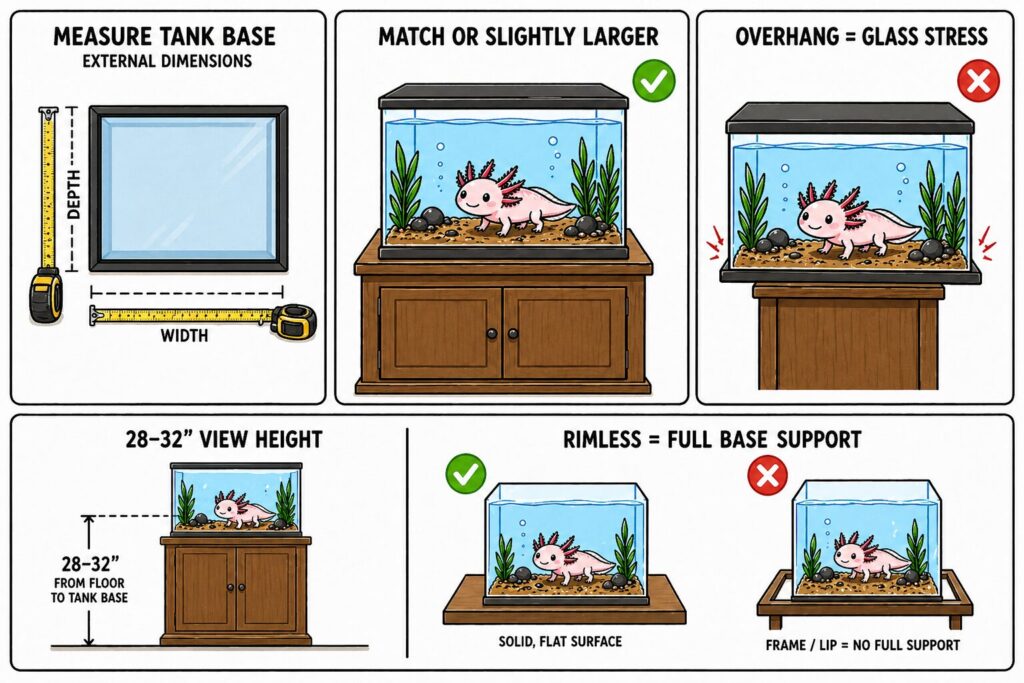
Before buying anything, get the external base dimensions of your specific tank. For the Aqueon 40-gallon breeder, that’s approximately 36.25″ × 18.25″. You want a stand tabletop that matches this as closely as possible — ideally within half an inch on each side. Slightly larger than the tank base is fine. Smaller than the tank base is not fine because unsupported glass edges create stress fractures over time.
Check the height too. Most stands position the tank base at 28–32 inches from the floor, which is standard for comfortable viewing. But if your setup needs to fit under a window or within a specific space, measure before you buy — don’t assume.
One more thing: if you’re running a rimless tank like the Landen 60P we recommended in the best axolotl tank guide, make sure the stand’s tabletop is a solid flat surface rather than framed with a lip. Rimless tanks rest on the entire base and need even contact across the full bottom, not just around the edges.
Setting Up Your Axolotl Tank Stand Correctly
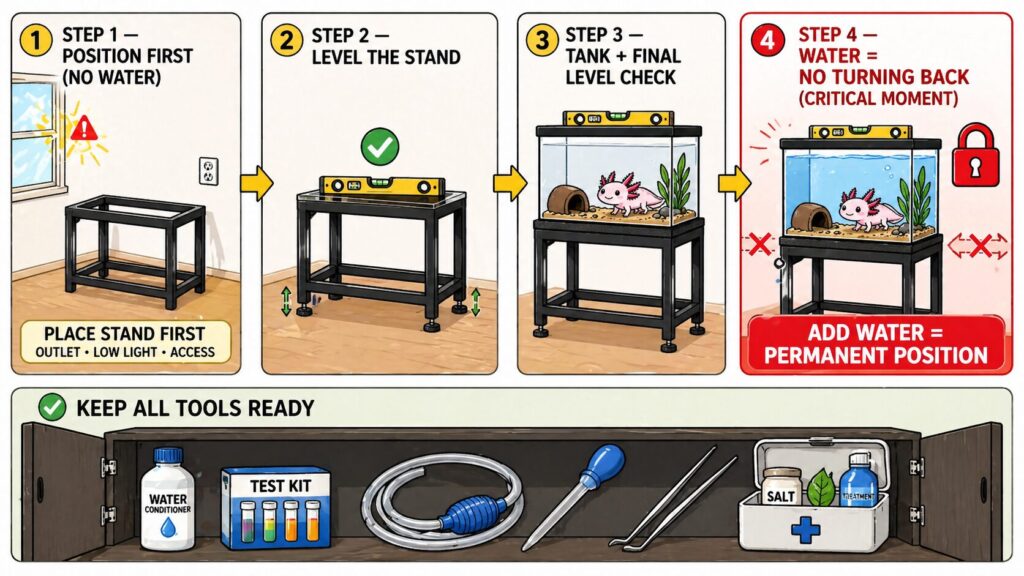
Once you’ve assembled your stand, position it in its permanent location before the tank goes on it. Full aquariums can’t be safely moved. Even an empty glass tank is awkward to shift once it’s sitting on a stand. Get the location right first.
Think about proximity to power outlets, access to your space for maintenance, and light exposure — axolotls prefer low light, so direct sunlight is a problem. According to IUCN research on wild axolotl habitat, axolotls in their native Lake Xochimilco live in murky, heavily vegetated water that filters out most direct light — which is exactly why they’re so sensitive to bright tank conditions. Our guide on what temperature axolotls need goes into more detail on their environmental preferences.
Use the adjustable feet to level the stand. Check with a spirit level along both the length and width of the tabletop. Then place the tank, add a foam levelling mat if your manufacturer recommends one, and check level again before adding water. Once water is in, you’re committed. That tank isn’t moving.
After everything’s set up and filled, you’re free to organise your cabinet.
Frequently Asked Questions
Can I use regular furniture as an axolotl tank stand? No. Regular household furniture — bookshelves, side tables, dressers — is almost never built to handle the sustained, concentrated load of a full aquarium. A 40-gallon tank weighs 400–450 pounds when full. Most furniture will bow, crack, or collapse under that weight over time, and it often happens without much warning. Always use a purpose-built aquarium stand.
What weight capacity do I need for a 40-gallon axolotl tank? A filled 40-gallon breeder weighs approximately 400–450 pounds. You want a stand rated to at least 600–660 pounds to give yourself a real safety margin above the actual load. Every stand recommended in this guide meets or exceeds that.
Does the stand need to be exactly the same size as the tank? The tabletop needs to be at least as large as the tank’s base footprint and support the full base evenly. Slightly larger is fine. Smaller than the tank base means unsupported glass edges and stress points that can lead to cracking over time.
Do I need a stand with a cabinet? You don’t strictly need one. But the storage is genuinely useful — you’ll have test kits, water conditioner, food, cleaning tools, and spare equipment to keep somewhere. A cabinet keeps it all organised and within arm’s reach when you need it.
Should I put anything between the tank and the stand? Many experienced keepers use a thin foam levelling mat between the tank base and the stand tabletop. It compensates for minor surface imperfections and prevents stress points on the glass. Some manufacturers include one or recommend it — check the documentation for your specific equipment.
What substrate should I use in my axolotl tank? That’s a whole separate topic, but worth thinking through before your tank goes live. The short answer is that bare bottom, fine sand, and slate tiles are all popular options — each with different tradeoffs. We cover it in detail in our guides on whether axolotls need substrate, best axolotl tank substrate, best axolotl tank sand, and best axolotl tank tiles.
Are axolotls actually safe to handle? Generally yes, but with care. The Axolotl Society has good guidance on safe handling practices and general husbandry. Axolotls have delicate, permeable skin and should only be handled when necessary. You can also read our guide on whether axolotls carry diseases before handling.