

Choosing the best axolotl tank thermometer is a small decision with consequences that genuinely matter. Temperature is the single most important environmental variable in axolotl keeping, and without an accurate thermometer you are essentially flying blind. You might think your tank is within the safe 60–68°F (16–20°C) range when it has climbed to 72°F (22°C) — a difference that begins causing real physiological harm to your axolotl. This guide covers everything you need to know about axolotl tank thermometers: why they matter, what types exist, what features to look for, and our top verified Amazon picks for every type of keeper. Pair this guide with our article on what temperature axolotls need and our full axolotl care guide for the complete picture.
Why Temperature Monitoring Is Non-Negotiable for Axolotls
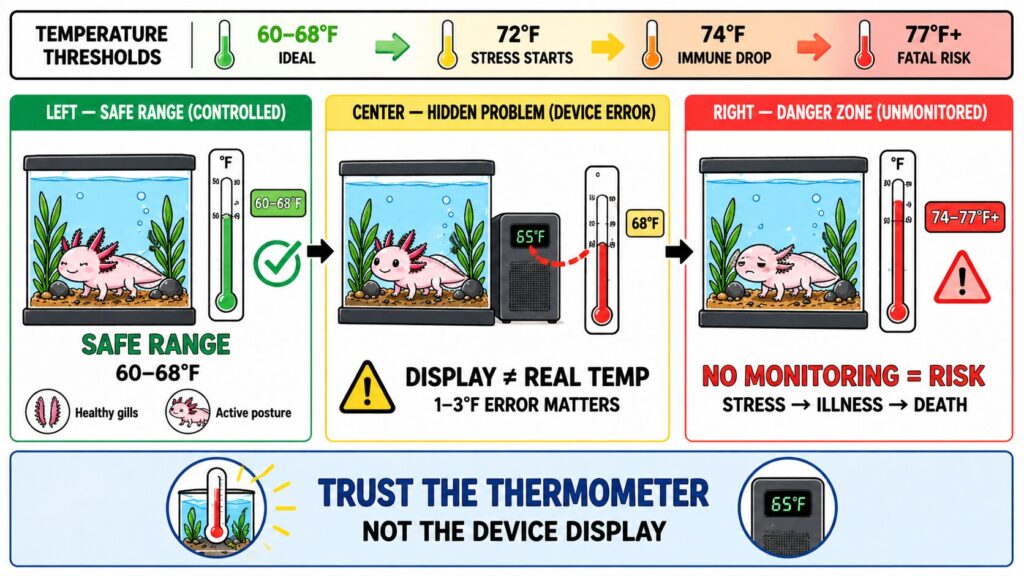
Axolotls (Ambystoma mexicanum) are cold-water animals native to the cool, high-altitude lakes of Xochimilco in Mexico City. Their physiology — metabolism, immune function, digestion, gill respiration — is calibrated to perform optimally within a narrow temperature window of 60–68°F (16–20°C). When water temperature climbs above 72°F (22°C), axolotls begin experiencing heat stress. Above 74°F (23°C), immune suppression sets in, appetite drops, and gill tissue begins to degrade. Sustained exposure above 77°F (25°C) is often fatal within days.
According to research published in Comparative Biochemistry and Physiology, temperature elevation in aquatic salamanders directly suppresses immune responses and impairs normal metabolic function. The Ambystoma Genetic Stock Center at the University of Kentucky, which maintains the world’s most significant axolotl research colony, lists precise temperature management as a fundamental requirement for axolotl welfare in captivity. Monitoring temperature is not a precaution — it is a basic care requirement, and a thermometer is the tool that makes it possible.
There is a second reason accurate temperature monitoring matters specifically for axolotl keepers: many of the cooling devices used to manage axolotl tank temperature — water chillers and cooling fans — have built-in temperature sensors or displays that can have calibration offsets of 1–3°F. This means you cannot rely solely on the device’s own display to know your actual water temperature. An independent thermometer gives you the true reading, which is what your decisions should be based on. Given how narrow the safe temperature window is for axolotls, a 2°F error can genuinely matter.
Types of Axolotl Tank Thermometers
Understanding the different types available helps you choose the best fit for your specific setup.
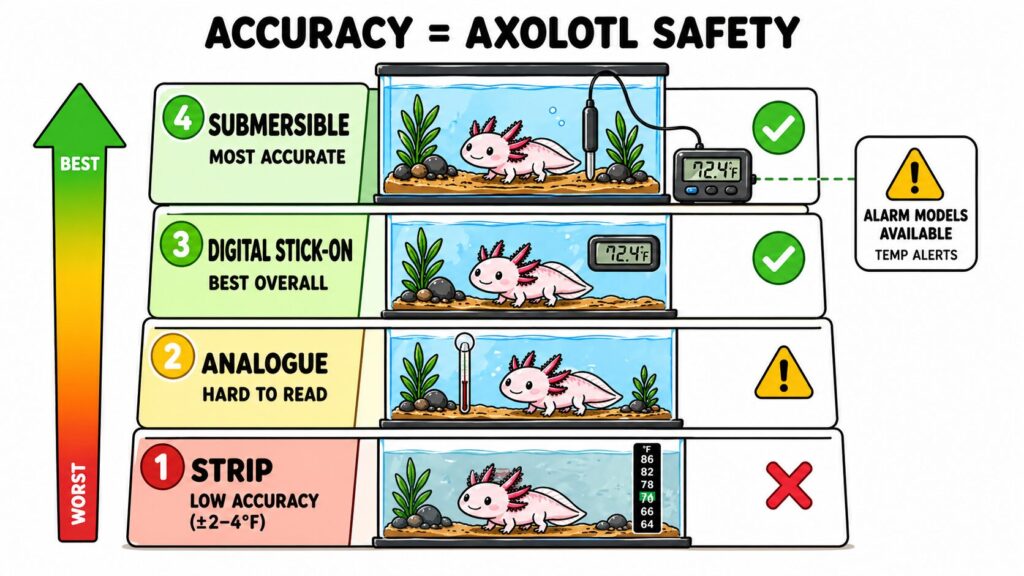
Digital stick-on thermometers are the most popular type for axolotl tanks and the format we recommend for most keepers. They adhere to the outside of the tank glass using 3M adhesive, with a copper or metal probe sensor on the back that reads water temperature through the glass. The display sits on the outside of the tank with no wires inside the water, keeping the tank interior clean. They are touch-operated, typically activating the display on a button press and entering sleep mode after a few seconds to conserve battery. Accuracy ranges from ±0.9°F to ±1°F in quality models, which is precise enough for axolotl temperature management. Installation is a matter of peeling off the adhesive backing and pressing the unit firmly below the waterline on the exterior of the tank glass.
Digital submersible thermometers have a probe on a cable that sits inside the tank water, with a digital display unit clipped to the rim or placed outside the tank. They tend to be slightly more accurate than stick-on designs because they measure the water directly rather than through glass. The downside is a wire running into the tank, which requires a cable management solution and adds another potential entry point for water. They are a good choice for keepers who want the highest possible accuracy.
LCD stick-on thermometers with high/low alarms are a step up from basic digital stick-ons. They include programmable temperature alarms that flash or alert you when the water temperature goes above or below your set limits. For axolotl keepers managing temperature year-round, this feature provides early warning before a temperature problem becomes an emergency. These models also often record and display the minimum and maximum temperatures reached since the last reset, which tells you what happened to your tank temperature overnight or while you were at work.
Analogue floating or standing thermometers are glass or plastic thermometers that float in the tank or stand against the glass. They are inexpensive and require no battery, but they are harder to read quickly, less accurate than digital options, and add a visible element inside the tank. For axolotl setups where you are actively monitoring a chiller or cooling fan, an analogue thermometer is not the right tool — you need a clear, quickly readable digital reading.
Strip thermometers are adhesive colour-change strips that stick to the outside of the tank. They are extremely inexpensive but provide only a very rough indication of temperature — accuracy is ±2–4°F in real-world conditions, which is simply not precise enough for axolotl keeping. At best, they serve as a backup indicator. Do not rely on a strip thermometer as your primary temperature monitoring tool for an axolotl tank.
What Makes the Best Axolotl Tank Thermometer?
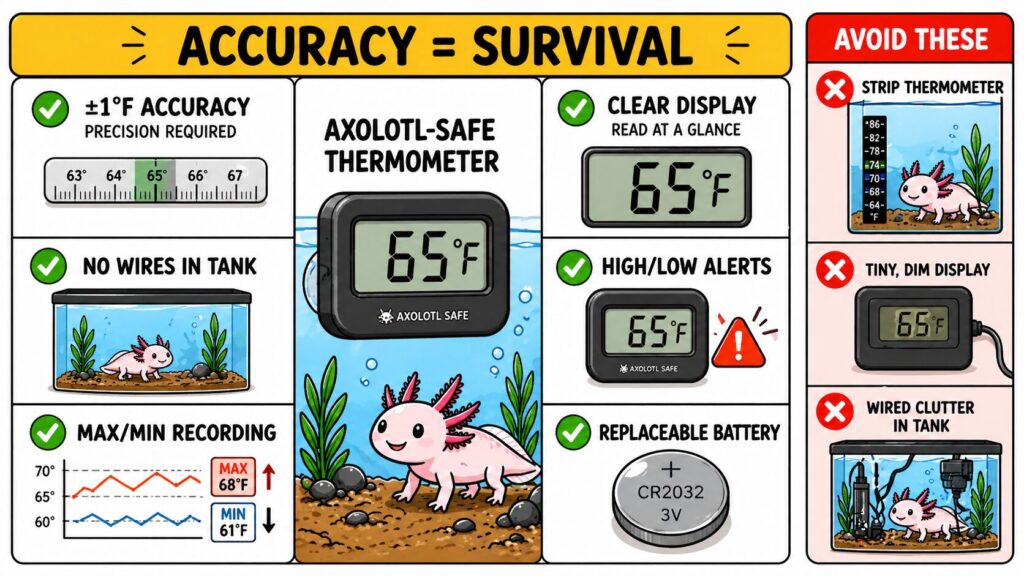
Accuracy of ±1°F or better. For axolotl keeping, accuracy matters. The difference between 68°F and 72°F represents the difference between comfortable and stressed. Look for thermometers rated at ±1°F or ±0.9°F accuracy at minimum. Models claiming ±0.5°F or better in digital format are even more reliable for precise temperature management.
Clear, easy-to-read display. You will check your tank temperature daily, often quickly in passing. A thermometer with a large, high-contrast display — whether LED or LCD — that is readable from a normal viewing distance without squinting or pressing a button every time is significantly more practical than a small, dim display. LED displays are particularly readable in dim room conditions.
No wires in the tank. For axolotl tanks, minimising items in the water is generally preferable — axolotls can interact with probes and wires in ways that cause stress or injury. Stick-on digital thermometers with sensors on the back of the unit read through the tank glass without any component inside the water, keeping the setup cleaner.
High/low alarm function. If your thermometer can alert you when temperature goes outside a programmed range, it becomes an early warning system for cooling failures. For a warm climate or an older cooling setup, this feature can mean the difference between catching a problem in time and losing your axolotl.
Max/min temperature recording. A thermometer that records and displays the highest and lowest temperatures reached since the last reset tells you what happened to your tank when you were not watching. This is invaluable for understanding overnight temperature patterns and catching gradual temperature creep before it becomes dangerous.
Replaceable battery. Thermometers with replaceable batteries outlast sealed units significantly. Look for models using standard CR2032 button cells, which are widely available and inexpensive to replace.
Our Top Axolotl Tank Thermometer Picks
Best Overall: PAIZOO Fish Tank Digital Thermometer with LED Display (±0.9°F)
The PAIZOO Fish Tank Digital Thermometer is our top overall recommendation for axolotl keepers. It sticks to the outside of the tank glass using 3M adhesive, reads temperature through the glass via a copper nickel-plated probe on the back, and displays the result on a high-definition LED screen with a 160° viewing angle that is readable from across the room. Accuracy is rated at ±0.9°F, which is precise enough for confident axolotl temperature management. The touch-to-activate, auto-sleep design conserves the included CR2032 battery, and the replaceable battery design means the unit will last for years without disposal. It covers a temperature range of 0–140°F, comfortably covering the cold end of axolotl-safe temperatures. This thermometer is specifically cited in its product listing as suitable for axolotl tanks, and it consistently earns strong marks from the axolotl keeping community for its accuracy and readability. This is the thermometer we recommend running alongside your water chiller or cooling fan as your independent temperature reference.
Best with Max/Min Recording: hygger Digital Aquarium Thermometer with Max/Min LCD Display
The hygger Digital Aquarium Thermometer with Max/Min LCD Display is the best choice for keepers who want to know not just the current temperature but the full daily temperature range their tank is experiencing. It records and displays the maximum and minimum temperatures reached since the last reset, letting you see what happened overnight or during the day while you were away. This is particularly useful during summer months when you are managing temperature with a cooling fan or chiller and want to verify that your setup is holding through the warmest parts of the day. The aluminium alloy sensor provides precise measurement, it sticks to the outside of the tank glass with no internal wires, and the LCD display is clean and easy to read. The included spare battery ensures you have a replacement on hand before you need it.
Best with High/Low Temperature Alarm: PAIZOO Aquarium Thermometer Digital with Auto-Alert LED Display
For keepers who want an early warning system for temperature problems, the PAIZOO Aquarium Thermometer Digital with Wireless Accurate Temperature Gauge combines the same ±0.9°F accuracy as our top pick with a larger LED display and a replaceable battery design. The 10-second refresh rate means temperature changes are caught quickly. If you are running a cooling setup that you want to monitor with peace of mind — particularly if you keep your tank in a warm room — running this alongside a high/low alarm-capable thermometer gives you both accurate readings and automated temperature boundary alerts. It reads in both Fahrenheit and Celsius and covers the full axolotl-safe temperature range comfortably.
Best Stick-On with Bright Visible Display: PAIZOO Aquarium Thermometer with Stick-On Design (±0.9°F, White Display)
The PAIZOO Aquarium Thermometer Stick-On with White Display is a clean, minimalist option for keepers who want a simple stick-on digital thermometer that is visible at a glance without requiring a button press. Its white LED display contrasts sharply against the tank glass, making it particularly readable in a range of lighting conditions. Accuracy is ±0.9°F, the battery is replaceable, and the 3M adhesive attachment requires no tools. This is a solid choice if you primarily want a reliable, attractive, easy-to-read temperature display on your tank without additional features.
Best for Two-Tank Setups or a Backup: PAIZOO Fish Tank Thermometer 2-Pack
For keepers running a main display tank and a quarantine tub simultaneously — which is the responsible approach to axolotl keeping — having a reliable thermometer on each is important. The PAIZOO Fish Tank Thermometer 2-Pack provides two identical ±0.9°F LED stick-on thermometers at a cost significantly lower than buying two individually. One for your main tank and one for your quarantine setup means you always have temperature data on both systems, which is especially important when you are treating a sick axolotl and monitoring recovery conditions.
How to Install and Use Your Axolotl Tank Thermometer
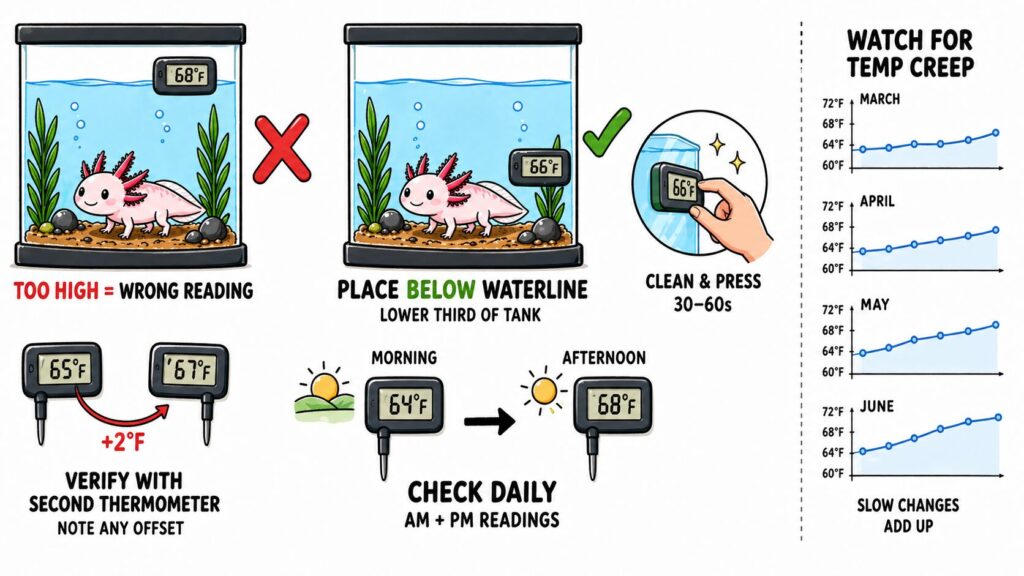
Installing a stick-on digital thermometer correctly ensures accurate readings. The most common mistake is placing the unit too high on the tank glass — the sensor on the back of the unit needs to be below the waterline to read water temperature rather than air temperature above the water surface. Before you peel off the adhesive backing, hold the unit against the tank at your intended position and verify that the sensor area on the back would be fully submerged when the tank is filled to its normal water level. A good position is typically in the lower third of the tank, away from the filter intake, heater (if any), or areas of direct airflow from your cooling fan.
Clean the tank glass thoroughly in the placement area before applying — even a thin film of dust or condensation reduces adhesive contact and can cause the unit to fall over time. Press the unit firmly against the clean, dry glass and hold it in position for 30–60 seconds to ensure the adhesive has bonded properly. Wait several hours before checking your first temperature reading to allow the adhesive to cure fully.
Once installed, compare your thermometer’s reading with a known accurate reference — a probe thermometer or a second digital thermometer placed in the tank water — to verify calibration. If your thermometer is reading 1–2°F off from the actual water temperature, note the offset and apply it mentally to all readings. Most quality ±0.9°F units are accurate enough that this is rarely necessary, but it is good practice to verify.
Check your tank thermometer every day, ideally at the same time. For axolotl keepers, a quick morning check before feeding — when the tank has had all night to equilibrate and you can see the overnight low — and an afternoon check during the warmest part of the day — when you can see the daytime high — gives you the most complete picture of your tank’s thermal environment. Use these readings alongside your water test kit results to build a full understanding of your tank’s conditions. Consistent monitoring over time also helps you spot gradual temperature creep before it becomes dangerous — a tank that is 66°F in March but 70°F by June without any change to your cooling setup is telling you that seasonal ambient temperature rise is starting to overcome your cooling capacity.
Frequently Asked Questions
What temperature should my axolotl tank be? The safe range for axolotls is 60–68°F (16–20°C), with 64–66°F (18–19°C) being an ideal midpoint. Above 72°F (22°C), heat stress begins. Above 74°F (23°C), serious health consequences follow rapidly. Our full guide on what temperature axolotls need covers the physiological reasoning in detail.
Can I use the temperature display on my water chiller instead of a separate thermometer? You can use it as a reference, but you should always verify against an independent thermometer. Water chillers — including quality units like the BAOSHISHAN and VEVOR models we recommended in our best axolotl water chiller article — can have display calibration offsets of 1–3°F. An independent thermometer on the tank glass gives you the actual water temperature to make decisions from.
How often should I check my axolotl’s tank temperature? Daily at minimum — morning and afternoon ideally. During the warmest months of summer, you should check more frequently on particularly hot days. Any time your axolotl appears lethargic, shows reduced appetite, or displays stressed body language, temperature should be the first thing you check.
Does the thermometer placement on the tank affect accuracy? Yes significantly. The sensor must be positioned below the waterline to read water temperature rather than ambient air. The lower third of the tank is ideal. Avoid placing the thermometer directly next to filter outlets or in the path of direct airflow from a cooling fan, both of which can create localised temperature variation.
What is the difference between LED and LCD thermometer displays? LED displays emit their own light and are readable in dark conditions without any additional illumination. LCD displays require ambient light to be readable and may be harder to see in dim conditions. For an axolotl tank in a room where you might check temperature in low light, an LED display is more practical.
Do I need two thermometers? If you are running a main tank and a quarantine tub, having one thermometer on each is strongly recommended. Temperature management in a quarantine setup is equally important for recovery — a sick axolotl being treated in a too-warm quarantine tub will not recover well. A 2-pack of identical thermometers is the most economical way to cover both.
Measure It, Know It, Control It
A thermometer costs a few dollars and takes two minutes to install — but the knowledge it gives you is foundational to everything else in axolotl keeping. Once you can see your tank temperature at a glance, you can act on it: adjusting your cooling fan, verifying your water chiller is holding its set point, or catching a problem before it escalates. If you want to explore every product that contributes to excellent axolotl care — from the substrate they walk on to the food they eat — head over to Best Axolotl Products for our complete, keeper-tested guide to the best gear in every category.