
Origin And Natural Habitat
Peru, Bolivia, Brazil, and French Guiana make up the confirmed distribution of Acanthoscurria theraphosoides, as recorded in the World Spider Catalog and confirmed through the 2014 Paula et al. revision published in Zoologia that consolidated its synonyms. The type specimen referenced by F.O. Pickard-Cambridge in 1896 — the female he collected in Pará state in Brazil’s lower Amazon and deposited with the Natural History Museum in London under the name Acanthoscurria brocklehursti — anchors the species to the humid Amazonian lowland rainforest. That specimen is now treated as a junior synonym of A. theraphosoides.
The Amazon basin habitat shared across much of this range is characterised by tropical wet forest, high annual rainfall averaging around 2,200mm, consistently warm temperatures around 25°C, and little to no dry season across the northern lowland portions. The spider lives as a terrestrial burrower in the forest floor, sheltering beneath roots, logs, and in soil burrows during the day and emerging at night to hunt. The Brazilian and Peruvian Amazon portions of the range sit at the heart of one of the most biodiverse forest systems on Earth, providing abundant invertebrate prey and the consistently warm, humid conditions the species has evolved to require.
Scientific Classification
The taxonomy surrounding this species is genuinely complicated and worth addressing clearly, because the confusion affects how keepers research and discuss it. The animal currently sold in the hobby as the Giant Black and White, commonly under the name A. theraphosoides and historically as A. brocklehursti, is scientifically confirmed by HandWiki’s review of the Paula et al. revision as a thinner-banded regional variant of Acanthoscurria geniculata from the Amazon basin — effectively the same species in a narrow-band form. The pet trade animal that reaches 7 to 9 inches and carries alternating light and dark leg banding is this A. geniculata narrow-band variant; it is sold under the A. theraphosoides name because that is how it entered the hobby and the label has persisted despite the taxonomic clarification.
Keepers holding specimens labelled A. brocklehursti or A. theraphosoides are almost certainly keeping the narrow-band geniculata form, and care requirements are effectively identical to the broad-banded Brazilian White Knee. Full classification as applied in the hobby: Kingdom Animalia, Phylum Arthropoda, Class Arachnida, Order Araneae, Infraorder Mygalomorphae, Family Theraphosidae, Subfamily Theraphosinae, Genus Acanthoscurria, Species A. theraphosoides (Doleschall, 1871).
Species Overview
The Giant Black and White occupies a distinctive niche in the Acanthoscurria genus as the visually refined alternative to the Brazilian White Knee. Where A. geniculata is famous for its bold, broad white banding, the Giant Black and White presents narrower, more refined cream or white banding against the same jet-black body — a thinner-striped pattern that many keepers consider even more visually striking for the precision of the contrast. It is less commonly available than A. geniculata but carries the same reputation for an explosive feeding response, impressive adult size, and the kind of bold, visible display personality that makes large terrestrial tarantulas rewarding to keep. Intermediate experience is appropriate. Keepers wanting more background on the Acanthoscurria genus can find comprehensive species-level information at iNaturalist’s genus page.
Appearance And Size
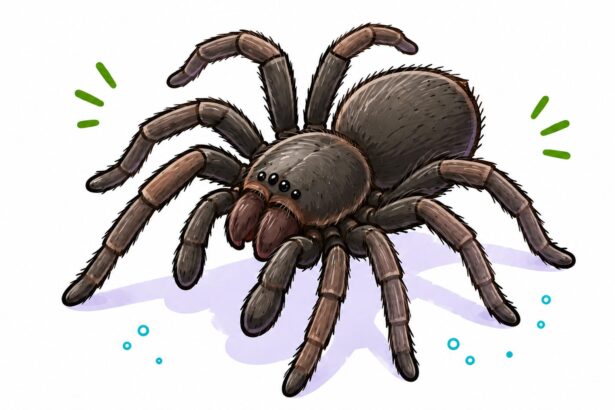
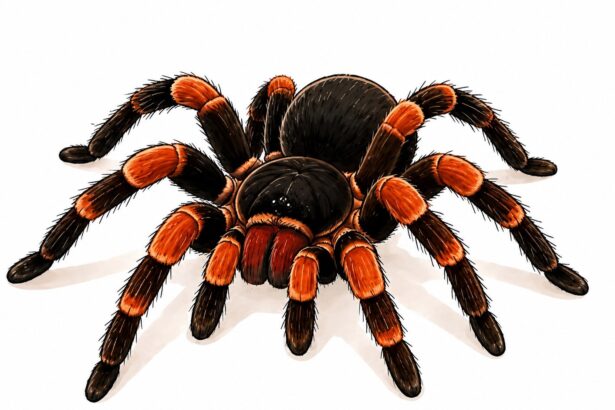
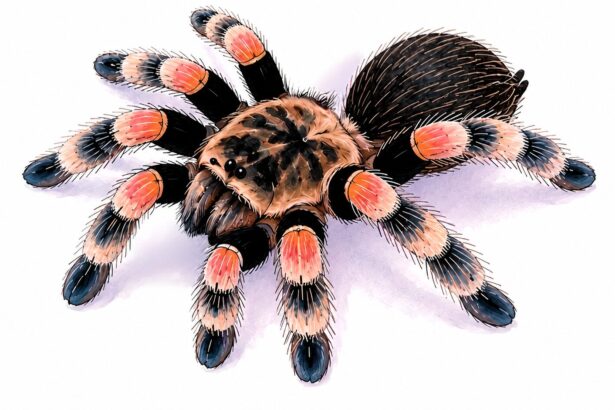
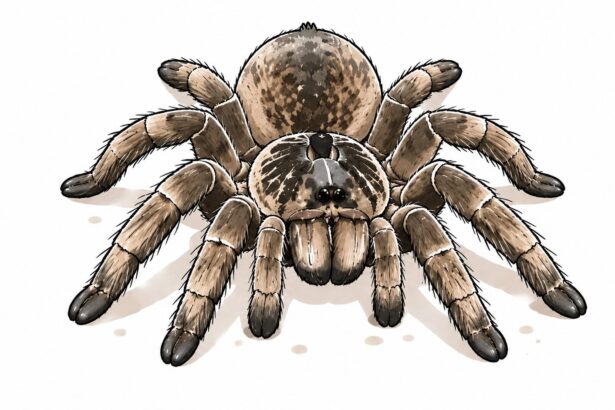
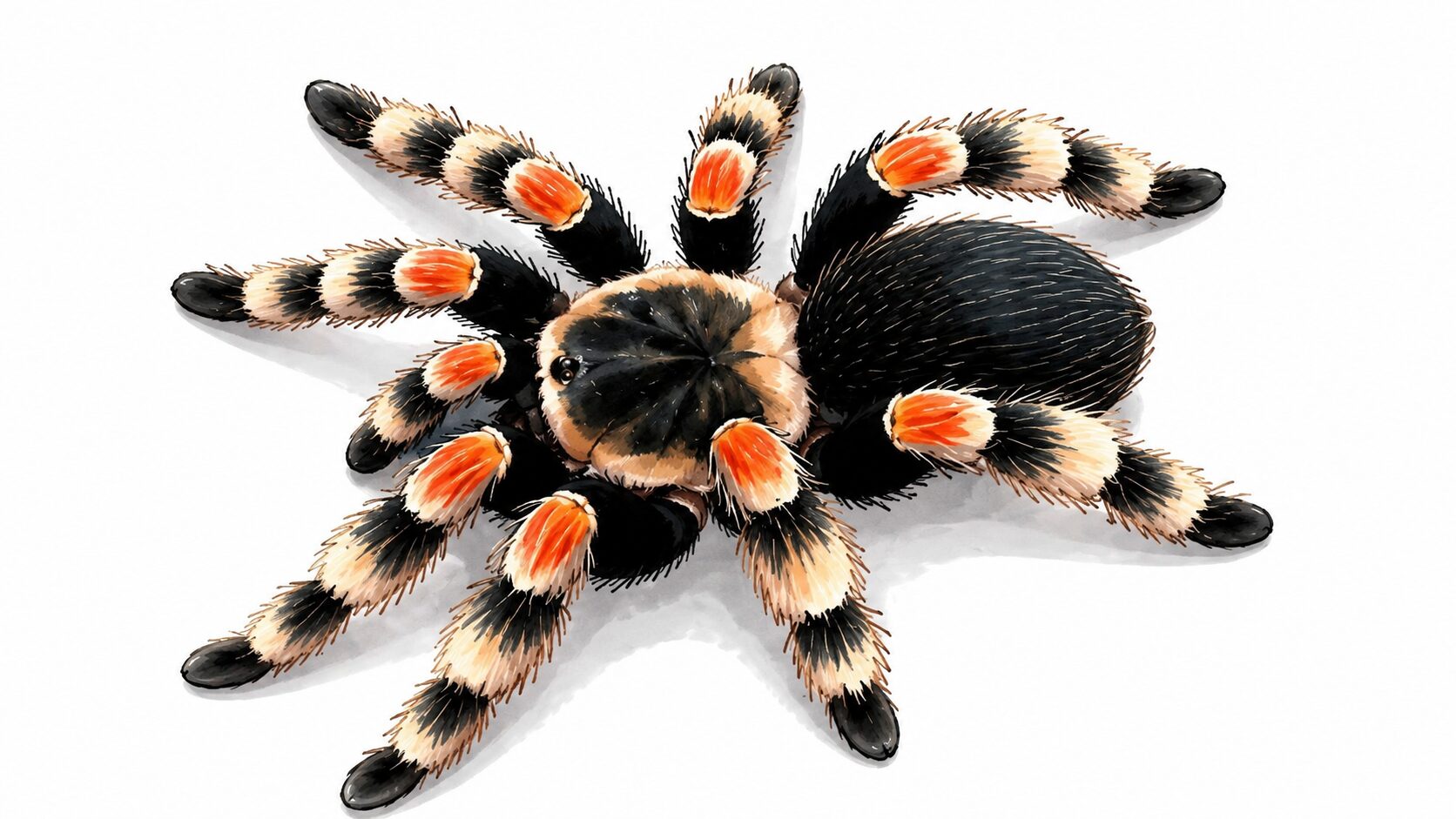
The banding is the point of comparison and the defining visual feature. Both this species and the Brazilian White Knee share the same deep black body with dense velvety setae and the same reddish-orange abdominal hairs that catch light dramatically. What differs is the width of the white leg bands — narrower here, sometimes described as pinstripe compared to the broader banding of A. geniculata, which gives the adult spider a more geometric, graphic quality. The contrast between jet black and bright white is sharpest immediately after a moult, when the setae are fresh and the banding most vivid. Tom’s Big Spiders’ coverage of the brocklehursti/theraphosoides naming history gives useful context on how the banding width distinction was used historically to separate them before the taxonomic revision.
Adults reach a diagonal legspan of 7 to 9 inches based on keeper reports and vendor data — among the largest tarantulas available in the hobby. Females are larger and longer-lived than males. Growth rate is fast, consistent with the A. geniculata characterisation of this animal.
Housing
Wide floor space and secure containment are the twin priorities for an animal of this size. A footprint of at least 30 by 30 centimetres for adults, with 5 to 6 inches of substrate below and modest height above — no more than twice the spider’s legspan — to minimise fall risk for a heavy adult. The lid must latch securely: a large, strong spider in good condition can push an unsecured lid. Front-opening access is strongly preferred over top-opening for the same reason it matters across all large fast-moving tarantulas — a top-opening lid over an alert specimen at the enclosure top creates a gap that fast-moving spiders exploit before the keeper can react. This species frequently sits out in the open rather than permanently retreating underground, making front-opening access important for safe routine maintenance. Our best tarantula enclosure guide covers terrestrial formats with appropriate floor space, substrate depth, and security for very large active Amazonian species.
Enclosure’s Decorations
Cork bark at substrate level provides a retreat anchor and the webbing foundation the spider builds outward from. A shallow water dish at the opposite end of the enclosure ensures accessible hydration — keeper experience with A. geniculata documents females actively splashing water from the dish onto adjacent substrate to create a damp patch, reflecting active microclimate management. Fake plants and additional cork bark provide webbing attachment points and visual interest. The genus tendency to sit out in the open makes a well-decorated enclosure particularly worthwhile — a spider this large and visually striking that chooses to be visible is worth providing an attractive backdrop. Our best tarantula cork bark, best tarantula fake plants, and best tarantula hide guides cover appropriate pieces for very large terrestrial setups.
Substrate
Five to six inches of moisture-retaining substrate minimum. Coconut coir and peat moss in equal parts, optionally with topsoil for structural firmness, kept consistently lightly damp throughout. The Amazon basin habitat has abundant year-round rainfall with little dry season, and the substrate should maintain moisture without being waterlogged. The upper layer can be slightly drier between water additions while the lower layers maintain the damp conditions the burrow microclimate provides. Our best tarantula substrate guide covers moisture-retaining blends appropriate for humid Amazonian terrestrial species at this size.
Water And Humidity
A shallow water dish at all times, refreshed every two to three days. Target ambient humidity of 65 to 75 percent, maintained through damp substrate and water dish evaporation. Keeper accounts on Arachnoboards across multiple large Acanthoscurria species consistently note that water dish access matters beyond passive drinking — these spiders interact with their water supply actively. A hygrometer confirms actual ambient conditions, and a misting bottle provides targeted top-ups when needed. Adequate enclosure ventilation keeps humidity stable without creating the stagnant conditions that cause mould.
Heating And Temperature
The Amazon basin maintains warm temperatures averaging 25°C year-round with limited seasonal variation. A captive range of 75 to 84°F suits this species well. Keeper experience with the closely related A. geniculata suggests these spiders are comfortable toward the cooler end of their range — specimens pressed against the cooler end of temperature-gradient enclosures, suggesting mid-70s rather than mid-80s as the preferred zone. A side-mounted heat mat controlled by a thermostat is appropriate when ambient temperatures drop consistently below 68°F. A thermometer at substrate level confirms actual enclosure conditions.
Diet And Nutrition
Voracious is accurate and well documented. The A. geniculata feeding response that defines genus expectations — pouncing on prey with full commitment, striking mid-air if the prey moves during approach — applies here in full. The Tarantula Collective’s care documentation for this species group describes one of the most enthusiastic feeding responses in the hobby. Adults take crickets, dubia roaches, and other appropriately sized invertebrates every seven to fourteen days. Juveniles every five to seven days. Prey should be sized to the spider’s abdomen or slightly smaller. Feeding tongs are essential at this size — a committed strike from a 7 to 9 inch tarantula is not something to test with bare hands near the enclosure opening. Remove uneaten prey within 24 hours. Our best tarantula food guide covers feeder insect options and gut loading relevant to a very large, fast-metabolising Amazonian terrestrial.
Compatibility
Solitary only. For breeding, a well-fed female and supervised introduction are non-negotiable. The close relationship to A. geniculata means breeding insights from that well-documented species apply here, though captive breeding of the narrow-band form specifically is less common and stock remains more limited than the broad-banded form.
Behavior And Temperament
Bold is the defining behavioural word — not aggressive in the bite-first sense, but present, visible, and unafraid. This is a species that sits out rather than hiding, investigates disturbance rather than fleeing, and responds to feeding activity with obvious engagement. Urticating hair deployment happens readily at genuine disturbance, and the sheer volume of setae available on a large adult means a significant cloud is possible when the spider decides to kick — eye protection during enclosure maintenance is genuinely advisable. Jamie’s Tarantula Blog notes that bites of this species group are rare, with fleeing and hair-kicking the typical first response to disturbance. Our are tarantulas nocturnal article provides context on activity patterns — this species is most active after dark but frequently visible during daylight hours too, which is part of what makes it such a rewarding display animal.
Handling
Possible with appropriate care for experienced keepers, though not recommended as routine practice. The adult size means a fall from handling height carries real injury risk for the spider regardless of temperament, and the urticating hair propensity means eye protection is advisable during any handling attempt. Venom is considered medically insignificant to healthy humans. Keepers who do handle do so at floor level with slow, deliberate movements. Our why are tarantulas so big article provides useful context on the evolutionary pressures that produced animals this size.
Health And Lifespan
Females live 15 to 20 or more years in captivity based on the A. geniculata lifespan data that applies to this narrow-band variant. Males survive considerably shorter lives after sexual maturity. The species is robust and hardy within appropriate Amazonian conditions. The primary health risks are the standard combination of chronic dryness causing dehydration and mould from excess moisture with poor ventilation. Pre-moult periods in a large specimen produce a sealed retreat and prolonged fasting that can extend for months — a spider that has sealed its burrow and stopped eating should be left completely undisturbed. Our tarantula dehydration article covers identification and recovery for dehydration-related health concerns in large long-lived specimens.
Price
More accessible than its relative rarity compared to A. geniculata might suggest, with captive breeding producing periodic stock. Slings typically sell for $25 to $55 USD. Juveniles range from $50 to $100. Confirmed adult females are less frequently available and command $100 to $200 or more, reflecting the visual impact of a fully grown specimen. Reptile Rapture is one of the US vendors that stocks this species intermittently. Source captive-bred specimens only. Everything needed to provide appropriate conditions for this very large Amazonian species is on our best tarantula products page.