
Origin And Natural Habitat
The Brazilian Amazon is one of the most biodiverse regions on Earth, and the Juruá River basin — a major western tributary of the Amazon running through the state of Amazonas — gives Acanthoscurria juruenicola both its species name and its primary documented range. The species is a ground-dwelling resident of the Amazonian tropical forest, inhabiting the warm, humid lowland rainforest floor where it constructs burrows and shelters in the concealed microhabitats typical of large South American terrestrial tarantulas. A synonym, Acanthoscurria xinguensis Timotheo 1960, places additional records from the Xingu River drainage in Pará state, extending the confirmed range eastward within the Amazon basin. A 2014 comprehensive revision of Brazilian Amazonian Acanthoscurria species by Paula, Gabriel, Indicatti, Brescovit, and Lucas in the journal Zoologia established detailed morphological characterisation of this species from museum material and fresh specimens.
The Amazonian lowland climate that defines this species’ natural habitat is consistently warm and humid throughout the year — mean temperatures around 26°C, high annual rainfall, and dense forest canopy providing a stable, shaded ground environment. This is the thermal and moisture template that captive care should approximate, without the pronounced seasonal variation that species from more southerly or more variable environments experience.
Scientific Classification
Described by the Brazilian arachnologist Cândido Firmino de Mello-Leitão in his 1923 monograph Theraphosideas do Brasil — a foundational work in South American tarantula taxonomy that described numerous species in a single publication — A. juruenicola has been refined through subsequent work including the male description published by Lucas et al. in Memórias do Instituto Butantan in 1981, and the full redescription of both sexes in the 2014 Paula et al. revision of Brazilian Amazonian Acanthoscurria in Zoologia. The synonym A. xinguensis Timotheo 1960 is now considered invalid, subsumed under the earlier Mello-Leitão name. Full classification: Kingdom Animalia, Phylum Arthropoda, Class Arachnida, Order Araneae, Infraorder Mygalomorphae, Family Theraphosidae, Subfamily Theraphosinae, Genus Acanthoscurria, Species A. juruenicola Mello-Leitão, 1923.
Species Overview
Among the Acanthoscurria genus, A. juruenicola sits in a distinctive position as a species that is simultaneously less common in the hobby than its well-known relatives and more visually distinctive than most of them. Where A. geniculata is famous for bold white banding, A. juruenicola offers orange banding against a dark body — a warmer, more saturated palette that competes favourably for visual interest. The Wikipedia entry’s frank acknowledgement that it “is not often kept as a pet” is accurate: captive-bred stock appears intermittently, captive breeding programmes are less established than for more popular genus members, and many keepers who encounter it for the first time express surprise that a tarantula this attractive remains this uncommon in collections. For experienced keepers who appreciate the genus’s characteristic robustness and feeding response in a rarer package, it is a rewarding addition. Intermediate experience is appropriate.
Appearance And Size
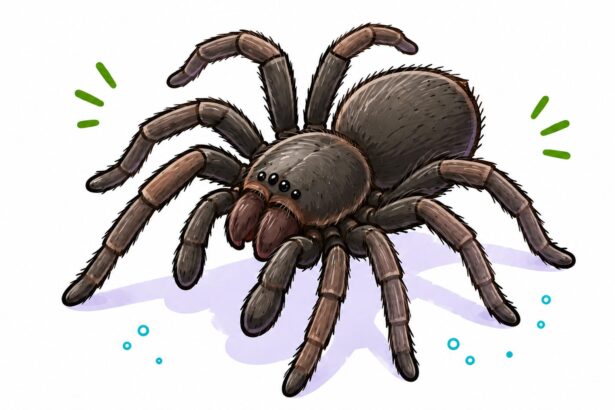
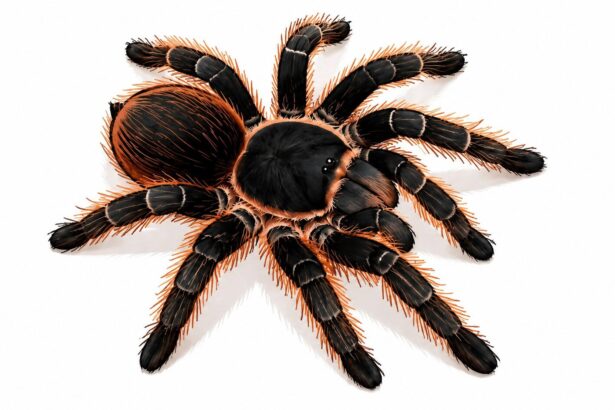
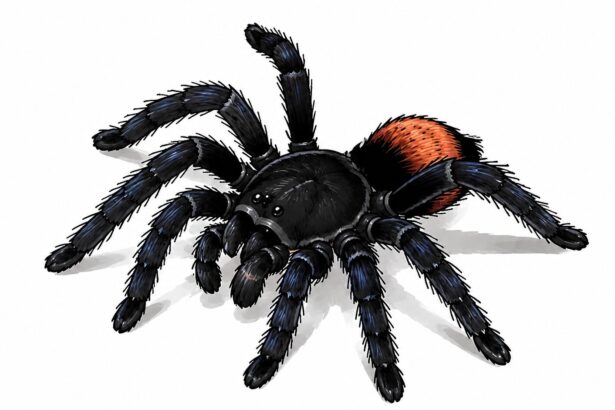
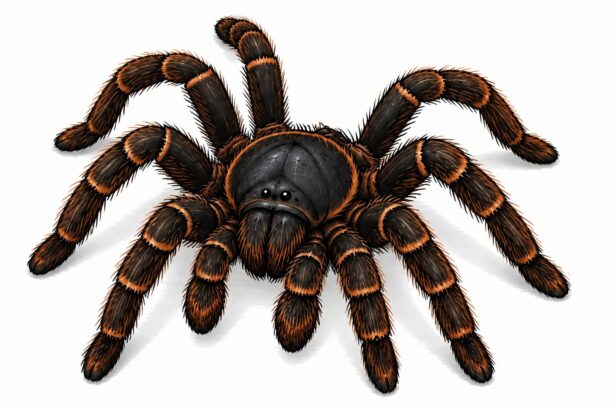
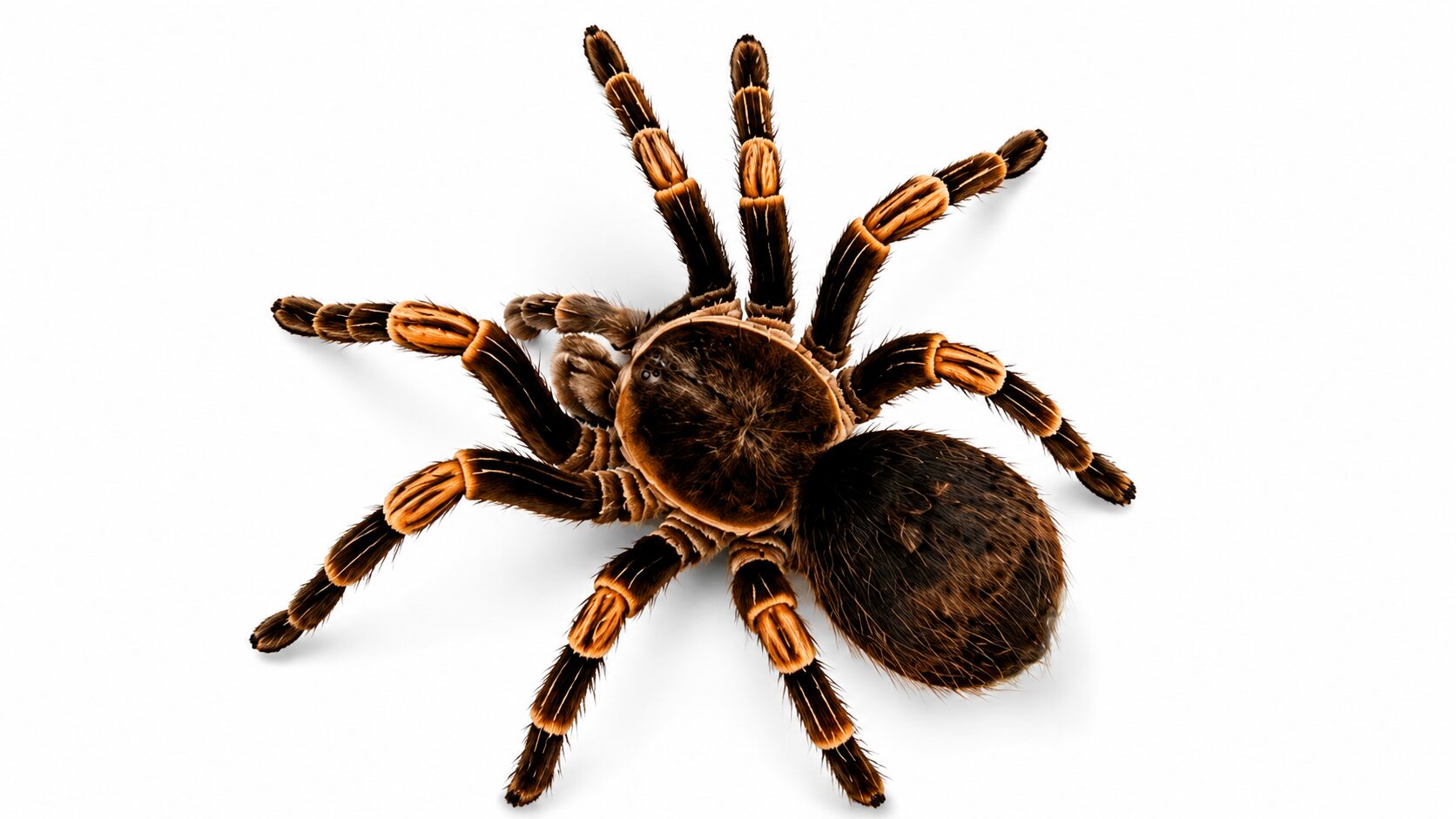
The orange banding is the defining visual characteristic, and it is worth understanding exactly what that looks like in practice based on keeper observations. The body is a warm mid-brown to light brown overall, and the legs carry orange banding at the joints — most prominently at the patellae and tibiae — that shows most vividly on freshly moulted specimens under good lighting. Experienced keepers on Arachnoboards note that the orange bands can look stronger in photographs than they appear in person under normal lighting, and that there is individual variation in how vivid the banding appears, with some individuals carrying distinctly richer orange tones and others trending more towards reddish-brown. The setae covering the body are dense in the typical Acanthoscurria fashion, giving the spider a textured, shaggy appearance. As with most large tarantulas, the banding is most saturated immediately after a moult and fades somewhat as the setae age.
Adult females reach a diagonal legspan of approximately 7 inches, with body length and sex both influencing final size. Males are smaller and mature earlier. Growth rate under good conditions is described as fast, consistent with the genus norm.
Housing
A wide, floor-focused terrestrial enclosure is appropriate. A footprint of at least 30 by 30 centimetres for adults, with modest height — twice the spider’s legspan maximum above the substrate surface — and a locking lid. Like other large Acanthoscurria species, this is a strong-bodied animal that can push unsecured lids. Front-opening access is preferred over top-opening for minimising disturbance during maintenance. Slings can be housed in small deli cup containers and transitioned upward through progressively larger enclosures as growth warrants. Our best tarantula enclosure guide covers terrestrial formats with the floor space, substrate depth, and security appropriate for large active Amazonian terrestrial species.
Enclosure’s Decorations
Cork bark at substrate level provides a primary retreat and webbing anchor. A shallow water dish positioned at the opposite end of the enclosure from the hide ensures accessible hydration without flooding the retreat area. Additional cork bark, fake plants, or other surface structures add visual interest and give the spider further webbing anchor options — the genus characteristically uses silk in and around its retreat area. A pre-formed starter burrow pressed into the substrate at one corner or beneath the cork bark encourages the spider to establish its home quickly after a rehouse. Our best tarantula cork bark and best tarantula fake plants guides cover appropriate pieces for large terrestrial setups.
Substrate
Four to six inches minimum for adults, using a moisture-retaining blend that supports the consistently humid Amazonian forest floor environment. Coconut coir and peat moss in equal parts is the standard reliable choice, with optional topsoil for additional structural firmness that supports burrowing. The substrate should be maintained consistently lightly damp throughout — this is an Amazonian lowland species from a high-rainfall environment, not a dry-savanna animal. A moisture gradient from lightly damp in the lower substrate to slightly drier near the surface, combined with a consistent water dish and adequate enclosure ventilation, maintains appropriate conditions without creating the stagnant wet conditions that invite mould. Our best tarantula substrate guide covers moisture-retaining blends appropriate for humid Amazonian terrestrial species.
Water And Humidity
A shallow water dish at all times, refreshed every two to three days. Target ambient humidity of 65 to 75 percent, maintained through the consistent moisture gradient in the substrate and evaporation from the water dish. Periodic light misting of the enclosure walls adds moisture during drier periods without saturating the substrate. A hygrometer inside the enclosure confirms actual ambient conditions, and a fine-mist misting bottle provides targeted top-ups when needed.
Heating And Temperature
The Juruá River basin maintains warm temperatures year-round with little seasonal variation. A captive range of 76 to 85°F suits this species well, and most keepers in temperate climates maintain A. juruenicola at room temperature without supplemental heat for most of the year, adding a side-mounted heat mat controlled by a thermostat when ambient temperatures drop below 70°F. A thermometer at substrate level provides accurate data on actual conditions inside the enclosure rather than relying on room temperature alone, which can differ meaningfully from conditions within a well-insulated substrate.
Diet And Nutrition
Consistent with the genus character: a strong, committed feeder that accepts prey enthusiastically outside of pre-moult periods. Adults take crickets, dubia roaches, and other appropriately sized invertebrates every seven to fourteen days. Juveniles can be fed every five to seven days. Prey should be sized to the spider’s abdomen or slightly smaller, and uneaten prey should be removed within 24 hours. A spider sealing its retreat and refusing food is approaching a moult and should be left undisturbed until it reopens the burrow. Our best tarantula food guide covers feeder insect options and gut loading relevant to a large, fast-growing Amazonian terrestrial species.
Compatibility
Solitary only. For breeding, the female must be well-fed and the introduction supervised throughout. The relative rarity of captive-bred stock means that successful pairings are genuinely valuable to the hobby, and responsible breeders who work with this species are doing meaningful work in establishing a more stable captive population.
Behavior And Temperament
The genus disposition applies: bold, food-motivated, and a willing urticating hair kicker when disturbed rather than a biter by inclination. The threshold for hair-kicking varies by individual, but the shared Acanthoscurria character of becoming progressively more visible and confident as the spider grows is documented here too. Adults tend to spend more time out of their retreats than juveniles, making well-kept adults good display animals for a large terrestrial species. The colour is most visible when the spider is out in the open, which makes the investment in maintaining comfortable conditions — including a suitably enriched enclosure where the spider feels settled — directly rewarding for the keeper. Our article on are tarantulas nocturnal covers the activity patterns relevant to knowing when to expect this species to be most visible.
Handling
Possible with appropriate care given the species’ non-aggressive disposition, though not recommended as a routine practice. The urticating hair capability and adult size are the main practical concerns; the venom is considered medically insignificant to healthy humans. Keepers who handle do so at floor level with deliberate, slow movement. The species’ relative rarity is also a consideration — a spider that can’t be easily replaced warrants more cautious handling protocols regardless of its temperament.
Health And Lifespan
Females are expected to live 15 or more years in captivity based on genus norms, though precise long-term data for A. juruenicola specifically is limited by the small number of specimens maintained in captivity over extended periods. Males survive considerably shorter lives after sexual maturity. The species is considered hardy within appropriate Amazonian humidity conditions. The primary health risk is the standard combination of chronic dryness causing dehydration and excess moisture with poor ventilation causing mould — both managed by the substrate moisture gradient and ventilation approach described above. Our tarantula dehydration article covers identification and recovery for dehydration-related concerns.
Price
Availability is intermittent and driven primarily by the limited number of keepers working with this species in captive breeding. When available, slings typically sell for $30 to $60 USD. Juveniles range from $60 to $100. Confirmed adult females are rarely available and command $100 to $180 or more depending on source and size. This is a species where keeper patience and alerting reputable breeders to your interest tends to pay off more than expecting to find it readily listed. Source captive-bred specimens only. Everything needed to set this species up correctly is on our best tarantula products page.