
Origin And History
The Pumi, pronounced POO-mee in the English-speaking world with the Hungarian plural Pumik following the grammatical conventions that Hungary’s breed enthusiasts consistently and correctly insist upon, sometimes called the Hungarian Herding Terrier — a nickname that reflects the breed’s specifically terrier-like attributes of quick movement, bold independent initiative, and quadratic lean body type without implying any actual terrier blood in the ancestry — is a medium-small, corkscrew-curled, semi-erect-eared, relentlessly energetic, whimsically expressive herding breed from Hungary that is simultaneously one of the oldest working breeds of the Hungarian plains in its ancestral Puli foundation and one of the most recently recognized new breeds in this series, having received full AKC Herding Group status only on July 1, 2016, having been recognized by the UK Kennel Club only in 2015, and having been recognized as a distinct breed separate from the Puli only in the early 20th century after centuries during which the two names were used interchangeably and the Pumi was considered merely a regional variation of its older sibling.
The breed’s founding history begins with its ancestral breed, the Puli — the ancient corded Hungarian herding dog brought to Hungary by the Cuman and Magyar peoples from Central Asia beginning around 800 CE. Approximately 300 years ago, in the 17th and 18th centuries, the Puli came into contact with Western European herding dogs during the active livestock trading between Hungary, France, and Germany that characterized the Austro-Hungarian Empire’s agricultural trade during this period. Livestock was driven on hoof to their destinations across European trade roads, and the shepherds accompanying these animals naturally used their herding dogs to manage the flocks during the journey. Accidental or perhaps even intentional matings between the respective parties’ dogs took place as their paths crossed on the roads and markets of Europe — producing the first dogs that would eventually be recognized as Pumik.
The specific Western European breeds that contributed to the Pumi’s founding are documented with reasonable historical specificity. From Germany, the contributors were the Pomeranian Schafpudel (Sheep Poodle, still existing today in small numbers) and the Hütespitz (Herding Spitz), which was considered extinct by 1935. From France, the Briard contributed herding capability and possibly coat characteristics. Merino sheep were imported to Hungary in the 18th century from Spain, and small Pyrenean Mountain Dogs accompanying these Merino flocks are believed to have contributed to the Pumi, producing dogs with a shorter and curlier coat than the corded Puli.
The geographic heartland of the Pumi’s development was the hills and small pastures of western Hungary — a landscape fundamentally different from the vast open Puszta plains where the Puli had developed. Western Hungary’s terrain consisted of small pastures only accessible through woods or along narrow roads, requiring a herding dog with a specifically different working style: a dog that could work close to livestock and drive it through tight passages, that was quick and decisive, that could function independently to manage stock in confined terrain, and that could keep animals out of crops along roadsides by patrolling rapidly back and forth between the flock and the field margin. The working tools the Pumi employed were barking, quick movement, and an occasional nip if needed — a working style specifically adapted to the close, quick, vocal herding that the landscape required.
The first known drawing of a Pumi dates to 1815. The name Pumi was first mentioned in writing in 1815 as well. For most of the 18th and 19th centuries, the Pumi and Puli names were used interchangeably in Hungary, with the Pumi considered a regional variant of the older breed. It was the Hungarian University of Veterinary Medicine professor Emil Raitsits who initiated the formal standardization of both the Puli and the Pumi as distinct breeds in the 1910s and 1920s. The first distinction between the two breeds was published in 1902. The Hungarian Kennel Club established the first Pumi breed standard in 1921, and the FCI approved the international breed standard in 1935. In the early 20th century, Hungarian cynologists identified three distinct herding breeds based on phenotype: the Puli first, prevalent on the eastern Hungarian plains; the Pumi next, from the hills of western Hungary; and the Mudi last, from southern Hungary.
The breed’s international spread began in 1972 when the Pumi was first introduced to Finland, where it is now the most popular Hungarian herding dog in the country — a specifically remarkable achievement for a breed that remains rare outside its homeland. The first Pumi arrived in the United States in the 1980s, though the breed was likely present informally before records were maintained. The UK Kennel Club recognized the breed in 2015. The AKC granted full recognition on July 1, 2016, placing the breed in the Herding Group. The Hungarian Pumi Club of America is the primary breed organization in North America.
Breed Overview
| Trait | Details |
|---|---|
| Origin | Western Hungary (hills of Transdanubia; distinct from Puli’s eastern Puszta plains) |
| Hungarian Name | Pumi; plural Pumik |
| Pronunciation | POO-mee |
| Nickname | Hungarian Herding Terrier (terrier-like attributes; no actual terrier blood) |
| Ancestral Breed | Puli (ancient corded Hungarian herding dog; ~800 CE) |
| Cross Breeds | Pomeranian Schafpudel; Hütespitz; Briard; Pyrenean Shepherd; Spanish Merino sheep companions |
| Cross Period | 17th and 18th centuries (Austro-Hungarian livestock trade with France and Germany) |
| First Drawing | 1815 |
| First Written Mention | 1815 |
| First Distinction from Puli | Published 1902 |
| Standardization Leader | Emil Raitsits (professor, Hungarian University of Veterinary Medicine; 1910s–1920s) |
| Hungarian Kennel Club Standard | 1921 |
| FCI Recognition | 1935 |
| First Finland Introduction | 1972 (now most popular Hungarian herding breed in Finland) |
| First US Arrival | 1980s |
| UK Kennel Club | 2015 |
| AKC Recognition | July 1, 2016 (Herding Group) |
| Parent Club (USA) | Hungarian Pumi Club of America (HPCA) |
| AKC Breed Description | “Compact, nimble-footed herder of Hungarian origin” |
| Hungary Population | Over 2,000 registered; also notable in Finland and Sweden |
| Three Hungarian Herding Breeds | Puli (east plains); Pumi (west hills); Mudi (south) |
| Height | Males 16–18.5 inches (41–47 cm) / Females 15–17.5 inches (38–44 cm) |
| Weight | Males 27–29 pounds (12–13 kg) / Females 22–24 pounds (10–11 kg) |
| Lifespan | 12–13 years |
| Coat | Wavy and curly; corkscrew curls; never corded; equal mix of harsh outer coat and soft undercoat |
| Colors | All shades of gray (most common; born black, graying from 6–8 weeks); black; white; fawn |
| Gray Coat | Born black; lightens progressively; final shade predicted by parents’ colors |
| Shedding | Minimal |
| Ears | Two-thirds erect; top third tips forward — most specifically distinctive individual feature |
| Tail | Carried in full circle over back |
| Coat Does NOT Cord | Specifically distinguishes Pumi from Puli despite similar ancestry |
The Three Hungarian Herding Siblings
Because the Pumi is most specifically understood in the context of its two sibling breeds — the Puli from eastern Hungary and the Mudi from southern Hungary — a brief orientation serves any reader encountering the breed for the first time.
All three are Hungarian herding breeds that were formally distinguished from each other only in the early 20th century when Hungarian cynologists separated them by phenotype. The Puli is the oldest and the most ancient, with the corded coat that develops over years from the ancient Central Asian herding dog lineage. The Pumi developed from the Puli through 17th and 18th century Western European herding dog crosses, producing the corkscrew-curled but never-corded coat, the semi-erect ears, the longer muzzle, and the terrier-quick working style. The Mudi developed most recently, from southern Hungary. The three breeds share Hungarian heritage but are physically and temperamentally distinct enough to have been formally separated by breed standards more than a century ago.
Appearance And Size
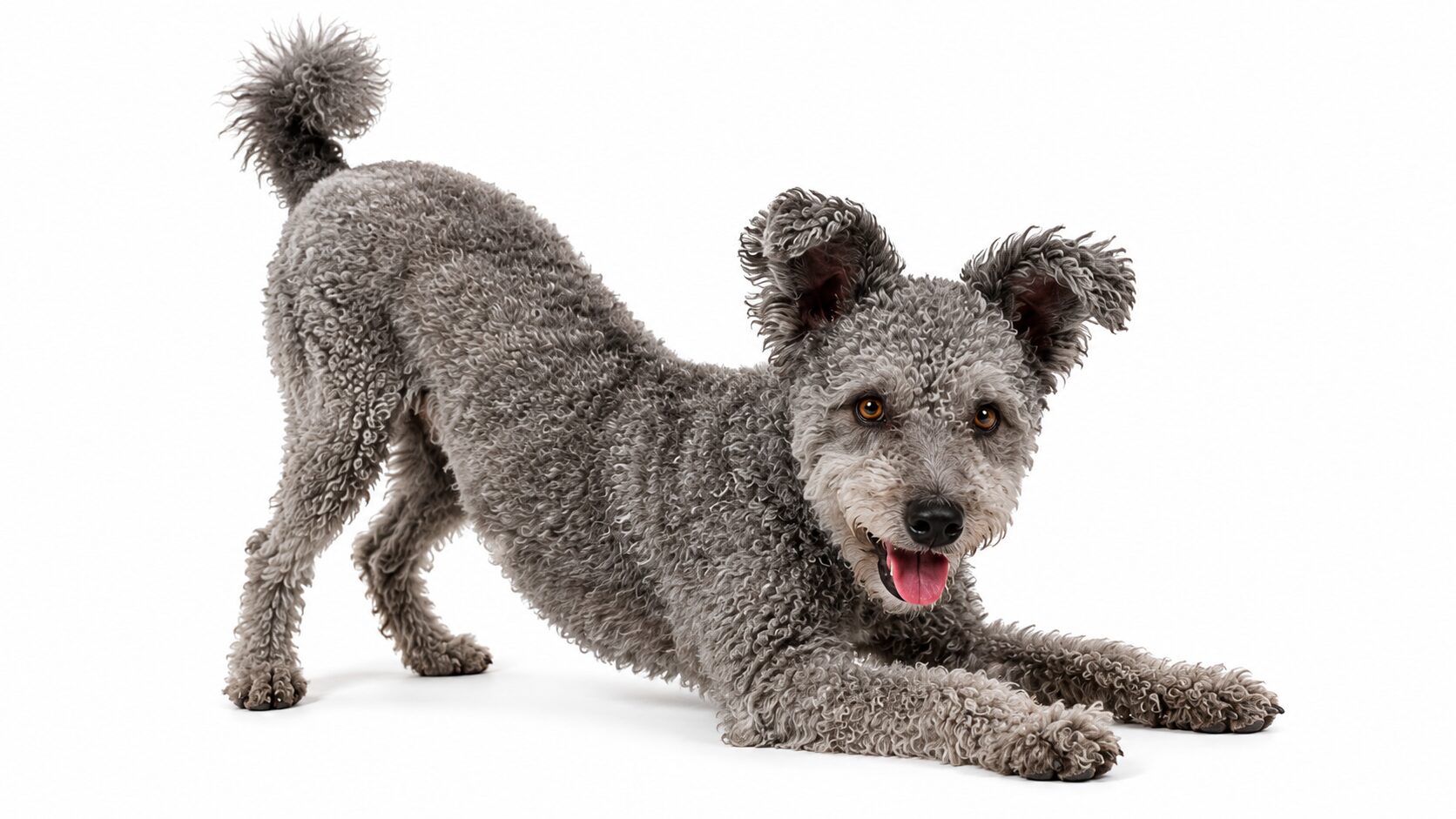
The Pumi is a medium-small, compact, square-outlined dog that presents with the most immediately distinctive feature shared across all color varieties: the semi-erect ears with the top third tipping forward — the most specifically individual and the most personally charming ear configuration of any herding breed, giving the breed the whimsical expression that the AKC specifically notes and that makes even the most experienced dog observers pause to look twice.
Males stand 16 to 18.5 inches and weigh 27 to 29 pounds; females are slightly smaller. The body is square in outline — height at the withers equals body length. The corkscrew-curled coat covers the entire body with equal parts harsh outer coat and soft undercoat, forming curls that are never corded and that — a critical grooming distinction — must be wetted after brushing to re-establish the characteristic curl pattern. The tail is carried in a full circle over the back.
The gray coat deserves specific acknowledgment as the breed’s most characteristic and most visually distinctive individual quality. The vast majority of Pumik are born black and begin greying between six and eight weeks of age, the shade progressively lightening throughout the first year or two of life. The final shade — ranging from almost black to very light silver gray — is predicted by the colors of the parents. This born-black-turns-gray pattern is among the most personally interesting individual developmental traits of any breed.
Housing And Living Requirements
The Pumi is among the more broadly adaptable of any herding breed in terms of living environment — considered a town dog in Hungary and specifically noted for its ability to thrive in city apartments or suburban homes provided adequate daily exercise and training are consistently maintained. Unlike some herding dogs that genuinely struggle outside rural settings, the Pumi’s adaptability is specifically acknowledged as a real characteristic rather than an owner-optimistic claim.
The most critically important housing welfare consideration is daily vigorous exercise and mental stimulation — the breed is described in the FCI standard as unable to keep quiet, a specifically unusual individual characterization that confirms the working breed energy that a Pumi brings to domestic life. A securely fenced yard is important given the herding drive and the breed’s quick, agile movement that can cover ground at surprising speed.
A comfortable dog bed in a social area of the home suits the breed’s specifically family-centered domestic character. An orthopedic dog bed provides appropriate joint support given the hip dysplasia documented in the breed.
Exercise Requirements
The Pumi is a herding breed with a seemingly unlimited willingness to work — the most personally useful individual characterization of what a prospective Pumi owner should expect in daily energy management. At minimum 60 minutes of vigorous daily exercise is appropriate, with the most genuinely satisfied individual dogs receiving actual herding work, extended field activity, or organized sport engagement that combines physical exertion and the cognitive demand that this working breed requires.
Dog agility specifically suits the breed’s extraordinary speed, nimble-footed agility, and quick intelligence in structured competitive sport. The AKC rates Pumik five out of five for energy, making agility the most specifically appropriate organized working expression. Herding trials provide the most authentically heritage-appropriate competitive outlet. Flyball engages the breed’s quick, team-oriented working energy in organized competitive format. Obedience trials engage the handler-focused precision work in organized format.
Puzzle toys and enrichment activities are genuinely and specifically important for a breed with the intelligence and the working drive that the Pumi consistently demonstrates. A dog agility equipment set at home provides structured daily engagement between organized competition. A GPS tracker is an absolutely essential safety investment for outdoor exercise in any open area given the Pumi’s speed and the herding drive that can take it after any moving target with the quick decisiveness of a dog bred for exactly that purpose.
Grooming Requirements
The Pumi’s corkscrew-curled coat requires a specifically unusual grooming technique — and the most important individual piece of grooming information for any prospective Pumi owner is this: the coat must be brushed and then wetted to re-establish the characteristic corkscrew curl pattern. Brushing without subsequent wetting produces a fluffy, straight-looking coat that loses the breed’s most distinctive aesthetic quality.
Brushing thoroughly every three to six weeks, followed by wetting the coat to re-establish the curls and allowing it to air dry, maintains the coat in correct condition. Importantly, the coat should never be blow-dried — heat drying destroys the natural curl pattern. Air drying only is the most consistently important individual grooming management note for the breed.
The coat does not cord despite the Puli ancestry — the Western European herding dog crosses specifically produced the curly non-cording texture that distinguishes the Pumi visually from its ancestral breed. The Pumi sheds minimally, which contributes to the breed’s appeal for owners who value a working herding dog without the significant shedding that many double-coated breeds produce.
Dental care should be established as a consistent routine from puppyhood. The semi-erect ears with the tipping top third require weekly inspection and cleaning — the forward-tipping conformation reduces airflow more than fully erect ears while not restricting it as severely as fully pendant ears, creating a moderate infection risk worth monitoring. Nails should be trimmed regularly.
Diet And Nutrition
The Pumi is a medium-small, highly active working herding breed with daily caloric needs calibrated to its actual 22-to-29-pound size and genuine working output. A high-quality medium breed active formula with a named protein source as the first ingredient provides the nutritional foundation.
Most adults do well on two measured meals per day. The breed’s lean, muscular body type means that maintaining appropriate body condition is straightforward for most Pumik — the herding activity and the breed’s natural lean conformation prevent the easy weight gain seen in less active breeds. Training treats are highly effective motivators given the breed’s food engagement and its genuine intelligence applied to the treat-earning opportunities that training provides.
Compatibility
The Pumi’s compatibility profile reflects its heritage as a working herding dog developed for close daily partnership with Hungarian shepherds who needed a dog as alert, as vocal, and as decisive as the terrain they worked required — loyal and deeply bonded to the established family, specifically reserved with strangers, and specifically vocal enough that the FCI breed standard simply states the breed is unable to keep quiet.
With its own established family, the breed is completely devoted — the Pumi will bond strongly to its people and center its behavior around them, expecting to be involved in everything its humans do and insisting on being in the middle of the action. With children, the breed is typically appropriate for older, respectful children. The breed’s AKC compatibility rating of three out of five for young children reflects the herding instinct’s tendency to nip heels and the vocal, busy energy that younger children may find overwhelming. With strangers, the breed is typically reserved and assesses most new situations carefully before warming — the most specifically practical watchdog quality of a breed whose farm-guarding tradition produced a constitutionally alert initial wariness. With other dogs, the breed is typically cooperative when properly socialized. A dog crate is a useful management tool during puppyhood.
Behavior And Temperament
The Pumi is lively and energetic, possessing the high intelligence of other herding breeds while sharing the terrier’s alertness and love of life — the most concisely and the most personally accurate individual characterization of the breed’s essential behavioral truth. The combination of herding dog intelligence and terrier-like quick decisiveness produces a dog that is specifically and specifically engaging to live with in a way that both experienced herding breed owners and first-time owners consistently describe as more personality per pound than any other breed of similar size.
The vocalness is the most specifically and the most practically important individual behavioral characteristic for any prospective Pumi owner to understand before acquisition. The breed uses its voice as a working tool — barking to drive livestock, alert to intruders, and communicate with its handler — and this vocal tendency does not diminish simply because the dog lives in a house rather than a farm. Barking management from the earliest possible puppyhood age is the most critically important individual training investment, particularly for owners in residential settings where excessive barking creates neighbor relations challenges.
The herding instinct is genuine and specifically applied to every moving thing in the domestic environment. Pumik will naturally try to herd their human family members by nipping at heels — a behavior that reflects the same constitutionally embedded working drive that managed flocks of sheep through narrow Hungarian pasture lanes and that requires specific consistent training to redirect from family members to appropriate outlets. The clown nickname earned by the breed in Hungary captures the playful humor that coexists with this herding seriousness.
Training And Handling
The Pumi is a quick learner and an energetic willing partner that makes an excellent candidate for all kinds of training and dog sports — the most consistently positive individual training assessment of any herding breed in this series. The breed’s fabulous partnership for dog sports is not merely breed-club enthusiasm but a reflection of the genuine intelligence, physical capability, and handler focus that the breed consistently demonstrates in organized sport contexts.
Positive reinforcement methods are the most effective approach. Training treats are highly effective motivators in varied, genuinely challenging sessions that engage the breed’s exceptional intelligence without repetitive drilling that bores a breed this capable. The breed requires training from someone familiar with herding dog psychology — the Pumi’s style of working close to and driving livestock is specific and requires specific handler understanding to channel appropriately in organized herding competition contexts.
The most critically important early training investment is barking management and socialization — building the broadly calibrated social confidence that manages the initial stranger reserve most effectively and establishing the clear communication that prevents the breed’s vocal tendencies from becoming excessive.
Health And Lifespan
The Pumi is generally a healthy breed with a lifespan of 12 to 13 years, with notably few breed-specific hereditary conditions documented beyond the general concerns common to medium-sized herding breeds. The breed’s robustness reflects the selection pressure of working herding use that maintained constitutional soundness across its centuries of development.
Hip Dysplasia Hip dysplasia is the most consistently documented orthopedic concern. OFA hip evaluation of breeding animals is the most important orthopedic screening. Maintaining lean body condition and appropriate juvenile exercise management are the most practically meaningful protective measures.
Degenerative Myelopathy Degenerative myelopathy — a progressive neurological condition affecting the spinal cord — is documented as a hereditary condition in the breed. DNA testing is available and recommended for all breeding animals.
Primary Lens Luxation Primary lens luxation — a condition in which the lens of the eye shifts from its normal position — is documented as a hereditary condition. DNA testing identifies affected and carrier dogs and is recommended for all breeding animals.
Patellar Luxation Patellar luxation causing intermittent hopping lameness is documented. OFA patellar evaluation is recommended for breeding animals.
Routine preventive care including regular vet checks, OFA hip and patellar evaluation, degenerative myelopathy and primary lens luxation DNA testing for breeding animals, annual CAER ophthalmological examination, consistent dental hygiene, up-to-date vaccinations, and parasite prevention provides the foundation for a healthy Pumi.
Price And Availability
The Pumi is a rare breed in the United States with only a few new litters born annually. Finding a well-bred Pumi requires direct engagement with the Hungarian Pumi Club of America and patience with the wait lists that accompany any genuinely rare breed breeding program. The breed is significantly more available in Hungary (over 2,000 registered individuals), Finland, and Sweden than in the United States. From reputable breeders with OFA, DM, and PLL health testing documentation, expect to pay between $1,500 and $2,500 for a well-bred American puppy.
Conclusion
The Pumi developed from the Puli approximately 300 years ago through accidental and intentional crossing with Western European herding dogs — the German Pomeranian Schafpudel, the Hütespitz, the French Briard, and possibly small Pyrenean Mountain Dogs accompanying Merino sheep imports — as Hungarian shepherds and Western European counterparts’ dogs met on the livestock trade roads of the Austro-Hungarian Empire, was considered a regional variant of the Puli with the two names used interchangeably until the early 20th century, was first drawn in 1815 and first mentioned by name in writing that same year, was formally distinguished from the Puli in 1902 as the second of three Hungarian herding breeds identified by phenotype with the Puli from the eastern plains and the Mudi from the south, had Professor Emil Raitsits lead the formal standardization in the 1910s and 1920s, received Hungarian Kennel Club standard in 1921 and FCI recognition in 1935, was introduced to Finland in 1972 where it is now the most popular Hungarian herding breed, received UK Kennel Club recognition in 2015 and AKC Herding Group full recognition on July 1, 2016, is specifically described in the FCI standard as unable to keep quiet, has a corkscrew-curled coat that is never corded — specifically distinguishing it from its Puli ancestor — that must be brushed and then wetted to re-establish the curls and never blow-dried, has gray individuals born black and progressively lightening from 6-8 weeks of age to a final shade predicted by parents’ colors, and stands today as the most specifically Puli-plus-Western-European-herding-dogs-300-years-ago-created, the most specifically first-written-as-1815-then-ignored-as-a-regional-Puli-variant-until-1902, the most specifically unable-to-keep-quiet-FCI-standard-characterization, the most specifically born-black-turns-gray-from-six-weeks, the most specifically brush-then-wet-never-blow-dry, the most specifically Finland’s-most-popular-Hungarian-herding-dog, and the most specifically July-1-2016-AKC-newest-Herding-Group-recognition of all the three-Hungarian-herding-sibling breed partnerships available. Get properly set up before bringing one home. Our Best Dog Products page has everything you need for corkscrew-curled-never-corded, semi-erect-top-third-tipping-ears, born-black-turns-gray, whole-heartedly devoted Hungarian hills herding dogs that carry the full heritage of the Puli ancestral foundation, the 17th and 18th-century Austro-Hungarian livestock trade road accidental matings with German and French herding dogs, the 1815 first drawing, the 1902 formal Puli distinction, Emil Raitsits’s 1910s-1920s standardization, the 1921 Hungarian standard and 1935 FCI recognition, the 1972 Finland introduction, the 2015 UK and 2016 AKC recognitions, and the specific lively, clownish, unable-to-keep-quiet, herding-instinct-nips-heels, agility-champion-potential, brush-then-wet-to-restore-curls intelligence of the breed that Hungary’s western hills produced and that Finland has now enthusiastically adopted as its favorite Hungarian herding dog.