
Origin And History
The Ryukyu dog, known in Japan as the Ryūkyū-ken or Ryūkyū-inu and called turā or akain by the oldest Okinawan people before the modern preservation movement gave the breed its formal name — with turā referring to tiger stripes and akain meaning red dog, the two most historically characteristic coat expressions of the breed — is a medium-sized, prick-eared, brindle-coated, wolf-muzzled hunting Spitz from the subtropical Ryukyu Islands of Japan, specifically from the Yanbaru region of northern Okinawa Island and Ishigaki Island, designated as a Natural Monument of Okinawa Prefecture in 1995, recognized by no major international or national kennel club including the Japanese Kennel Club or the Nihon Ken Hozonkai that protects the six mainland Japanese breeds, protected instead by the Ryukyu Inu Hozonkai — the Ryukyu dog Preservation Society — founded on April 1, 1990 by Yoshio Aragaki, and as of 2015 numbering only approximately 400 individuals in the world, making the Ryukyu dog the most critically endangered indigenous Japanese dog breed by population count and one of the most genuinely endangered working dog breeds in this series.
The breed’s origin is among the most specifically and the most honestly ancient of any Japanese dog breed, and simultaneously the most poorly documented because of wartime destruction. Just as there are Uchinānchu people — in other words, Okinawans — there are also Uchinānchu dogs. The Ryukyu dog is indigenous to Okinawa and the surrounding island chain, and the most significant scientific finding about its origins is the genetic evidence connecting it to the dogs of the Jōmon people — the ancient hunter-gatherer inhabitants of Japan who preceded the agricultural Yayoi people and whose dogs were the earliest domesticated animals in the Japanese archipelago. Crucially, the Ryukyu dog’s genome most closely resembles that of the Hokkaido dog found on Japan’s northernmost island, despite the Ryukyu dog living at the opposite southern extreme of the Japanese archipelago. This genetic proximity between the far south and the far north reflects the geographic isolation that both Okinawa and Hokkaido experienced from the Japanese mainland, preserving Jōmon-era dog genetics in both island environments while mainland Japanese breeds intermixed with Yayoi-introduced dogs over centuries. People often mention all the similarities between Okinawans and the Ainu people of Hokkaido, and one might say the same for their dogs, providing proof that people and dogs really do move together through history.
The breed’s traditional working role in Okinawa was the inbiki method of hunting — literally meaning dog-leading — which has been the favored method of hunting in Okinawa since time immemorial. In inbiki hunting, dogs would track and corral Ryukyu wild boar through the dense subtropical forest until the boar was driven to a place where the hunter could kill it with a spear or polearm. This boar-hunting application in the demanding terrain of the Yanbaru forest shaped every physical characteristic the breed possesses: the narrow, wolf-like muzzle for scenting; the agile, long-bodied build for forest navigation; the prick ears for directional hearing through dense vegetation; and the most specifically unusual and the most personally fascinating individual physical feature associated with the breed, the working rear dewclaw that a small percentage of Ryukyu dogs possess, which the preservation society theorizes developed from ancestors genetically closer to wolves and may assist in braking during high-speed prey pursuit. The inbiki hunting tradition required dogs to work in packs, contributing to the breed’s sociable, cooperative character with familiar animals despite its high prey drive.
Much of the Ryukyu dog’s history has been destroyed and misplaced, hence it is very sparse. The devastation of World War II in Okinawa — where the Battle of Okinawa in 1945 was among the most destructive land battles of the Pacific war, destroying approximately 90% of the island’s buildings and displacing most of the population — eliminated both the historical records of the breed and much of its breeding population as food shortages during and after the war reduced dog populations dramatically. The subsequent American occupation of Okinawa, which brought Western breeds including German Shepherds to the island, led to widespread crossbreeding with surviving Ryukyu dogs as hybrid vigor was sought and purebred maintenance was not prioritized by a population focused on immediate survival concerns. The purebred Ryukyu dog was thought to be extinct after World War II. Rapid urbanization driven by the American occupation and military base construction further eroded the rural hunting landscapes where the breed had always been maintained.
The breed’s survival was secured through a single act of individual dedication. In the early 1980s, Yoshio Aragaki felt a strong urge to save the breed when he managed to find purebred Ryukyu dogs in the remote Yanbaru mountains in northern Okinawa. Scientists accompanied Aragaki to verify the dogs’ purity and confirmed they were indeed turā-in, the ancient indigenous breed that had been assumed lost. This small pack in the Yanbaru forest is the founder population from which every living Ryukyu dog descends. All current Ryukyu Ken are descendants of this small pack from the 1980s. Aragaki founded the Ryukyu Inu Hozonkai on April 1, 1990, which became the only institution to recognize and maintain the breed. By 1993, three years after the club’s formation, 134 Ryukyu dogs were registered. Numbers reached approximately 1,500 individuals around 2005 before declining again to approximately 400 by 2015 — a second population crash that the Hozonkai attributed to renewed neglect and the genetic bottleneck of the 1980s founder population.
The breed was designated a Natural Monument of Okinawa Prefecture in 1995. In 2013, the Okinawa Children’s Country Zoo and Museum opened an exhibit themed around the native animals of the Ryukyu Arc, with Ryukyu dogs among the featured species. The NPO Lavida in Miyakojima began protecting the breed in 2010 and produced 15 puppies in 2017. Preservation activities also took place at Chubu Norin High School, where students helped preserve the purebred Ryukyu dog. The breed is not yet recognized by the AKC, UKC, FCI, Japanese Kennel Club, or Nihon Ken Hozonkai.
Breed Overview
| Trait | Details |
|---|---|
| Origin | Yanbaru region, northern Okinawa Island and Ishigaki Island, Ryukyu Islands, Japan |
| Japanese Name | Ryūkyū-ken / Ryūkyū-inu |
| Old Okinawan Names | Turā (tiger stripes); Akain (red dog) |
| Prefecture Natural Monument | Designated by Okinawa Prefecture 1995 |
| Preservation Society | Ryukyu Inu Hozonkai (founded April 1, 1990 by Yoshio Aragaki) |
| AKC / FCI / JKC | Not recognized by any major kennel club |
| Nihon Ken Hozonkai | Not protected (protected only by Ryukyu Inu Hozonkai) |
| Recovery Founder | Yoshio Aragaki discovered surviving purebred pack in Yanbaru mountains, early 1980s |
| All Current Dogs | Descendants of the small Yanbaru pack found in 1980s |
| First Registration Year | 1990 (Hozonkai founded) |
| 1993 Population | 134 registered individuals |
| Peak Population | Approximately 1,500 individuals (around 2005) |
| 2015 Population | Approximately 400 individuals (critically endangered) |
| Yanbaru Line (2011) | Approximately 140 individuals |
| Conservation Strategy | Open studbooks; dogs registered on merit if they meet breed standard |
| Two Lines | Yanbaru (smaller, more compact); Yaeyama (larger, longer body, deeper chest) |
| Lines NOT Mixed | Hozonkai advises against crossing Yanbaru and Yaeyama lines at present |
| Genetic Closest Relative | Hokkaido dog (genetically closest despite opposite geographic locations) |
| Jōmon Heritage | Ryukyu dog retains ancient Jōmon-era dog genetics; little Yayoi intermixing |
| Traditional Hunting Method | Inbiki (dog-leading); packs track and corral Ryukyu wild boar |
| WWII Decimation | Battle of Okinawa (1945); food shortages; American occupation crossbreeding |
| Therapy Work | Described as ideal for therapy dog work; unsuitable for disability assistance (prey drive) |
| Famous Individual | Kai — lived in Okinawa World; retired February 2, 2019 at age 16 |
| Height (Yanbaru males) | Average 46.3 cm (18 inches) |
| Height (Yaeyama males) | Average 49.6 cm (19.5 inches) |
| Weight | 14–23 kg (30–50 pounds) |
| Lifespan | 10–12 years; Kai reached at least 16 years |
| Coat | Short to medium; single or double-coated; long coat considered a fault |
| Colors | Black brindle; red brindle; white brindle (silver and cream); red; liver |
| Newer Official Colors | Black; white; ivory; sesame |
| Brindle Requirement | Must be beautiful and clear |
| Working Rear Dewclaw | Present in small percentage; theorized to assist braking and ancestral climbing |
| Tail | Blade-shaped (preferred); sickle; some carry straight up (not curled over) |
The Jōmon Connection: The Most Ancient Japanese Dog
Before discussing care, the Ryukyu dog’s most specifically and the most personally scientifically significant individual characteristic deserves dedicated acknowledgment, because the genetic evidence connecting it to the Jōmon period of Japanese prehistory makes it the most specifically ancient of any currently living Japanese dog breed and one of the most genetically pristine surviving expressions of Japan’s pre-agricultural dog heritage.
The Jōmon people were the hunter-gatherer inhabitants of the Japanese archipelago for approximately 10,000 years before the Yayoi agricultural immigrants arrived from the Korean Peninsula around 2,300 years ago. The Jōmon kept dogs as their sole domesticated animals and buried them with care alongside their human companions. When the Yayoi people arrived, they brought their own dogs, and on the Japanese mainland, the two dog populations intermixed extensively over centuries. But Okinawa and Hokkaido were separated from the mainland by the sea, which means that in those places the Jōmon dogs remained more genetically intact. This is why the Ryukyu dog and the Hokkaido dog are genetically closest to each other despite living at opposite ends of the Japanese island chain. They are both, in a very real genetic sense, living windows into what the dogs of ancient Japan looked like and were like before the agricultural revolution changed both the human and canine landscapes of the archipelago.
The Inbiki Hunting Tradition
Because the Ryukyu dog’s entire physical character and temperament were shaped by the specific inbiki hunting method of Okinawa, an understanding of this tradition provides the most important single insight into why the breed is the way it is.
Inbiki hunting — literally dog-leading — differs from most hunting dog traditions in Japan and the broader Asian hunting world. Rather than a single dog working independently or a dog pointing and flushing game, inbiki uses a pack of Ryukyu dogs to locate a Ryukyu wild boar through the dense subtropical forest of Yanbaru, chase and pressure it cooperatively through difficult terrain, and drive it to a confined location where the human hunter can approach with a spear or polearm for the kill. This tradition required dogs that could work cooperatively in a pack, navigate the specific subtropical forest terrain of Okinawa, sustain pursuit through heat and dense vegetation, and communicate effectively with their pack members and their human hunter. The Ryukyu dog’s pack sociability, narrow wolf-muzzle for scenting through dense forest, the agile long body for negotiating undergrowth, the prick mobile ears for directional hearing in dense vegetation, and the specific bravery to confront wild boar in close quarters are all direct adaptations to the inbiki method.
Appearance And Size
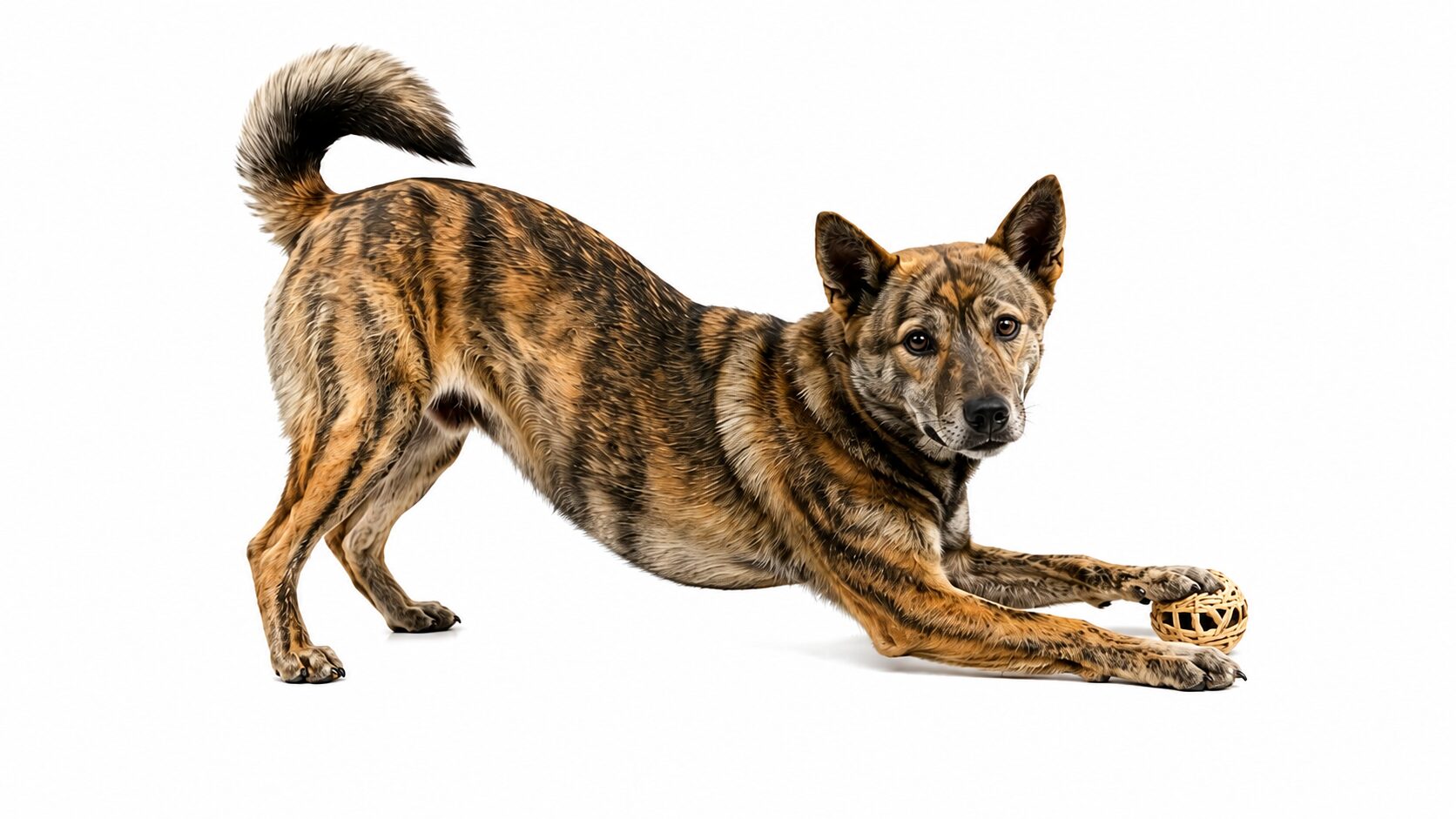
The Ryukyu dog is a medium-sized, lean, agile, and specifically wolf-like hunting dog that presents with the most immediately distinctive feature shared across all individuals: the shallow stop and the narrow muzzle that extends in a straight line from the eyes like a wolf’s muzzle, combined with the wide V-shaped prick ears and the dark brown eyes that create the sharp, alert expression that Okinawans have always associated with their turā.
The body is longer than it is high, with well-developed muscles on the hind legs providing the speed and agility for forest hunting. The deep chest spotted with white in many individuals is another characteristic feature. The coat is short to medium in length, single or double-coated, with the brindle pattern — black brindle, red brindle, or white brindle — being the most traditional and most specifically celebrated individual color expression. The brindle pattern must be beautiful and clear to meet the breed standard. The tail in most modern individuals rises straight upward rather than curling over the back in the classic Spitz manner. The Yaeyama line tends toward larger individuals with longer bodies and deeper chests than the Yanbaru line.
The working rear dewclaw present in a small percentage of individuals is the most specifically unusual and the most personally fascinating individual anatomical feature, theorized by the Hozonkai as a throwback from ancestors genetically closer to wolves, used primarily to assist braking when chasing prey at speed rather than for climbing.
Housing And Living Requirements
The Ryukyu dog is among the most specifically athletic and the most genuinely outdoor-oriented of any hunting breed in this series, adapted to the subtropical forest terrain of Okinawa and requiring the outdoor space and active engagement appropriate to a boar-hunting pack dog. The breed would rather climb mountains than sit in an apartment all day left to its own devices.
Rural or suburban homes with secure, high fencing and meaningful outdoor space provide the most appropriate housing context. The breed’s intelligence and athleticism make it an escape artist capable of remarkable climbing. Fence security requires specific attention given the breed’s athletic capability and its prey drive that will motivate it to overcome inadequate fencing when any interesting scent is detected.
The breed’s subtropical Okinawan origin makes it well-suited to warm and hot climates, tolerating tropical conditions with the ease of a breed adapted for centuries to the specific heat and humidity of the Ryukyu Islands. Cold climate management is more specifically important for a breed without the dense undercoat of Hokkaido and other northern Japanese breeds.
A comfortable dog bed in a social area suits the breed’s people-devoted character. An orthopedic dog bed provides appropriate joint support.
Exercise Requirements
The Ryukyu dog requires vigorous daily exercise reflecting its heritage as an active boar-hunting dog that navigated the demanding terrain of the Yanbaru forest in pack hunts. At minimum 60 to 90 minutes of vigorous daily outdoor exercise is appropriate, with hiking and free running in secured areas providing the most genuinely satisfying individual engagement.
Scent work and tracking activities engage the breed’s exceptional tracking nose in purposeful organized sport. Dog agility suits the breed’s athletic intelligence in structured competitive format. Barn hunt engages the prey drive in the most organized and controlled individual competitive context available to a breed with this hunting heritage.
Puzzle toys and enrichment activities are genuinely important between outdoor sessions. A GPS tracker is an absolutely essential safety investment for outdoor exercise in any area without complete secure enclosure. A Ryukyu dog that detects interesting game or scent will pursue it with the constitutional commitment of a breed whose entire existence was defined by that pursuit.
Grooming Requirements
The Ryukyu dog’s short to medium coat is among the most practically low-maintenance grooming commitments of any hunting breed in this series, reflecting the functional coat heritage of a breed adapted for subtropical forest hunting where a longer or heavier coat would create significant heat management problems.
Brushing once or twice weekly removes loose hair and maintains coat health. The coat’s natural short texture sheds field debris efficiently. Bathing every four to six weeks or when genuinely needed maintains coat cleanliness. The breed’s short coat means bathing and drying are relatively quick procedures compared to longer-coated breeds.
The prick ears require weekly inspection and cleaning. Dental care should be established as a consistent routine from puppyhood. Nails should be trimmed regularly. Paws should be inspected after outdoor exercise for debris between the toes.
Diet And Nutrition
The Ryukyu dog requires a high-quality diet that includes the necessary set of minerals and microelements appropriate to an active medium-sized hunting breed. A high-quality medium breed active formula with a named protein source as the first ingredient provides the nutritional foundation.
Most adults do well on two measured meals per day. Maintaining lean, athletic body condition appropriate to an active hunting dog supports both working capability and long-term health. Training treats are effective motivators in training sessions and should be counted into the daily caloric total.
Compatibility
The Ryukyu dog is obedient and loyal to its people, not sensitive in temperament, playful, and described as making excellent companions. The breed’s people-devotion is genuine and specifically personal. The Ryukyu dog wants to be included with its family rather than left alone, and does not have the aloofness of some primitive Japanese breeds. The Ryukyu dog wants to be included rather than left alone.
With children, the breed is appropriate and playful. The cooperative pack hunting heritage produced a sociable, tolerant character with familiar individuals. With strangers, the breed is alert and territorial, making a capable watchdog. The breed does not bark without reason, which makes its alerts meaningful and specific.
With other dogs within the established household, the breed coexists appropriately, reflecting the cooperative inbiki hunting tradition that required working alongside other dogs. With unfamiliar dogs, territorial behavior requires specific management. With small animals and wildlife, the prey drive is constitutionally genuine. A dog crate is a useful management tool during puppyhood.
Behavior And Temperament
The Ryukyu dog is quiet and agile, obedient and playful, with a keen sense of smell and movements that are quick. It does not bark without reason. The most specifically unusual and the most personally memorable individual domestic behavioral characterization — described as ideal for therapy dog work because of their calm, placid temperament when trained correctly — is the most surprising individual behavioral assessment of a breed with this high-level prey drive and boar-hunting heritage, and it captures the essential duality of the Ryukyu dog’s character: fierce and athletic in the hunt, calm and devoted with the familiar family.
The independent nature of the breed reflects centuries of autonomous pack hunting without constant handler direction. They are intelligent dogs that seek to be respected. Train them early and with a clear voice, and you will have a loyal friend always at your side. This characterization from Ryukyu dog enthusiasts is among the most specifically personally accurate individual breed assessments in this series.
The climbing ability is the most personally memorable individual behavioral curiosity. Those individuals with working rear dewclaws demonstrate climbing capability that surprises observers familiar with other dog breeds. The entire breed is described as capable of scaling steep mountains and in some cases trees, a capability maintained through the specific rainforest terrain of the Yanbaru that may have historically provided selective pressure favoring individuals capable of navigating the vertical as well as the horizontal.
Training And Handling
The Ryukyu dog is intelligent, quick to learn, and obedient. The breed responds especially well when treats and play are involved. Though the breed has wilder traits than most domestic breeds from its centuries of semi-wild hunting use in Okinawa, the genuine people-devotion and the eagerness to please make it a cooperative training partner for patient, experienced handlers.
Positive reinforcement methods are the most effective approach. Training treats are highly effective motivators in varied, genuinely engaging sessions. Early socialization from puppyhood is the most critically important behavioral investment, building the broad social confidence that the breed’s naturally alert, territorial character supports when properly developed.
Leash training and reliable recall before any off-leash exercise in unsecured areas are the most practically important individual safety investments. The prey drive that made this breed the indispensable partner of Okinawan boar hunters cannot be reliably overridden by recall training when active quarry is detected.
Health And Lifespan
The Ryukyu dog, like all Japanese dog breeds, has relatively few health issues — the most specifically encouraging and the most broadly consistent individual health assessment across the entire Japanese native breed family. The breed typically lives 10 to 12 years, with documented individuals reaching 16 years including the famous Kai who lived in Okinawa World until his retirement from public life on February 2, 2019 at age 16.
The single most critical individual health challenge is not a hereditary disease but genetic diversity. One of the biggest health issues in the Ryukyu dog is inbreeding. All current Ryukyu Ken are descendants of the small pack from the 1980s, making genetic diversity the most urgently important individual conservation concern. The Hozonkai’s policy of open studbooks and registering dogs on merit if they meet the breed standard is the most specifically important individual strategy for addressing this bottleneck.
Hip and Elbow Dysplasia Western breeders of Ryukyu dogs are urged to test for hip dysplasia and elbow dysplasia as standard practice even though these conditions are not specifically well-documented in the breed.
Patellar Luxation Patellar luxation testing is recommended for Western breeding programs.
Eye Conditions Glaucoma and Collie Eye Anomaly (CEA) testing are recommended for breeding animals.
Hypothyroidism Thyroid testing is recommended from middle age as a standard preventive monitoring practice.
Routine preventive care including regular vet checks, OFA hip and elbow evaluation for breeding animals, patellar, eye, and thyroid screening, consistent dental hygiene, up-to-date vaccinations appropriate for a subtropical climate active outdoor breed, and year-round parasite prevention provides the foundation for a healthy Ryukyu dog.
Price And Availability
The Ryukyu dog is critically endangered with approximately 400 individuals worldwide as of 2015, and is essentially unavailable outside Okinawa and Japan through any normal channel. Even within Okinawa, finding a well-bred purebred individual requires direct engagement with the Ryukyu Inu Hozonkai and participation in the preservation effort rather than simple purchase. The breed’s endangered status means that every individual matters to the population’s genetic future, and ownership represents conservation responsibility rather than pet acquisition in the conventional sense.
Conclusion
The Ryukyu dog has lived in the subtropical forests of Okinawa and the Ryukyu Islands since the time of the Jōmon people, carrying genetic evidence of Japan’s pre-agricultural dog heritage that is most closely matched by the Hokkaido dog at the opposite geographic end of the Japanese archipelago, was used for centuries in the inbiki pack hunting tradition to corral Ryukyu wild boar through dense subtropical Yanbaru forest until hunters could approach for a spear kill, was known to oldest Okinawans as turā for the tiger-stripe brindle coat and akain for the red coloring, had much of its history destroyed by the Battle of Okinawa in 1945 and its population decimated by wartime food shortages and subsequent crossbreeding with American occupation Western breeds, was thought extinct after World War II until Yoshio Aragaki discovered a surviving purebred pack in the Yanbaru mountains in the early 1980s, had the Ryukyu Inu Hozonkai founded on April 1, 1990, was designated a Natural Monument of Okinawa Prefecture in 1995, reached a peak of approximately 1,500 individuals around 2005 before declining again to approximately 400 by 2015, is recognized by no major kennel club and protected only by the Ryukyu Inu Hozonkai, maintains open studbooks registering dogs on merit to protect genetic diversity, has the famous Kai who retired from public life at Okinawa World at age 16 in 2019, and stands today as the most specifically Jōmon-era-dog-genetics-most-ancient-Japanese-breed, the most specifically turā-and-akain-oldest-Okinawan-names, the most specifically inbiki-pack-boar-hunting-Yanbaru-forest, the most specifically Battle-of-Okinawa-destroyed-history-then-thought-extinct, the most specifically Aragaki-1980s-Yanbaru-mountains-discovered-surviving-pack, the most specifically all-400-individuals-descend-from-that-one-pack, the most specifically genetically-closest-to-Hokkaido-despite-opposite-geographic-ends, the most specifically working-rear-dewclaw-small-percentage-ancestral-wolf-trait, and the most specifically therapy-dog-calm-when-trained-but-unsuitable-for-disability-assistance-high-prey-drive of all the critically endangered indigenous Japanese hunting breed partnerships available. Get properly set up before bringing one home. Our Best Dog Products page has everything you need for short-brindle-coated, prick-eared, wolf-muzzled, straight-tail-not-curled, whole-heartedly devoted Okinawan subtropical forest hunting dogs that carry the full heritage of the Jōmon people’s ancient dog partnership, the inbiki boar-hunting tradition, the turā tiger-stripe and akain red-dog traditional names, the Battle of Okinawa survival, Yoshio Aragaki’s 1980s Yanbaru forest rediscovery, the Ryukyu Inu Hozonkai’s 1990 founding, the 1995 Okinawa Prefecture Natural Monument designation, the open-studbooks genetic diversity strategy, and the specific quiet, agile, not-barking-without-reason, calm-with-family, fierce-for-the-hunt, subtly-wolf-ancestored, critically-endangered intelligence of the most ancient of all Japanese dogs that Okinawa nearly lost and is fighting to keep.