
Origin And History
The Russian Toy, known in its native Russia as the Russkiy Toy, registered by the FCI under Standard Number 352 in Group 9 (Companion and Toy Dogs), Section 9 (Continental Toy Spaniels and Russian Toy), fully recognized by the AKC in the Toy Group effective January 1, 2022 after three years in the Miscellaneous Class and earlier participation in AKC companion events from 2010, is one of the smallest dog breeds in the world, a fine-boned, elegant, alert, and deeply devoted companion breed that comes in two distinct coat varieties — the smooth-coated Russian Toy, formerly known as the Russian Toy Terrier, and the long-coated variety formerly known as the Moscow Long-Haired Toy Terrier — unified under a single breed name in 1988, and a breed whose history is the most specifically and the most personally politically turbulent of any toy companion breed in this series, having gone from the most fashionable companion of the Russian Imperial aristocracy in the early 18th century to a breed specifically disapproved of and nearly erased during the Soviet era because of its aristocratic associations, surviving through the dedication of individual Soviet dog enthusiasts who worked through decades of ideological hostility to preserve a breed that represented precisely the kind of pre-revolutionary luxury the new order sought to eliminate.
The breed’s most ancient connection to Russia begins with Peter the Great, whose personal terrier Lizetta is depicted in an English-style portrait dated 1716 to 1726 with a sign reading this dog is a short hair terrier named Lizetta. It personally belonged to the Russian Emperor Peter the Great. The English Toy Terrier had been imported to Russia throughout the 18th century as a fashionable companion for the aristocracy, and by the early 19th century these small elegant terriers had become deeply embedded in Russian noble society. Some accounts indicate that eight smooth-coated Russian Toys competed at a dog show in St. Petersburg as early as 1874. The more generally accepted first formal reference appears in May 1907, when 11 Russian Toys were shown at an exhibition in St. Petersburg. In 1923, two dogs appeared at a Moscow dog show and in 1924, three more were awarded medals at a show in Odessa.
The breed’s near-annihilation began with the October Revolution of 1917. As the new Soviet order dismantled the aristocratic life that had sustained the breed, companion dogs representing that life were specifically unwelcome. The Russian Toy diminished dramatically in popularity and numbers. After Stalin’s era, dog clubs worked hard to save rare breeds including the Russian Toy, and a new generation of energetic Soviet dog breeders began a resurgence. However, when these breeders eventually had the opportunity to compare their preserved dogs with contemporary English Toy Terriers from abroad, they discovered that decades of isolated Soviet breeding without contact with the international standard had produced a dog that looked quite different from the modern English Toy Terrier. Rather than attempting to bring the Russian version back into conformance with the English standard, Soviet cynologists made the specifically important decision to recognize their dogs as a distinct breed and rename them the Russian Toy Terrier. This decision effectively created a new breed from what had been a regional variant of an older one.
The most specifically unusual and the most personally memorable individual moment in the breed’s founding documentation came on October 12, 1958, when a long-haired puppy named Chikki was born to two smooth-coated parents that both had slightly longer hair than was typical. Chikki is considered the original long-coated Russian Toy. the smooth-coated parents’ slightly longer-than-standard hair had unexpectedly combined to produce the fringe-eared, feathered-legged long-coated variety that is today one of the breed’s two recognized coat types. The long-coated variety was subsequently developed separately and was recognized separately for many years as the Moscow Long-Haired Toy Terrier before both varieties were brought together under the single Russian Toy Terrier name in 1988. The first official breed standard for both varieties was written in 1966.
The Russian Kynological Federation published a unified breed standard in 1988, dropping the word Terrier from the name. The FCI provisionally recognized the breed in 2006 and granted definitive recognition in 2017. The AKC Foundation Stock Service accepted the breed in August 2008. AKC companion event competition was approved from January 1, 2010. Full AKC Toy Group recognition came effective January 1, 2022, when the Russian Toy joined the Mudi as one of two new AKC-recognized breeds at the start of that year. The UK Kennel Club and the Canadian Kennel Club both recognize the breed. The Russian Toy Club of America serves as the AKC parent club.
Breed Overview
| Trait | Details |
|---|---|
| Origin | Russia (18th century; from English Toy Terrier imports to Russian aristocracy) |
| Also Known As | Russkiy Toy; Russian Toy Terrier; Moscow Long-Haired Toy Terrier (historical) |
| Peter the Great Connection | Portrait of Peter’s terrier Lizetta dated 1716–1726 |
| First Exhibition | 11 Russian Toys shown in St. Petersburg, May 1907 |
| AKC Recognition | January 1, 2022 (Toy Group) |
| FCI Recognition | Provisional 2006; definitive 2017 (Group 9, Section 9, Standard No. 352) |
| UKC Recognition | 2008 (Companion Dog Group) |
| AKC Parent Club | Russian Toy Club of America |
| AKC Foundation Stock Service | August 2008 |
| AKC Companion Events | Eligible from January 1, 2010 |
| First Breed Standard | 1966 (both varieties) |
| Unified Name | 1988 (Russian Toy Terrier; Terrier dropped when FCI listed the breed in 2006) |
| Long-Coat Origin | Chikki — born October 12, 1958 to two smooth-coated parents |
| Soviet Near-Extinction | Russian Revolution 1917 onward; breed linked to aristocracy; severely suppressed |
| Stalin Era Recovery | Post-Stalin dog clubs worked to save and rebuild breed |
| Name Change Reason | Soviet-isolated breeding produced dogs distinct from English Toy Terrier standard |
| Two Coat Varieties | Smooth coat; long coat (fringe on ears; feathering on legs) |
| Height | 20–28 cm (8–11 inches) |
| Weight | Up to 3 kg (6.5 pounds) |
| Lifespan | 12–14 years (AKC); 11–13 years (UK Kennel Club) |
| Colors | Black and tan; blue and tan; brown and tan; red; sable |
| Coat (Smooth) | Short; close-fitting; no undercoat |
| Coat (Long) | Semi-long; lying flat; ear fringe most striking feature |
| Common Mistaken For | Chihuahua; Papillon |
| CHIC Health Requirements | OFA patellar luxation; CAER eye examination; cardiac evaluation |
The Long-Coat Surprise: How Chikki Changed the Breed
Before discussing care, the Russian Toy’s most specifically unusual and the most personally charming individual founding moment deserves dedicated acknowledgment. The long-coated variety that is today one of the breed’s most immediately recognizable features was not a planned development but an entirely spontaneous genetic expression that occurred on a single October day in 1958 when a puppy named Chikki was born with a long, fringe-eared coat from two smooth-coated parents.
This single puppy represented a recessive gene combination that neither parent’s breed standard had anticipated. Soviet breeders recognized the distinctive beauty of the long-coated type and began selectively developing it. The long coat variety’s most immediately striking feature is the ear fringe — longer, flowing hair on the ears that becomes more pronounced as the dog matures, giving the long-coated Russian Toy an appearance specifically reminiscent of the Papillon and English Toy Spaniel traditions while being genetically and historically distinct from both. The long-coated variety was developed and registered separately as the Moscow Long-Haired Toy Terrier for decades before being unified with the smooth-coated variety into the single Russian Toy breed standard in 1988.
Appearance And Size
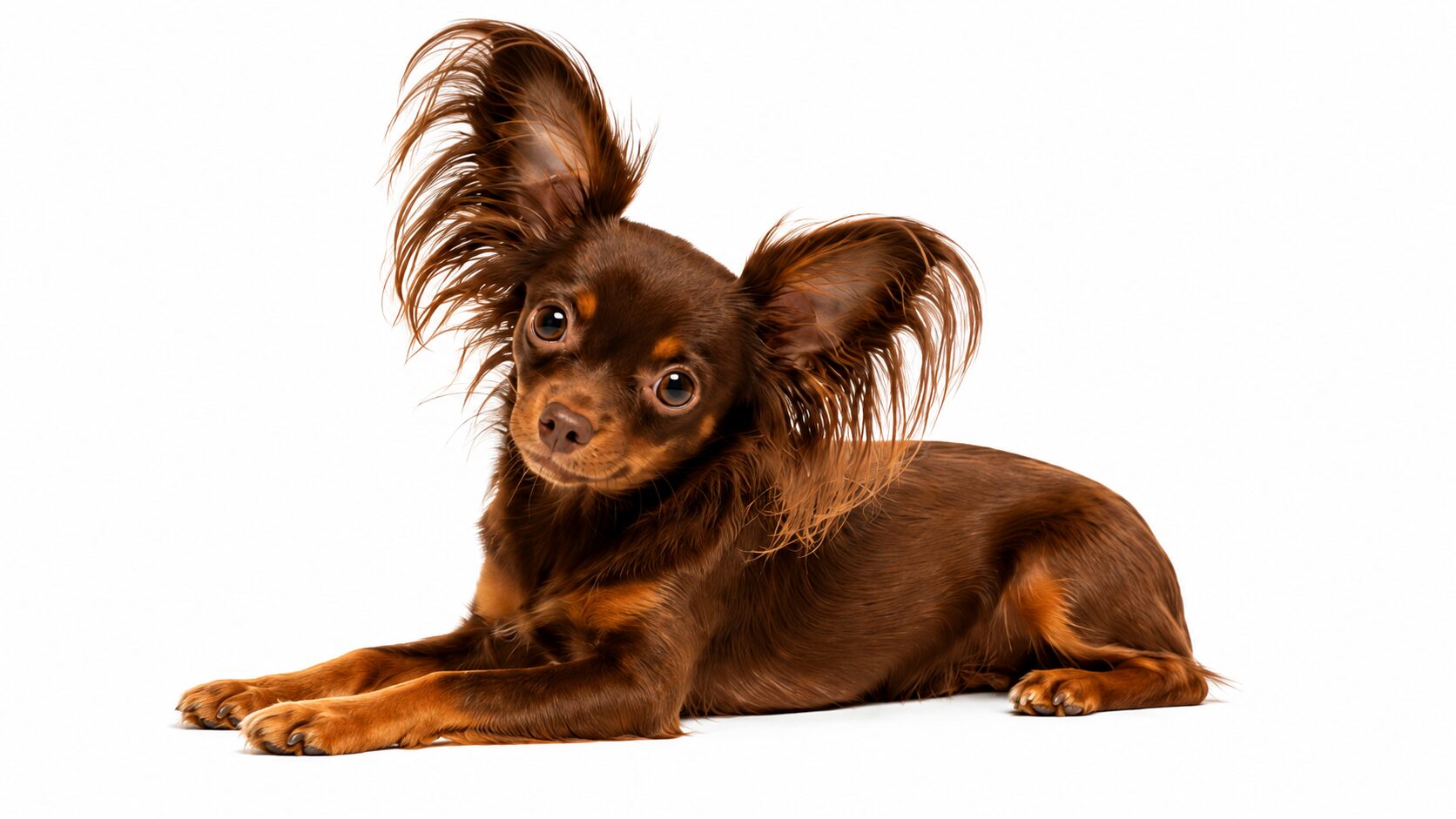
The Russian Toy is among the smallest dog breeds in the world, fine-boned, elegant in silhouette, and specifically light-framed in a way that gives the breed a graceful, almost aerodynamic appearance that is quite unlike the compact sturdiness of the Chihuahua with which it is most frequently confused.
Adults stand 20 to 28 centimeters and weigh up to 3 kilograms. The head features a narrow, wedge-shaped skull, large expressive eyes, and large upright ears that are a breed hallmark. The body is lean and slightly longer than tall. Colors include black and tan, blue and tan, brown and tan, red, and sable.
The smooth-coated variety is short and close-fitting with no undercoat, giving the breed a sleek, tidy appearance with minimal coat volume. The long-coated variety has semi-long hair lying flat to the body with the characteristic ear fringe that is among the most personally distinctive visual features of any toy breed in the AKC Toy Group.
Housing And Living Requirements
The Russian Toy is among the most genuinely and the most honestly apartment-appropriate breeds available, combining a size that fits comfortably in the smallest urban living spaces with a temperament that adapts well to city life when provided with consistent daily companionship. The breed’s compact size makes it well-suited to apartment living, and it remains popular in Russian cities for precisely this reason.
The most critically important individual welfare consideration is human companionship. The Russian Toy is a companion breed to its core and does not do well when left alone for extended periods. Being owned by a Russian Toy is never dull as they seem like a perpetual two-year-old with their own opinions, requiring engaged and consistent ownership rather than passive cohabitation.
The breed’s fine bone structure makes it specifically vulnerable to injury from falls, rough handling, and interaction with larger or rambunctious animals. Supervision in environments with larger dogs, young children, or elevated surfaces where a fall is possible is specifically warranted. A comfortable dog bed in a safe, social area of the home suits the breed’s devoted family character. An orthopedic dog bed provides appropriate joint support.
Exercise Requirements
The Russian Toy is more active than many similar-sized toy dogs, and the breed’s terrier heritage produces genuine energy and enthusiasm for play that exceeds what its tiny frame initially suggests. Daily walks and play sessions appropriate to a dog weighing under 6.5 pounds provide the most appropriate physical engagement. The breed excels in dog agility for toy breeds, rally obedience, and nose work and can be remarkably agile given the right motivation and encouragement. One Russian Toy named Pyxis had earned 17 titles by just over one year of age and became the first Russian Toy to earn an AKC Trick performance title.
The specific balance of physical and mental engagement is important for this breed. Russian Toys are extremely intelligent and the switch from physical activity to mental control produces the most genuinely satisfied individual. Puzzle toys and enrichment activities are genuinely important between outdoor sessions. Short daily walks combined with indoor play and training sessions are entirely adequate for this breed’s physical requirements.
Grooming Requirements
Grooming requirements differ meaningfully between the two coat varieties, but both are among the more manageable grooming commitments of any toy breed.
The smooth-coated variety requires only a quick brushing once or twice a week to remove loose hair and maintain the close, glossy appearance. Occasional bathing when genuinely needed is sufficient. The smooth coat is the most genuinely low-maintenance coat of any variety within this breed.
The long-coated variety requires brushing two to three times weekly to prevent tangles in the ear fringe and leg feathering — the areas where the longer hair accumulates and mats most readily. The breed should not be clipped in the long-coated variety. Bathing every four to six weeks maintains coat health and cleanliness.
Both varieties share the same ear, nail, and dental maintenance requirements. Dental care is specifically important for a tiny-mouthed breed where dental crowding creates accelerated plaque buildup. Ears should be checked and cleaned weekly. Nails should be trimmed every two to three weeks. The fine structure of the breed makes gentle handling during all grooming essential from the earliest possible puppyhood age.
Diet And Nutrition
The Russian Toy requires small meals throughout the day rather than one or two larger feedings, due to the fast metabolism and small stomach size that all toy breeds carry. Feeding small meals throughout the day is the best way to keep them comfortable and energized. Most adults need no more than half a cup of food daily, though individual needs vary with activity level and body condition.
A high-quality small breed formula with a named protein source as the first ingredient and appropriate caloric density for a toy breed provides the nutritional foundation. Hypoglycemia risk in puppies requires specific attention to frequent feeding schedules throughout the growth period. Training treats are effective motivators and must be counted very carefully into the daily caloric total given the tiny caloric budget of a dog this small.
Compatibility
The Russian Toy is spirited, intelligent, and deeply devoted to its owner. The breed forms strong bonds with its people and thrives on companionship. The breed’s devotion is complete and consistent. Owners who commit to the Russian Toy will find a dog that watches them constantly and participates in every daily activity with genuinely cheerful enthusiasm.
With children, the breed is best suited to older, respectful children who understand gentle handling. The delicate bone structure makes the breed vulnerable to injury from rough play, and very young children represent a genuine safety risk for a dog weighing under 6.5 pounds. With strangers, the breed may be initially shy or wary. Early socialization is specifically recommended to build the confident, outgoing character that the breed is capable of developing. Russian Toys may need more socialization than one would expect, particularly in the first year.
With other dogs, the breed’s terrier-lineage boldness means Russian Toys are rarely intimidated by larger dogs and may challenge them despite the obvious size disadvantage. This fearless scrappiness requires specific supervision in multi-dog households with larger individuals. With cats and other small pets, the breed is generally appropriate when properly introduced. A dog crate is a useful management tool during puppyhood.
Behavior And Temperament
The Russian Toy is athletic, cheerful, devoted, and known for being loyal, alert, and fearlessly defensive when it senses something is amiss. The breed is a mighty dog in a little package that can get itself into trouble through the combination of terrier boldness and an honest unawareness of its own size. Owning a Russian Toy is not for the meek as they require a firm owner and consistent training alongside the affectionate companionship that makes the breed so rewarding.
The alertness is among the most consistently noted individual behavioral qualities. Russian Toys make excellent watchdogs due to their alert and protective nature, and barking when visitors arrive is characteristic. This vocal alertness requires specific bark management from puppyhood in residential settings where excessive barking would create issues with neighbors.
The perpetual energy and inquisitiveness of the breed is captured most accurately by the characterization of being like a perpetual two-year-old with their own opinions. These dogs are never passive companions. They engage with their environment, their owner’s activities, and any available stimulation with the full investment of their considerable personality.
Training And Handling
The Russian Toy is extremely intelligent, responsive, and an easy and quick learner who always has an energetic pep in their step and loves to stay close to their owners. Training this breed is typically satisfying precisely because the intelligence and the eagerness to please make the learning relationship genuinely rewarding. However, the breed’s intelligence also means they pick up bad habits just as fast as good ones, making consistent positive guidance from the earliest age the most important individual training investment.
Positive reinforcement methods are the most effective and the most specifically required approach given the breed’s sensitivity to harsh correction. Training treats are highly effective motivators in short, varied, genuinely engaging sessions. Early socialization from puppyhood is the most critically important behavioral investment. Puppies that meet new people and explore different places develop well-rounded behavior and the confident character that prevents the shyness or fear responses that under-socialized individuals can develop.
Health And Lifespan
The Russian Toy has a lifespan of 12 to 14 years and is generally considered a healthy breed with no major breed-specific hereditary diseases beyond those common to toy breeds. The Canine Health Information Center (CHIC) requirements for the breed include OFA patellar luxation evaluation at a minimum of 12 months, a CAER eye examination by a board-certified veterinary ophthalmologist, and a cardiac evaluation. These three screenings address the conditions most commonly documented in the breed.
Patellar Luxation Patellar luxation causing intermittent hopping lameness is the most consistently documented orthopedic concern for the Russian Toy, consistent with most toy breeds whose small limb structure creates specific kneecap stability challenges. OFA patellar evaluation at 12 months and again at adult maturity is the most important individual orthopedic screening.
Hypoglycemia Hypoglycemia is a specific risk for toy breed puppies whose small bodies have limited glycogen reserves. Frequent scheduled feeding throughout the day is the most critically important preventive practice during puppyhood and the first year.
Eye Conditions Progressive rod-cone degeneration and other eye conditions are documented in the breed. Annual CAER ophthalmological examination from the dog’s first year provides ongoing clinical monitoring.
Cardiac Conditions Cardiac evaluation as part of the CHIC health screening program is recommended for breeding animals.
Dental Disease Dental disease is the most practically impactful ongoing health management priority for the Russian Toy. The tiny mouth creates dental crowding that accelerates periodontal disease. Daily toothbrushing from puppyhood and regular professional dental cleanings are the most important preventive health practices for this breed’s long-term quality of life.
Genetic testing is also recommended for hyperuricosuria and degenerative myelopathy in breeding animals. Routine preventive care including regular vet checks, CHIC screening, consistent dental hygiene, up-to-date vaccinations, careful bone structure protection from falls and rough handling, and parasite prevention provides the foundation for a healthy Russian Toy.
Price And Availability
The Russian Toy remains relatively rare outside Russia and a few Eastern European countries, with Finland, Estonia, Czech Republic, Belarus, and Ukraine having established breeding programs. In the United States, the breed is available through breeders connected to the Russian Toy Club of America and the AKC parent club network. From reputable breeders with CHIC health testing documentation, expect to pay between $1,500 and $3,000 for a well-bred puppy.
Conclusion
The Russian Toy traces its history to 18th-century Russia when English Toy Terriers were imported as fashionable companions for the Russian aristocracy, with a portrait of Peter the Great’s terrier Lizetta dated 1716 to 1726 providing the most specific individual royal connection, was formally exhibited in St. Petersburg in 1907, nearly disappeared after the Russian Revolution of 1917 because of its specific association with the aristocracy that the Soviet order dismantled, was preserved through the dedication of Soviet dog enthusiasts working through ideological hostility, was recognized as a distinct breed from the English Toy Terrier after Soviet-era isolation produced a dog with its own distinct appearance, had its first breed standard written in 1966, had the long-coated variety born spontaneously from two smooth-coated parents on October 12, 1958 in the puppy named Chikki, had both varieties unified under a single name in 1988, received FCI provisional recognition in 2006 and definitive recognition in 2017, entered the AKC Foundation Stock Service in August 2008, became eligible for AKC companion events from January 1, 2010, received full AKC Toy Group recognition on January 1, 2022, and stands today as the most specifically Peter-the-Great-Lizetta-portrait-1716-royally-documented, the most specifically Russian-Revolution-aristocracy-linked-nearly-erased, the most specifically Chikki-October-12-1958-long-coat-surprise-birth, the most specifically Soviet-isolated-breeding-distinct-from-English-Toy-Terrier, the most specifically mighty-dog-in-little-package-perpetual-two-year-old, the most specifically never-dull-not-for-the-meek, and the most specifically 2022-AKC-Toy-Group-newly-fully-recognized of all the toy companion breed partnerships available. Get properly set up before bringing one home. Our Best Dog Products page has everything you need for fine-boned, large-eared, smooth-or-long-ear-fringed-coated, under-6.5-pounds, whole-heartedly devoted Russian aristocratic companion dogs that carry the full heritage of Peter the Great’s Lizetta portrait, the 18th-century aristocratic salons of St. Petersburg, the 1917 Revolution’s near-annihilation, the Soviet dog club members who preserved the breed through ideological hostility, Chikki’s spontaneous 1958 long-coat birth, the 1966 first breed standard, the 1988 unified name, the 2006 FCI recognition, the 2022 AKC Toy Group placement, and the specific athletic, cheerful, devoted, alert, fearlessly-scrappy, perpetually-curious, dental-care-requiring intelligence of the tiniest dog that Russian aristocracy ever loved and Soviet Russia nearly forgot.