

Origin And History
The Russo-European Laika, known in Russia as the Russko-Evropeiskaia Laika, often abbreviated by North American enthusiasts as the REL, is a medium-sized, prick-eared, sickle-tailed, double-coated hunting Spitz from the northern European forests of Russia between Finland and the Ural Mountains, recognized by the FCI under Standard Number 304 in Group 5 (Spitz and Primitive Types), Section 2 (Nordic Hunting Dogs), recognized by the UKC on January 1, 1996 in the Northern Breed Group, the smallest of the three hunting Laika breeds recognized internationally alongside the West Siberian Laika and the East Siberian Laika, closely related to the Karelian Bear Dog that developed on the Finnish side of the same ancestral Karelian regional population, and a breed whose name explains its entire working identity in the most linguistically direct individual etymology of any hunting breed in this series: laika derives from the Russian verb layat meaning to bark, making the breed name literally the Russian-European Barker, the barking being the most specifically celebrated and the most functionally essential individual working quality of a dog that locates game in dense forest and holds it in place through sustained vocal signaling until the hunter arrives.
The breed’s most ancient origins trace to the Spitz-type landrace dogs that indigenous peoples of the northern European Russian forests maintained as essential hunting companions for centuries before any formal breed documentation was attempted. These early dogs emerged among local populations in areas including Arkhangelsk, the Komi Republic, Karelia, Udmurtia, Yaroslavl, and the regions around Moscow, adapting through natural selection to the demands of hunting in the dense taiga forests that cover the northern European part of Russia. The indigenous peoples who relied on these dogs most completely were the Komi people, historically known as Zyrians, and the Udmurt people, formerly called Votyaks. Both cultures integrated their Laika dogs so completely into daily survival that these animals were indispensable companions rather than peripheral working tools, relied upon for locating and treeing squirrels for fur, tracking elk and bear for food and hides, and alerting their people to approaching predators and intruders.
The first documented records of these regional Laika types date to 1895, when Prince A.A. Shirinsky-Shikhmatov published his landmark illustrated book the Album of Northern Dogs (Laikas), the most specifically comprehensive early documentation of the entire Laika family. Shirinsky-Shikhmatov cataloged multiple regional Laika varieties by geographic name, noting the distinct differences between the Zyryan Laika, the Votyak Laika, the Komi Laika, the Archangelsk Laika, and the Karelian Laika among others. These regional dogs were different enough from each other in size, coat, ear shape, and muzzle length that experienced hunters could identify their geographic origin, but similar enough in fundamental type and working style to be recognized as related regional expressions of the same ancient northern forest hunting dog tradition.
The most devastating individual event in the breed’s documented history was not a single moment but a double catastrophe across two global conflicts. Before World War II, a small breeding program had developed in Moscow and Leningrad among hunters who recognized the need to preserve the traditional forest hunting dogs. The 872-day Siege of Leningrad, which began on September 8, 1941, when the city’s last land connection was severed by German forces and ended on January 27, 1944 when the Red Army broke the German line, devastated the Leningrad breeding population as dramatically as it devastated everything else in that city. The Moscow population was similarly reduced by the war’s demands.
The recovery effort began in 1944 in the Kalinin Province, where the All Union Research Institute for the Hunting Industry established a dedicated breeding program specifically to reestablish the breed. The program’s most specifically demanding individual requirement was that the hunting ability of each potential breeding dog be thoroughly tested on squirrels before it was allowed to mate. Dogs that tested well contributed their genes. Dogs that did not were excluded from breeding regardless of their physical quality. This working-test-before-breeding requirement was among the most specifically functionally committed individual breeding program requirements of any breed’s institutional recovery in this series, and it ensured that the Russo-European Laika rebuilt from the best working individuals available rather than from the most physically convenient survivors.
Crossing lines from Leningrad and Moscow added additional genetic diversity to the recovery program, and the regional Laika varieties that had contributed to the breed’s pre-war development were drawn upon once more. The crossing of the Arkhangelsk, Karelian, Votyak, Komi, and other regional Laika strains brought genetic diversity and health back into the breed at the cost of minor variations in appearance. By the 1960s, the majority of Russo-European Laikas were various proportions of black and white, ranging from completely black to completely white. This represented a significant color shift from the pre-war period, when the predominant coat colors were red, reddish grey, or grey wolf, with black and white being the rarity. Only three of the Russo-European Laikas shown at the 1940 Moscow Dog Show featured the modern black and white coat.
The first temporary Soviet breed standard was approved in 1949. The permanent breed standard was approved by the Cynological Soviet of Glavokhota of the Russian Federation in 1952. The FCI granted international recognition to the breed in 1980, publishing Standard Number 304. The Russian Kynological Federation maintains the primary studbook established in 1951 and oversees breeding programs and field trials within Russia. The UKC recognized the breed on January 1, 1996. The AKC has not yet recognized the breed, limiting North American participation to AKC Canine Partners events.
Breed Overview
| Trait | Details |
|---|---|
| Origin | Northern European Russia (between Finland and Ural Mountains) |
| Russian Name | Russko-Evropeiskaia Laika |
| Name Meaning | Laika = barker (from layat = to bark); Russian-European Barker |
| Abbreviation | REL (informal North American usage) |
| Status | Smallest of the three FCI-recognized hunting Laika breeds |
| FCI Recognition | 1980 (Standard No. 304, Group 5, Section 2, Nordic Hunting Dogs) |
| UKC Recognition | January 1, 1996 (Northern Breed Group) |
| AKC Status | Not recognized (eligible for AKC Canine Partners events) |
| Primary Registry | Russian Kynological Federation (RKF); studbook established 1951 |
| First Documented Records | 1895 (Shirinsky-Shikhmatov’s Album of Northern Dogs) |
| Regional Founding Types | Komi Laika; Zyryan Laika; Votyak Laika; Archangelsk Laika; Karelian Laika |
| Indigenous Peoples | Komi (Zyrians) and Udmurt (Votyaks) as primary traditional keepers |
| Soviet Recovery | 1944 All Union Research Institute program; breeding test required before mating |
| First Soviet Standard | Temporary 1949; permanent 1952 |
| WWII Near-Destruction | Leningrad Siege (872 days 1941-1944) and Moscow breeding population decimated |
| Color Shift | Pre-war: red/grey dominant; post-war recovery: black and white became dominant |
| Related Breed | Karelian Bear Dog (Finnish side of same ancestral regional population) |
| Height | Males 52–58 cm (20–23 inches) / Females 48–54 cm (19–21 inches) |
| Weight | 18–25 kg (40–55 pounds) |
| Lifespan | 12–14 years |
| Coat | Harsh, straight outer coat; thick woolly undercoat; side-whiskers; neck collar |
| Colors | Black and white; black; grey; white; salt and pepper; predominantly dark with white patches or vice versa |
| Disallowed | Red coloring; heavy ticking on legs |
| Ears | Prick; pointed at tips; very mobile |
| Tail | Sickle; carried curled over back |
| Eyes | Small; oval; slightly oblique; dark brown |
| Hunting Style | Bark-pointer; trees small game and bays; tracks and corners large game |
| Primary Small Game | Squirrel; marten; sable |
| Large Game | Bear; elk; moose; boar |
| Additional Use | Duck hunting; waterfowl retrieval |
The Laika Family: Understanding the Barking Hunters
Because the Russo-European Laika is most specifically understood in the context of the broader Laika family and its two sibling FCI-recognized hunting Laika breeds, a brief orientation serves any reader encountering these breeds for the first time.
The word laika designates a type rather than a single breed, and the three hunting Laikas recognized by the FCI are distinct breeds that developed in different geographic regions of Russia. The West Siberian Laika is the largest and most widely distributed, developed west of the Ob River in Western Siberia. The East Siberian Laika is the most powerfully built, from the vast territory east of the Ob River to the Pacific coast. The Russo-European Laika is the smallest, from the European forest zone between Finland and the Urals.
All three share the fundamental bark-pointing working method that gives the Laika family its name. Unlike pointing breeds that freeze in a rigid point when game is located, all Laika breeds bark continuously when game is treed or cornered, vocalizing to communicate the location of the quarry to the hunter through the dense forest where visual contact between dog and hunter is impossible. This bark-pointer method is the most distinctly and specifically different hunting technique from the silent trailer method of scent hounds or the rigid point of continental pointing breeds, and it is the technique that made the Laika indispensable to the forest-dwelling peoples of northern Russia for thousands of years.
Appearance And Size
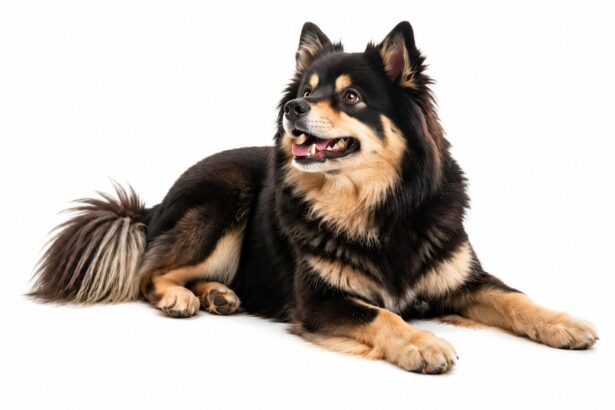
The Russo-European Laika is a medium-sized, slightly rectangular, strongly built, lean, and specifically agile Spitz-type hunting dog that presents with the most immediately classic Spitz conformation of any Russian hunting breed: the prick ears pointed at the tips and very mobile in their responsiveness to sound, the sickle tail carried curled over the back, the wedge-shaped head with the equilateral-triangle skull, and the double coat with the distinctive side-whiskers on the cheekbones and a collar of longer hair around the neck.
Males stand 52 to 58 centimeters and weigh 18 to 25 kilograms. Females are slightly smaller. The outer coat is harsh and straight, providing weather resistance in the taiga environment. The thick woolly undercoat provides the thermal insulation needed for hunting in Russian winters where temperatures can fall to severe lows for extended periods. The coat is shorter on the face and ears while longer on the neck and shoulders where the collar and whiskers form.
Colors are predominantly black and white combinations, ranging from nearly all black with white patches to nearly all white with dark patches. Solid grey and salt and pepper are also acceptable. Red coloring and heavy ticking on the legs are specifically considered undesirable under the breed standard. The eyes are small, oval, slightly oblique, and dark brown in all coat colors.
Housing And Living Requirements
The Russo-European Laika is among the most specifically and the most honestly rural-oriented and working-context-dependent of any hunting breed in this series. This is a breed from the dense taiga forests of northern Russia, developed over centuries for hunting in vast wild terrain, and its genuine welfare requires either active hunting engagement or the equivalent sustained daily vigorous outdoor activity in meaningful space.
Apartment living is not appropriate for this breed. Without enough activity, they will suffer from boredom and may become destructive. Rural environments with meaningful outdoor space and secure fencing are the minimum appropriate housing context. The breed is an energetic, free-spirited dog and any opportunities to run free and hunt are optimal.
The double coat provides exceptional cold-weather tolerance. The breed flourishes in northern climates with harsh winters where many breeds would require significant management. Heat management in warm climates is the primary individual welfare concern for a coat developed for Siberian and northern forest conditions.
A comfortable dog bed in a social area suits the breed’s people-devoted domestic character when indoors. An orthopedic dog bed provides appropriate joint support for an active hunting breed.
Exercise Requirements
The Russo-European Laika requires substantial daily exercise reflecting its heritage as an active hunting dog bred for full-day hunting sessions in the demanding terrain of the Russian taiga. At minimum 90 minutes of vigorous daily exercise is appropriate, with actual hunting engagement or equivalent sustained outdoor activity providing the most complete individual satisfaction.
Scent work and tracking activities engage the breed’s exceptional hunting nose in purposeful organized sport and represent the most directly heritage-appropriate competitive outlet available. Dog agility suits the breed’s athleticism and intelligence in structured competitive format. Barn hunt engages the small game treeing instinct in the most directly analogous organized sport context available in North America for a breed whose working heritage was always about locating and signaling the location of small game.
Puzzle toys and enrichment activities are genuinely important between outdoor sessions for a breed this intelligent. A GPS tracker is an absolutely essential safety investment for outdoor exercise in any area without complete secure enclosure. A Russo-European Laika that detects interesting game will pursue it with the specific constitutional commitment of a dog bred for exactly that purpose, regardless of what distance from home the pursuit requires.
Grooming Requirements
The Russo-European Laika’s harsh, straight double coat is among the more practically manageable of any Nordic hunting dog coat, requiring regular maintenance to keep it in condition without the elaborate grooming demands of longer-coated working breeds.
Brushing two to three times weekly with a pin brush and metal comb removes loose hair and prevents the tangles that develop most readily in the neck collar and side-whisker areas where the longer hair accumulates. During the twice-yearly heavy shedding seasons when the undercoat is released, daily brushing manages the significant hair volume appropriately. Bathing every six to eight weeks or after particularly muddy hunting sessions maintains coat health. The coat’s natural harsh texture sheds field debris and moisture efficiently after hunting.
The mobile prick ears require weekly inspection and cleaning. The breed’s hunting use in dense forest creates opportunities for seeds, burrs, and debris to enter the ear canals. Dental care should be established as a consistent routine from puppyhood. Nails should be trimmed regularly. Paws should be inspected after every field outing for embedded debris in the hair between the toes.
Diet And Nutrition
The Russo-European Laika is a medium-sized, highly active hunting breed with significant daily caloric needs calibrated to its actual size and genuine working output. A high-quality medium breed active formula supplemented with quality protein sources provides the most appropriate nutritional foundation. Laikas thrive on a high-quality diet formulated for their activity level, medium size, and life stage.
Most adults do well on two measured meals per day. Maintaining lean, athletic body condition appropriate to an active hunting dog supports both field performance and long-term health. Treats should make up no more than 10% of the dog’s daily caloric intake. Training treats are effective motivators in training sessions.
Compatibility
The Russo-European Laika has a strong love of humans and makes a good family dog. Once bonded to someone, the breed is quite territorial and makes an excellent guard dog. The breed is extremely tolerant of children. These are the three most consistently documented and the most specifically personally important individual compatibility facts for any prospective Russo-European Laika owner to understand before acquisition.
With its own established family, the breed is friendly, affectionate, loyal, and deeply devoted. With children within the established family, the breed’s extreme tolerance is specifically documented and specifically genuine. With strangers, the breed is aloof and wary. The territorial nature that makes it an excellent guard dog also requires specific management in residential settings with regular visitor contact. Early socialization is essential for building the social calibration that prevents stranger-wariness from developing into problematic responses.
With other dogs, the Russo-European Laika is the most specifically challenging compatibility area. The breed is strongly territorial and may be aggressive towards dogs that invade its territory. Dogs that have grown up in the same household since puppyhood will generally coexist once they establish their social hierarchy. The introduction of adult dogs of the same sex requires caution and the genuine expectation that a conflict may develop. Some individuals may remain incompatible with specific other dogs for life. A dog crate is a useful management tool during puppyhood.
Behavior And Temperament
The Russo-European Laika is a lively breed that enjoys time spent in the wilderness. It is energetic, keen, and always ready for active engagement. At the same time, the breed has a strong love of humans and brings genuine warmth and devotion to its established family. The contrast between the independent, territorially assertive hunting character and the warmly devoted family companion character is the most specifically defining individual behavioral duality of the breed.
The bark is the most specifically celebrated and the most specifically essential individual working behavioral quality. The Russo-European Laika uses its bark to alert the hunter to any treed prey, typically squirrel or marten, and may often bark freely in the house as well because it is easily excited from its natural instinct. This vocality requires specific management in residential settings where neighbors are in proximity. The hunting bark that carries through dense forest to alert a hunter a quarter mile away will carry equally well through suburban walls.
The independence is genuine and functionally embedded. Experienced Laika handlers understand that these dogs are intelligent, independent thinkers. The breed thinks for itself in the field and makes hunting decisions without waiting for handler direction. This independence is the quality that makes a Russo-European Laika such a capable autonomous hunting partner and the quality that requires the most specific and the most consistent management in domestic and training contexts.
Training And Handling
The Russo-European Laika benefits tremendously from training of any kind. Because of its high energy and eagerness to please, the breed responds positively to consistent structured engagement. Obedience training or a working job gives the dog a sense of purpose and the frequent exercise it requires. With proper training, the Russo-European Laika can quickly become well-balanced as a family dog.
Positive reinforcement methods are the most effective approach. Training treats are effective motivators in patient, consistent sessions. The breed’s intelligence makes it a capable training partner when the handler establishes genuine leadership that the dog respects. The most critically important early training investments are socialization from puppyhood, bark management, and leash reliability before the hunting drive is fully established in the adult dog.
Many Russian breeders refuse to breed dogs that have not demonstrated adequate hunting abilities in working trials. This commitment to working-test-before-breeding is among the most specifically integrity-focused individual breeding program requirements of any hunting breed, and it is the reason the breed has maintained its exceptional hunting capability across the decades since its Soviet-era recovery.
Health And Lifespan
The Russo-European Laika is a generally healthy and constitutionally robust breed with a lifespan of 12 to 14 years, reflecting the genetic diversity of the multi-regional foundational stock that the Soviet recovery program assembled and the natural selection pressure of centuries of working life in demanding taiga forest conditions.
Hip and Elbow Dysplasia
Hip and elbow dysplasia are possible in any medium-sized active breed. OFA hip and elbow evaluation is recommended for breeding animals. Maintaining lean body condition and appropriate juvenile exercise management are the most practically meaningful protective measures.
Eye Conditions
Progressive rod-cone degeneration is documented. Annual CAER ophthalmological examination from the dog’s first year provides ongoing clinical monitoring.
Bloat
The moderately deep chest creates some GDV susceptibility. Two smaller meals daily and avoiding vigorous exercise for at least one hour before and after meals are sensible preventive practices.
General Robustness
Routine preventive care including regular vet checks, OFA evaluation for breeding animals, CAER ophthalmological examination, consistent dental hygiene, up-to-date vaccinations appropriate for an active outdoor hunting breed in the tick-rich environments of forest and field, year-round parasite prevention, and regular coat and ear maintenance provides the foundation for a healthy Russo-European Laika.
Price And Availability
The Russo-European Laika is rare in North America and most countries outside Russia and neighboring European nations. The breed is primarily maintained by active hunting families in Russia, Finland, Estonia, and other countries with strong northern forest hunting traditions. Finding a well-bred Russo-European Laika in North America requires direct engagement with the limited community of breeders who maintain the breed outside Russia and patience with the significant wait times that accompany any genuinely rare breed breeding program.
Conclusion
The Russo-European Laika descends from the ancient Spitz-type landrace hunting dogs of the Komi and Udmurt peoples and other indigenous communities of the northern European Russian forests, was first formally documented in 1895 in Shirinsky-Shikhmatov’s Album of Northern Dogs as a collection of regional types including the Komi Laika, Zyryan Laika, Votyak Laika, Archangelsk Laika, and Karelian Laika, had its breeding population decimated during World War II and specifically by the 872-day Siege of Leningrad, was reconstructed from 1944 onward by the All Union Research Institute for the Hunting Industry in the Kalinin Province using the requirement that every breeding animal first demonstrate adequate squirrel-hunting ability, had a temporary Soviet standard adopted in 1949 and a permanent standard in 1952, received FCI recognition in 1980 under Standard Number 304, received UKC Northern Breed Group recognition on January 1, 1996, is closely related to the Karelian Bear Dog from the Finnish side of the same ancestral regional population, is the smallest of the three FCI-recognized hunting Laikas alongside the West Siberian Laika and East Siberian Laika, underwent a significant color shift from pre-war red and grey dominant to post-war black and white dominant through the recovery crossing program, maintains the working-test-before-breeding requirement that makes it among the most functionally integrity-committed hunting breed programs in Russia, and stands today as the most specifically Komi-and-Udmurt-indigenous-peoples-centuries-of-forest-hunting, the most specifically Shirinsky-Shikhmatov-1895-Album-of-Northern-Dogs-first-documented, the most specifically 872-day-Leningrad-Siege-decimated-then-squirrel-test-before-breeding-rebuilt, the most specifically pre-war-red-grey-to-post-war-black-and-white-color-shift, the most specifically bark-pointer-vocally-alerts-hunter-through-dense-taiga, the most specifically smallest-of-three-FCI-hunting-Laikas, and the most specifically Russian-breeding-programs-refuse-dogs-not-tested-on-game of all the Nordic Hunting Dog breed partnerships available. Get properly set up before bringing one home. Our Best Dog Products page has everything you need for harsh-double-coated, prick-eared, sickle-tailed, black-and-white-predominantly, side-whiskered, neck-collared, whole-heartedly devoted Russian taiga forest hunting dogs that carry the full heritage of the Komi and Udmurt indigenous peoples’ centuries-long forest hunting partnership, Shirinsky-Shikhmatov’s 1895 documentation, the World War II population decimation and Leningrad Siege survival, the 1944 All Union Research Institute squirrel-test recovery program, the 1949 and 1952 Soviet standards, the 1980 FCI recognition, the 1996 UKC recognition, and the specific lively, bark-pointing, squirrel-treeing, bear-tracking, family-devoted, children-tolerant, bark-freely-in-the-house, independent-thinking-in-the-field intelligence of the smallest and the most specifically European-forest-adapted of all the Russian hunting Laikas.