
Origin And History
The Pyrenean Sheepdog, known in its native France as the Chien de Berger des Pyrénées — the Dog of the Shepherd of the Pyrenees — called the Petit Berger (Little Shepherd) or simply the Labrit or Labri in regional usage, and nicknamed by the breed’s enthusiast community the Pyr Shep with the specific affection that small, intense, excellent breeds consistently inspire, is a small-to-medium-sized, lean, athletic, quick-stepping, energetic herding breed from the Pyrenean Mountains of France — the smallest French herding breed by a significant margin — that has been herding sheep and goats through the steep mountain passes, rocky slopes, and narrow valley roads of the French Pyrenees and the Basque Country for at least 6,000 documented years based on the archaeological evidence of small dogs found in Neolithic sub-fossil deposits in the Pyrenean region alongside evidence of well-developed sheep and goat herding, and a breed that in the most specific and the most personally evocative single working statistic of any herding breed in this series could manage a flock of 1,000 sheep with only two dogs working in partnership — a ratio of herding efficiency without parallel in any comparable breed — recognized by the AKC in the Herding Group in 2009 following more than two decades of advocacy by the Pyrenean Shepherd Club of America founded in 1987, and a breed whose wartime service in the French Army during World War I as messenger dog, guard, and search-and-rescue dog earned it public recognition outside the remote Pyrenean mountain valleys that had been its only home for millennia, while simultaneously devastating its population so severely that the post-war preservation effort was the most urgently necessary individual breed rescue in French cynological history.
The breed’s working tradition places it in a family of similar rough-coated European sheep herding breeds whose ancestors scholars believe were introduced to Europe during Indo-European migrations over 4,000 years ago and that subsequently spread across the continent, evolving through selective breeding into distinct regional types. The Pyrenean Sheepdog is the most specifically Pyrenean expression of this broader European herding dog tradition, sharing structural and functional similarities with the Briard and Berger Picard of France, the Polish Lowland Sheepdog of Poland, the Bearded Collie of Britain, and the Gos d’Atura Català of Catalonia, while remaining the most specifically mountain-adapted, the most specifically lean-and-compact, and the most specifically endurance-optimized individual expression of the small rough-faced European herding breed type.
The most personally specific and the most anciently evocative origin myth associated with the breed is the claim that the Pyrenean Sheepdog was the dog of the Cro-Magnon people who created the famous Lascaux cave paintings of southwestern France — a tradition that places the breed’s companionship with humans in the most dramatically prehistoric individual context of any herding breed in this series, though the specific archaeological evidence for this claim is more evocative than definitive. What is archaeologically specific is that small dogs lived alongside the herding peoples of the Pyrenean region during the Neolithic period, and that the region had been transformed through overgrazing by 6000 BCE, confirming that sheep and goat herding were highly developed at this point — providing an agricultural context in which a purpose-built herding dog of the Pyrenean Sheepdog’s specific capabilities would have been the most valuable individual working tool a shepherd could possess.
In the 19th century, a small number of Pyrenean Sheepdogs reached the United States — most likely accompanying Basque shepherds who immigrated to manage sheep herds in the American West — and may have contributed to the development of the Australian Shepherd, a breed whose development in the American West during this period included the input of multiple European herding dogs brought by immigrant shepherds.
World War I brought the Pyrenean Sheepdog its first recognition outside the Pyrenean Mountains, but at devastating cost. The French Army used the breed’s exceptional speed, intelligence, and mountain agility as messenger dogs, search-and-rescue dogs, and guard dogs across the Western Front battlefields — roles that the breed performed with the specific excellence that its centuries of mountain herding work had produced. The losses were so severe that the breed nearly became extinct, prompting the post-war preservation efforts that established the modern breed’s formal institutional framework.
The modern recognition history begins with the Réunion des Amateurs de Chiens Pyrénéens (RACP), founded in 1922 — the same organization that simultaneously championed the Pyrenean Mountain Dog — with the first official breed standard drawn up between 1921 and 1925 by Bernard Sénac-Lagrange. The Société Centrale Canine granted formal recognition in 1926. The FCI accepted the smooth-faced variety on March 13, 2001 and the long-haired variety on March 26, 2009. The UKC recognized the breed in 1995. The AKC granted full Herding Group recognition in 2009 following the Pyrenean Shepherd Club of America’s more than two decades of advocacy since its 1987 founding.
Breed Overview
| Trait | Details |
|---|---|
| Origin | Pyrenees Mountains, southern France (Basque Country and beyond) |
| French Name | Chien de Berger des Pyrénées |
| Regional Names | Petit Berger (Little Shepherd); Labrit / Labri; Berger des Pyrénées |
| AKC Nickname | Pyr Shep |
| Status | Smallest French herding breed |
| Archaeological Evidence | Small dogs in Neolithic sub-fossil deposits from Pyrenean region (~6000 BCE) |
| Indo-European Connection | Possible ancestor introduction during Indo-European migrations (~4,000+ years ago) |
| Australian Shepherd Connection | 19th-century imports to American West with Basque shepherds may have contributed |
| WWI Service | French Army messenger, guard, search-and-rescue dog — devastating population losses |
| RACP Founded | 1922 (same organization as Pyrenean Mountain Dog parent club) |
| First Breed Standard | 1921–1925 (Bernard Sénac-Lagrange) |
| SCC Recognition | 1926 |
| FCI Recognition | Smooth-faced: March 13, 2001 / Long-haired: March 26, 2009 |
| UKC Recognition | 1995 (Herding Dog Group; as Berger des Pyrenees) |
| AKC Recognition | 2009 (Herding Group) |
| Parent Club (USA) | Pyrenean Shepherd Club of America (PSCA; founded 1987) |
| UK Club | Pyrenean Sheepdog Club of Great Britain (established 1992) |
| Two Varieties (FCI) | Two separate breeds: Long-Haired (à Poil Long); Smooth-Faced (à Face Rase) |
| Coat Types | Long-haired; goat-haired (together forming rough-faced); smooth-faced |
| Height (Long-Haired) | Males 40–50 cm (16–20 inches) / Females 38–48 cm (15–19 inches) |
| Height (Smooth-Faced) | Males 40–54 cm (16–21 inches) / Females 40–52 cm (16–20 inches) |
| Weight | 8–15 kg (18–33 pounds) |
| Lifespan | 17–19 years (exceptionally long-lived for any breed) |
| Daily Working Distance | Easily covers 32+ km (20+ miles) per day |
| Herding Efficiency | 2 dogs could manage a flock of 1,000 sheep |
| Working Partnership | Pyrenean Sheepdog herds; Pyrenean Mountain Dog guards |
| Colors | Fawn; grey; blue; brindle; black; may be overlaid with black; small white permissible |
The Most Efficient Herders in the World
Before discussing care, the Pyrenean Sheepdog’s most specifically and the most operationally remarkable individual working achievement deserves dedicated acknowledgment, because the claim that two Pyrenean Sheepdogs could manage a flock of 1,000 sheep is not breed mythology but the documented historical working practice of French Pyrenean shepherds who depended on this capability for their economic survival across centuries.
The specific conditions that produced this extraordinary herding efficiency were the transhumance routes of the French Pyrenees — narrow mountain paths, steep rocky terrain, and the need to move large flocks through terrain where a missed sheep could disappear over a cliff or into dense woodland before a human shepherd could cover the necessary ground. The breed developed the specific combination of lightning speed, exceptional mountain agility, constant vigilance, independent problem-solving, and the specific herding behavior of covering enormous ground at a sustained trot — described by observers as movement that shaves the earth, so close to the ground and so fluid that the dog appears to be flying rather than running — that made two individuals capable of managing what would require a small team of dogs of any other herding breed.
The Working Partnership with the Pyrenean Mountain Dog
Because the Pyrenean Sheepdog is most specifically understood in partnership with the Pyrenean Mountain Dog — the large white guardian breed that worked alongside it on the same mountain slopes — a brief acknowledgment serves any reader encountering either breed for the first time.
The two breeds fulfilled complementary functions: the large, calm, white Pyrenean Mountain Dog (Patou) guarded the flock against wolves and bears with its impressive size and fearless confrontation capability, while the small, active, electric Pyrenean Sheepdog herded the flock, moving animals between pastures, collecting strays, and managing the direction and pace of the entire flock during transhumance. This guardian-and-herder partnership is the most specifically complementary and the most specifically well-documented two-breed pastoral system in any European mountain tradition, and both breeds carry in their contrasting temperaments — the Pyr’s calm self-possession and the Pyr Shep’s furious speed and focus — the precise behavioral profiles required by their respective half of the work.
Appearance And Size
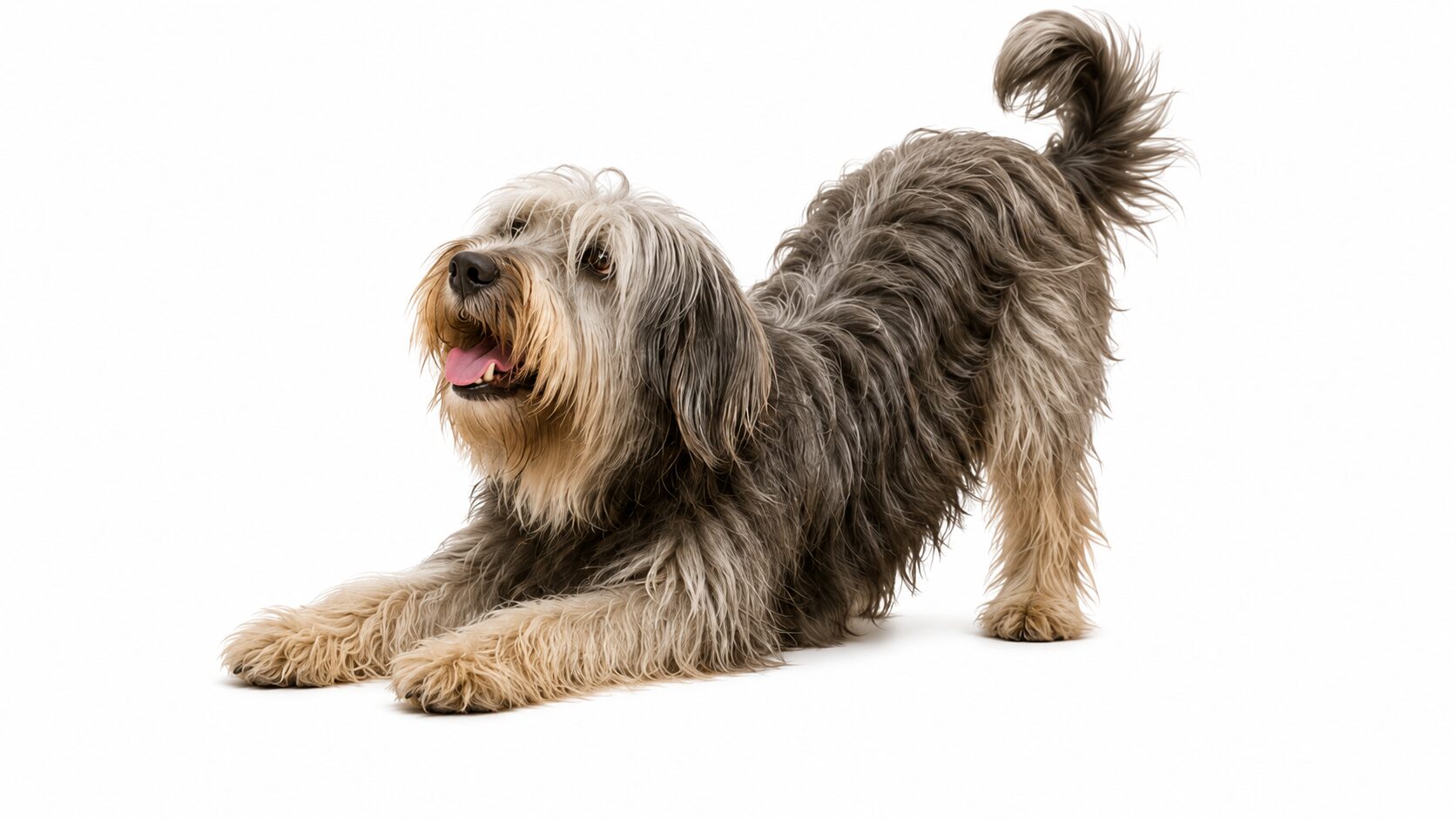
The Pyrenean Sheepdog is a small-to-medium-sized, lean, sinewy, and specifically athletic herding dog that presents with the most immediately striking individual visual quality of any French herding breed — the coat that varies from the windswept goat-hair texture to the long, rough-faced furnishings of the full long-haired variety, all framing a fine-boned, wedge-shaped muzzle and alert, dark, expressive eyes that communicate the intense, focused intelligence the breed possesses in such abundance.
Adults weigh 8 to 15 kilograms depending on the variety. The build is lean and athletic — the impression of concentrated athletic power in a small package that the breed’s extraordinary working performance history specifically and specifically validates. The long-haired variety has longer hair on the face and throughout the body; the goat-haired variety has a shorter, harsher texture that is neither silky nor woolly but specifically goat-like in its resistance and density; the smooth-faced variety has much shorter hair on the face contrasting with the body coat. All varieties can have the same range of colors: fawn, grey, blue, brindle, or black, with or without black overlay, and small white markings on the chest and limbs permissible.
The Pyrenean Sheepdog is exceptionally long-lived for its size — with a documented lifespan of 17 to 19 years, it is among the longest-lived of any herding breed and most working breeds in this series, a longevity reflection of the specific constitutional soundness of a breed maintained primarily through working selection in demanding mountain conditions across thousands of years.
Housing And Living Requirements
The Pyrenean Sheepdog is genuinely more adaptable in terms of living environment than the most energetic herding dog’s heritage might suggest — if this dog gets enough exercise, it can be content in any type of home, including an apartment — but the most honest qualification is critical: the necessary exercise quantity and intensity required to achieve this apartment-appropriate contentment is substantial and specifically non-negotiable. A Pyr Shep that does not receive sufficient exercise is among the most creatively and most persistently mischievous dogs per pound of any breed in this series.
A securely fenced yard is specifically important given the herding drive and the breed’s athletic jumping capability — these are lean, athletic, fast dogs with mountain terrain heritage that produces capabilities that consistently surprise first-time owners who underestimate what an 18-pound dog with exceptional athletic ability can accomplish. The breed’s tolerance for weather is genuine given the mountain coat heritage but extreme heat requires specific management given the dense coat.
A comfortable dog bed in a social area of the home suits the breed’s warmly family-devoted domestic character — particularly to the one special person to whom many Pyr Sheps attach with specifically exclusive devotion. An orthopedic dog bed provides appropriate joint support.
Exercise Requirements
The Pyrenean Sheepdog is among the highest-energy small herding breeds available anywhere and the most specifically and the most honestly demanding in terms of daily vigorous exercise. In its herding days the breed traversed up to 25 miles per day — a historical working context that defines the exercise baseline any prospective Pyr Shep owner should understand. At minimum 60 to 90 minutes of vigorous daily exercise is appropriate, with organized working or sport activities providing the most complete individual satisfaction.
Dog agility is the most specifically celebrated competitive sport for the breed — if you ever see a Pyr Shep run an agility course, you’ll be astonished by the enthusiasm and speed of this lean but muscular little herding dog. His movement is said to shave the earth, and it almost looks like he’s flying. Herding trials provide the most authentically heritage-appropriate competitive outlet. Flyball engages the team-competitive quick-movement energy in organized format. Rally obedience provides handler-focused cognitive engagement.
Puzzle toys and enrichment activities are genuinely and specifically important — a Pyr Shep that is under-stimulated cognitively applies its considerable intelligence to household problem-solving with the specific creativity that makes it simultaneously the most impressive and the most domestically challenging dog of its size. A dog agility equipment set at home provides structured daily engagement. A GPS tracker is a practical safety investment for outdoor exercise given the breed’s speed and the herding drive that will take it after any moving target.
Grooming Requirements
Grooming requirements vary between the three coat varieties, with the long-haired variety requiring the most specific and the most consistently maintained attention and the smooth-faced variety requiring the least.
The long-haired and goat-haired varieties benefit from brushing every one to two weeks to prevent the mats and tangles that develop in the coat — particularly behind the ears and in the leg feathering where friction creates the most consistent mat-formation conditions. The coat naturally has what experienced Pyr Shep handlers describe as a rustic, slightly unkempt quality appropriate to its working heritage — the coat variation seen across individuals being a specific indication that the breed has always been bred for working ability rather than appearance. The smooth-faced variety requires only occasional brushing given the shorter, finer coat texture.
Bathing every six to eight weeks maintains coat health. Dental care should be established as a consistent routine from puppyhood. Nails need regular trimming given the breed’s strong, fast-growing nail characteristic. Ears should be checked and cleaned weekly. Any traditional ear or tail docking — once common in French working dogs — is now restricted or banned in most European countries.
Diet And Nutrition
The Pyrenean Sheepdog is a small, lean, high-activity herding breed with daily caloric needs disproportionately high for its size given the genuine working energy output that even domestic Pyr Sheps characteristically produce in daily activity. A high-quality small-to-medium breed active formula with a named protein source as the first ingredient provides the nutritional foundation.
Most adults do well on two measured meals per day. Maintaining lean, athletic body condition appropriate to a breed historically traversing 25 miles daily is both the most natural and the most health-supporting individual management approach. Training treats are highly effective motivators given the breed’s food engagement and its genuine eagerness to work cooperatively with its handler in training contexts.
Compatibility
The Pyrenean Sheepdog is a breed of fierce loyalties, intense attachments, and specifically exclusive devotion — the breed often attaches to one special person to the exclusion of the rest, a working-dog quality that reflects the shepherd-and-dog bond that was always the breed’s most specifically personal individual domestic context.
With its own established family, the breed is warmly devoted and specifically attuned to its people’s emotional states. The breed retains its playful, mischievous, enthusiastic character throughout its entire life — the 17-to-19-year lifespan combined with the puppy energy of the Pyr Shep means owners enjoy, or manage depending on their energy levels, decades of undiminished working-breed intensity. With children, the breed can do well when raised together, though the herding instinct to nip and chase requires specific consistent management. With strangers, the breed is characteristically wary — ever vigilant, it tends to distrust strangers and makes an excellent watchdog. With other dogs, the breed can be too bossy to share easily given the natural dominance confidence of a dog that has always directed entire flocks. A dog crate is a critical management tool during puppyhood.
Behavior And Temperament
The Pyrenean Sheepdog is enthusiastic, mischievous, and whip-smart — the AKC’s most concise individual characterization that is simultaneously the most accurate and the most personally useful summary any prospective owner could receive before acquisition. To live with a Pyrenean Shepherd is to take on a highly energetic, intelligent, mischievous companion whose passion for you will be matched only by its desire to work.
The speed is the most immediately impressive individual physical quality for any first-time encounter — the breed’s agility course movement described as shaving the earth is not competitive exaggeration but literal description of a dog so close to the ground at speed, so fluid in direction change, and so economical in movement that the standard terms for fast-moving dogs do not quite apply. This speed combined with the specific herding intelligence that managed 1,000 sheep with two dogs produces the most impressively capable small dog in the herding group.
The herding behavior will be applied to everything that moves in the domestic environment — children, other pets, visitors, vacuum cleaners, and occasionally the owner’s feet. This is not aggression but the breed’s most deeply and most constitutionally embedded working expression, and it requires specific consistent management and appropriate herding sport outlet to channel productively.
Training And Handling
The Pyrenean Sheepdog is among the most trainable of any small herding breed given the genuine intelligence and the genuine eagerness to work with a respected handler — and among the most specifically challenging to live with if that training is inconsistent, because the same intelligence that produces excellent sport dog performance produces creative and persistent mischief when undertrained.
Positive reinforcement methods are the most effective approach. Training treats are highly effective motivators in varied, genuinely challenging sessions that engage the breed’s exceptional intelligence. The most specifically important individual training investment is barking management from puppyhood — without obedience training, the breed may become adept at nuisance barking that is difficult to manage in an adult dog once the habit is established. Early socialization from puppyhood is equally critical for managing the breed’s natural stranger-wariness.
Health And Lifespan
The Pyrenean Sheepdog’s most specifically remarkable individual health characteristic is its extraordinary longevity — documented lifespan of 17 to 19 years makes the breed one of the longest-lived of any herding breed and reflects the specific constitutional soundness of a working breed maintained through natural and functional selection across thousands of years in demanding mountain conditions.
Hip Dysplasia Hip dysplasia is possible in the breed given the active athletic working heritage. OFA hip evaluation of breeding animals is recommended.
Patellar Luxation Patellar luxation causing intermittent hopping lameness is documented in the breed given its small size. OFA patellar evaluation is recommended for breeding animals.
Eye Conditions (PRA and Collie Eye Anomaly) Progressive Retinal Atrophy and Collie Eye Anomaly — a condition shared with several British collie-type herding breeds whose ancestral lineage overlaps with the Pyrenean Sheepdog family — are documented. DNA testing is available for both conditions and is recommended for all breeding animals. Annual CAER ophthalmological examination from the dog’s first year provides ongoing clinical monitoring.
Epilepsy Epilepsy is documented in some lines. Dogs with epilepsy should be excluded from breeding programs.
Routine preventive care including regular vet checks, OFA hip and patellar evaluation, PRA and CEA DNA testing, CAER ophthalmological examination, consistent dental hygiene, up-to-date vaccinations, and parasite prevention provides the foundation for a healthy Pyrenean Sheepdog.
Price And Availability
The Pyrenean Sheepdog remains rare in the United States — the breed has consistently placed among the least-registered AKC herding breeds since recognition. Finding a well-bred Pyr Shep requires direct engagement with the Pyrenean Shepherd Club of America and patience with the wait lists that inevitably accompany a rare breed breeding program. From reputable breeders with appropriate DNA health testing documentation, expect to pay between $1,500 and $2,500 for a well-bred American puppy.
Conclusion
The Pyrenean Sheepdog has herded sheep and goats in the French Pyrenean Mountains for at least 6,000 documented years based on Neolithic sub-fossil archaeological evidence of small dogs alongside evidence of well-developed mountain herding practices, possibly descends from the dogs of the Cro-Magnon peoples who created the Lascaux cave paintings, received its most specific external recognition when the French Army used it as a messenger, guard, and search-and-rescue dog during World War I while devastating its population to near-extinction, was preserved through the post-war efforts of the Réunion des Amateurs de Chiens Pyrénéens founded in 1922, had its first breed standard drawn up by Bernard Sénac-Lagrange between 1921 and 1925, received SCC recognition in 1926, received FCI recognition for the smooth-faced variety in 2001 and the long-haired variety in 2009, received UKC recognition in 1995 and AKC Herding Group recognition in 2009, had the Pyrenean Shepherd Club of America founded in 1987, historically managed 1,000-sheep flocks with only two dogs working in partnership with the larger Pyrenean Mountain Dog guardian, historically traversed up to 25 miles per day, may have contributed to the Australian Shepherd through 19th-century Basque shepherd immigration to the American West, has a documented lifespan of 17 to 19 years making it one of the longest-lived herding breeds, and stands today as the most specifically Neolithic-sub-fossil-6000-BCE-documented, the most specifically 1000-sheep-managed-by-only-two-dogs, the most specifically shaves-the-earth-agility-movement, the most specifically World-War-I-French-Army-messenger-and-devastating-population-losses, the most specifically Pyrenean-Mountain-Dog-guardian-and-herder-complementary-partnership, the most specifically attaches-to-one-special-person-to-the-exclusion-of-the-rest, and the most specifically 17-to-19-year-lifespan-longest-lived-herding-breed of all the Herding Group breed partnerships available. Get properly set up before bringing one home. Our Best Dog Products page has everything you need for rough-faced-goat-haired-or-smooth-faced, fawn-or-grey-or-brindle-coated, wedge-muzzled, earth-shaving-in-motion, whole-heartedly devoted French Pyrenean herding dogs that carry the full heritage of the Neolithic mountain herding tradition, the Cro-Magnon shepherd companion claim, the 6,000-year mountain flock management history, the World War I messenger service and post-war near-extinction, Bernard Sénac-Lagrange’s 1921-1925 breed standard, the 1922 RACP founding, the 1926 SCC recognition, the 19th-century Basque shepherd immigration and Australian Shepherd contribution, the 1987 PSCA founding, the 2009 AKC Herding Group recognition, and the specific enthusiastic, mischievous, whip-smart, one-special-person-devoted, 1000-sheep-managing-with-a-partner intelligence of the little shepherd that the Pyrenees Mountains produced and that the French Army used in its darkest hours.