
Origin And History
The Styrian Coarse-Haired Hound, known in its native Austria by the German name Steirische Rauhhaarbracke — with Steirische meaning Styrian, rauh meaning coarse or rough, haar meaning hair, and Bracke being the traditional German term for a hunting hound that pursues game by scent — also called the Styrian Roughhaired Mountain Dog, the Wirehair Styrian Mountain Dog, and the Peintinger Bracke after the specific man who created it, is a medium-sized, wiry-coated, fawn-or-red-colored, moustached, serious-expressioned scent hound from Styria, the southernmost and second-largest of Austria’s nine federal states, recognized in its homeland by the Österreichische Kynologenverband (Austrian Kennel Club) and internationally by the FCI under Standard Number 62 in Group 6 (Scent Hounds and Related Breeds), Section 1.2 (Medium-Sized Hounds, with proof of work), recognized in North America by the UKC in the Scenthound Group since 2006, and a breed whose history is among the most specifically and the most personally completely documented of any hunting breed in this series — unlike most dog breeds, the history of the Styrian Coarse-Haired Hound is easily traced and undisputed — because a single individual created it with a specific documented purpose, from specific documented founding individuals, over a specific documented period, producing a breed that has changed very little since its recognition in 1889.
That individual was Karl Peintinger, an Austrian industrialist and passionate hunter from Styria, who in the early 1870s became frustrated with the hunting breeds available to him for pursuing wild boar in the Austrian Alps and decided to create his own. His goal was among the most practically specific of any intentional breed creation in this series: he wanted a hunting hound that could work in the rugged, steep, rocky, and unpredictably weathered mountain terrain of Styria, forcing game through dense alpine vegetation and tracking wounded animals by blood trail through conditions that would exhaust, injure, or defeat less specifically adapted breeds. The existing hound breeds of the period were capable in lowland or moderate terrain, but the specific demands of Styrian mountain hunting — the altitude, the cold, the rough going underfoot, the dense scrub, and the wild boar that would fight back when cornered — required a dog with greater physical hardiness, coat protection, and sheer tenacity than any existing breed he could find in the region.
Peintinger’s solution was a specific and specifically well-recorded cross between his female Hela 1, which came from an old type of Hanoverian Scent Hound — the heavy, cold-nosed German blood-tracking breed used primarily for tracking wounded deer — and a male Istrian Coarse-Haired Hound, the rough-coated Croatian hound that contributed the specific wire coat texture, the mountain-terrain agility, and the hunting tenacity that the Hanoverian Scent Hound’s heavier, smoother type lacked. From this founding cross, Peintinger continued selective breeding over approximately 20 years — adding native Austrian hound blood at various points, likely including ancestors of the Austrian Black and Tan Hound and the Tyrolean Hound — until the rough-coated, hardy, mountain-capable hunting hound he had envisioned was reliably reproducing true. The breed is related to the two other Grand Brackes of Austria — the Brandlbracke and the Tyrolean Hound — which are short-haired breeds descended from the same ancient types of hounds.
The breed was first recognized in 1889 — less than two decades after Peintinger began his program — by the Austrian Kennel Club under the name Styrian Coarse-Haired Hound, acknowledging the geographic identity of Styria and the most distinctive individual physical characteristic in the breed’s name simultaneously. The FCI recognized the breed internationally on August 31, 1954. The UKC recognized the breed in 2006 in the Scenthound Group. Breeding oversight and hunt testing in Austria are managed by the Österreichischer Verein Brack, the dedicated hunt club that ensures the working-test requirement of the FCI classification is maintained in breeding programs. Today the breed is used by both Austrian and Slovenian hunters for wild boar hunting in mountain terrain, and is seldom seen outside this geographic hunting culture.
Breed Overview
| Trait | Details |
|---|---|
| Origin | Styria, southern Austria (created 1870s by Karl Peintinger) |
| German Name | Steirische Rauhhaarbracke |
| Also Known As | Peintinger Bracke; Styrian Roughhaired Mountain Dog; Wirehair Styrian Mountain Dog |
| Named After Creator | Peintinger Bracke — after Karl Peintinger |
| FCI Standard | Number 62 (Group 6, Section 1.2, Medium-Sized Hounds; with proof of work) |
| FCI Recognition | August 31, 1954 |
| Austrian Kennel Club | First recognized 1889 |
| UKC Recognition | 2006 (Scenthound Group) |
| Breeding Oversight | Österreichischer Verein Brack (Austrian hunt club) |
| AKC Status | Not recognized |
| Founding Cross | Hela 1 (old-type Hanoverian Scent Hound) × Istrian Coarse-Haired Hound |
| Development Period | Approximately 20 years of selective breeding |
| Related Austrian Brackes | Brandlbracke (FCI 63); Tyrolean Hound (FCI 68) |
| Celtic Hound Connection | Believed by some sources to descend from ancient Celtic Hounds of the Alps |
| Primary Working Use | Wild boar hunting; blood tracking of wounded animals in mountain terrain |
| Geographic Use | Austria and Slovenia |
| Height | 46–53 cm (18–21 inches) |
| Weight | 15–18 kg (33–40 pounds) |
| Lifespan | 10–12 years |
| Coat | Harsh, wiry, rough (not shaggy); body coat coarser than face; moustache present |
| Colors | Fawn or red; small white chest mark permissible |
| Ears | Not too large; lying flat against cheeks; covered with fine hair |
| Eyes | Brown; determined expression |
| Muzzle | Solid, straight |
| Tail | Medium length; thick at base; sickle-carried; well-furnished with hair; never curled |
| Voice | Strong; used to force game |
| Coat Health Management | Refresher breeding (Auffrischungszucht / outcrossing) used to maintain genetic health |
| Pet Suitability | Not recommended as general pet; bred exclusively for work |
Karl Peintinger and the Most Specifically Documented Breed Creation
Before discussing care, the Styrian Coarse-Haired Hound’s most specifically unusual individual historical characteristic deserves acknowledgment: this is among the very few breeds in this series whose founding history is completely known, documented, and undisputed from the first generation. There are no competing theories about the Styrian Coarse-Haired Hound’s ancestry. There is no debate about its geographic origin or its founding purpose. There is a man, a name, two founding parent breeds, a specific documented female named Hela 1, and a specific working goal — to create a hound that could hunt wild boar over the mountains of Styria. This level of historical specificity is the most personally unusual individual founding documentation of any Austrian hunting breed.
Peintinger’s two-decade breeding program was not accelerated by fashion, financial interest, or any ambition beyond creating the most useful individual hunting partner for his specific mountain terrain. The breed he produced changed very little in the 130-plus years since its 1889 recognition. The Styrian Coarse-Haired Hound of today that hunts wild boar through the Styrian Alps is working from essentially the same physical and temperamental template that Peintinger fixed — a testament to the precision of the original design.
Appearance And Size
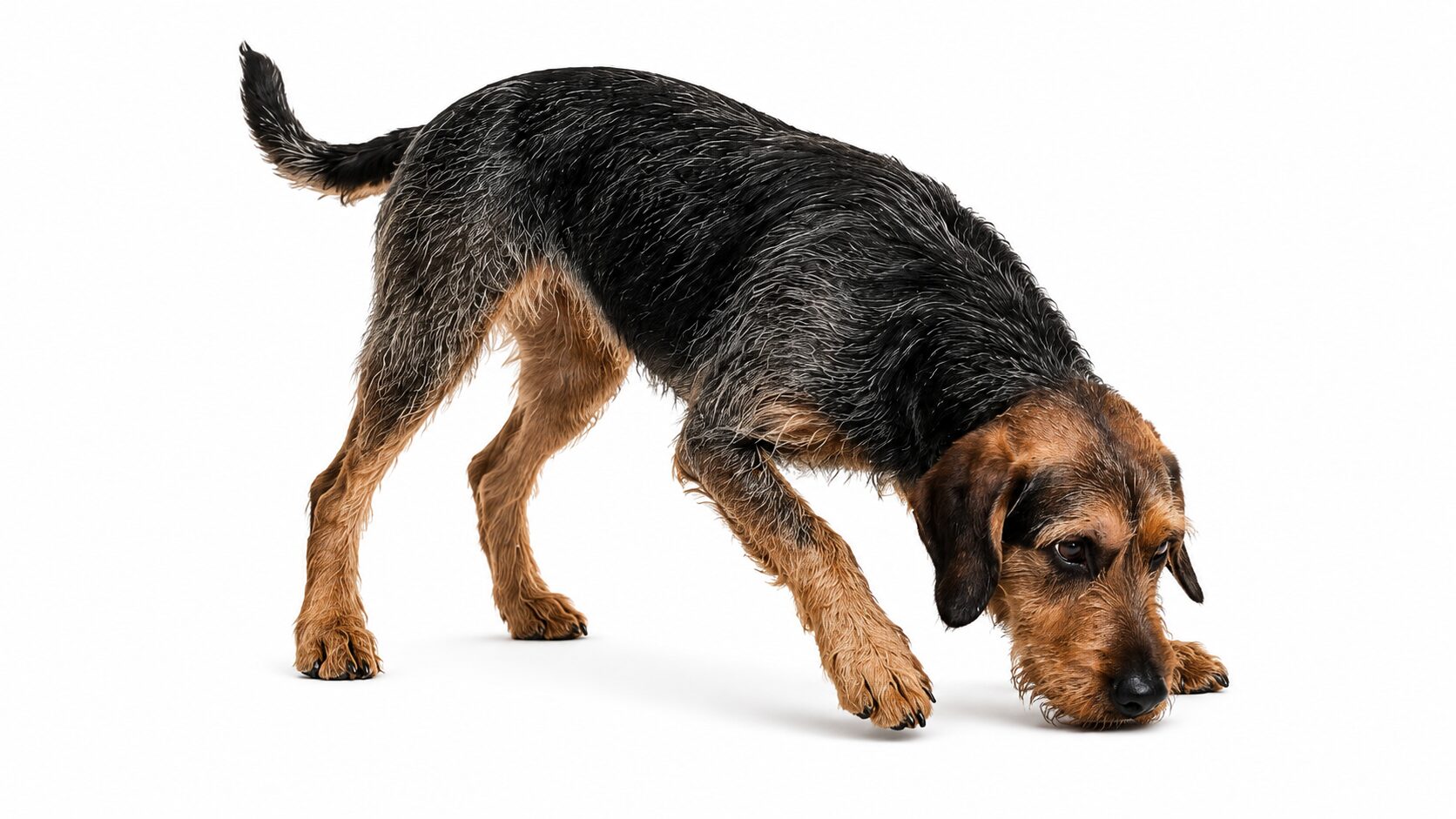
The Styrian Coarse-Haired Hound is a medium-sized, well-muscled, strongly built scent hound that presents with the most immediately individually distinctive visual combination of its rough, wiry, unkempt-looking but specifically functional coat, the serious expression, the determined brown eyes, and the modest moustache formed by the slightly longer facial furnishings that is required by the breed standard.
Adults stand 46 to 53 centimeters and weigh 15 to 18 kilograms. The body is solid, with a well-let-down and broad chest that provides the cardiovascular capacity for sustained mountain work, the straight and broad back, and the muscular hindquarters that provide the power for negotiating steep alpine terrain. The coat is harsh and rough throughout — the breed name refers specifically to this coat quality, which is harsh and rough though not shaggy. The coat is slightly shorter and finer on the face while coarser on the body, with the tail well-furnished with hair. Colors are red and fawn, with a small white chest marking permitted. The tail is carried in a loose sickle fashion and is never curled.
Housing And Living Requirements
The Styrian Coarse-Haired Hound is specifically and specifically honestly a working hunting dog first, a companion second, and a casual domestic pet essentially not at all. As with many breeds bred for work, they are not generally kept as a companion dog and do not make good pets. They require a lot of space and exercise, and can be dominant and destructive.
This is not a characterization from critics of the breed but from those who know it best, and it is the most honest individual welfare assessment of any breed in this series. A Styrian Coarse-Haired Hound in an apartment or suburban home without active hunting engagement or an equivalent amount of sustained vigorous outdoor activity will be destructive, vocal, and genuinely frustrated — not because of any behavioral problem but because of the complete mismatch between the dog’s constitutional working drive and the domestic context.
Rural environments with substantial outdoor space, secure fencing, and preferably access to hunting or tracking activities provide the only genuinely appropriate context. The wiry coat provides excellent weather resistance — the breed was developed specifically to function through the unpredictable and often severe weather of the Austrian Alps, and tolerates temperature extremes well in both directions.
A comfortable dog bed in a social area suits the breed’s devoted character with familiar people. An orthopedic dog bed provides appropriate joint support for an active mountain hunting breed.
Exercise Requirements
The Styrian Coarse-Haired Hound requires at least two hours of vigorous daily physical activity, ideally featuring opportunities for off-leash exploration to follow scents freely. Insufficient exercise creates boredom and destructive behavior that owners consistently report as the breed’s most immediately consequential welfare failure in domestic contexts.
This is a dog that can hunt in snow for hours, perhaps days, over rock and rough going, persevering where other breeds would stop. Its exercise requirement is not the casual active-dog need of many sporting breeds but the genuine working stamina of a dog that may track a wounded animal across alpine terrain for an entire day. Satisfying this requirement requires commitment that non-hunting owners must find through sustained outdoor activity rather than yard access alone.
Scent work and tracking activities provide the most directly appropriate organized competitive outlet, engaging the exceptional blood-trailing nose in structured sport. Dog agility suits the breed’s athleticism. Extended hiking and mountain trail walking most closely approximate the working conditions the breed was built for. Puzzle toys and enrichment activities provide cognitive engagement between outdoor sessions. A GPS tracker is an absolutely essential safety investment for any outdoor exercise in areas without complete secure enclosure — a scent hound with this level of nose and this level of working drive will follow an interesting trail to extraordinary distances without heed for owner calls or traffic.
Grooming Requirements
The Styrian Coarse-Haired Hound’s rough, wiry coat requires regular maintenance to keep it healthy and protective, but should never be trimmed, clipped, or shaved as these interventions damage the coat’s natural weather-proofing qualities and may cause the growth of a softer, less protective replacement coat.
Brushing one to two times weekly with a firm brush removes loose hair and debris while maintaining the coat’s natural rough texture. After every hunting session, thorough brushing removes any brambles, grass awns, or burrs accumulated in the rough coat during forest work, and the spaces between the toes should be specifically checked and cleared of embedded material. Regular baths are not advised as they may remove the weather-proofing from the coat. When bathing is genuinely necessary, a light dog shampoo used infrequently is the most appropriate approach.
The ears are the most specifically important ongoing health maintenance feature. The pendant ears with reduced airflow require weekly inspection and cleaning to prevent the accumulation that creates infection conditions. Dental care should be established as a consistent routine from puppyhood. Nails should be trimmed regularly, though active hunters naturally wear nails through field work. Paw inspection after every field outing is specifically recommended for this working breed.
Diet And Nutrition
The Styrian Coarse-Haired Hound is a medium-sized, highly active hunting breed with daily caloric needs calibrated to its actual size and genuine working output. A high-quality medium breed active formula with a named protein source as the first ingredient provides the nutritional foundation.
Most adults do well on two measured meals per day. Working dogs in active hunting use during hunting season may require additional caloric supplementation to maintain lean body condition through sustained high-output activity. Maintaining lean, athletic body condition appropriate to a mountain hunting scent hound supports both working performance and long-term joint health. Training treats are effective motivators in training sessions.
Compatibility
The Styrian Coarse-Haired Hound is loyal, affectionate, and gentle toward familiar humans while maintaining a working dog’s independence and reserve with the unfamiliar. At home, the Styrian Coarse-Haired Hound is very close to its master and particularly wary of strangers. This fundamental domestic character reflects the historical context of a breed that lived alongside its hunter in Styrian rural communities, deeply bonded to its immediate household while assessing the unfamiliar with the caution of a working dog accustomed to making its own field decisions.
With children, the breed is more appropriate for families with older children and those experienced with working breed temperament. The breed requires a settled, experienced domestic context rather than a chaotic household. With strangers, the wariness is genuine and specific management through early socialization is the most important individual investment. With other dogs, the breed tends to get along well with properly socialized counterparts. With cats and small animals, the hunting prey drive requires specific management and early introduction. A dog crate is a useful management tool during puppyhood.
Behavior And Temperament
The Styrian Coarse-Haired Hound has a working identity that is total and self-defining. These are incorruptible hunters that will try to complete the task they were given despite anything that might get in their way. The tenacity is genuine, constitutionally embedded, and not merely temperamentally inclined but physically expressed through the coat that protects the dog from alpine weather, the nose that trails blood through snow and rock, and the stamina that sustains pursuit through terrain that would exhaust most dogs.
The independent character reflects the specific working requirement of a breed that must make tracking decisions far from the hunter, reading the trail, interpreting the scent, and adjusting pursuit strategy without handler direction. Self-willed describes this most accurately. This dog does not rely on people’s instructions every second. It was reared to make decisions while on the trail, even a few kilometers away from the owner. In domestic contexts, this working independence requires the most consistent and most confidently maintained handler leadership of any Austrian hunting breed.
Despite the uncompromising hunting character, the Styrian Coarse-Haired Hound possesses cheerful and affectionate nature with unusual sensitivity toward familiar people. This domestic warmth is not inconsistent with the field tenacity but represents the specific duality of a breed that has always been its hunter’s closest companion as well as its most reliable working partner.
Training And Handling
The Styrian Coarse-Haired Hound is an intelligent breed that learns quickly but requires specific handling that respects the working independence rather than attempts to suppress it. Training sessions should be brief, varied, and engaging to hold their attention. Repetitive drilling produces disengagement in a breed this intelligent. Hunting instincts are always present and their hunting skills must only be sharpened — for the hunter, training is refinement of the existing capability rather than installation of an entirely new behavioral framework.
Positive reinforcement methods combined with consistent, firm, and patient leadership are the most effective approach. Training treats and praise are effective motivators. Negative training methods should be completely avoided — punishment can result in shy or aggressive individuals, and the sensitive, affectionate domestic character of this apparently tough breed is genuinely real and responds poorly to harsh correction. Early socialization from the earliest possible puppyhood age is the most critically important behavioral investment. Recall training in secure enclosed areas with high-value rewards is the single most practically important individual safety investment for any Styrian Coarse-Haired Hound owner.
Health And Lifespan
The Styrian Coarse-Haired Hound is a healthy and hardy breed with an average lifespan of 10 to 12 years, reflecting the constitutional robustness built through Karl Peintinger’s original design brief and maintained through the Österreichischer Verein Brack’s hunt testing requirement. The breed has remained healthy through Auffrischungszucht — German for refresher breeding or outcrossing — a specific genetic management strategy used to maintain health and genetic diversity without compromising the working type.
Hip Dysplasia Hip dysplasia is possible given the breed’s active mountain working heritage and size. OFA hip evaluation is recommended for breeding animals.
Ear Infections The pendant ears create specific infection risk. Weekly inspection and cleaning after every field session is the most consistently important preventive practice.
Patellar Luxation Patellar luxation is documented as a potential concern. OFA evaluation is recommended for breeding animals.
General Robustness Routine preventive care including regular vet checks, OFA evaluation for breeding animals, consistent dental hygiene, up-to-date vaccinations appropriate for an active outdoor hunting breed in the tick-rich environments of Styrian alpine forests, year-round tick and parasite prevention, and regular ear and paw maintenance after field exercise provides the foundation for a healthy Styrian Coarse-Haired Hound.
Price And Availability
The Styrian Coarse-Haired Hound is rare outside Austria and Slovenia, where it remains primarily a working hunting dog maintained by hunting families in Styria and the surrounding alpine regions. Finding a well-bred Styrian Coarse-Haired Hound outside these countries requires direct engagement with the Österreichischer Verein Brack or Austrian hunting breed networks and acceptance that the breed is genuinely rare outside its homeland for specific and specifically legitimate reasons.
Conclusion
The Styrian Coarse-Haired Hound was created in the early 1870s by Karl Peintinger, an Austrian industrialist and hunter from Styria, through a founding cross between Hela 1 — a female from an old type of Hanoverian Scent Hound — and an Istrian Coarse-Haired Hound male, developed over approximately 20 years of selective breeding with possible addition of native Austrian hound blood, specifically designed to hunt wild boar in the rugged alpine terrain of the Austrian Alps with greater physical hardiness, coat weather-resistance, and mountain tenacity than any existing breed available to him, was first recognized by the Austrian Kennel Club in 1889, received FCI international recognition on August 31, 1954 under Standard Number 62 in Group 6 Section 1.2, received UKC Scenthound Group recognition in 2006, has breeding oversight managed by the Österreichischer Verein Brack which maintains the proof-of-work requirement for breeding animals, has maintained a healthy breed through Auffrischungszucht (outcrossing) genetic management, is among the few breeds whose founding history is completely documented and undisputed, and stands today as the most specifically Karl-Peintinger-Hela-1-Hanoverian-and-Istrian-documented-founding, the most specifically 1870s-to-1889-recognition-20-years-development, the most specifically proof-of-work-FCI-classification-hunt-testing-required, the most specifically incorruptible-hunter-self-willed-makes-decisions-kilometers-from-owner, the most specifically Auffrischungszucht-outcrossing-health-maintained, the most specifically not-recommended-as-a-general-pet-most-honestly-assessed, and the most specifically Austrian-and-Slovenian-wild-boar-mountain-terrain-specialist of all the Central European scent hound breed partnerships available. Get properly set up before bringing one home. Our Best Dog Products page has everything you need for harsh-wiry-fawn-or-red-coated, moustached, sickle-tailed, pendant-eared, whole-heartedly devoted Styrian mountain hunting hounds that carry the full heritage of Karl Peintinger’s 1870s working brief, Hela 1’s Hanoverian blood-trailing nose, the Istrian Coarse-Haired Hound’s wire coat and mountain agility, the 1889 Austrian Kennel Club recognition, the 1954 FCI international standard, the 2006 UKC North American recognition, the Österreichischer Verein Brack’s hunt testing oversight, the Auffrischungszucht genetic health strategy, and the specific self-willed, incorruptible, snow-through-hours-over-rock, cheerful-and-affectionate-at-home, serious-expression-determined-eyes, wild-boar-pursuing tenacity of the one breed whose entire founding story fits on a single undisputed page.