
Origin And History
The Bolognese is one of the oldest companion breeds in Europe, a small, white, flocked-coated toy dog from the Italian city of Bologna whose documented association with European nobility stretches back to the 11th and 12th centuries and whose cultural presence in the art of the Renaissance and Baroque periods has given it one of the most visually documented histories of any toy breed in the world. It belongs to the Bichon family of small white companion dogs, a group that includes the Bichon Frisé, the Maltese, the Havanese, the Löwchen, and the Coton de Tuléar, and within that group it holds the distinction of being the most reserved, the most seriously devoted to its own family, and the one most often described as a companion’s companion rather than a people-pleasing charmer.
The breed’s precise origins are uncertain in the way that only genuinely ancient breeds can be uncertain. The Bolognese belongs to the broader Bichon family whose ancestry in the Mediterranean basin may extend back to antiquity. One of the earliest possible references to dogs of this type is Aristotle’s mention of the Melitensis, described as small but beautifully proportioned, and small white dogs of the Bichon type appear to have traveled the Mediterranean coast with Phoenician and later Greek and Roman merchants for centuries before the Bolognese was documented as a specific Italian type.
By the Middle Ages, dogs recognizably similar to the modern Bolognese were firmly established in the court culture of the Italian city-states, and Bologna specifically was known as their center of development. The first recorded mention of the breed in its specifically Bolognese form appears around the 11th and 12th centuries. By the Renaissance, the Bolognese was among the most celebrated and most frequently gifted of all companion animals within the complex gift-exchange diplomacy of the Italian and broader European nobility. Cosimo de’ Medici sent eight Bolognese to Belgium as diplomatic gifts in the 16th century, acknowledging the breed’s established role as a token of aristocratic favor. Philip II of Spain received Bolognese as gifts and valued them highly. Catherine the Great of Russia, Maria Theresa of Austria, and the Marquise de Pompadour, maîtresse-en-titre of Louis XV of France, are among the most historically celebrated owners of Bolognese.
The breed’s presence in European art is extensive and spans centuries. Titian painted the Duke Federico Gonzaga with a small white dog believed to be a Bolognese. The breed appears in works by Goya, Gosse, and Watteau, providing a pictorial record of its continuous association with the European elite across several centuries of aristocratic culture.
The weakening of royal and noble power in Europe through the 19th and 20th centuries removed the social context that had sustained the breed, and by the mid-20th century the Bolognese had declined to near-extinction. The revival of the breed is credited primarily to Italian breeder Gianfranco Giannelli, who devoted decades to rebuilding the population from surviving dogs. The breed reached England in the 1990s and was imported to the United States, with the first American import arriving in 1987. The FCI recognizes the breed, placing it in Group 9 alongside other Bichon-type companion breeds with Italy as the country of origin. The AKC admitted the breed to its Miscellaneous Class in 2011, and full AKC Toy Group recognition came in January 2023, making the Bolognese one of the most recently fully recognized breeds in the AKC’s history.
Breed Overview
| Trait | Details |
|---|---|
| Breed Group | Toy |
| Height | 25–31 cm (10–12 inches) |
| Weight | Ideally not exceeding 4 kg (9 pounds); typically 2.5–4 kg |
| Lifespan | 12–14 years |
| Coat | Long, fluffy, open ringlets; single coat with no undercoat |
| Colors | Solid white only |
| Temperament | Devoted, serious, calm, reserved, playful in bursts |
| FCI Recognition | Yes |
| AKC Recognition | January 2023 |
Appearance And Size
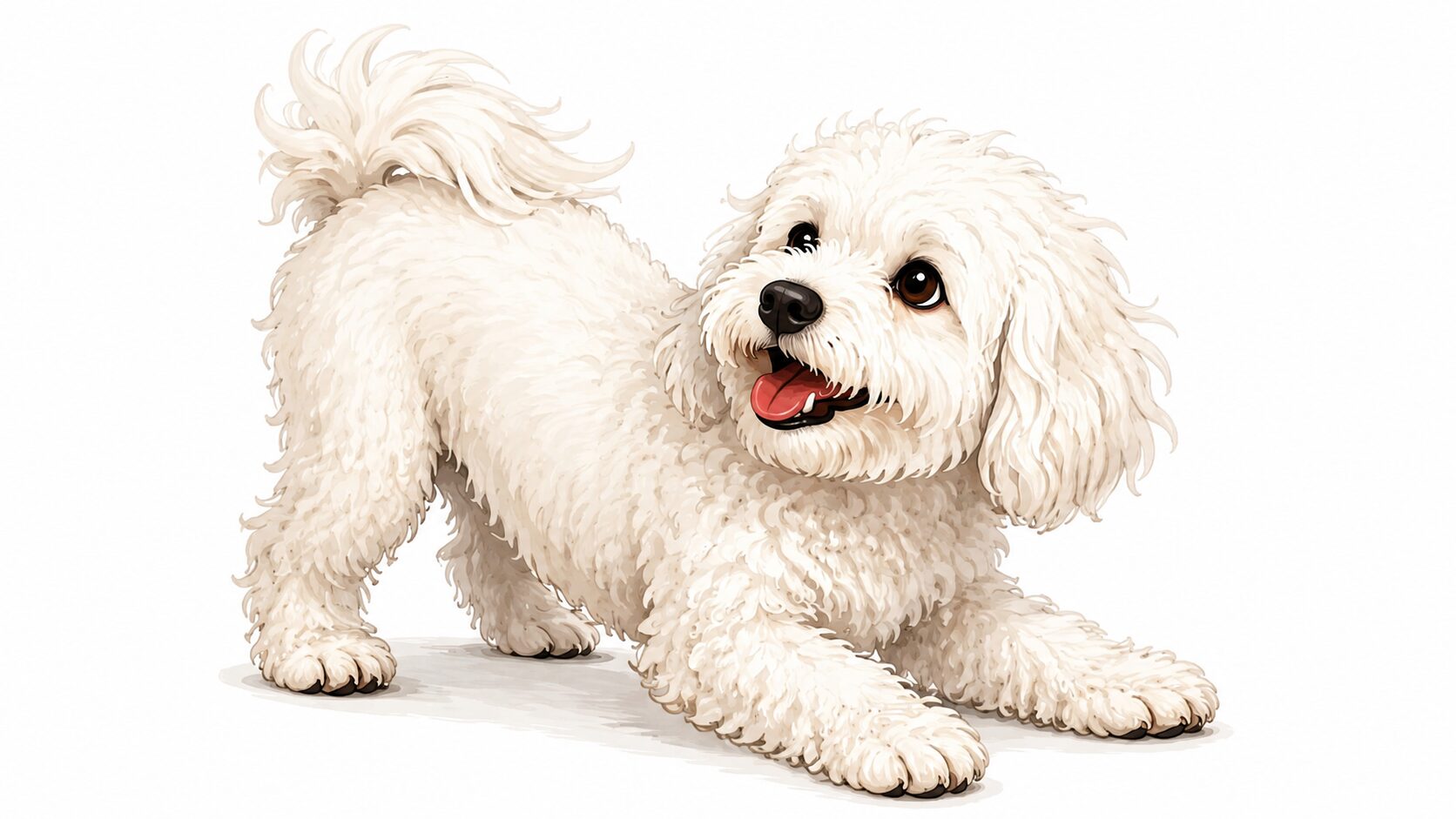
The Bolognese is a small, compact, squarely built toy dog that presents with a distinctive fluffy white appearance unlike any other breed in the Bichon family. It stands 25 to 31 centimeters at the shoulder and ideally does not exceed 4 kilograms in weight, with most individuals in the 2.5 to 4 kilogram range. The overall impression is of a compact, well-proportioned small dog of moderate bone and solid substance, carrying its square frame with an upright, dignified bearing that reflects the serious, reserved character that distinguishes the Bolognese from its more extroverted Bichon relatives.
The head is of medium length, reaching approximately one-third of the height at the withers. The skull is slightly rounded, the stop is well-defined, and the muzzle is moderately long and tapering. The eyes are large, round, dark, and prominent, with notable black eye rims that provide the strong contrast against the white coat that gives the Bolognese its characteristic expression. The nose is large and black, also providing important contrast. The ears are set high, pendant, and covered with long hair that blends into the general coat.
The body is square in profile, with a level back, a moderately broad and deep chest, and a broad, slightly sloping croup. The tail is set high, carried curved over the back, and well covered with long hair.
The coat is the breed’s most immediately distinguishing feature and the quality that most clearly sets it apart from the curly-coated Bichon Frisé with which it is most often confused. The Bolognese coat consists of long, fluffy, open ringlets or flocks rather than the tight, pom-pom curls of the Bichon Frisé. It is a single coat with no undercoat, and the texture is described as woolly or cotton-like rather than silky or crisp. The hair is shorter and flatter on the face. The coat is always solid white, which is the only acceptable color under the breed standard.
Housing And Living Requirements
The Bolognese is among the most genuinely adaptable toy breeds in terms of living environment, combining the small size that makes it physically practical in any space with a calm, settled indoor character that manages apartment, urban, suburban, and rural settings with equal ease when its social needs are consistently met.
The most fundamental housing requirement for the Bolognese is not about space but about company. This is a breed that bonds with extraordinary intensity to its own people and that does not manage prolonged daily isolation with anything approaching equanimity. The Bolognese is known for its tendency toward separation anxiety, which is the direct expression of the devoted, family-focused character that centuries of selection as an intimate companion produced. A household where the dog is genuinely included in daily life and rarely left alone for extended periods is the most appropriate setting.
Inside the home, the Bolognese is a warm, calm, and deeply devoted companion that positions itself close to its people with the quiet, attentive presence of a dog that regards proximity to its family as its primary purpose. A soft, comfortable dog bed in a social position where the dog can observe household activity suits the breed’s watchful, people-oriented nature during rest periods.
The single-layer coat provides minimal weather insulation, and the Bolognese’s small size means it loses heat quickly in cold conditions. A dog coat for outdoor sessions in cold or wet weather is a practical consideration rather than an optional indulgence, and this is a breed whose outdoor cold tolerance should not be overestimated.
Exercise Requirements
The Bolognese is a calm breed with moderate exercise needs that are entirely achievable for a wide range of owner profiles, which is one of the practical qualities that has made it a reliable companion for elderly owners, apartment dwellers, and households that cannot provide the demanding daily exercise requirements of more active breeds.
A daily walk of 20 to 30 minutes combined with active indoor play sessions meets the baseline needs of most adult Bolognese. The breed is not a hyperactive, constantly demanding companion. It is calm between the bursts of playful energy that Bolognese owners describe as the characteristic Bolo Dance, a sudden, joyful expression of exuberance that contrasts with the breed’s generally more serious, settled demeanor and that serves as one of the most endearing aspects of living with this breed.
Mental stimulation is as important as physical exercise for a breed this intelligent. Puzzle toys and enrichment activities provide meaningful cognitive engagement between structured walks and indoor play sessions. The Bolognese participates willingly in obedience and dog sports at an appropriate scale for its size, and owners who find structured activities to do together with their dog consistently report stronger bonds and more content, settled dogs.
Grooming Requirements
The Bolognese’s long, fluffy, single-layer flocked coat is the breed’s most visually distinctive feature and its most significant ongoing grooming commitment. The coat requires consistent maintenance to prevent the matting that develops rapidly in the fluffy, open ringlet texture when brushing is inconsistent.
Brushing three to four times a week is the minimum commitment under normal conditions to keep the coat free of tangles and maintain the characteristic fluffy, flowing appearance that is the breed’s most immediately recognizable quality. A metal comb used after brushing catches any remaining tangles in the deeper layers of the single-layer coat. The absence of an undercoat means the Bolognese is considered low-shedding, which is one of its practical advantages for allergy-sensitive households, but the same absence of undercoat means the outer coat is all there is to maintain, and it mats more readily than double-coated breeds of comparable length.
Professional grooming every six to eight weeks is the standard maintenance approach for most Bolognese owners. The coat can be maintained at full show length or trimmed to a shorter, more manageable pet cut according to owner preference. Tear stains around the eyes are a common management consideration in this breed given the prominent, round eye placement and the white coat that shows staining readily. Keeping the area beneath the eyes clean and dry during daily grooming is the most effective preventive approach.
Dental care is critical for this breed given the documented predisposition to dental disease in small breeds. Establishing daily or near-daily tooth brushing from puppyhood, combined with annual professional veterinary cleanings, significantly reduces the periodontal problems that affect a high proportion of toy breeds by middle age. Nails should be trimmed monthly and ears checked and cleaned weekly.
Diet And Nutrition
The Bolognese is a small toy breed with relatively modest daily caloric needs that should be carefully matched to its actual size and activity level. A high-quality small breed formula with a named protein source as the first ingredient provides the nutritional foundation the breed requires. Small breed formulas address the higher metabolic rate, the dental disease predisposition, and the specific nutritional needs of toy dogs, making them the most appropriate choice for the Bolognese across most life stages.
The breed’s documented predisposition to patellar luxation and hip dysplasia means that maintaining appropriate body condition is genuinely important rather than merely cosmetic. Even modest overweight in a dog this small places disproportionate strain on small joints, and consistent portion control throughout the dog’s life is one of the most practically meaningful ongoing health investments an owner can make.
Most adults do well on two measured meals per day. Training treats are effective motivators given the breed’s food motivation and should be counted into the daily calorie total. Given how small the daily caloric margin is for a dog this size, treat management requires more active attention than in larger breeds.
Compatibility
The Bolognese is a breed that distributes its loyalty intensely and selectively, forming bonds of extraordinary depth with its own family while maintaining the reserved, somewhat wary approach to unfamiliar people that distinguishes it from the more broadly sociable Bichon Frisé.
With its own family, the Bolognese is genuinely and deeply devoted. The word devotion appears in virtually every source on the breed, and it captures something accurate and specific about how this dog relates to its people. The Bolognese does not distribute its warmth casually or broadly. It gives it completely and selectively to the people it regards as its own, and the quality of that bond is one of the most rewarding aspects of living with this breed.
With children in its household, the breed is generally patient and gentle when socialized from puppyhood. Its small size requires supervision with very young children who might accidentally injure a dog weighing under 4 kilograms, and the breed’s somewhat serious character means it may prefer calm, gentle interaction over boisterous roughhousing.
With strangers, the Bolognese maintains the reserved, watchful character that reflects centuries of selection as an intimate companion to specific aristocratic households rather than a dog expected to welcome anyone who approached. Early and consistent socialization from puppyhood is the most effective tool for ensuring this natural reserve is expressed as appropriate discernment rather than anxious reactivity.
With other dogs, the breed is generally sociable when properly introduced, particularly with dogs of similar size. A dog crate is a useful management tool during puppyhood and the settling-in period.
Behavior And Temperament
The Bolognese’s temperament is one of the most distinctively described in the toy group, and the consistent language used across centuries of accounts of the breed reflects something genuine and stable. The Bolognese is a rather serious dog and generally not high energy but is intelligent and witty. That characterization from the AKC breed standard accurately captures the essential quality that distinguishes the Bolognese from its more exuberant Bichon relatives.
The seriousness is not joylessness. It is the settled, considered quality of a dog that engages with its world thoughtfully rather than impulsively, that forms its relationships with deliberate care rather than indiscriminate enthusiasm, and that expresses its affection through steady, attentive devotion rather than the performative, crowd-pleasing charm of some toy breeds. The Bolognese earns the trust of people it decides to trust and then gives that trust completely. It does not give it automatically.
The Bolo Dance is the behavioral expression of what lies beneath the seriousness: genuine playful joy that emerges in bursts of exuberant, spontaneous movement that owners describe as one of the most charming and unexpected qualities of life with a Bolognese. The contrast between the breed’s generally calm, dignified bearing and these sudden expressions of delight is part of what makes it such a rewarding companion.
The sensitivity to its owner’s emotional state is consistently noted across sources. The Bolognese is described as being notably attuned to the feelings of its people, adjusting its behavior to match the household’s emotional register and providing the kind of quiet, close emotional support that makes it an effective therapy dog candidate.
Training And Handling
The Bolognese is an intelligent breed that takes well to training when approached with the patience, positive engagement, and genuine respect for its somewhat independent character that suit a dog of this history and temperament.
Positive reinforcement methods are the approach that works most reliably. The Bolognese responds to reward, to genuine engagement, and to training that feels collaborative and purposeful. Its food motivation makes treat-based training highly productive, and training treats are among the most effective motivators available for this breed.
Housetraining can require patience, as is typical of toy breeds generally. The small bladder capacity of a very small dog means more frequent outdoor opportunities are needed, particularly in puppyhood, and expecting a Bolognese to hold its bladder for intervals appropriate to a larger breed is unrealistic.
The independent, somewhat reserved character that is so authentic to the Bolognese occasionally expresses itself as a reluctance to perform on demand for people outside the dog’s inner circle. The Bolognese is a remarkably different dog with its own family than with strangers, which is worth bearing in mind when evaluating training responsiveness in social contexts involving unfamiliar people.
Early socialization from puppyhood is the most important investment an owner can make in the Bolognese’s future suitability as a companion in varied social environments. The breed’s natural reserve with strangers is genuine and persistent, but the degree to which it is expressed as anxious reactivity versus calibrated discernment depends substantially on the quality and breadth of early social experiences.
Health And Lifespan
The Bolognese is a generally healthy breed with an impressive lifespan of 12 to 14 years. Its development as an ancient companion breed, maintained through centuries of aristocratic breeding programs that prized health and longevity as well as appearance, has produced a constitution that is generally robust. The conditions most documented in the breed are manageable hereditary concerns rather than fundamental constitutional fragility.
Patellar Luxation Kneecap dislocation is the most consistently documented health concern in the breed, ranging from mild, requiring only monitoring and weight management, to severe, requiring surgical correction. Sourcing from breeders who conduct OFA patellar evaluation on their breeding animals is the most important preventive step. Low-impact exercise management during puppyhood and maintaining lean body condition throughout the dog’s life are meaningful ongoing protective measures.
Hip Dysplasia Abnormal hip joint development is documented in the breed at low rates, consistent with the general predisposition of small companion breeds. OFA hip evaluation of breeding animals and appropriate weight management are the most meaningful preventive measures.
Eye Conditions Cataracts and other eye conditions are documented in the breed. Regular annual veterinary eye examinations allow for early detection and appropriate management. CAER eye certification of breeding animals is the most meaningful preventive step for prospective buyers.
Dental Disease As with all toy breeds, the small mouth creates crowding that significantly increases the risk of periodontal disease. Establishing consistent dental care from puppyhood, brushing teeth two to three times weekly, and scheduling annual professional veterinary cleanings significantly reduces the periodontal problems that affect a high proportion of toy breeds by middle age.
Skin and Coat Conditions Skin conditions and coat-related concerns are documented at low rates. Maintaining appropriate coat grooming and regular skin inspection during brushing sessions allows for early detection of any developing conditions.
Separation Anxiety While not a physical health condition, separation anxiety is one of the most practically significant welfare concerns for this breed. The Bolognese’s deep bonding and documented difficulty with extended solitude make managing alone time through appropriate enrichment, training, and scheduling one of the most important ongoing welfare commitments of Bolognese ownership.
Routine preventive care, including regular vet check-ups, consistent dental hygiene, up-to-date vaccinations, and parasite prevention, provides the foundation for a healthy Bolognese across its full lifespan.
Price And Availability
The Bolognese remains a moderately rare breed in the United States, though its January 2023 AKC full recognition into the Toy Group has increased visibility and may encourage additional breeders to establish programs in North America in coming years. From reputable breeders, expect to pay between $1,000 and $2,500 for a well-bred puppy from health-tested parents. The limited number of active breeders means wait lists are common.
The American Bolognese Club is the most authoritative starting point for locating breeders in the United States who breed to the AKC standard and conduct appropriate health testing. Responsible breeders will conduct OFA patellar evaluation, hip evaluation, and eye certification on their breeding animals and will be transparent about all health testing results. They will ask thorough questions about the prospective buyer’s lifestyle, household composition, and ability to provide the daily companionship and grooming commitment the breed genuinely requires.
European breeders, particularly in Italy where the breed’s primary population remains, are an option for North American buyers willing to navigate the logistics of international import. The FCI-affiliated Italian parent club, the Amici del Bolognese, maintains breeder connections across European breeding programs.
Adoption is occasionally possible through toy breed rescue organizations and through the breed club’s rehoming network, though the Bolognese’s rarity means this is an infrequent option rather than a reliable channel.
Annual ongoing ownership costs include food, which is modest given the breed’s small size, professional grooming every six to eight weeks, routine veterinary care including annual dental cleanings, and standard supplies.
Conclusion
The Bolognese has been sitting on the laps of Italian nobility, being carried in diplomatic pouches between European courts, being depicted by Titian and Goya and Watteau, and occasionally nearly disappearing, since at least the 11th century. It arrived at full AKC recognition only in January 2023, which may be the longest road to recognition of any breed whose association with human aristocracy is as thoroughly documented. What Gianfranco Giannelli saved from near-extinction in the late 20th century, and what the small community of dedicated breeders on both sides of the Atlantic has carefully maintained, is a companion dog of genuine antiquity and singular character: reserved with strangers in the way of a dog that takes its relationships seriously, devoted to its family in the way of a dog that has been bred for nothing else for a thousand years, and given to the occasional burst of spontaneous, joyful dance that reminds everyone that beneath the serious bearing lives a dog of genuine warmth. For the owner who can provide the daily companionship, the grooming commitment, and the genuine engagement this devoted little Bichon requires, the Bolognese offers a companionship unlike any other toy breed in its combination of history, character, and quiet, complete loyalty. Get properly set up before bringing one home. Our Best Dog Products page has everything you need for fluffy, white, whole-heartedly devoted Italian companion dogs that carry over a thousand years of Bolognese aristocratic heritage into every home they grace.