
Origin And History

Few dog breeds carry the weight of history, culture, and national identity as fully as the Akita. This is a breed that has been declared a natural monument, honored on postage stamps, and mourned in stories that spread around the world. It is also one of the oldest and most distinctive breeds on earth, shaped over centuries in one of the most demanding environments imaginable.
The Akita originated in the mountainous Akita Prefecture of northern Japan, a region of harsh winters, dense forests, and rugged terrain where the indigenous Matagi hunters relied on powerful, cold-hardy dogs to track and bay bear, boar, and deer. These early dogs, known as Matagiinu, were medium-sized spitz-type animals with erect ears and a tightly curled tail, and they are considered the direct ancestors of the modern Akita. Their defining characteristics were fearlessness, independence, and an ability to work in conditions that would defeat most other breeds.
During the Tokugawa Shogunate era, the breed’s purpose shifted. The nobility began breeding these dogs larger for use as guardians of people and property, and the traits of loyalty and self-directed courage that had served them as hunters made them equally effective in that role. Dog fighting also entered the picture during this period, and for roughly three centuries the hunting dogs and fighting dogs of Akita Prefecture coexisted, with the fighting lines being crossed with larger Western breeds including the Tosa Inu, Mastiff, and German Shepherd during the Meiji era to increase size and power. This crossbreeding diluted the original spitz characteristics significantly, and by the early 20th century, the purebred Akita was genuinely endangered.
In 1927, the Akitainu Hozonkai, the Akita Dog Preservation Society, was established in Odate to restore and protect the original breed. In 1931, the Japanese government formally designated the Akita as a national natural monument, one of only a handful of dog breeds to receive that distinction anywhere in the world. The effort to restore the original spitz type was well underway when the Second World War intervened. The Japanese government ordered non-combat dogs destroyed, and the breed’s numbers collapsed again. Some breeders hid their dogs or crossed them with German Shepherds to have them classified as military animals. Those breeding decisions had lasting consequences for the breed’s development.
The dog that changed the Akita’s global story was not a champion show dog or a warrior. It was Hachiko, the Akita who waited at Shibuya Station in Tokyo every day for nearly ten years for his deceased owner to return, and whose story of loyalty became one of the most famous in canine history. Hachiko’s story brought the breed to international attention and cemented its association with unwavering devotion.
American GIs stationed in Japan during the postwar occupation encountered the breed and brought dogs home in significant numbers during the 1950s. The American Akita that developed from these imports, heavier-boned, broader-headed, and more bear-like in appearance, eventually diverged enough from the Japanese Akita Inu that the two are now recognized as separate breeds by most international kennel clubs. Helen Keller is credited with bringing the first Akita to the United States in 1937. The AKC recognized the breed in 1972, and the Akita Club of America was founded in 1956.
Breed Overview
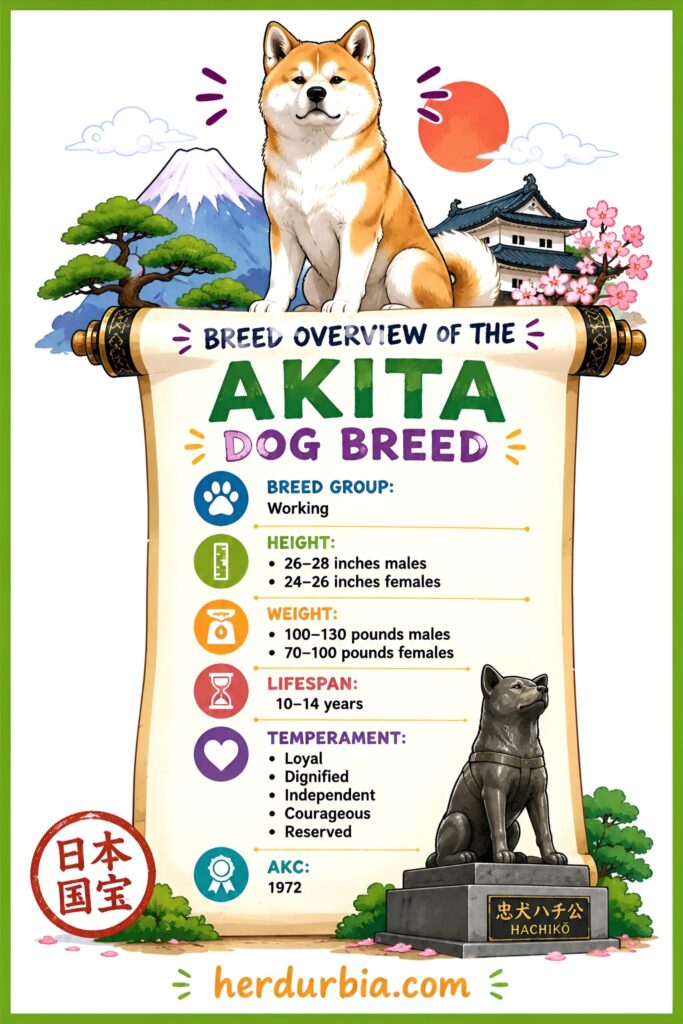
| Trait | Details |
|---|---|
| Breed Group | Working |
| Height | Males 26–28 inches / Females 24–26 inches |
| Weight | Males 100–130 pounds / Females 70–100 pounds |
| Lifespan | 10–14 years |
| Coat | Thick double coat, short to medium length |
| Colors | Any color including white, brindle, pinto |
| Temperament | Loyal, dignified, independent, courageous, reserved |
| AKC Recognition | 1972 |
Appearance And Size
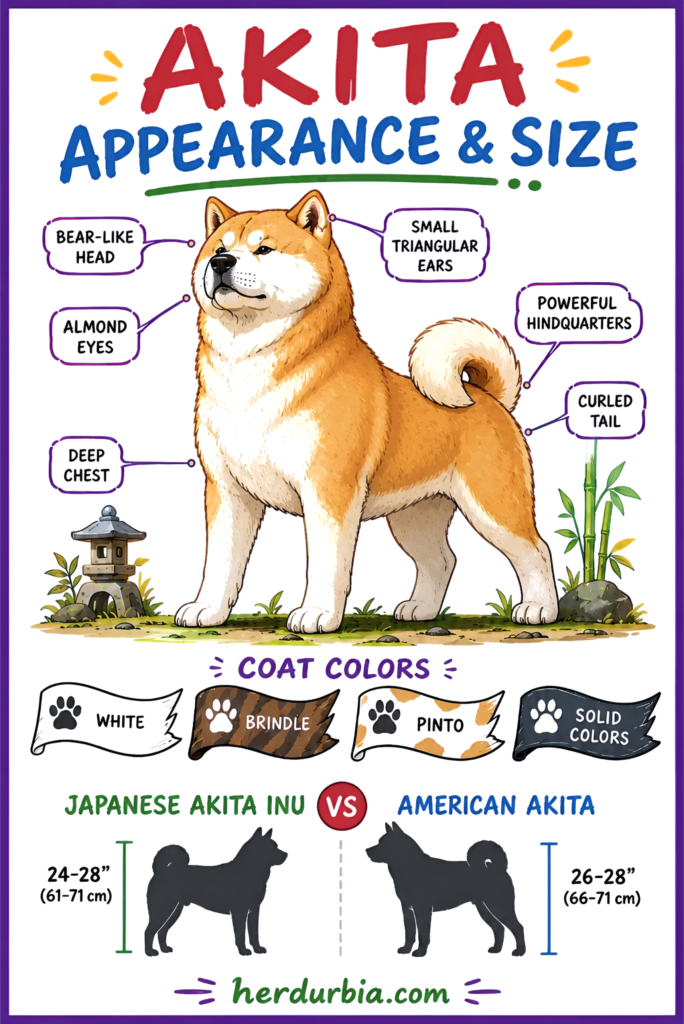
The Akita is a large, powerfully built dog that commands attention without asking for it. Males stand 26 to 28 inches at the shoulder and weigh between 100 and 130 pounds. Females are noticeably smaller, running 24 to 26 inches and 70 to 100 pounds. The overall impression is one of substance and balance, a dog that carries its considerable size with a natural dignity that is one of the breed’s most defining qualities.
The head is broad and bear-like, with a flat skull, a defined stop, and a strong, deep muzzle. The small, triangular, upright ears and the dark, almond-shaped eyes set into a wide skull give the face a composed, watchful expression that Akita owners describe as distinctly regal. The eyes carry an expression of calm intelligence that is immediately recognizable once you have seen it.
The body is muscular and well-proportioned, slightly longer than tall, with a deep chest, a level back, and powerful hindquarters built for strength and endurance. The double coat is one of the most striking physical features of the breed. The outer coat is straight, coarse, and stands off the body, providing effective weather resistance. The undercoat is dense and soft, providing insulation against the cold temperatures of the Japanese highlands. The coat is short to medium in length on most of the body, slightly longer on the tail, which curls tightly over the back in the classic spitz fashion and is one of the breed’s most recognizable features.
American Akitas come in virtually any color including white, brindle, pinto, and solid shades. The Japanese Akita Inu is restricted to red, fawn, sesame, white, and brindle under its separate breed standard.
Housing And Living Requirements
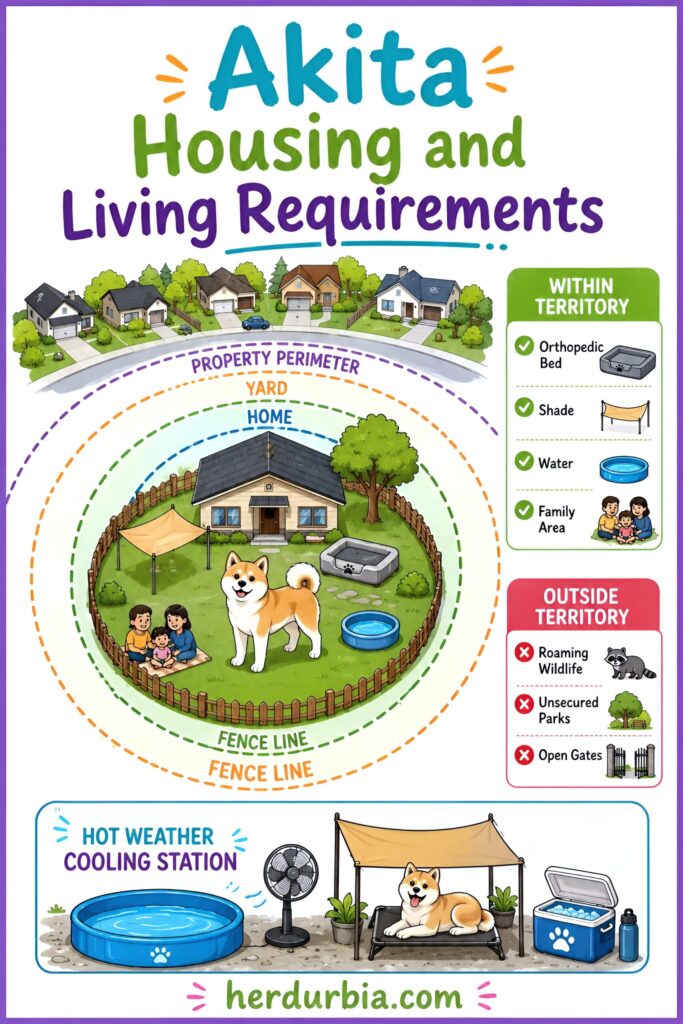
The Akita is adaptable in terms of living space to a point, but it has specific and non-negotiable requirements that every prospective owner needs to understand before committing. A home with a securely fenced yard is strongly preferred. This is a large, physically capable, and territorially minded dog, and providing it with adequate outdoor space to move and rest comfortably is a practical necessity rather than a luxury.
The fence matters considerably with this breed. The Akita has a strong prey drive and a territorial instinct that can cause it to respond unpredictably to animals or people it perceives as intruders. A secure perimeter is essential. Off-leash exercise in any unfenced area is genuinely risky with this breed and should be avoided.
Inside the home, a settled Akita is calm, clean, and remarkably dignified in its behavior. This is not a hyperactive breed that bounces off the walls or demands constant entertainment. It carries itself with a quiet confidence indoors and tends to choose a position where it can observe the household rather than inserting itself into every interaction. A large, comfortable orthopedic dog bed is a sound investment for a dog of this size, particularly as it ages into its senior years.
The Akita does not tolerate being left alone for extended periods on a regular basis, but it handles solitude better than many more people-dependent breeds. It forms deep bonds with its own family and takes its role as household guardian seriously. What it does not handle well is being confined without adequate space, exercise, or mental stimulation.
The Akita’s thick double coat means it handles cold weather exceptionally well and significantly less well in hot and humid climates. In warmer regions, access to shade, cool surfaces, and fresh water at all times is important, and exercise should be scheduled during cooler parts of the day.
Exercise Requirements
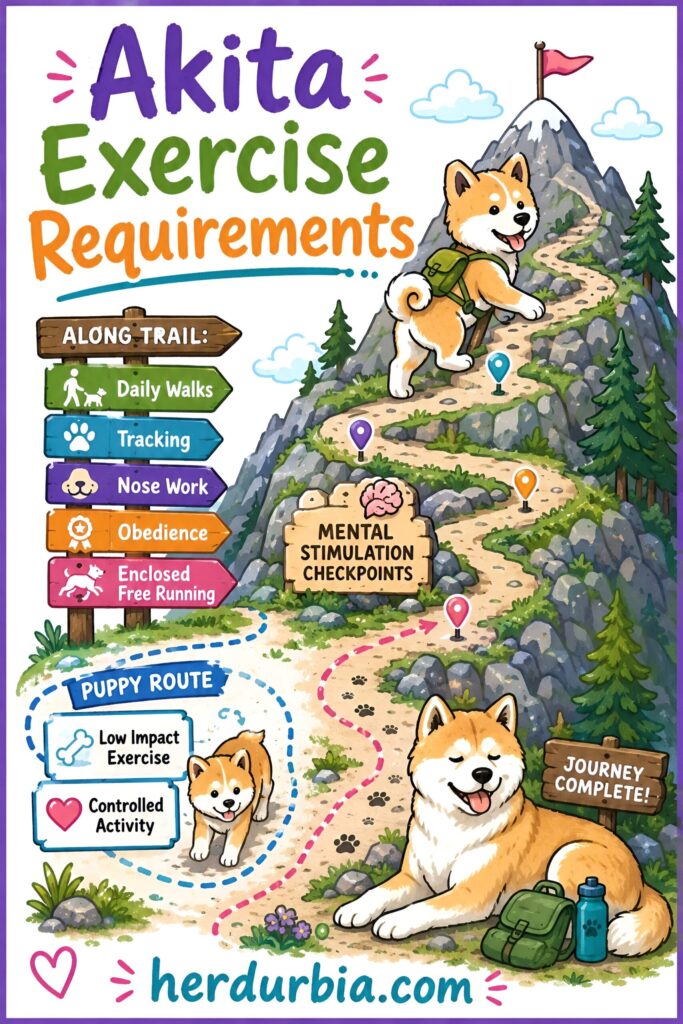
The Akita has moderate to high exercise needs that should not be underestimated based on its calm indoor temperament. This is a large, muscular working breed that needs a minimum of one to two hours of daily physical activity to stay healthy and behaviorally settled. A dog that is not getting adequate exercise will find its own ways to express that frustration, and for a dog of the Akita’s size and strength, those expressions are rarely minor.
Daily walks of meaningful length are the foundation of the exercise routine. The Akita is not a sprint-and-stop dog like some terrier breeds. It is built for sustained, steady movement, and longer walks at a comfortable pace suit it better than short, intense bursts. Off-leash running in a fully enclosed space supplements structured walks and gives the dog the freedom to move at its own pace.
The Akita responds well to activities that engage both its body and its intelligence. Tracking, scent work, and nose-based activities tap into the breed’s natural abilities and provide mental stimulation alongside physical exercise. Obedience work, done consistently and with patience, also provides meaningful mental engagement. The breed excels at various dog sports when the right motivational approach is used.
During puppyhood, exercise should be carefully managed. Akitas grow rapidly, and excessive high-impact activity before the growth plates close, which typically occurs around 18 to 24 months, increases the risk of joint damage. Leash walks and controlled play on soft surfaces are the appropriate approach for young dogs. Your vet can advise on appropriate activity levels as the puppy develops.
Grooming Requirements
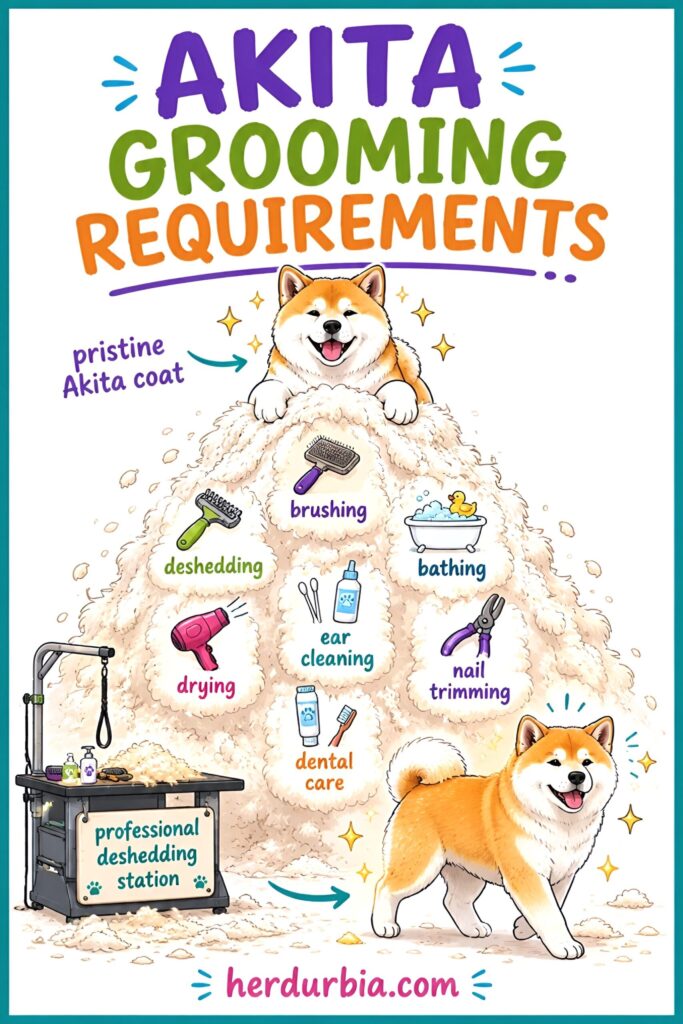
The Akita’s double coat is beautiful, functional, and sheds in quantities that new owners frequently find surprising. The breed is a year-round shedder that experiences two heavy coat blows annually, typically in spring and fall, during which the undercoat releases in large volumes. Daily brushing during these periods is the only practical way to manage the output. Outside of shedding seasons, a thorough brush two to three times per week keeps the coat in good condition and significantly reduces the amount of hair distributed around the home.
The Akita is known for its cat-like fastidiousness in self-grooming, which means the coat stays cleaner between baths than many people expect. Bathing every six to eight weeks is appropriate for most dogs. The dense undercoat holds moisture and takes considerable time to dry fully, so thorough drying after every bath is important to prevent skin issues developing underneath.
The coat does not require trimming or professional styling. It is a natural working coat that maintains its structure without intervention. Professional grooming is not a regular requirement for this breed, though many owners take their dogs in for a professional deshedding treatment during the heavy seasonal blows, which can be significantly more efficient than home brushing alone.
Standard maintenance fills the rest of the routine. Nails should be trimmed monthly. Ears should be checked and cleaned weekly. Dental care is particularly important for this breed given its susceptibility to certain health conditions, and brushing teeth several times a week from puppyhood is worth establishing as a non-negotiable habit.
Diet And Nutrition

The Akita is a large, muscular dog with a significant daily caloric requirement to match. A high-quality large-breed formula with a named protein source as the first ingredient is the right foundation. This breed needs adequate protein and healthy fat to support its size, muscle mass, and coat condition. Monthly food costs for an active adult Akita typically run between $70 and $150 depending on the brand and formula.
Most adult Akitas do well on two measured meals per day. Two meals rather than one is also a meaningful preventive measure against bloat, which is a genuine life-threatening risk for this breed given its deep chest. Portion control matters throughout the dog’s life. The Akita can put on weight if food quantities are not matched to actual activity levels, and extra weight on a large, joint-prone dog accelerates the development of hip and elbow problems considerably.
Bloat, the common name for gastric dilatation-volvulus, is a life-threatening emergency that requires immediate surgery and that Akita owners need to take seriously from day one. Feeding two or more smaller meals rather than one large serving, avoiding vigorous exercise for at least an hour before and after eating, and using a slow-feeder bowl to reduce eating speed are all meaningful preventive steps. Know the warning signs, which include unproductive retching, a visibly distended abdomen, and extreme restlessness after eating, and treat any suspicion as an emergency requiring immediate veterinary attention.
Training treats are effective motivators but should always be counted into the daily calorie total rather than added on top of full meals.
Compatibility
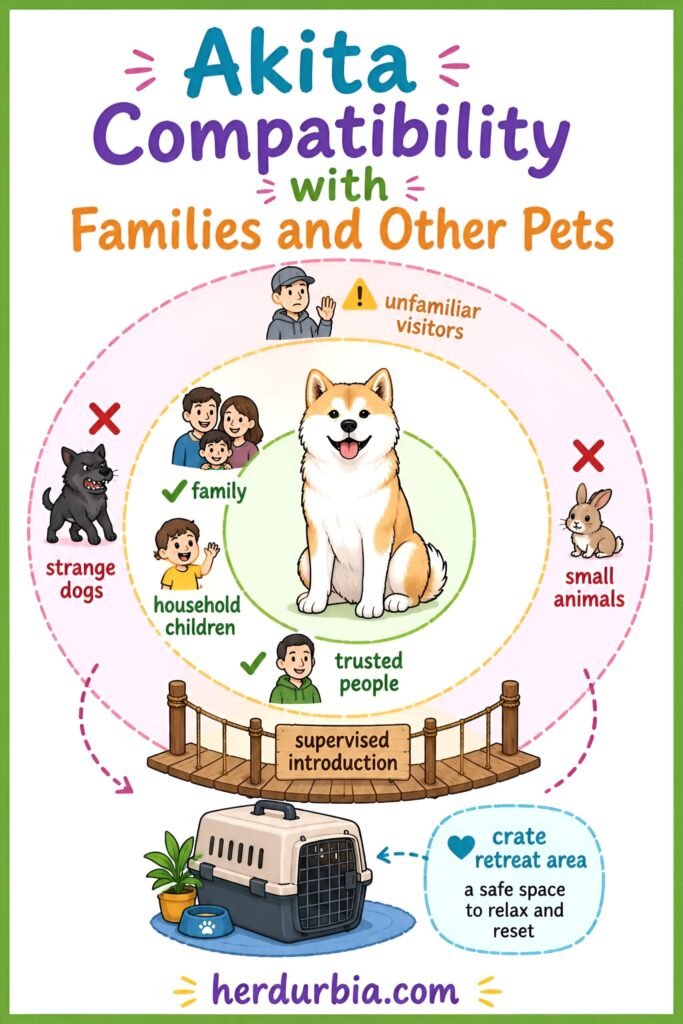
The Akita is one of the most deeply loyal dog breeds in existence, and it extends that loyalty with a selectivity that defines everything about how it interacts with the world. Within its family circle, it is devoted, affectionate in its reserved way, and genuinely protective. Outside that circle, it is a different animal entirely. With strangers, the Akita is aloof, watchful, and sometimes outright suspicious, and that response is not a training failure. It is breed behavior, bred in over centuries, and it will always be present to some degree regardless of how well the dog is socialized.
With children it has been raised alongside, the Akita can be gentle, patient, and protective in the way that large guardian breeds often are with the children of their household. With unfamiliar children, particularly those who are loud, erratic, or physically intrusive, the situation requires careful management. Any interaction between an Akita and children should be supervised.
The Akita’s relationship with other dogs is one of the most important things to understand before bringing one home. This is a breed with a strong tendency toward same-sex aggression, and conflicts between two Akitas of the same sex can be serious. Introductions to unfamiliar dogs should always be done carefully, on neutral ground, and monitored closely. Multi-dog households can work, but they require experience, careful management, and thoughtful pairing.
With small animals, the Akita’s prey drive is significant. Cats, rabbits, and other small pets should be introduced with extreme caution and managed consistently. Co-existence is possible in some cases, particularly when the dog has been raised alongside the smaller animal from puppyhood, but it should never be assumed.
A dog crate is a genuinely useful management tool during puppyhood and the settling-in period, providing the dog with a defined, secure space and the owner with a reliable way to manage the environment while boundaries and habits are being established.
Behavior And Temperament
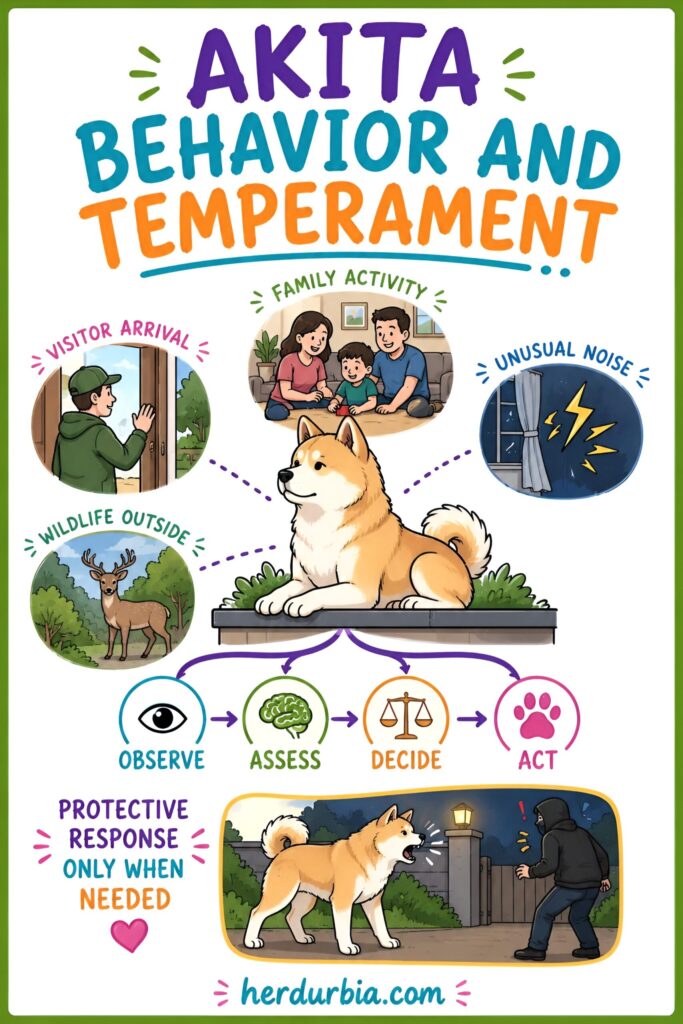
The Akita is dignified, complex, and unlike most other breeds in how it relates to the world around it. It does not seek approval. It does not perform for attention. It does not warm to strangers on cue or tolerate intrusions into its space with good humor. What it does offer is something considerably more substantive: a loyalty so complete and so consistent that Akita owners frequently describe it as unlike anything they have experienced with other breeds.
In Japan, the Akita is considered a symbol of good health, happiness, and long life. Families receive small Akita statues when a child is born, and friends send them when someone falls ill, as a wish for recovery. That cultural reverence is not accidental. It reflects what people who have lived alongside this dog for centuries understand about its character.
The Akita is a thinking dog that makes its own assessments and acts on them. It was bred to hunt bear without waiting for instruction, to guard without being told when a threat was present, and to make decisions in the field that its handler might not even be aware of. That self-directed intelligence is present in every domestic Akita today and is one of the qualities that makes the breed so compelling to live with, and simultaneously so demanding to manage.
The Akita is not a vocal breed by nature. It tends to be quiet and measured in its responses, which makes the moments when it does react all the more significant. It is also a stoic breed that masks pain and discomfort effectively, which means behavioral changes are often the first indication that something is physically wrong. Owners need to pay close attention to shifts in energy, appetite, or movement.
Training And Handling

Training an Akita is one of the more genuinely challenging undertakings in the domestic dog world, and being honest about that is a service to both the breed and the people considering it. The Akita is not difficult to train because it lacks intelligence. It is difficult to train because its intelligence is coupled with a profound independence and a deeply held sense of its own judgment that does not yield easily to human authority.
Positive reinforcement is the only approach that produces reliable results. The Akita responds to respect, consistency, and clear communication. It does not respond to force, intimidation, or repetitive drilling. Reward-based training methods delivered with patience and genuine understanding of the breed’s nature are where progress happens. High-value training treats provide the motivation that this breed’s independent nature requires, particularly in the early stages of building a working relationship.
Early socialization is absolutely critical with this breed and should begin as soon as the puppy has completed the necessary vaccinations. Exposing a young Akita to a wide range of people, dogs, environments, and experiences during the developmental window shapes the adult dog’s ability to navigate the world without defaulting to suspicion or reactivity. An Akita that misses that socialization window becomes significantly harder to manage as it matures, and the consequences of that gap are real and lasting.
This is emphatically not a beginner’s breed. Experienced owners who understand dominant, independent dogs, who can establish themselves as calm and consistent leaders without resorting to confrontation, and who are prepared to invest years rather than weeks in building the relationship this breed requires are the right match. For those owners, the Akita repays every investment many times over.
Health And Lifespan
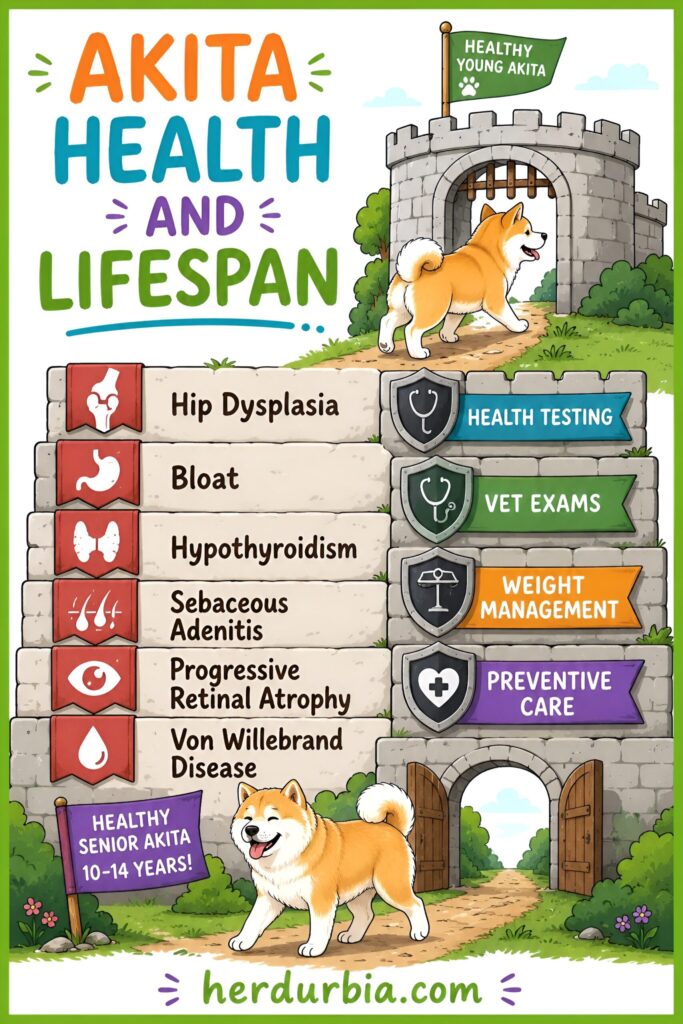
The Akita is a generally robust breed with a lifespan of 10 to 14 years, and its working heritage produced a constitution that holds up well in many respects. That said, there are hereditary and size-related predispositions every owner needs to understand and monitor for actively.
Hip Dysplasia Abnormal development of the hip joint is among the most commonly documented health concerns in large breeds, and the Akita is no exception. It can range from mild to severe and causes pain, restricted movement, and progressive arthritis. Sourcing puppies from breeders who conduct OFA hip screening on their breeding stock is essential. Maintaining a healthy weight throughout the dog’s life and keeping early exercise to low-impact activities are both meaningful preventive measures. Joint supplements are worth discussing with your vet as the dog reaches middle age.
Bloat (Gastric Dilatation-Volvulus) The Akita’s deep chest creates significant susceptibility to this life-threatening emergency, in which the stomach twists and requires immediate surgical intervention. Understanding the warning signs and taking practical steps around feeding are essential for any Akita owner from day one.
Hypothyroidism An underactive thyroid is a recognized concern in the breed. Symptoms include weight gain, lethargy, skin and coat changes, and reduced energy. It is diagnosed through blood testing and managed with daily hormone supplementation, which typically restores normal function.
Sebaceous Adenitis This skin condition, which affects the sebaceous glands and causes hair loss, scaling, and secondary infections, occurs at a higher rate in Akitas than in most other breeds. There is no cure, and lifelong management is required. Regular skin inspection during grooming allows early detection.
Progressive Retinal Atrophy and Eye Conditions Several hereditary eye conditions including progressive retinal atrophy, retinal dysplasia, and cataracts have been identified in the breed. Regular veterinary eye examinations and sourcing from breeders who screen for these conditions are the most effective preventive measures.
Von Willebrand Disease This hereditary bleeding disorder affects the blood’s ability to clot normally. It can be identified through DNA testing, and responsible breeders screen for it before breeding.
Routine preventive care, including regular vet check-ups, up-to-date vaccinations, consistent dental care, and parasite prevention, provides the foundation for keeping an Akita healthy across its full lifespan. Pet insurance is worth serious consideration given the breed’s predisposition to several conditions that can carry significant treatment costs.
Price And Availability

The Akita is a well-established breed with an active community of reputable breeders in the United States, which makes finding a well-bred puppy more straightforward than with rarer breeds, though it still requires research and patience. From a reputable breeder, expect to pay between $1,000 and $2,500 for a pet-quality puppy. Show-quality dogs from champion bloodlines command significantly more, often $2,500 to $4,500 or higher. Japanese Akita Inu imports tend to sit at the upper end of the pricing range given their scarcity outside Japan.
The Akita Club of America is the most reliable starting point for locating breeders who maintain proper health testing protocols and breed to the established standard. Responsible breeders will conduct hip, eye, and thyroid screening at minimum, will be transparent about results, and will ask as many questions of the buyer as the buyer asks of them.
Adoption is a meaningful alternative. Akita-specific rescue organizations operate across the country and frequently have dogs of various ages available. Adoption fees typically range from $150 to $500 and often include prior veterinary care including vaccination and spay or neuter. Because the Akita can be a challenging breed to manage without experience, rescue organizations typically screen applicants carefully, which benefits both the dog and the adopter.
Beyond the purchase price, annual ownership costs are substantial. Food for a large, active dog runs $70 to $150 per month. Routine veterinary care, grooming, pet insurance, and standard supplies add significantly to the total. Annual ongoing costs typically run from $2,000 to $4,000 or more depending on the dog’s health and your location.
Any breeder who cannot provide health testing documentation, refuses to let you meet the parents, or sells through a pet store or unvetted online marketplace without transparency should be avoided.
Conclusion
The Akita is a breed that demands to be understood on its own terms, and it will not pretend otherwise. It is not for everyone, and it will make that abundantly clear to anyone who approaches it without the patience, experience, and genuine respect this dog requires. For the owner who does the work, who earns the trust, and who provides the structure and commitment this breed needs, what comes back is one of the most profound bonds the dog world has to offer. A breed declared a national treasure, mourned across an entire country, and immortalized in stories of loyalty that have lasted a century deserves nothing less than an owner who takes it seriously from day one. Our Best Dog Products page has everything you need to set up properly for a large, powerful breed with standards as high as its own.