
Axolotl morphs are one of the most fascinating aspects of keeping these animals, and they are a big part of why axolotls have exploded in popularity among aquarium hobbyists worldwide. A morph refers to a specific combination of coloration, pigmentation, and patterning that gives each axolotl its distinctive appearance. Some morphs are common and affordable, others are extraordinarily rare and command high prices, and a few exist only as the result of careful selective breeding programs. This guide covers every major axolotl morph in detail — what they look like, what causes them genetically, and what makes each one unique.
What Causes Different Axolotl Morphs?
Before diving into individual morphs, it helps to understand what actually creates them. Axolotl coloration is controlled by three types of pigment cells, called chromatophores: melanophores, which produce dark brown and black pigment; xanthophores, which produce yellow and orange pigment; and iridophores, which produce iridescent, reflective pigment. The presence, absence, or mutation of these cells — determined by genetics — is what creates every morph you will ever see.
According to research published through the Ambystoma Genetic Stock Center at the University of Kentucky, which maintains one of the world’s most important axolotl research colonies, the genetic loci controlling axolotl pigmentation are well-documented and have been studied for decades. Most morphs in captivity today are the result of selective breeding that combines specific recessive and dominant genes to produce predictable color outcomes. Understanding this helps explain why two axolotls of the same morph can still look slightly different — individual expression of those pigment cells varies even within the same genetic category.
Wild Type Axolotl Morph
The wild type is the morph that most closely resembles axolotls as they appear in their natural habitat — the canals and wetlands surrounding Lake Xochimilco in Mexico. Wild type axolotls have a dark brown or olive-green body covered with irregular dark spots and speckles, golden iridescent flecks scattered across the skin, and deep red or maroon gills. Their eyes are dark with a golden iris ring.
This is the morph that nature produced, and it remains one of the most striking precisely because of how well-camouflaged it looks. In the wild, this coloration helps axolotls blend into the muddy, plant-heavy lake beds they inhabit. Wild axolotl populations are now critically endangered, as we cover in our article on whether axolotls are endangered, making the wild type morph in captivity a small but meaningful connection to what these animals look like in their natural state.
Leucistic Axolotl Morph
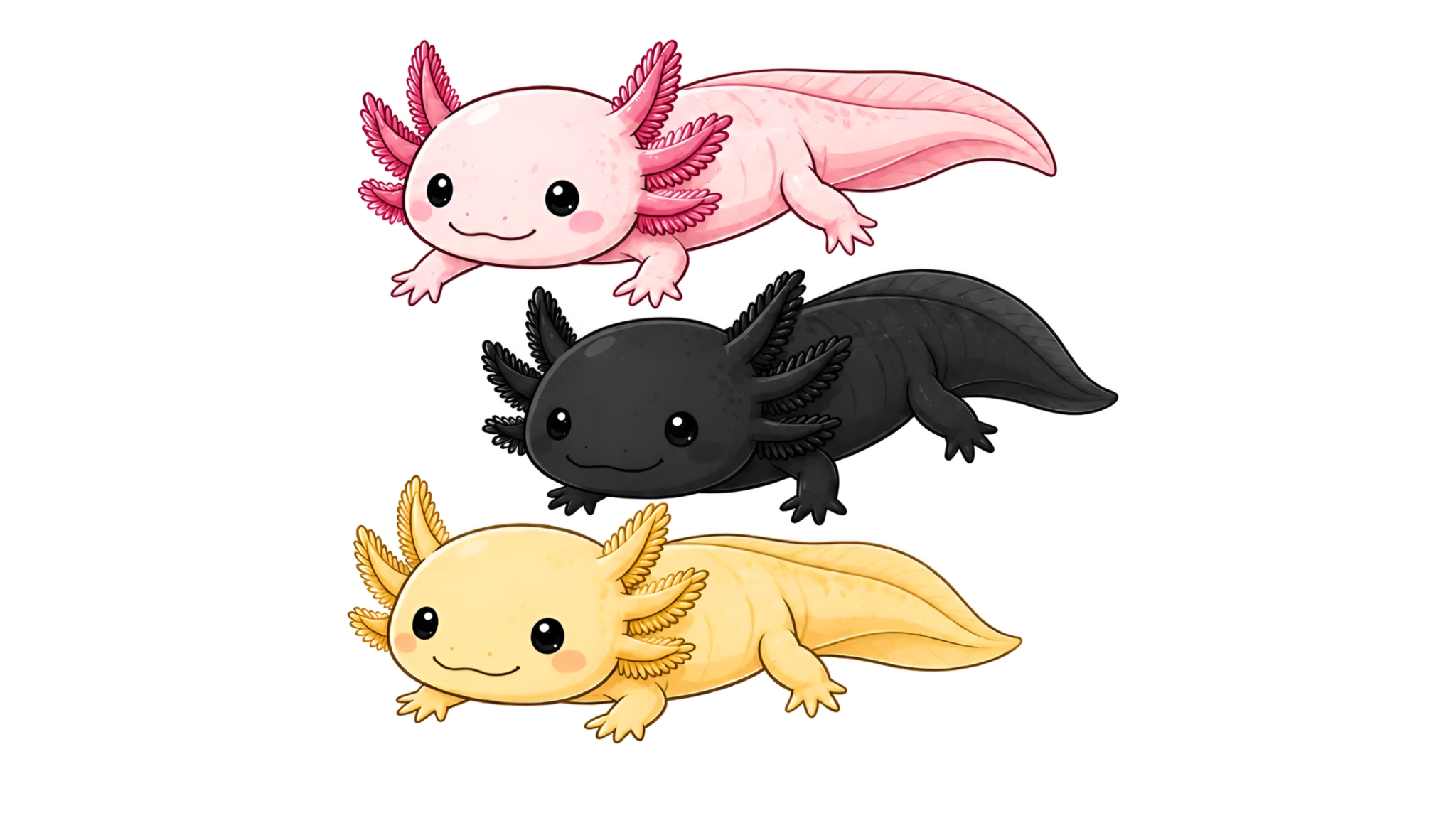
Leucistic axolotls are arguably the most recognizable morph and the one most people picture when they think of an axolotl. They have a pale, translucent white or pale pink body with dark eyes — usually black or very dark brown — and bright pink or red feathery gills. The pink color comes from blood vessels visible through the skin, not from pigment itself.
Leucism is caused by a reduction in melanophore activity, meaning the cells that produce dark pigment are present but not functioning fully. This is an important distinction from albinism, where those cells are entirely absent. Leucistic axolotls still have some pigmentation capacity, which is why their eyes remain dark. They are sometimes called “pink” axolotls informally, though leucistic is the correct term.
This morph is widely available and is often the first axolotl new owners encounter. It is also popular among people choosing axolotl names inspired by their animal’s ghostly, ethereal appearance.
Albino Axolotl Morphs
There are two distinct albino morphs in axolotls, and they are often confused with each other and with leucistic animals.
Golden albino axolotls have a yellow to golden-orange body, pinkish or reddish gills, and pale gold or pink eyes with a visible reddish pupil. Their coloration comes from xanthophores — the yellow pigment cells — remaining active while melanophores are completely absent. The result is a warm, luminous animal that can appear almost translucent under certain lighting. A good axolotl tank light really brings out the depth of a golden albino’s coloration.
White albino axolotls, sometimes called simply “albino,” have a white to very pale pink body with red or pink gills and pink or red eyes. They lack all functional melanophores and have reduced xanthophore activity compared to golden albinos, giving them a cooler, paler appearance. Their red eyes are the clearest indicator of true albinism — the color comes from blood vessels in the eye, visible because there is no pigment to obscure them.
Both albino morphs are sensitive to light due to their lack of eye pigmentation, which is worth factoring into tank placement. Keeping the tank away from direct sunlight and using a soft, adjustable tank light helps keep them comfortable.
Melanoid Axolotl Morph
The melanoid morph sits at the opposite end of the color spectrum from the albinos. Melanoid axolotls have an increased concentration of melanophores and a complete absence of iridophores, which means they appear very dark — often a deep grey, dark olive, or near-black — with no golden sheen or iridescent flecks anywhere on their body. Their gills are typically dark, ranging from maroon to almost black, and their eyes are also very dark.
The melanoid gene is recessive, meaning both parents must carry it for offspring to display the full melanoid morph. The result is one of the most dramatic-looking axolotls available, and dark tank décor tends to make melanoids look particularly striking.
Axanthic Axolotl Morph
Axanthic axolotls lack xanthophores — the yellow and orange pigment cells — resulting in a grey, silver, or blue-grey appearance. They retain their melanophores and iridophores, so they can still display dark spots and a subtle metallic sheen, but the warm yellow tones are completely absent. Axanthic morphs are significantly rarer than the mainstream morphs and are sought after by collectors who appreciate their cool, silvery appearance.
GFP Axolotl Morph
GFP stands for Green Fluorescent Protein, and this is one of the most scientifically interesting axolotl morphs in existence. GFP axolotls were originally developed as part of research programs studying gene expression and cellular biology, where a jellyfish gene producing green fluorescent protein was introduced into axolotl genetics. The result is an axolotl that, under ultraviolet or blue light, glows a vivid green color.
GFP can be combined with almost any other morph, so you can have GFP leucistic, GFP wild type, GFP melanoid, and so on. Under normal white light, a GFP axolotl looks essentially identical to whatever base morph it carries. Only under UV light does the glow become visible. The GFP trait is heritable, meaning GFP axolotls pass it on to their offspring. For keepers interested in axolotl breeding, GFP is one of the most popular traits to work with.
Copper Axolotl Morph
Copper axolotls are a form of albino that originates from axolotl populations bred in the United States and Canada rather than the original Mexican lineages. They have a warm, coppery-brown or reddish-tan coloration with pale pink gills and light pinkish-red eyes. Their coloration comes from reduced but still partially active melanophores combined with strong xanthophore expression.
Coppers are relatively rare compared to golden albinos and white albinos, and they occupy a visually distinct niche — warmer and more earthy-toned than either of the classic albino morphs. They are popular with collectors and are increasingly available through reputable breeders.
Piebald Axolotl Morph
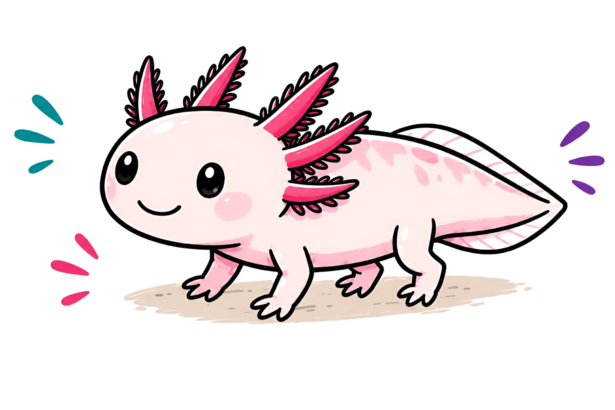
Piebald axolotls are leucistic axolotls with an additional irregular dark pigmentation pattern on their back and sides. Rather than being uniformly pale, they have patches of dark spotting — usually along the dorsal surface — giving them a mottled, two-toned appearance. The pattern is caused by an uneven distribution of melanophores during embryonic development and varies significantly from animal to animal.
No two piebald axolotls look exactly alike, which makes them particularly appealing to collectors. The degree of dark patterning can range from just a few small spots to large, sweeping patches covering much of the back. Piebalds are significantly rarer and more expensive than standard leucistics.
Mosaic Axolotl Morph
Mosaic axolotls are among the rarest and most visually stunning morphs in existence, and they cannot be deliberately bred. A mosaic axolotl results from the fusion of two fertilized eggs very early in development, creating an animal whose body contains two distinct sets of genetic material — one from each original egg. The result is an animal that displays two completely different color morphs simultaneously, often in sharp, patchwork-like divisions across the body.
A mosaic might be half wild type and half leucistic, or half albino and half melanoid, with the two color types distributed in unpredictable patterns across its skin, eyes, and gills. Because mosaics arise from a random developmental event rather than a specific genetic combination, they cannot be replicated through selective breeding. Every mosaic is genuinely one of a kind. According to the Ambystoma Genetic Stock Center, chimeric and mosaic animals represent some of the most scientifically interesting individuals in any captive population due to their mixed cellular genetics.
Chimera Axolotl Morph
Chimera axolotls are similar in concept to mosaics — they contain two distinct genetic populations of cells — but they arise through a slightly different developmental mechanism and often display even more dramatic differences between their two halves. A classic chimera might appear to be two completely different axolotl morphs split cleanly down the middle, with one side displaying wild type coloration and the other side appearing leucistic or albino.
Like mosaics, chimeras cannot be intentionally produced and are extremely rare. They are perhaps the most prized animals in the axolotl hobby, both for their visual impact and for their total unpredictability.
Lavender Axolotl Morph
Lavender axolotls have a pale grey-purple or silvery-lavender body coloration, often with faint dark spotting and grey or silver gills. The coloration is subtle and elegant, caused by a reduced concentration of dark pigment combined with the reflective properties of iridophores creating a cool, bluish undertone. Lavender morphs are moderately rare and have become increasingly popular as the axolotl hobby has grown.
Enigma Axolotl Morph
The enigma morph is one of the newer and rarer morphs to emerge from selective breeding programs. Enigma axolotls have a dark base coloration — similar in some respects to melanoid — with a distinctive olive or slate-grey sheen and unusual, mottled patterning. They are rare enough that detailed genetic documentation is still limited, and they command significant prices when available.
Heavily Melanized and Speckled Leucistic Morphs
Within the leucistic category, there is significant variation. Some leucistic axolotls develop increasing amounts of dark speckling on their bodies as they age — a phenomenon sometimes called “dirty leucistic” or “speckled leucistic.” This is caused by the gradual activation of melanophores that were suppressed in early development. In some animals the speckling remains light; in others it becomes quite pronounced over the animal’s lifespan.
This variability means that a leucistic axolotl purchased as a juvenile may look noticeably different by the time it reaches adulthood, which is worth knowing before you fall in love with a completely clean white animal and expect it to stay that way.
Do Different Morphs Have Different Care Requirements?
In terms of diet, water parameters, and housing, all axolotl morphs have essentially the same care requirements. Every morph needs cold, clean, well-filtered water, a proper diet of pellets, nightcrawlers, or bloodworms, and a tank set up with their comfort in mind. Our full axolotl care guide covers everything you need regardless of which morph you own.
There are a couple of morph-specific considerations worth noting. Albino morphs, including golden albinos and white albinos, are more sensitive to light because they lack the eye pigmentation that protects against bright conditions. Keeping their tank away from direct sunlight and using a gentle tank light is more important for these animals. Similarly, very light morphs like leucistic and albino axolotls can show stress responses or health issues more visibly than darker morphs — pale skin flushes or reddens more noticeably, which can be a helpful early warning sign but can also cause unnecessary alarm in new owners.
Temperature requirements are identical across all morphs — 60–68°F is the safe range for every axolotl, regardless of color. If you are struggling to keep your tank cool enough, a water chiller is the most reliable solution, and our guide on what temperature axolotls need explains why this range matters so much.
Morph Genetics and Breeding
If you are interested in producing specific morphs through selective breeding, understanding the underlying genetics is essential. Many of the most desirable morphs — melanoid, axanthic, copper — are controlled by recessive genes, meaning that producing offspring displaying the morph requires both parents to carry the relevant gene. Two leucistic parents can produce wild type offspring if both carry the wild type gene recessively, which surprises many new breeders.
The Ambystoma Genetic Stock Center and various academic genetics resources document the known loci controlling axolotl coloration and can be invaluable references if you want to go deeper into the science. Our article on axolotl breeding and how axolotls mate can also help you understand the practical side of what a breeding program involves, including the reality that axolotls are cannibalistic toward their own eggs and larvae if not carefully managed.
Before getting into breeding, also check the legal situation in your area — some regions have restrictions on axolotl ownership and breeding. Our articles on why axolotls are illegal in some places and whether it is legal to own an axolotl are good starting points.
Rarest vs. Most Common Axolotl Morphs
To summarize the rarity spectrum: leucistic and golden albino are the most commonly available morphs and are typically the most affordable. Wild type, melanoid, and white albino are moderately available. GFP variants, copper, piebald, lavender, and axanthic are rarer and more expensive. Mosaic and chimera axolotls are in a category of their own — genuinely rare, impossible to breed intentionally, and among the most expensive axolotls in the hobby.
The IUCN Red List reminds us that all of these captive morphs ultimately descend from a species that is critically endangered in the wild, which gives the diversity of captive morphs a bittersweet dimension. The extraordinary variety we enjoy in the hobby exists because axolotls have been bred in captivity for well over a century — far longer than most aquarium species.
Frequently Asked Questions About Axolotl Morphs
Can axolotl morphs change over time? The base morph does not change, but coloration can shift somewhat, particularly in leucistic animals that develop dark speckling as they age. Stress, illness, and water quality can also cause temporary changes in skin tone and gill color across all morphs.
Is one morph healthier than another? No morph is inherently healthier than another. All morphs descended from the same wild population and have comparable immune systems and lifespans when cared for properly. Albino morphs require slightly more attention to lighting, but this is a minor consideration in an otherwise identical care routine.
What is the rarest axolotl morph? Mosaic and chimera axolotls are generally considered the rarest, as they cannot be intentionally produced. Among intentionally bred morphs, enigma and copper are among the most uncommon.
Can I tell a morph’s genetics just by looking at it? Often yes for common morphs, but not always. Carrying hidden recessive genes is invisible to the naked eye. Two animals that look identical can produce very different offspring depending on what recessive genes they carry.
Do morphs affect personality or behavior? No. Axolotl behavior — including their tendency to sleep for much of the day and their opportunistic feeding instincts — is consistent across all morphs. Color has no bearing on temperament.
Final Thoughts on Axolotl Morphs
Axolotl morphs are one of the most compelling reasons people fall in love with this species. From the earthy wild type to the otherworldly mosaic, the variety of colors and patterns available in captivity is genuinely remarkable — especially for a single species. Whichever morph you choose, the care requirements are the same and the reward of keeping these incredible animals is equally great.
No matter which morph shares your home, they all deserve the same high standard of care — and that starts with the right equipment. From tanks and filters to food and water care, explore everything your axolotl needs at the Herdurbia Best Axolotl Products hub, where great axolotl keeping begins.