
Finding the best axolotl pellets is one of the most practical things you can do for your axolotl’s long-term health. While nightcrawlers are widely considered the gold standard for axolotl nutrition, a high-quality sinking pellet is the backbone of most successful feeding routines — it is convenient, consistent in nutrition, introduces no parasite risk, and is accepted readily by most axolotls once they are established on it. The challenge is that not all pellets are appropriate for axolotls. Many products marketed broadly as “aquarium fish food” are high in plant-based fillers, float rather than sink, or dissolve too quickly before the axolotl finds them — all of which cause problems. This guide covers exactly what makes a pellet appropriate for axolotls, what to look for and avoid, how to feed correctly, and our top Amazon picks for every life stage and setup. Pair this with our complete best axolotl food guide and our full axolotl care guide for the full picture on axolotl nutrition.
Why Pellets Matter So Much in an Axolotl Diet
Axolotls are obligate carnivores — they eat only animal-based prey and have no ability to derive nutrition from plant material. In the wild, Ambystoma mexicanum feeds on small crustaceans, worms, insect larvae, and small vertebrates in the remnants of the Xochimilco lake system in Mexico City. The wild population is critically endangered, which gives captive axolotl nutrition genuine conservation significance — keeping captive animals healthy and potentially breeding-ready matters beyond the individual animal.
In a captive setting, a quality pellet serves as the most practical way to deliver consistent, balanced nutrition on a predictable schedule. Unlike live food, pellets carry no risk of introducing parasites or bacterial pathogens into your tank. Unlike fresh worms, pellets require no preparation, refrigeration, or portion cutting. And unlike freeze-dried bloodworms — which should only be used as a treat — a well-formulated carnivore pellet provides a protein profile appropriate for axolotl metabolic needs across a full feeding schedule.
The key requirement is that the pellet must be genuinely designed for carnivorous aquatic animals. This means animal protein as the primary ingredient — not corn meal, wheat flour, or soy protein. It means a sinking formulation that reaches the tank floor where axolotls feed. It means a size appropriate for the individual axolotl — since axolotls swallow food whole, a pellet that is too large can cause choking or regurgitation. And it means a formula that holds its shape in water long enough for the axolotl to locate and consume it, without dissolving immediately into a cloudy mess that spikes ammonia.

What Makes the Best Axolotl Pellets?
Sinking formulation — non-negotiable. Axolotls are exclusive bottom-dwellers that feed at floor level. They will almost never surface-feed. A floating pellet will be ignored entirely and will simply degrade in your tank, fouling the water and creating ammonia problems. Always verify that any pellet you purchase is a sinking, bottom-feeding formulation.
Animal protein as the first ingredient. Check the ingredient list carefully. The first ingredient should be fish meal, whole fish, shrimp meal, or another animal protein source. If the first ingredient is a plant-based product — corn meal, wheat flour, soy protein, or rice — the pellet is not appropriate as a primary food for a carnivore like an axolotl.
High crude protein content (40%+). Axolotls need a high-protein diet to support their metabolism, tissue maintenance, and immune function. The guaranteed analysis on quality carnivore pellets typically shows crude protein of 40–55%. Pellets below this range are nutritionally insufficient for a long-term axolotl diet.
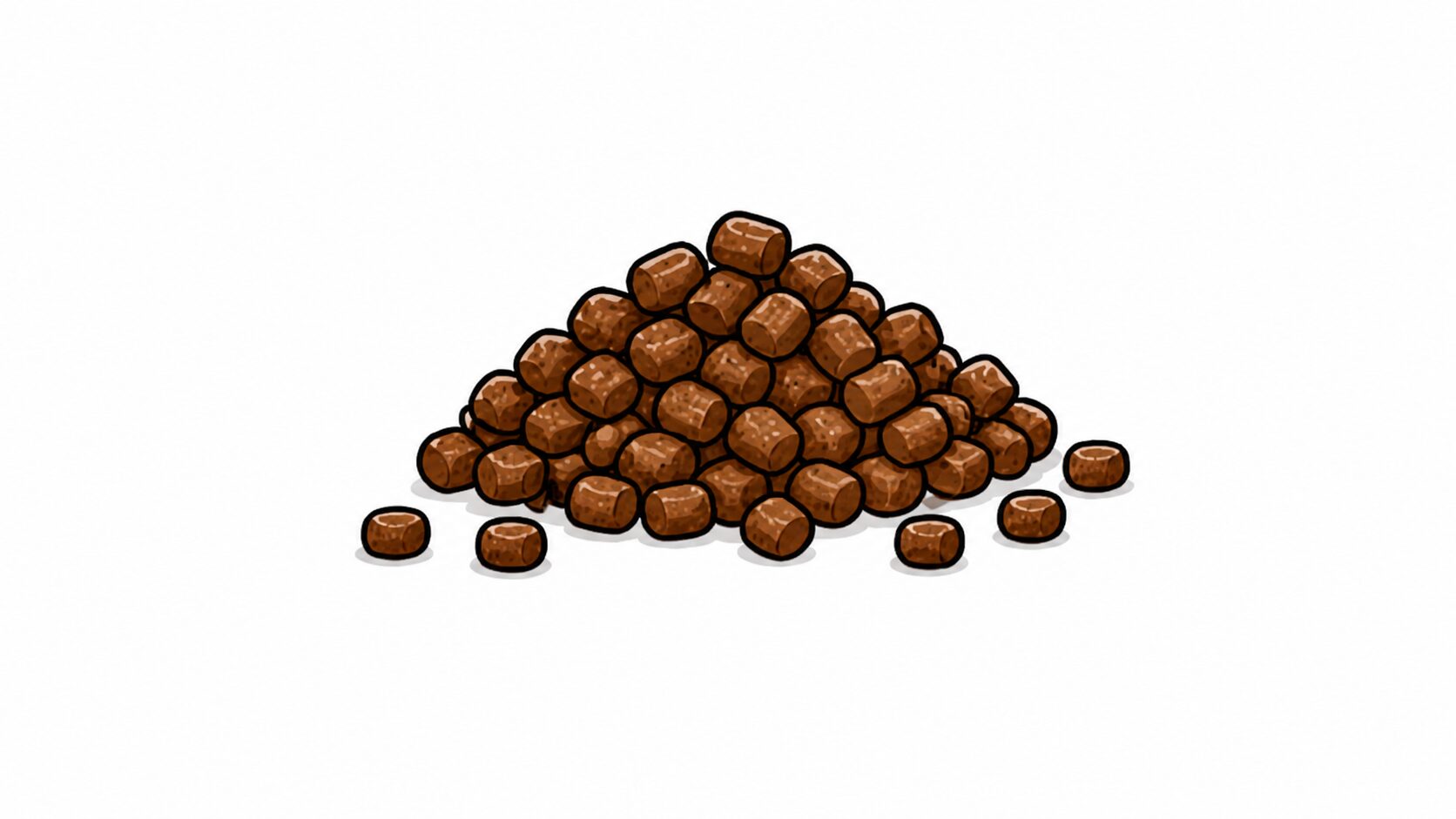
Appropriate pellet size for the axolotl’s life stage. Axolotls swallow food whole — they cannot bite or chew. A pellet that is significantly wider than the axolotl’s head is a choking risk and should not be offered. Small juveniles (under 3 inches) need very small pellet sizes or pre-softened, crumbled pieces. Sub-adults (3–6 inches) can manage a medium sinking pellet. Full-grown adults (6+ inches) handle the standard Hikari Sinking Carnivore pellet size without issue.
Stable in water before dissolving. A good axolotl pellet holds its shape for at least 10–15 minutes in water before breaking down. This is essential because axolotls locate food primarily by smell rather than sight, and a pellet that dissolves immediately creates a cloud of particulate matter rather than a retrievable food item. Always test a new pellet by dropping one in a cup of water and watching how long it maintains its shape.
No excessive dyes or artificial additives. Artificial colourings — particularly Red 3 (erythrosine) found in some Hikari products — are worth avoiding if possible. While the evidence on harm at aquarium food doses is mixed, a pellet with natural colouring and minimal artificial additives is preferable for a sensitive species like an axolotl.

What to Avoid in Axolotl Pellets
Floating pellets. Any pellet that floats should be immediately ruled out. Axolotls do not surface feed and a floating pellet will simply go uneaten while dissolving and creating water quality problems.
Pellets with plant protein as the primary ingredient. Corn, wheat, and soy are common filler ingredients in lower-quality fish food that reduce protein quality and digestibility for strict carnivores.
Very fast-dissolving pellets. Some budget pellets dissolve within minutes of hitting the water. These turn into a paste that axolotls cannot locate and eat, and that fouls water chemistry rapidly.
Pellets sized for large cichlids or koi. These are far too large for axolotls to swallow safely and can cause impaction or regurgitation.
Vitamin-only supplement pellets. Some products are sold as vitamin supplements to add to existing diets. These are not complete foods and should not replace a proper carnivore pellet.

Our Top Axolotl Pellet Picks
Best Overall: Hikari Sinking Carnivore Pellets (2.61oz)
The Hikari Sinking Carnivore Pellets (2.61oz) are the most consistently recommended axolotl pellet in the hobby, and they have been the community default for many years for good reason. They are a purpose-built sinking carnivore formulation that reaches the tank floor immediately, holds its shape well in water, and provides a high animal protein content from fish and other aquatic protein sources appropriate for an obligate carnivore like an axolotl. According to Hikari’s own product documentation, the Sinking Carnivore series is specifically developed to replicate the nutritional profile of natural carnivore prey, providing the protein, fat, and amino acid balance that strictly meat-eating species require.
These pellets are accepted readily by most axolotls, sink immediately upon contact with water, and are sized appropriately for adult and large sub-adult axolotls. The 2.61oz pack provides a good supply for routine feeding at the recommended adult rate (1–2 pellets every 2–3 days). The 2-pack option on Amazon is worth considering for the better per-ounce cost over the single pack. This is the pellet we recommend as the default for most adult axolotl keepers — the same recommendation we gave in our best axolotl food guide — and the one most likely to be accepted by your axolotl without a transition period.
Best for Juveniles and Small Axolotls: Hikari Minivore Delite Pellets (1.41oz)
The Hikari Minivore Delite Pellets (1.41oz) are explicitly formulated for smaller carnivorous species and the product page specifically lists axolotls as a target species with a dedicated feeding frequency recommendation (once every 2–3 days, reducing to once per week in winter when metabolism slows). The smaller pellet size makes them ideal for juvenile axolotls and sub-adults below 5 inches who would struggle with the larger standard Sinking Carnivore pellet. These also work well for adults who have been raised on smaller pellets and have difficulty transitioning to larger formats. The formulation uses the same premium Hikari standards as the Sinking Carnivore line, with colour-enhancing ingredients that are particularly valuable for displaying the vibrant colouration of various axolotl morphs.
Best Specialist Axolotl Pellet: A Lot’l Axolotls Carnivore Sinking Pellets (50g Sample)
The A Lot’l Axolotls Carnivore Sinking Fish Food (50g) is produced by a brand created specifically around axolotl keeping. It is a meat-based, high-protein sinking carnivore pellet explicitly described by the manufacturer as the best earthworm alternative for axolotls. The 50g sample format is ideal for keepers who want to test whether their axolotl accepts this specific pellet before committing to a larger quantity. These pellets have been formulated with axolotl biology specifically in mind rather than adapted from a fish food. For keepers who want a purpose-built axolotl pellet from a specialist brand, this is the option to try alongside or in comparison to the Hikari standard.
Best Large Format for Long-Term Feeding: Hikari Sinking Carnivore Pellets (2.2lb)
For keepers with multiple axolotls, those running breeding setups, or simply anyone who wants to avoid frequent reordering, the Hikari Sinking Carnivore Pellets (2.2lb) offer the same trusted formulation in a substantial bulk quantity at a significantly better cost-per-ounce ratio. A single adult axolotl on a pellet staple diet uses pellets slowly enough that a 2.2lb bag can last many months. Store in a sealed container away from heat and light to preserve freshness. This is the most economical choice for established keepers committed to the Hikari Sinking Carnivore as their primary pellet.
How to Feed Axolotl Pellets Correctly
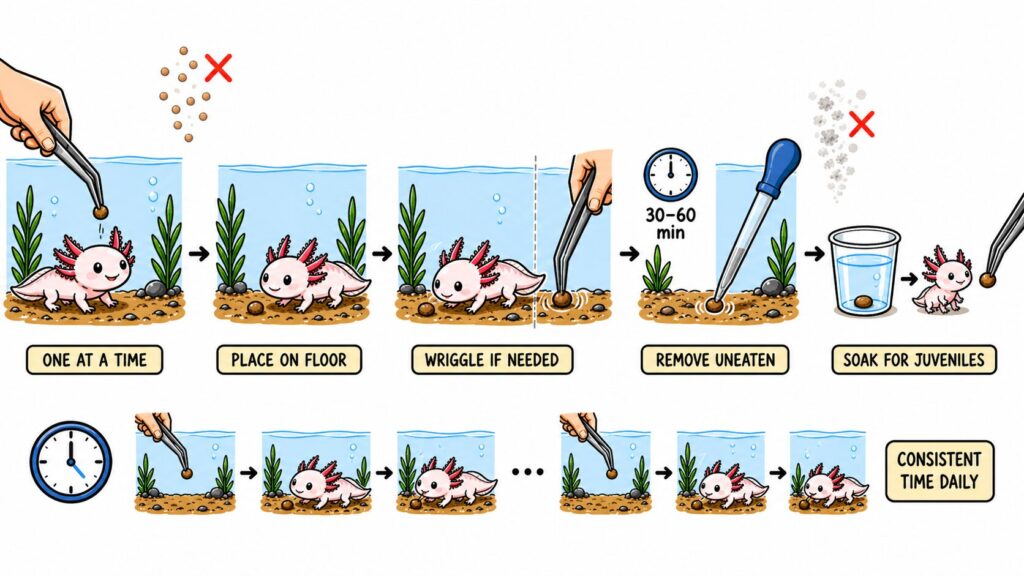
One pellet at a time, using feeding tongs. Always offer pellets one at a time using feeding tongs rather than dropping multiple pellets at once. This allows you to monitor exactly how much your axolotl eats and prevents uneaten pellets from being missed, dissolving, and fouling the water. Lower the pellet gently to tank floor level in front of your axolotl — do not drop it from above the water surface, as the impact and movement can startle the axolotl and cause it to retreat.
Remove uneaten pellets within 30–60 minutes. If a pellet is not eaten within an hour of being offered, remove it promptly using a turkey baster. Dissolving pellets produce significant ammonia — the same kind of water quality problem that your filter and cycling bacteria work to keep in check. Never leave uneaten food in the tank overnight. Track uneaten food as a health indicator — an axolotl that consistently ignores offered pellets may be experiencing water quality stress, temperature problems, or early illness.
Pre-soak for juveniles. For very small juveniles (under 2 inches), soak the pellet in a small amount of tank water for 30–60 seconds before offering. This softens the pellet, reduces the risk of it expanding in the stomach, and makes it easier for tiny axolotls to manage. As your axolotl grows beyond 3–4 inches, pre-soaking is no longer necessary.
Wriggle if ignored. If your axolotl is near a pellet but not striking at it, gently wriggle the pellet with feeding tongs to create movement that mimics live prey and triggers the feeding response. Most axolotls will strike at a moving pellet readily once the wriggling begins.
Feed at a consistent time. Axolotls learn feeding schedules and become more alert and active at their established feeding time. A consistent schedule makes feeding sessions more efficient and makes it easier to notice when appetite changes — which is one of the earliest indicators of health problems. Combine your feeding routine with a quick check of tank temperature using your thermometer and a visual inspection of your axolotl’s gills, skin, and general behaviour.
Transitioning an Axolotl to Pellets

Many axolotls acquired from breeders or pet stores have been raised primarily on live or frozen bloodworms and may initially refuse pellets. Transitioning to a pellet-based diet is important for long-term nutritional balance and convenience, but it requires patience.
The most effective method is to offer a pellet first at each feeding session. If the axolotl ignores it after 15–20 minutes of gentle wriggling, remove the pellet and offer a small bloodworm instead. Repeat this approach at every feeding. Most axolotls transition within 2–3 weeks as they learn to associate the pellet’s scent with food. According to research on feeding behaviour in aquatic salamanders published in Aquaculture, conditioned feeding responses develop reliably in captive Ambystoma mexicanum when presentation is consistent and paired with accepted food items during the transition period. Some particularly stubborn individuals may take longer — up to 4–6 weeks. Avoid fasting your axolotl for extended periods in an attempt to force pellet acceptance, as this stresses the animal unnecessarily.
If your axolotl consistently rejects the Hikari Sinking Carnivore pellet even after weeks of patient transition attempts, try the A Lot’l Axolotls specialist pellet or the Minivore Delite — different formulations have different scent profiles that some axolotls respond to differently.
Pellet Feeding Frequency by Life Stage
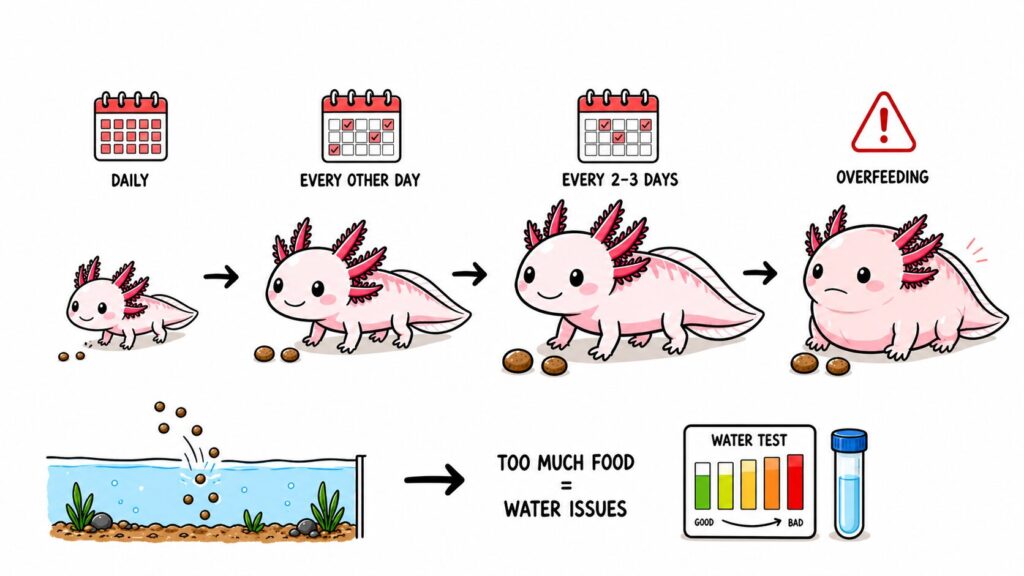
Juveniles (under 4 inches): Feed 1–2 small pellets daily, or every other day for slower-growing individuals. Growing axolotls have high protein requirements and should never go more than a day or two without food during active growth phases.
Sub-adults (4–6 inches): Feed 1–2 appropriately sized pellets every other day. Appetite is still strong but the urgency of the growth-phase feeding requirement has passed.
Adults (6+ inches): Feed 1–2 pellets every 2–3 days. Adult axolotls have a low metabolic rate and require significantly less food than juveniles. Overfeeding adults leads to obesity — visible as fatty deposits around the head and arms — and associated organ stress. A lean adult axolotl is a healthy one.
Always monitor your water parameters with your water test kit regularly. If ammonia or nitrate is climbing faster than your water change schedule can keep up with, reduce feeding quantity or frequency before increasing water change volume — it is often easier to reduce the input than to increase the output.
Frequently Asked Questions
Can axolotls eat pellets as their only food? Yes, a high-quality carnivore pellet like Hikari Sinking Carnivore can be used as the sole staple food for adult axolotls with good results. Most experienced keepers recommend supplementing with nightcrawlers 2–3 times per week for optimal nutrition, but pellets alone are nutritionally adequate for long-term health.
Why won’t my axolotl eat pellets? The most common reasons are: the pellet floats (choose a sinking pellet), the pellet is too large (try the Minivore Delite or crumble pieces), the axolotl has not yet learned to associate the pellet with food (continue transition), or water quality or temperature is affecting appetite (test water parameters and temperature immediately).
How do I know if I am overfeeding pellets? Signs of overfeeding include uneaten pellets consistently left after feeding sessions, increasing nitrate between water changes, and visible fat deposits on the axolotl’s body. Reduce portion size or frequency and remove uneaten food more promptly.
Do pellets affect water quality? Any food that is not eaten and left to dissolve will spike ammonia. Good feeding practice — feeding one pellet at a time, monitoring consumption, and removing anything uneaten within 30–60 minutes — keeps pellet impact on water quality minimal. Keep up with regular water changes as covered in our guides on how to clean an axolotl tank and how often to clean an axolotl tank.
Are there any pellets specifically made for axolotls? Yes — the A Lot’l Axolotls Carnivore Sinking Pellets are purpose-formulated for axolotls specifically. Hikari’s Minivore Delite also explicitly names axolotls on its product page with dedicated feeding instructions. Most experienced keepers, however, use Hikari Sinking Carnivore as their primary recommendation regardless.
One Pellet, One Healthy Axolotl
A great pellet dropped in front of a healthy, well-maintained axolotl is one of those simple joys of the hobby — the quick strike, the satisfying disappearance, the algolotl retreating contentedly to its hide. Getting the pellet choice right, feeding the right amount at the right frequency, and maintaining the tank environment that allows your axolotl to thrive around it — that is what responsible axolotl keeping looks like in practice. For the complete, keeper-tested guide to every product in your axolotl’s care routine — from the tank and filtration to health supplies and enrichment — Best Axolotl Products is your go-to resource for the best gear in every category.