
Origin And Natural Habitat
The Gran Chaco — one of South America’s largest ecosystems and one of its least celebrated — stretches across Bolivia, Paraguay, Argentina, and into western Brazil, and it is from this vast lowland territory that Acanthoscurria chacoana takes both its species name and much of its ecological identity. The Chaco is a mosaic of dry forests, open savanna, thorny scrubland, and seasonally flooded grasslands, characterised by intense heat in summer, cool winters, and rainfall concentrated enough to make permanent water bodies rare in many areas. It is a harder, more variable environment than the Amazonian rainforest, and the spiders that evolved there reflect that hardiness in their physiology and temperament.
The species’ range extends well beyond the Chaco proper, connecting through the Pantanal wetlands of western Brazil and the Cerrado savanna into populations documented from Mato Grosso and Mato Grosso do Sul, reflecting what researchers have described as a characteristic distribution pattern of Chaco fauna that bridges through the Cerrado toward northeastern Brazil. Published research confirming the synonymy of A. chacoana with A. altmanni documented specimens from Argentina, Bolivia, Paraguay, and Brazilian states including Mato Grosso and Mato Grosso do Sul, establishing the full extent of the range. In the wild, this species occupies fallen logs as retreats and constructs burrows in workable soil, active primarily at night and emerging most frequently around the burrow entrance during warmer months.
Scientific Classification
First described by Juan Brèthes in 1909 from specimens originating in Argentina, Bolivia, and Paraguay, Acanthoscurria chacoana circulated in taxonomy for decades before research confirmed the synonymy of a later-described species, A. altmanni Schmidt 2003, under the earlier name. The genus Acanthoscurria is one of the larger and more widespread South American tarantula genera, closely related to and sharing the subfamily Theraphosinae with the Brazilian White Knee and several other large, fast-growing terrestrial species. Full classification: Kingdom Animalia, Phylum Arthropoda, Class Arachnida, Order Araneae, Infraorder Mygalomorphae, Family Theraphosidae, Subfamily Theraphosinae, Genus Acanthoscurria, Species A. chacoana Brèthes, 1909.
Species Overview
Also sold in the hobby as the Bolivian Pink and Bolivian Salmon Pink — names that reference the warm colouration of its abundant abdominal setae — A. chacoana sits in an interesting position as a large, fast-growing, visually appealing South American terrestrial that is less commonly encountered than its close relative A. geniculata but offers comparable rewards in terms of feeding response, growth rate, and display quality. It is a beginner to intermediate species depending on which characteristics you weight — the care requirements are straightforward and it is comparatively docile, but the urticating hair propensity and adult size require some experience to manage comfortably. Captive breeding has been reported as occasionally challenging, with females reportedly needing to reach larger sizes before becoming receptive to males.
Appearance And Size
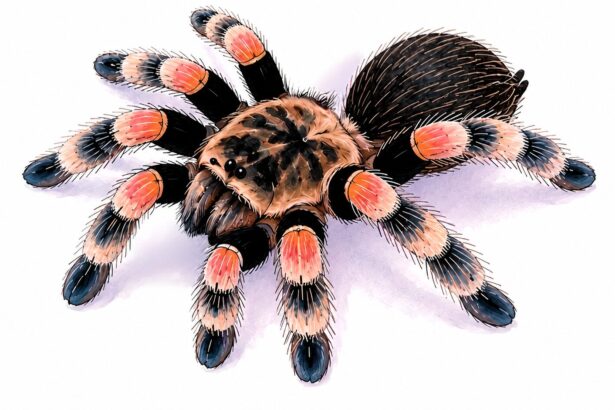
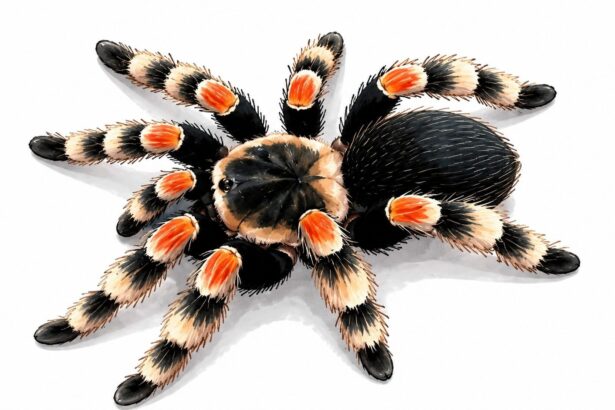
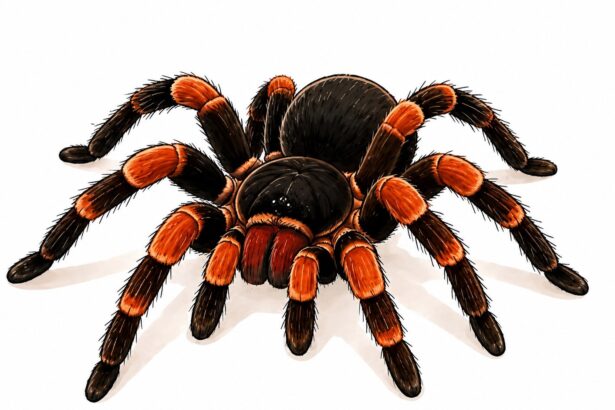
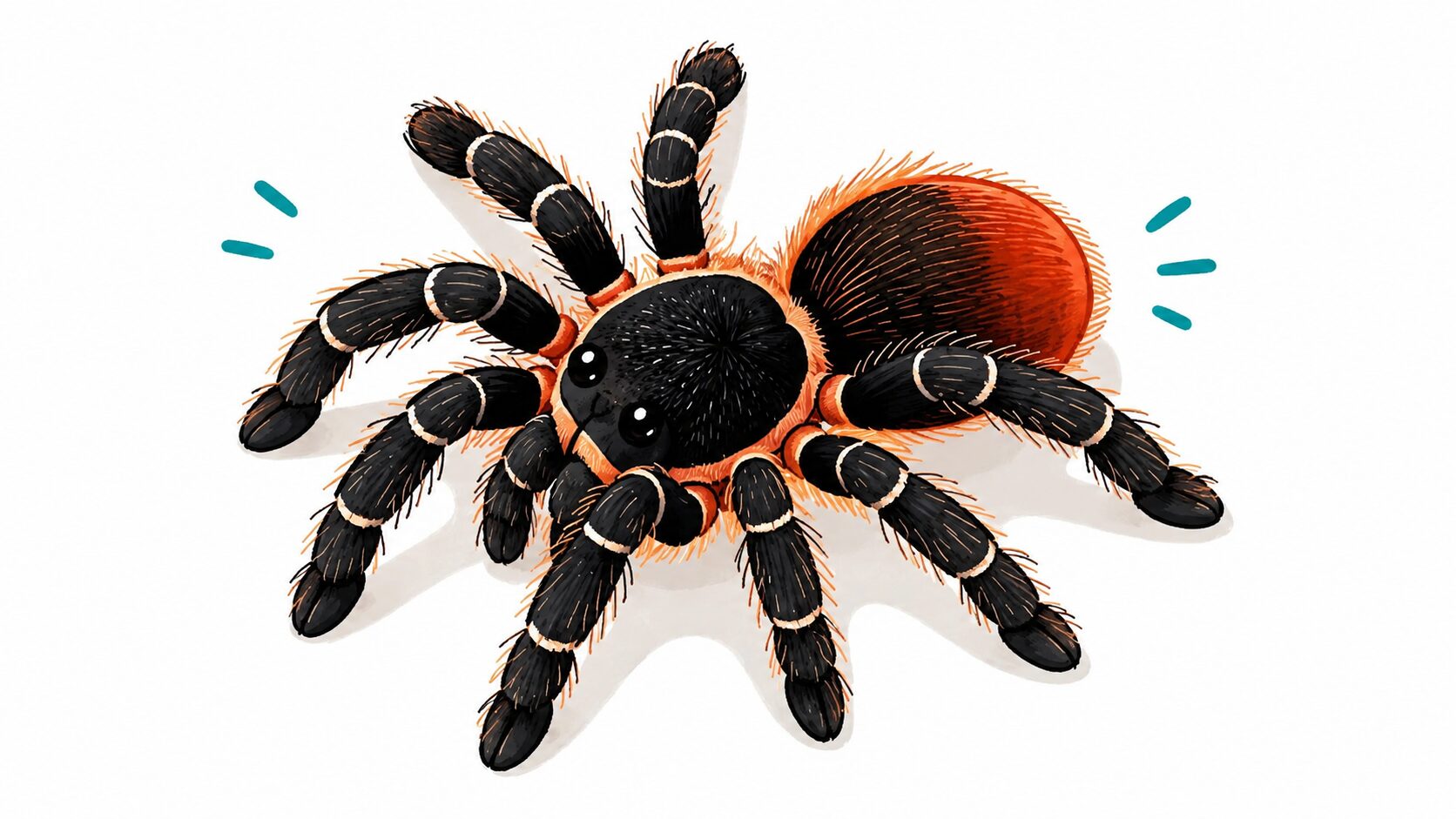
The common name “Red Rump” describes the most immediately visible feature: the abdomen is dark charcoal-grey to black but densely covered in long, reddish to pinkish-orange setae that give the posterior half of the spider a distinctly warm, salmon-pink tone in good light. This abdominal colouration is vivid enough that the spider looks as if it is wearing a different outfit from the waist down, and it creates a striking contrast with the darker carapace and leg colouration. The legs carry faint tan banding at the segments that becomes more visible as the spider grows and the setae develop their full density. The overall appearance has been compared to a bushier, more colourful version of related Acanthoscurria species — heavy-built, substantially setose, and visually substantial even at modest sizes.
Adult females reach a diagonal legspan of 6.5 to 7.5 inches, with some individuals approaching 7.5 to 8 inches reported under optimal captive conditions. Males mature smaller and considerably sooner than females. Growth rate in well-fed, well-maintained individuals is fast for a large terrestrial species, making it a rewarding animal to raise from a sling for keepers who enjoy watching rapid development.
Housing
Floor space drives the enclosure design for this large terrestrial species. A footprint of at least 30 by 30 centimetres is appropriate for adults, with larger being better given the animal’s eventual size and its tendency to be visible and active rather than permanently reclusive. Height above the substrate should be kept modest — no more than twice the spider’s legspan — to reduce fall risk for a heavy-bodied adult. The enclosure lid must close and latch properly; A. chacoana is noted by keepers as a strong spider that will push at a lid that merely rests rather than locks. Front-opening access is preferred over top-opening both for safety and for minimising disruption of any webbing at the lid level. Our best tarantula enclosure guide covers terrestrial formats with the floor space, substrate depth, and security appropriate for a large active species.
Enclosure’s Decorations
Cork bark at substrate level positioned at one end of the enclosure provides a retreat option and, combined with deep substrate, an anchor point for the burrow the spider may choose to excavate beneath and around it. A shallow water dish at the opposite end gives clear access to hydration without flooding the retreat area. Unlike some fossorial species that disappear underground almost permanently, A. chacoana is reported by experienced keepers to spend considerably more time out in the open once it reaches 3 inches or more in legspan, making it a genuinely active display animal that benefits from enough open floor space to be seen. Fake plants and additional cork bark provide aesthetic interest and additional surface structure. Our best tarantula hide and best tarantula fake plants guides cover appropriate pieces for large terrestrial setups.
Substrate
Four to six inches of substrate minimum for adults, using a moisture-retaining blend that holds structure for opportunistic burrowing. Coconut coir and peat moss in equal proportions, optionally with a small addition of topsoil for firmness, is the standard reliable choice. The substrate should be maintained with a moisture gradient — lightly damp in the lower portion where burrow activity occurs, drier toward the surface — reflecting the Chaco’s seasonal variation between wet and dry periods. The spider is not an obligate deep burrower and many individuals choose surface retreats under cork bark rather than excavating, but the substrate depth option should always be available. Our best tarantula substrate guide covers moisture-retaining blends appropriate for large South American terrestrial species.
Water And Humidity
A shallow water dish at substrate level should be present at all times and refreshed every two to three days. Target ambient humidity of 65 to 75 percent, maintained through the substrate moisture gradient and the evaporation from the water dish. Light periodic misting of the enclosure walls or overflow of the water dish into the substrate corner adds moisture when conditions drop in heated winter environments. A hygrometer inside the enclosure confirms actual conditions rather than relying on guesswork, particularly useful for a species from an environment with reasonably distinct wet and dry seasons where some humidity variation is normal and tolerated. Our best tarantula misting bottle guide covers fine-mist options for periodic enclosure maintenance.
Heating And Temperature
The eastern lowlands of Bolivia and the Gran Chaco experience warm to hot temperatures during the summer months and cooler, sometimes genuinely cold winters — mean annual temperatures in the eastern Bolivian lowlands average around 26°C, with seasonal and day-to-night variation. A captive range of 72 to 82°F covers this species comfortably year-round. Most keepers in temperate climates maintain A. chacoana at normal household temperatures without supplemental heat for most of the year, adding a side-mounted heat mat controlled by a thermostat only when ambient temperatures drop consistently below 68°F. A thermometer at substrate level rather than room level provides accurate data on actual conditions inside the enclosure.
Diet And Nutrition
Voracious is not an overstatement. A. chacoana is described across keeper accounts as an extremely food-motivated species that accepts prey enthusiastically and refuses only when approaching a moult. Crickets, dubia roaches, and other appropriately sized invertebrates are taken readily by adults every seven to fourteen days, adjusted for abdomen condition. Juveniles can be fed every five to seven days. Prey sized to the spider’s abdomen or slightly smaller is the appropriate guide, and the long 1.5 centimetre fangs of a full adult female are a meaningful reminder to use feeding tongs rather than bare hands when offering prey to a species with this level of feeding aggression. Remove uneaten prey within 24 hours regardless of life stage. Our best tarantula food guide covers feeder insect options and gut loading relevant to a large, fast-growing South American terrestrial.
Compatibility
Solitary only. For breeding, females should be substantially grown and well-fed before introduction — experienced keepers note that females need to reach larger sizes to become receptive, and premature introduction typically results in aggression toward the male without successful mating. Supervision throughout the introduction and prompt separation of the male after mating is confirmed are non-negotiable practices for this species, which is documented to attack males readily.
Behavior And Temperament
Docile by the standards of large tarantulas is the general consensus on A. chacoana, with the significant caveat that urticating hair deployment happens quickly and with considerable enthusiasm at even mild disturbance. The hair-kicking propensity is notably liberal — keepers describe the spider as quicker to flick hairs than many other New World species — and the setae from a large adult female can produce meaningful irritation. Beyond the hair-kicking, the species is not aggressive in the bite-seeking sense and handles routine enclosure maintenance without threat displays or charging behaviour in most individuals. The progressive shift in visibility as the spider grows is a rewarding aspect of keeping this species — juveniles can be somewhat reclusive, while adults, as noted consistently by keepers, tend to spend significant time in the open, making them among the better large display tarantulas in the hobby.
Handling
Possible with care and appropriate experience, but not recommended as a routine practice given the adult size and the liberal urticating hair deployment at disturbance. A large A. chacoana is not a small amount of spider to manage on a hand, and the speed with which it kicks hairs means eye protection is genuinely useful during any enclosure maintenance. Venom is considered medically insignificant to healthy humans. Keepers who do handle this species do so at floor level and with slow, deliberate movements that avoid triggering the defensive response.
Health And Lifespan
Females live up to 20 years in captivity under good conditions. Males survive 3 to 4 years after maturity. The species is considered hardy and tolerant of normal captive variation. The primary health concerns are the same as for other large humid-environment terrestrial species: mould from excessive substrate moisture combined with poor ventilation, and dehydration from chronically dry conditions. Both are managed by maintaining the moisture gradient described above and providing a consistent water dish. Our tarantula dehydration article covers identification and recovery for dehydration concerns.
Price
More accessible than many similar-sized South American species and more commonly available than its rarity in popular discussion might suggest. Slings typically sell for $20 to $50 USD from captive breeders when available. Juveniles range from $40 to $80. Confirmed adult females are less commonly available and command $80 to $150 or more depending on size and source. Captive breeding can be challenging as noted above, which somewhat limits consistent availability compared to species like A. geniculata, but dedicated breeders produce stock periodically. Source captive-bred specimens only. Everything you need to set this species up correctly from day one is on our best tarantula products page.