
Can axolotls go on land? The short answer is no — not safely, not comfortably, and not for any meaningful length of time. Axolotls are permanently aquatic animals that have never evolved the physiological tools needed for terrestrial life, and time spent out of water is not a neutral experience for them — it is genuinely harmful. Understanding exactly why axolotls cannot go on land, what happens to them when they do, and how to prevent accidental land exposure is essential knowledge for any owner. This article covers all of it in full.
Why Axolotls Cannot Go on Land
Axolotls are what biologists call obligate aquatic animals — meaning they are physiologically required to live in water and have no meaningful capacity for life on land. This is not simply a preference or a habit; it is built into every system in their body.
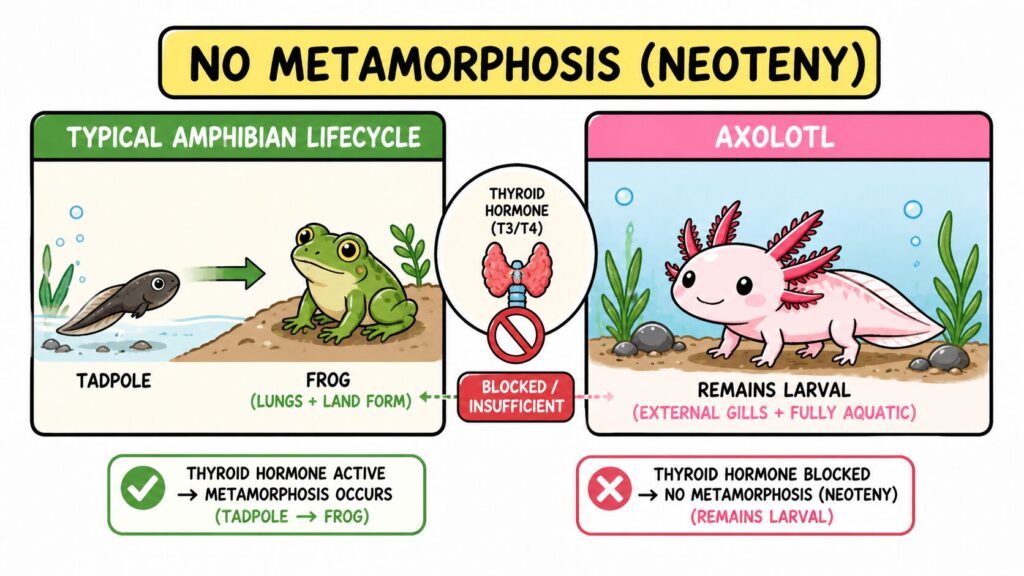
Most amphibians go through a process called metamorphosis, during which they transform from an aquatic larval form — living in water and breathing through gills — into a terrestrial or semi-terrestrial adult form with lungs capable of breathing air on land. Axolotls are famous in the scientific world precisely because they do not do this. Through a process called neoteny, axolotls retain their larval characteristics permanently — including their external gills, their fully aquatic body structure, and their dependence on water for survival. According to research published through the Ambystoma Genetic Stock Center at the University of Kentucky, the neotenic condition in axolotls is caused by reduced thyroid hormone signaling that prevents the hormonal cascade that would normally trigger metamorphosis.
This means that unlike a frog or a salamander that has completed metamorphosis, an axolotl has never developed the suite of physiological adaptations needed for land life — strong, weight-bearing limbs designed for terrestrial locomotion, a respiratory system optimized for air breathing, skin that resists desiccation, and eyes adapted for vision in air rather than water. An axolotl out of water is not a land animal temporarily displaced — it is an aquatic animal in a genuinely dangerous environment.
What Happens When an Axolotl Is Out of Water?
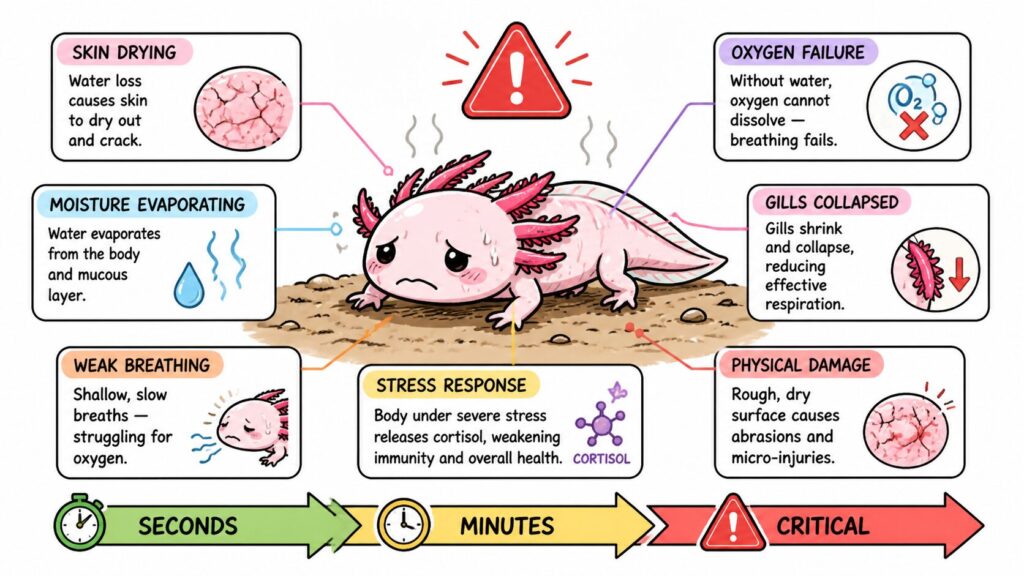
When an axolotl is removed from water or accidentally escapes its tank, several harmful processes begin immediately and simultaneously.
Desiccation — drying out — begins within minutes. Axolotl skin is highly permeable and moist, an essential characteristic for cutaneous respiration (absorbing some oxygen through the skin). On land, this moisture evaporates rapidly, and the skin begins to dry. A drying axolotl is losing not just surface moisture but the biological integrity of its skin, which serves as both a respiratory and protective organ. According to the American Museum of Natural History’s resources on amphibian biology, amphibian skin desiccation is one of the primary mechanisms of mortality in terrestrial exposure events for aquatic species.
Respiratory failure begins to develop alongside desiccation. Axolotls breathe primarily through their external gills and secondarily through cutaneous respiration — neither of which functions in air. While axolotls do have rudimentary lungs and will occasionally gulp air at the water surface, these lungs are underdeveloped compared to a fully metamorphosed salamander and cannot sustain the animal on their own. On land, an axolotl is progressively suffocating.
Stress hormones surge as the animal experiences a threat response. Even brief periods out of water trigger a significant physiological stress reaction, releasing cortisol and adrenaline that suppress immune function, disrupt normal metabolism, and place strain on organ systems. Research on amphibian stress responses published through the National Institutes of Health documents the measurable physiological impact of even short-duration terrestrial exposure in aquatic amphibians.
Physical injury from movement on land is also a concern. An axolotl’s limbs are not built for supporting its body weight on a hard, dry surface. Attempting to move on land causes the animal to drag itself in a way that can abrade and damage its delicate skin, and a fall from a surface — which is a very real risk if an axolotl escapes its tank and crawls to an edge — can cause serious internal injury.
Can an Axolotl Survive on Land Temporarily?
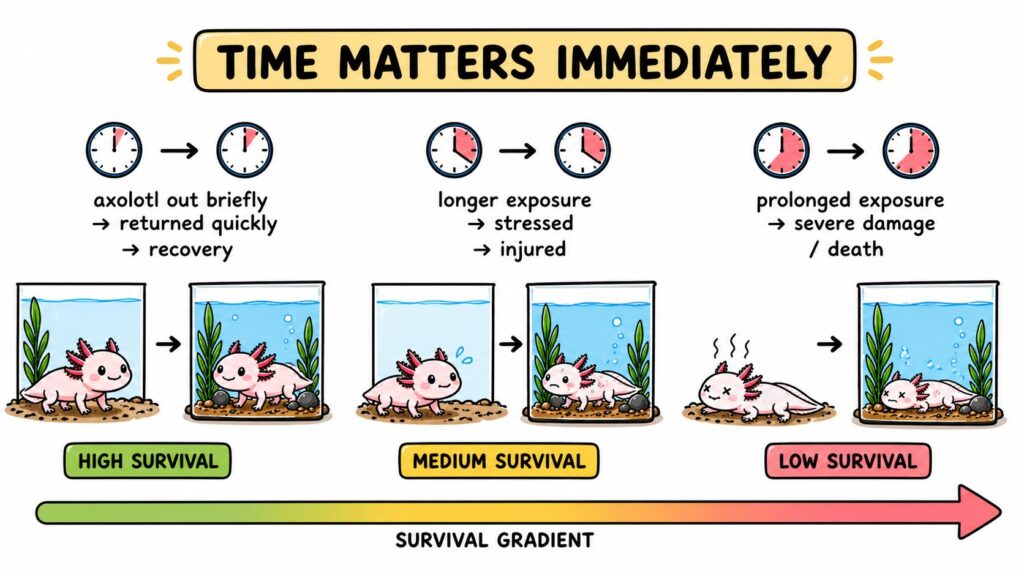
An axolotl can survive a very brief period out of water — a matter of seconds to a few minutes — if it is returned to clean, temperature-appropriate water quickly and without injury. The speed of the return matters enormously. An axolotl that has been out of water for thirty seconds and returned immediately will typically recover without lasting harm. An axolotl that has been out of water for several minutes will be significantly stressed and potentially injured, and one that has been out for longer risks irreversible damage or death.
There is no safe amount of time for an axolotl to be on land intentionally. Brief accidental exposure — during a tank transfer, for instance — is recoverable with quick action. Deliberate land exposure of any duration is never appropriate.
This is fundamentally different from how many other salamander species behave. Related species in the genus Ambystoma, including the tiger salamander, do complete metamorphosis and can live on land as adults. The axolotl is the extraordinary exception — the animal that evolution has equipped exclusively for underwater life. Its remarkable regenerative abilities, its extraordinary scientific significance, and its unusual permanent larval state are all part of what makes it unique, and permanent aquatic life is inseparable from all of those traits. For more on the axolotl’s unique biology, our axolotl care guide provides a comprehensive overview.
What to Do If Your Axolotl Gets Out of the Tank
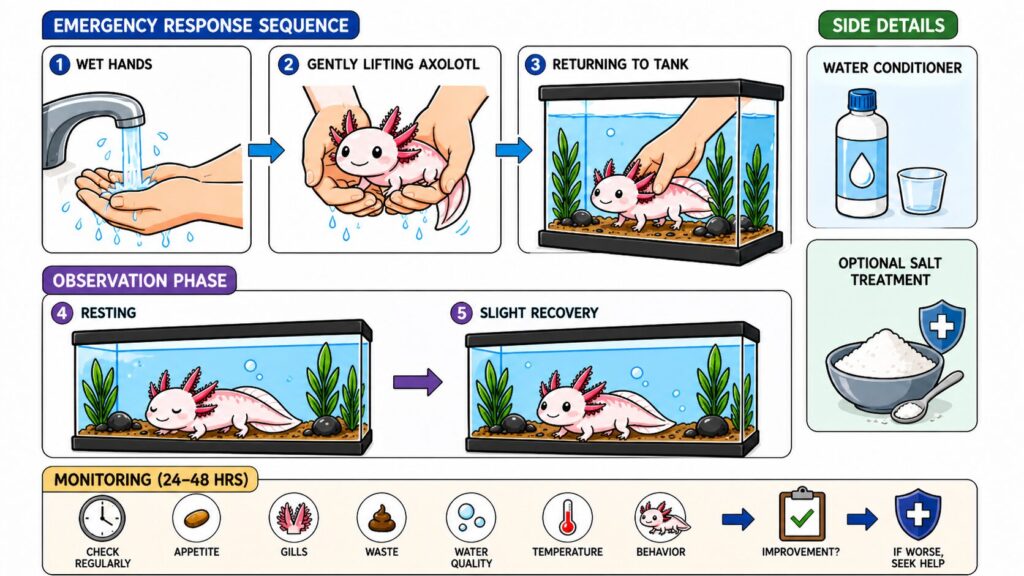
An axolotl escaping its tank is a genuine emergency that requires immediate action. If you find your axolotl out of the water — on the floor, on a shelf, anywhere outside its tank — act as quickly as possible.
Do not grab it roughly or with dry hands. Wet your hands first to minimize friction damage to the skin, then gently scoop the axolotl and return it to its tank immediately. Place it in the water carefully without dropping it.
Once returned to water, observe the animal closely. A recently returned axolotl may appear stunned, move erratically, or rest on the bottom appearing lethargic. Give it time to recover without additional disturbance. If the axolotl shows signs of skin damage — visible abrasions, redness, or areas where the mucus coat has been disrupted — treat the tank water with a quality water conditioner and consider adding a small therapeutic dose of aquarium salt to help prevent infection at compromised skin areas.
Monitor the axolotl’s gill condition, feeding behavior, and overall activity over the following 24–48 hours. A full recovery in a healthy animal is possible after very brief land exposure. Any persistent lethargy, refusal to eat, or visible skin or gill abnormalities after 24 hours warrants closer attention and potentially consultation with an aquatic veterinarian.
Most importantly, identify and fix how the escape happened. Axolotl escapes are almost always a result of an inadequate or absent tank lid. A proper, secure axolotl tank lid is non-negotiable equipment for any axolotl tank — not optional, and not something to defer until after an escape has already happened.
How Do Axolotls Escape Their Tanks?
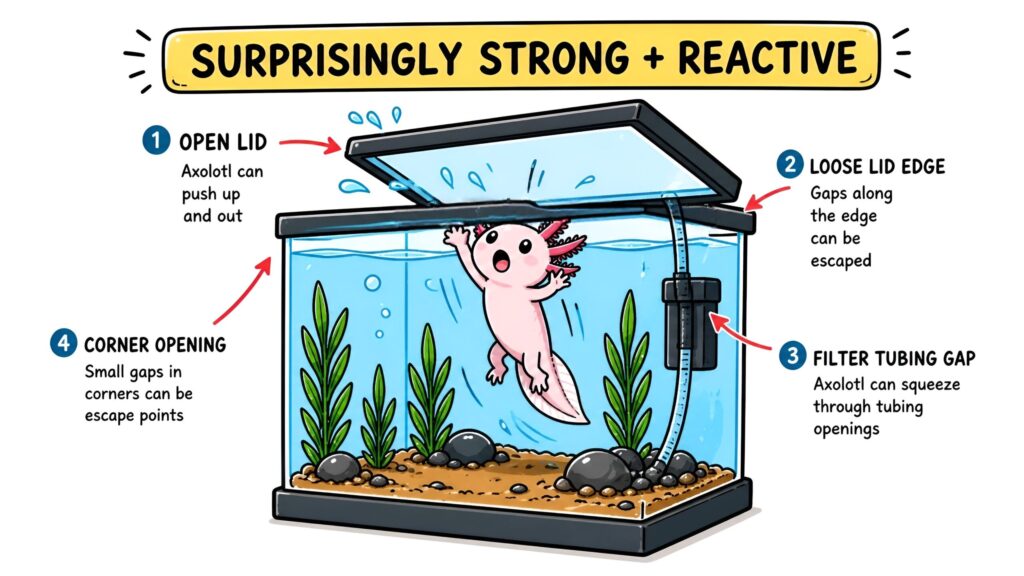
Axolotls escape more often than many new owners anticipate, and understanding how it happens helps prevent it. The most common escape routes are open or loosely fitted tank lids, gaps around filter inlet and outlet tubing, and the space between a lid and the tank rim that is left for equipment.
Axolotls are surprisingly capable of pushing against surfaces and squeezing through gaps that look too small for them. They are also capable of launching themselves out of the water in a startled response — a sudden noise, vibration, or unfamiliar stimulus can send an axolotl shooting upward and potentially over the tank rim if the lid is not secure.
A tank lid that fits properly and has no open gaps large enough for an axolotl to push through is the primary defense. Mesh lids or lids with adjustable cutouts for equipment allow ventilation and equipment access while keeping the axolotl safely inside. Check the fit of your lid regularly, particularly after any rearrangement of tank equipment that might have shifted the lid’s position.
The Myth of the Metamorphosed Axolotl
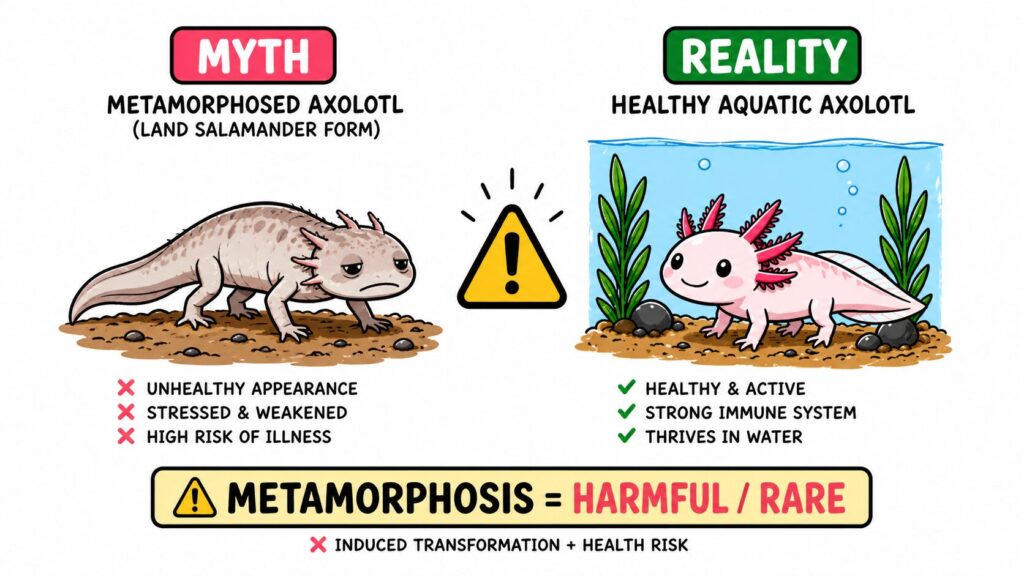
Occasionally, new owners come across accounts of axolotls supposedly metamorphosing — transforming into a terrestrial form like other salamanders — and wonder whether their axolotl might eventually be able to live on land. This is worth addressing directly.
Spontaneous metamorphosis can occur in axolotls under specific conditions, most notably when they are exposed to thyroid hormones, iodine supplementation, or environmental stressors that somehow trigger the hormonal cascade that neoteny normally suppresses. However, spontaneous metamorphosis in healthy, properly cared-for captive axolotls is extremely rare and is generally considered an abnormality rather than a natural outcome. More importantly, metamorphosis in axolotls is associated with significant health problems and shortened lifespan — the animals are not adapted to handle the transformation successfully, and metamorphosed axolotls typically live much shorter lives than neotenic ones.
Deliberately inducing metamorphosis in axolotls is considered harmful and unethical by the aquatic and amphibian veterinary communities. The Association of Reptilian and Amphibian Veterinarians does not recommend thyroid hormone administration for this purpose outside of specific research contexts, and no responsible keeper should attempt to trigger metamorphosis in their pet axolotl.
The axolotl is an aquatic animal. That is not a limitation — it is what makes it extraordinary.
Preventing Land Exposure: Practical Tank Management
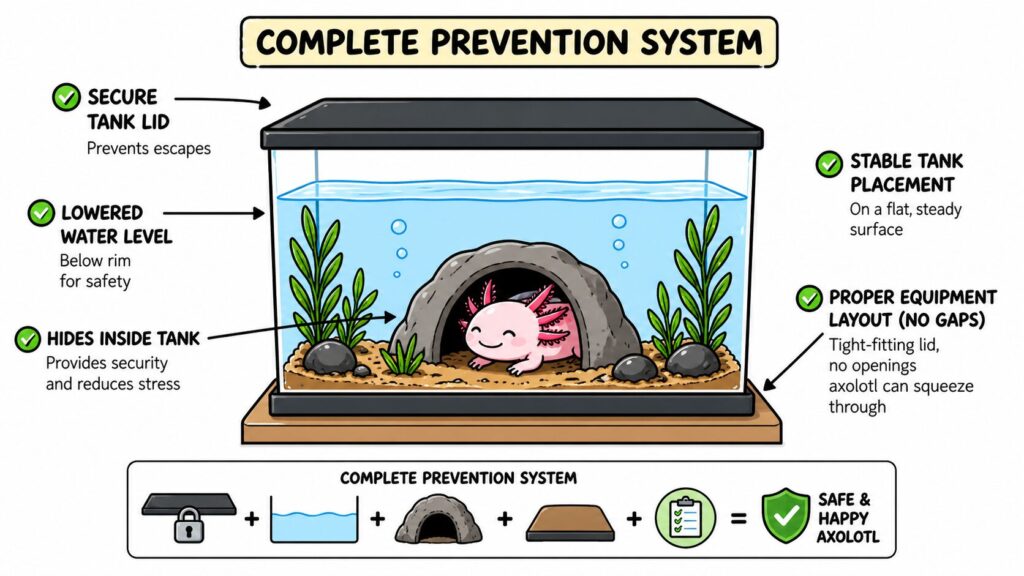
Beyond the tank lid, several aspects of tank setup and management reduce the risk of accidental land exposure.
Water level is worth considering. Many owners fill their axolotl tank to within an inch or two of the top rim. While this is generally fine with a secure lid, a tank filled extremely close to the rim with an inadequate lid gives an axolotl very little barrier between itself and the outside world if it decides to leap. Maintaining water levels a few inches below the lid provides an additional buffer.
A quiet, stable tank location reduces the startled-leap risk. Axolotls placed near frequently slammed doors, loud speakers, or surfaces that transmit regular vibration are more likely to startle and potentially launch themselves. Our guide on what temperature axolotls need also touches on tank placement considerations, since a stable, quiet location also helps with temperature management.
Providing adequate hides and caves gives axolotls places to retreat when they feel exposed or stressed, which reduces the reactive behaviors — including panicked swimming and surface lunging — that can lead to escape attempts. A secure, well-furnished tank is a calmer tank, and a calmer axolotl is far less likely to attempt an exit.
Is It Ever Okay to Take an Axolotl Out of Water?
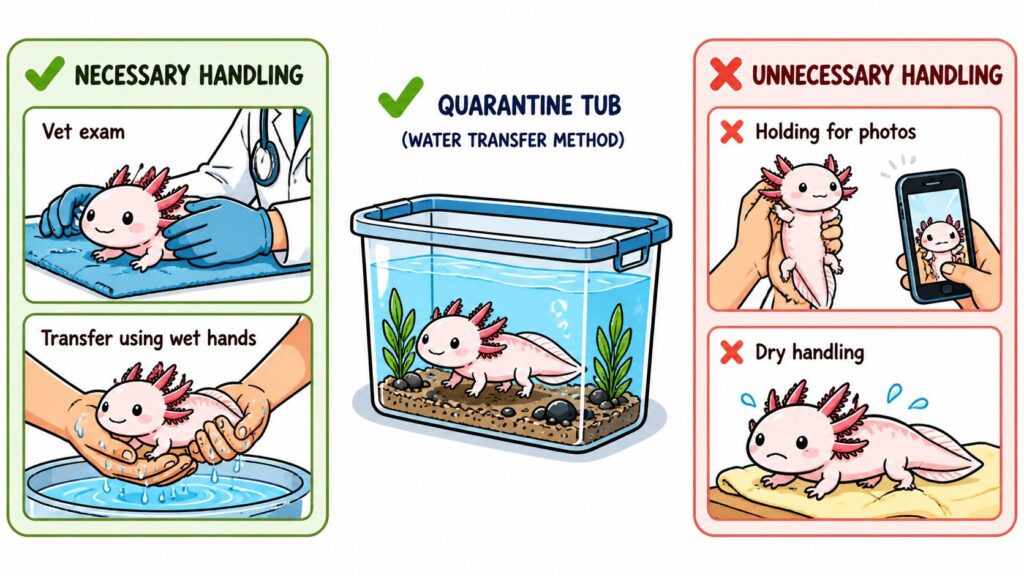
There are a small number of legitimate situations in which an axolotl may need to be briefly removed from water — most notably during veterinary examination or when transferring the animal between containers for a deep tank clean. In these cases, the time out of water should be kept to the absolute minimum, the animal should be handled with wet hands and moved gently, and it should be returned to appropriate water as quickly as possible.
A quarantine tub is the right tool for tank transfer situations — you move the axolotl from the main tank directly into the quarantine tub, which is pre-filled with dechlorinated, temperature-matched water, meaning the axolotl is never actually out of water at all. This is the safest approach whenever you need to separate your axolotl from its main tank.
Handling axolotls for any reason other than necessity — including for photographs, to show them to visitors, or simply out of curiosity — is not good practice and should be avoided. Our article on whether axolotls bite covers the handling risks from the keeper’s perspective, and the risks to the axolotl from handling are equally real.
Frequently Asked Questions
Can axolotls breathe air? They can gulp air at the surface, and they do have rudimentary lungs, but these are not sufficient to sustain them on land. Air breathing in axolotls is supplemental to gill and cutaneous respiration, not a substitute for aquatic life.
What happens if an axolotl is out of water for too long? Progressive desiccation, respiratory failure, immune suppression from stress, potential physical injury, and eventually death if not returned to water quickly enough. The exact timeline depends on temperature, humidity, and the individual animal, but the risk becomes serious within minutes.
Can I build a half-land, half-water setup for my axolotl? No. Axolotls have no use for a land area and should not have access to one. A paludarium-style setup with land areas is appropriate for semi-aquatic species — frogs, some turtles, newts that have completed metamorphosis — but not for axolotls, which must remain fully submerged.
My axolotl keeps trying to climb the tank walls — what does this mean? This can indicate stress, poor water quality, temperature problems, or an inadequate tank environment. Check your water parameters with a water test kit, verify temperature is within the 60–68°F range, and ensure the tank has enough space, proper filtration, and adequate hiding spots. Glass surfing is a behavioral signal worth taking seriously, not ignoring.
Can axolotls survive in the wild outside of water? No. Wild axolotls are fully aquatic inhabitants of Lake Xochimilco and its surrounding canal system. They have no capacity for terrestrial survival and would not survive any meaningful exposure to land conditions in the wild any more than they would in captivity.
Final Thoughts on Whether Axolotls Can Go on Land
Can axolotls go on land? They cannot — not safely, not voluntarily in any healthy sense, and not for any duration that a responsible owner would deliberately allow. The axolotl is one of the most remarkable and scientifically significant animals in the world precisely because of its permanent aquatic existence, its neotenic biology, and its extraordinary adaptations to underwater life. That life needs to be protected, starting with a properly lidded tank and a complete understanding of what these animals need to survive and thrive.
Keeping an axolotl well means committing to its aquatic world fully — and that world deserves the best possible setup. From secure tank lids and quality filtration to water care essentials and the right food, find everything your axolotl needs at the Herdurbia Best Axolotl Products hub — because an axolotl that stays in the water, healthy and thriving, is the whole point.