
Origin And History
The Dalmatian is one of the most immediately recognizable dog breeds in the world, a medium-sized spotted dog whose distinctive coat pattern has made it a cultural icon across centuries of European art, an 18th and 19th century fixture of aristocratic carriage travel, the celebrated mascot of firehouses across the world, and the star of one of the most beloved animated films in Disney’s history. Its origins are genuinely and extensively debated, its history is as varied as any working breed’s, and its health challenges are as unique as its appearance.
The question of where the Dalmatian comes from has generated more genuine scholarly disagreement than almost any other breed. Spotted dogs appear in Egyptian bas-reliefs and Hellenic friezes, in medieval European paintings, and in the early modern artwork of Croatia, where the regional province of Dalmatia has historically been associated with the breed. The AKC’s own historical account notes that the breed certainly did not originate in Dalmatia, while the FCI recognized the Croatian roots of the Dalmatian in 1993. The Dalmatian Club of America acknowledges the origin dispute but states that it is from his first proved home that he takes his correct name, the Dalmatian, essentially accepting the name while declining to resolve the question of ultimate geographic origin.
What the earliest reliable documentation shows is a spotted dog in the region of Dalmatia, present-day Croatia’s Adriatic coast, from at least the 14th century. The first written mention of a dog matching the Dalmatian description comes from 1374, when a Catholic bishop wrote of a dog with short white hair and black round spots he saw in Dalmatia. The bishop and theologian Petar Bakić wrote in 1719 of the Canis Dalmaticus, a white dog with black spots from Croatia, describing it as a hunting dog. The first confirmed illustrations of dogs recognizably matching the modern breed appear in Croatian churches dating to 1600 to 1630.
By the 17th and 18th centuries, the Dalmatian’s association with horses and carriages was well-established in England. Their speed, protective nature, and remarkable affinity for horses made them the ideal carriage dogs of the English aristocracy, running alongside coaches to protect travelers and clear the road ahead. This carriage dog role produced one of the most important transitions in breed history: when horse-drawn fire engines became the standard apparatus for fighting urban fires in the 19th century, the Dalmatian’s established working relationship with horses made it a natural fit as the firehouse dog. Dalmatians ran ahead of fire engines, clearing streets, guiding horses, and providing the combination of speed, authority, and horse affinity that the role required. The firehouse Dalmatian became one of the most enduring cultural associations in American working dog history, and many fire departments across the United States maintain Dalmatian mascots in honor of this heritage.
The breed’s 20th century cultural moment came with Dodie Smith’s 1956 novel The Hundred and One Dalmatians, adapted by Disney into an animated film in 1961. The resulting surge in breed popularity was dramatic and ultimately problematic, as unprepared families acquired Dalmatians without understanding the breed’s genuine exercise needs, its health challenges, or its temperament, creating waves of breed-specific surrender to shelters that rescue organizations still manage today.
The AKC recognized the Dalmatian in 1888, placing it in the Non-Sporting Group. The FCI places the breed in Group 6 with Croatia as the country of origin.
Breed Overview
| Trait | Details |
|---|---|
| Breed Group | Non-Sporting (AKC) / Group 6 (FCI) |
| Height | Males 58–61 cm (23–24 inches) / Females 56–58 cm (22–23 inches) |
| Weight | 20–32 kg (45–70 pounds) |
| Lifespan | 11–13 years |
| Coat | Short, dense, smooth, close-lying |
| Colors | White with black or liver spots; puppies born white |
| Temperament | Outgoing, playful, intelligent, loyal, energetic |
| AKC Recognition | 1888 |
Appearance And Size
The Dalmatian is a medium to medium-large, elegantly proportioned, and powerfully muscled breed that presents with one of the most immediately and universally recognized appearances of any dog in the world. Males stand 58 to 61 centimeters at the shoulder and weigh between 20 and 32 kilograms. Females stand 56 to 58 centimeters and are somewhat lighter. The overall impression is of a strong, balanced, athletic dog of clean lines and symmetrical spotting, carrying its substance with the effortless, ground-covering movement of a breed built for sustained speed alongside carriages.
The head is long and well-defined, with a flat skull, a moderate stop, and a long, powerful muzzle. The eyes are medium-sized, round, and bright, set well apart. In black-spotted dogs the eyes are dark brown, in liver-spotted dogs they may be amber. The ears are moderate in size, set high and wide, tapering to a rounded tip, and carried flat against the head.
The body is deep-chested with well-sprung ribs providing substantial lung capacity, a level back, a slight arch over the loin, and powerful hindquarters. The tail is long, tapering, and carried with a slight upward curve. The movement is free, smooth, and ground-covering, the gait of a dog built for the sustained pace of carriage escorting rather than the explosive sprint of a racing sighthound.
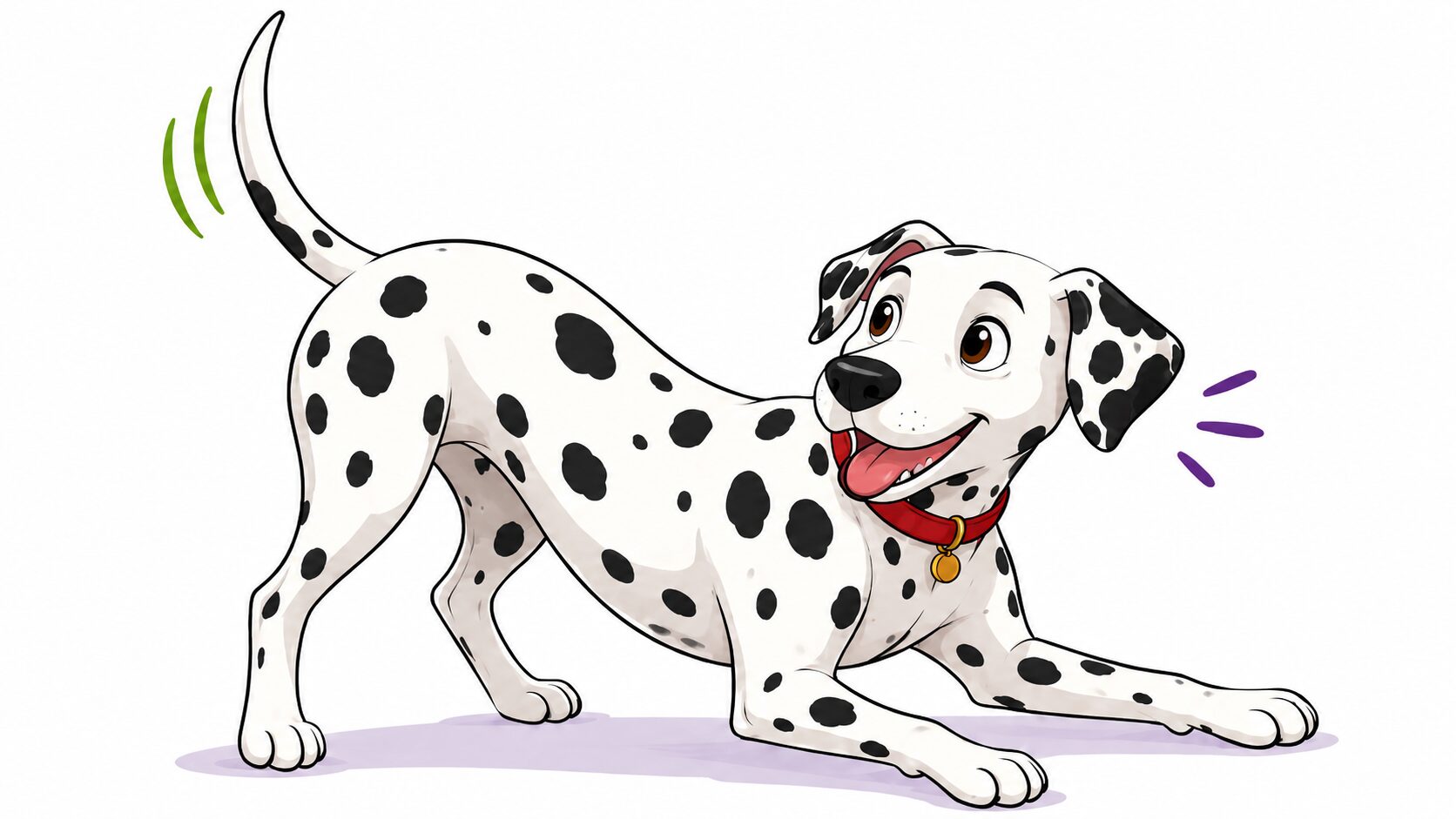
The coat is the breed’s most iconic feature: short, dense, fine-textured, and close-lying, providing a clean canvas for the spotted pattern that distinguishes the Dalmatian from every other breed. The base color is white, and spots are either black or liver-brown, distributed across the body individually rather than in patches or clusters, with each spot clearly distinct and ideally round in outline. The AKC standard calls for spots to range from the size of a dime to the size of a half-dollar. One of the breed’s most celebrated developmental facts is that Dalmatian puppies are born completely white, the spots developing and darkening over the first weeks and months of life as pigmentation develops.
Housing And Living Requirements
The Dalmatian is an energetic, active breed whose housing requirements are shaped primarily by its genuine daily exercise needs rather than by any specific space requirements. A home with access to a securely fenced outdoor area is the most naturally appropriate setting, and rural and suburban environments that provide meaningful outdoor space suit the breed’s active character considerably better than urban apartment living.
A securely fenced garden is important. The Dalmatian’s athletic capability, its curiosity, and the carriage dog heritage that selected for wide-ranging, forward-moving movement mean that adequate containment is a practical necessity rather than an optional precaution. The fence should be of appropriate height for a breed this athletic.
Inside the home, a well-exercised Dalmatian is a warm, affectionate, and engaged companion that bonds closely with its family and participates actively in household life. The breed is people-oriented and does not handle prolonged daily isolation well, making households where the dog is genuinely included in daily life the most appropriate settings.
A large dog bed in a social area of the home suits the breed’s people-focused nature during rest periods. The short, smooth coat provides minimal insulation in cold weather, and outdoor sessions in cold conditions may benefit from a dog coat for a breed this short-coated.
Temperature sensitivity, particularly in hot weather, should be managed by scheduling vigorous exercise for cooler parts of the day and ensuring access to shade and fresh water during warm seasons.
Exercise Requirements
The Dalmatian is a high-energy, genuinely athletic breed with daily exercise needs that are among the highest of any non-sporting or companion breed in the AKC’s classification system. At least one to two hours of vigorous daily exercise is appropriate for most adults, and this is not a breed that is satisfied by casual, leisurely walks.
The carriage dog heritage that shaped the Dalmatian’s physical form selected for sustained endurance at a running pace rather than short burst speed or athletic power, and this translates domestically into a breed that is capable of extended vigorous activity and that genuinely needs that activity to maintain its physical and mental health. Long daily runs, hikes, cycling companions, and extended play sessions across varied terrain are among the most naturally satisfying exercise forms for this breed.
The Dalmatian excels at dog agility, which suits the breed’s athleticism, intelligence, and handler-focused enthusiasm, and a set of dog agility equipment at home provides structured physical and cognitive engagement. Puzzle toys and enrichment activities provide meaningful cognitive engagement between outdoor sessions. A GPS tracker is a practical safety investment for outdoor exercise management.
An under-exercised Dalmatian is one of the most creatively destructive dogs in the breed world. The energy that has no appropriate outlet finds expression through the dog’s own initiative, and a Dal’s initiative in that direction is considerable.
Grooming Requirements
The Dalmatian’s short, dense, close-lying coat is one of the most practically low-maintenance grooming commitments of any medium to large breed in terms of time and professional grooming expense. Weekly brushing with a rubber grooming mitt or firm bristle brush removes loose hair and distributes natural oils. The coat sheds throughout the year, and the short white hairs that are the breed’s primary shedding output have a particular talent for embedding themselves in upholstery and clothing in ways that are disproportionately visible for a breed that appears to have a simple, low-maintenance coat.
Bathing every six to eight weeks is appropriate under normal conditions. The short coat dries very quickly after bathing, making the process efficient.
Ear care is important but straightforward given the breed’s pendant-but-not-extreme ear set. Weekly inspection and cleaning prevents debris accumulation from becoming established infections. Dental care should be established as a consistent routine from puppyhood. Nails should be trimmed monthly.
The most practically significant aspect of Dalmatian coat care is the management of the shedding that most owners find more substantial than expected given the coat’s short length. Regular weekly brushing significantly reduces the amount of hair deposited on furniture and clothing, and a good lint roller becomes a standard household item.
Diet And Nutrition
Feeding a Dalmatian correctly requires understanding a breed-specific metabolic characteristic that has more practical dietary implications than any other health condition in the breed. Virtually every purebred Dalmatian carries a mutation in the SLC2A9 gene that affects how the body processes purines, the compounds found in certain foods. Instead of converting purines to allantoin, which is easily excreted, Dalmatians convert purines to uric acid, which crystallizes in the urinary tract, forming the urate stones that are the breed’s most consistently documented health concern.
This means that for every Dalmatian owner, diet is a health management tool rather than simply a nutritional consideration. High-purine foods including organ meats, sardines, anchovies, mackerel, certain meat extracts, and gravies should be avoided or minimized. Lower-purine protein sources including eggs, most dairy products, and salmon are preferable. A high-quality dog food formulated with lower-purine protein sources and supported by consistent fresh water intake to promote frequent urination and dilute urinary uric acid concentration is the most practical dietary approach.
Most adults do well on two measured meals per day. Fresh water must always be available and should be offered generously, as high water intake is the most practical single preventive measure for urate stone formation. In some high-risk males, a veterinarian may recommend specific low-purine prescription diets or urinary management foods.
Training treats are effective motivators but should be chosen with awareness of their purine content. Discussing the breed’s dietary management with a veterinarian who is knowledgeable about Dalmatian-specific metabolism is one of the most important early ownership steps.
Compatibility
The Dalmatian is a warm, outgoing, people-oriented breed that combines genuine family devotion with the athletic energy and independent character of a breed that spent centuries working alongside carriages rather than following closely at the heels of a handler.
With its own family, the Dalmatian is affectionate, loyal, and genuinely engaged. They are very loving, affectionate, and devoted to their families, and this assessment is consistent across sources and reflects the genuine depth of bonding that this breed brings to its domestic relationships. The Dalmatian seeks proximity to its people, participates actively in family life, and expresses its loyalty through the cheerful, energetic companionship that its enthusiastic character produces.
With children, the breed is generally playful and affectionate when socialized from puppyhood. Its energy level and size mean that interactions with very young children benefit from supervision, as an enthusiastic Dalmatian in full play mode can be overwhelming for small children not because of any aggressive tendency but simply because of the physical energy involved. With older, more active children who can participate in the breed’s exercise needs, the Dalmatian is an outstanding companion.
With strangers, the breed is typically outgoing and friendly rather than reserved or suspicious, reflecting the social, people-oriented character of a breed that worked alongside varied people across centuries of carriage and firehouse life. Early socialization from puppyhood is important for ensuring this natural friendliness is the expression that develops consistently.
With other dogs, the breed is generally sociable when well-socialized from early in life. With small animals, the breed’s hunting heritage means prey drive can be present and should not be assumed absent without direct experience with the individual dog.
A dog crate is a genuinely useful management tool during puppyhood, providing a secure space during the energetic, destructive potential of the first year or two.
Behavior And Temperament
The Dalmatian’s temperament is one of the most genuinely distinctive combinations in the dog world: a breed of considerable intelligence, genuine athletic energy, and warmth that is simultaneously one of the most visually recognizable breeds and one of the most consistently misunderstood in terms of what living with one actually requires.
The energy is the most immediately relevant quality for prospective owners to understand honestly. Dalmatians are born to run, and this is not a metaphor or a marketing claim but a description of a breed whose working history selected for sustained, enthusiastic, forward-moving physical activity across extended periods. A Dalmatian that is not receiving adequate daily exercise is not a mellow, manageable companion. It is a creative, determined, energetic dog applying its considerable intelligence to finding its own activities.
The intelligence is genuine and requires consistent engagement. Dalmatians that are both physically exercised and mentally stimulated are settled, warm, and genuinely pleasant household companions. Those that are under-exercised and under-stimulated can become the poster breed for why dogs chew through walls.
The sensitivity that runs alongside the energy is equally genuine. Dalmatians are emotionally attuned to their households and to the quality of their relationships, and they respond to harsh handling with resentment and avoidance rather than increased compliance. The combination of energy, intelligence, and sensitivity makes positive, consistent, engaged training the most productive approach with this breed.
Training And Handling
The Dalmatian is an intelligent, capable, and trainable breed that takes well to training when approached with the consistency, positive engagement, and physical energy management that its character requires. Early breeders and owners sometimes mistook the breed’s independence or the behavioral consequences of undetected deafness for stubbornness or low intelligence, a misconception that good training and BAER testing have thoroughly corrected.
Positive reinforcement methods are the approach that works most reliably. The Dalmatian responds to reward, to genuine engagement, and to training that feels varied and purposeful. Its food motivation makes treat-based training highly productive, and training treats are effective motivators, chosen with awareness of purine content given the breed’s metabolic management requirements.
BAER testing is essential before any training program is designed. Approximately 30% of Dalmatians have some degree of hearing impairment, with around 8% bilaterally deaf and 22% unilaterally deaf. A trainer working with a Dalmatian who does not know the dog’s hearing status is working without essential information. Bilaterally deaf Dalmatians require visual cue-based training using hand signals rather than verbal commands, and they can become remarkably capable, well-trained companions when their trainers understand what they are working with. Unilaterally deaf dogs often function normally in most training contexts but have reduced sound localization.
Early socialization from puppyhood is critical for a breed whose Disney-driven popularity has produced many poorly socialized individuals in shelter populations. Broad, positive early socialization shapes the confident, friendly adult that the Dalmatian’s character naturally supports.
This is not an ideal breed for first-time dog owners. The exercise demands, the specific dietary management, the hearing testing requirements, and the genuine training commitment the breed needs to reach its potential as a companion make it more demanding than its cheerful, outgoing character might initially suggest.
Health And Lifespan
The Dalmatian is described as a relatively healthy breed, and this is accurate in terms of overall constitutional robustness, but the two breed-specific conditions that every Dalmatian owner must understand and manage proactively are genuinely serious and distinguish this breed’s health management requirements from those of most other breeds. The Dalmatian Club of America lists the average lifespan at 11 to 13 years.
Congenital Deafness Up to 30% of Dalmatians have some degree of hearing impairment, making this the most significant breed-specific health concern in terms of prevalence. The condition is linked to the same pigmentation gene, extreme white, that produces the breed’s iconic spotted coat. The lack of pigment cells in the inner ear causes sensorineural deafness that can affect one ear or both. Bilateral deafness affects approximately 8% of the breed and has no treatment. Unilateral deafness is more common and typically allows normal functional hearing. The association between blue eyes and higher deafness rates is documented but the mechanism is not fully understood; some breed clubs discourage use of blue-eyed dogs in breeding programs.
BAER (Brainstem Auditory Evoked Response) testing of all puppies before they leave the breeder, ideally at 5 to 6 weeks of age, is not optional in a breed with this prevalence of hearing impairment. Responsible breeders BAER test every puppy in every litter and provide documentation of results to all buyers. Sourcing from breeders who conduct BAER testing is one of the most important criteria for prospective Dalmatian buyers.
Hyperuricosuria and Urate Bladder Stones Every purebred Dalmatian carries the SLC2A9 gene mutation that causes elevated uric acid in the urine, making urate stone formation the second most significant breed-specific health concern. The condition is most dangerous in males, whose narrower urethra makes urinary blockage from stones a life-threatening emergency that can cause death within hours if not treated. Symptoms include straining to urinate, frequent attempts to urinate, blood in the urine, and licking the genital area. Complete inability to urinate requires immediate emergency veterinary treatment.
Long-term management combines a low-purine diet, high water intake to dilute urinary uric acid concentration, encouragement of frequent urination, and regular urinalysis to monitor uric acid levels. Males over 10 years of age are at elevated risk and may benefit from preventive medication discussed with a veterinarian.
The Dalmatian-Pointer Backcross Project, begun in 1973 by Dr. Robert Schaible, introduced the normal uric acid processing gene into the Dalmatian through a single English Pointer cross and subsequent back-crossing to purebred Dalmatians. By the fifth generation, the resulting dogs were indistinguishable from purebred Dalmatians in appearance but did not carry the SLC2A9 mutation. The AKC eventually recognized these backcross dogs as registerable purebred Dalmatians in 2011. A small number of Dalmatians in North America and Europe now carry this normal gene, and breeders working with these lines offer puppies that do not face the urate stone risk. Prospective buyers interested in this option should specifically ask breeders about backcross lineage.
Allergies and Skin Conditions Skin allergies to environmental and food-based triggers are documented in the breed. The short white coat that makes skin conditions visible also means that any irritation, rash, or allergic reaction is apparent earlier than in longer or darker-coated breeds. Working with a veterinarian to identify and manage allergy triggers provides effective ongoing management for affected dogs.
Autoimmune Thyroiditis Affecting approximately 11.6% of Dalmatians, this condition causes the immune system to attack the thyroid gland, potentially leading to hypothyroidism. Annual blood work beginning in middle age allows for early detection, and the condition is manageable with lifelong hormone replacement therapy once diagnosed.
Hip Dysplasia Hip dysplasia affects approximately 4.6% of purebred Dalmatians, which is notably lower than in many comparable breeds. Maintaining appropriate weight throughout the dog’s life and discussing joint supplements with your vet as the dog reaches middle age are meaningful protective measures.
Routine preventive care, including regular vet check-ups, consistent dental hygiene, up-to-date vaccinations, and parasite prevention, provides the foundation for a healthy Dalmatian across its lifespan. Pet insurance is strongly recommended given the breed’s specific health conditions and the potential costs of urate stone treatment, emergency urinary obstruction care, and allergy management.
Price And Availability
The Dalmatian is a moderately available breed in the United States with an active community of reputable breeders. From reputable breeders, expect to pay between $800 and $2,500 for a well-bred puppy from health-tested parents, with show-quality dogs from champion bloodlines occasionally commanding higher prices. The wide price range reflects significant variation in the depth of health testing conducted, the quality of conditions in which puppies are raised, and the geographic location of the breeder.
The Dalmatian Club of America is the most authoritative starting point for locating breeders who adhere to the AKC breed standard and conduct appropriate health testing. Responsible breeders will BAER test every puppy in every litter and provide documentation of all results. They will discuss their approach to the breed’s urate stone management, including whether they work with backcross lineages that carry the normal uric acid processing gene. They will ask thorough and pointed questions about the prospective buyer’s lifestyle, exercise capacity, fencing situation, and understanding of the breed’s specific health challenges.
Adoption is one of the most meaningful options for this breed, and the Dalmatian’s Disney-driven popularity cycles have left a significant population of well-adjusted adults in rescue organizations across the country. Dalmatian-specific rescue organizations including Dalmatian Rescue of Colorado and similar regional groups regularly have dogs of various ages available. General breed rescue through the Dalmatian Club of America’s rescue network and national databases including Petfinder list adoptable Dalmatians continuously. Adoption fees typically range from $150 to $500 and often include prior veterinary care, BAER testing, and vaccination.
Annual ongoing ownership costs include food, the specialized low-purine dietary management that the breed requires, routine veterinary care including annual urinalysis for urate stone monitoring, and standard supplies.
Conclusion
The Dalmatian has been running alongside horses and carriages since the 17th century, guarding coaches on English country roads, clearing streets for fire engines in American cities, capturing the world’s heart in a Disney film, and then being acquired in vast numbers by families who were not remotely prepared for the exercise demands, the deafness prevalence, the dietary management requirements, and the genuine training commitment that living with one of these spotted athletes actually requires. The breed deserves better than its cultural moment has sometimes given it, and the owners who do the research, source from breeders who BAER test every puppy, manage the diet with awareness of the uric acid metabolic reality, and genuinely provide the daily exercise this breed needs are rewarded with one of the most beautiful, athletic, warmly devoted, and genuinely characterful companions in the entire dog world. Get properly set up before bringing one home. Our Best Dog Products page has everything you need for spotted, athletic, whole-heartedly devoted Croatian coach dogs that carry centuries of carriage road and firehouse heritage into every home they grace.