
Origin And History
The Dandie Dinmont Terrier holds a distinction unique in the dog world: it is the only breed named after a fictional character. The character in question, Dandie Dinmont, appeared in Sir Walter Scott’s 1814 novel Guy Mannering, and the dogs in the story were so vividly described and so quickly recognized by readers familiar with the real terriers of the Scottish Borders that the name attached to the breed almost immediately and has remained ever since. The story behind that naming is one of the most genuinely engaging in cynological history, connecting a great Scottish novelist, a farmer with an unusual naming system for his dogs, and a community of Border country gypsies who had been breeding these distinctive terriers in secrecy for generations.
The breed’s documented origins reach back to the early 1700s in the hilly border country between England and Scotland, specifically the area known as the Teviotdale Hills and the broader Scottish Borders region. The terriers that would become the Dandie Dinmont were bred primarily by traveling people, including particularly the Allan family of Holystone in Northumberland, who had kept these pepper-and-mustard colored earthdogs pure since the early 18th century and guarded their breeding with considerable jealousy. Willie Allan, born in 1704, was a bagpiper and tinker who earned extra income by renting out his dogs to exterminate otters and other vermin. His dogs were so effective that the Duke of Northumberland reportedly offered Allan an entire farm in exchange for a dog named Hitchem, to which Allan reportedly replied that a piper had no use for a farm.
The precise genetic origins of the breed are debated by historians. The most widely cited theory holds that the Dandie Dinmont resulted from a cross between the now-extinct Scotch Terrier and the Otterhound, the latter contributing the distinctive domed head structure, the low-set ears, and the curved tail carriage that distinguish the breed from other terriers. An alternative theory suggests a cross between a rough-haired borderland terrier and a Dachshund, which would explain the long body and short legs. A third theory proposes descent from the Skye Terrier. None of these accounts can be confirmed from written records, and the breeding families who held the original stock were not in the habit of documenting their methods.
Sir Walter Scott encountered these dogs during his extensive travels through the Scottish Borders, where he served as Sheriff of Selkirkshire. He was immediately captivated by them, and when he wrote Guy Mannering, he included a character who kept a pack of these distinctive terriers and gave each one the name either Mustard or Pepper after its coat color. A farmer named James Davidson, who had acquired dogs from the Allan lineage and similarly named all his terriers Mustard or Pepper, became so associated with the fictional character that his friends began calling him Dandie Dinmont. Davidson’s breeding established what is now accepted as the foundation stock of the modern breed, and Scott himself was given two Dandies named Ginger and Spice by Davidson, subsequently breeding a dog called The Mertoun Dandie whose descendants appear in virtually every Dandie Dinmont pedigree in existence.
The publication of Guy Mannering in 1815 created immediate public fascination with the breed. The Dandie Dinmont Terrier Club, founded in 1875, is among the world’s oldest breed clubs, celebrating its 150th anniversary in 2025. The AKC recognized the breed in 1886, and the UKC recognized it in 1918.
The breed’s current status is one that its admirers consider a genuine crisis. The UK Kennel Club classifies the Dandie Dinmont Terrier as a Vulnerable Native Breed due to critically low annual puppy registrations, meaning fewer than 300 puppies are registered annually in the UK. The breed is at genuine risk of disappearing if its small population of dedicated breeders does not expand.
Breed Overview
| Trait | Details |
|---|---|
| Breed Group | Terrier |
| Height | 20–28 cm (8–11 inches) |
| Weight | 8–11 kg (18–24 pounds) |
| Lifespan | 12–15 years |
| Coat | Double coat; crisp mixture of hard and soft hairs; distinctive silky topknot |
| Colors | Pepper (silver-grey to blue-black) or Mustard (reddish-brown to pale fawn) |
| Temperament | Independent, intelligent, dignified, affectionate, courageous |
| AKC Recognition | 1886 |
Appearance And Size
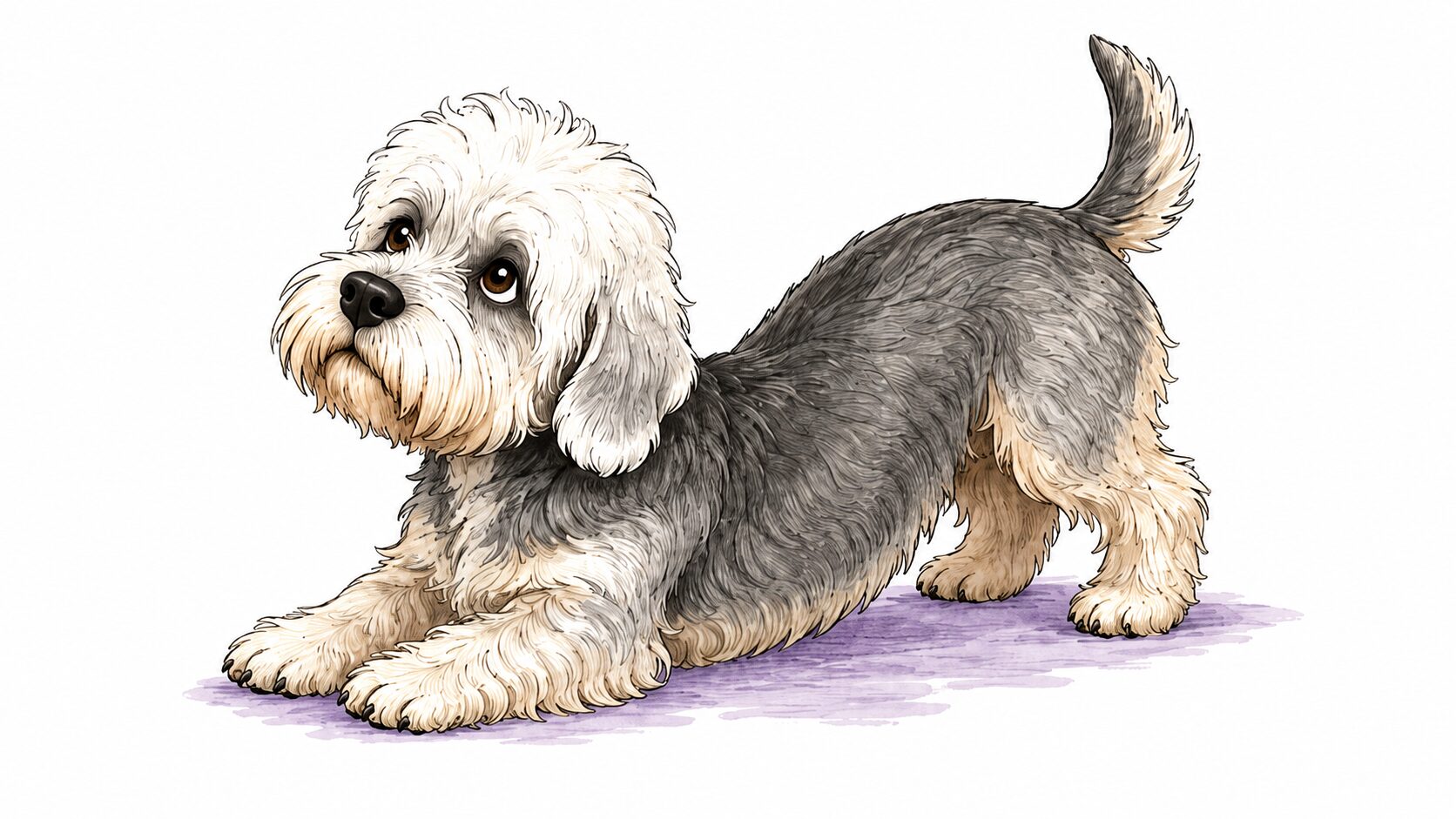
The Dandie Dinmont Terrier is a small dog of entirely unique and immediately distinctive appearance, unlike any other terrier breed and unlike almost any other dog in the world. It stands 20 to 28 centimeters at the shoulder and weighs between 8 and 11 kilograms, making it a medium-small dog of solid, well-muscled construction despite its modest dimensions. The overall impression is of a compact, low-slung dog of considerable substance whose curved body, large domed head, and distinctive topknot give it an appearance that is simultaneously charming, dignified, and vaguely improbable.
The head is the breed’s most immediately striking feature: large in proportion to the body, strongly made, and crowned by a large, soft, silky topknot of hair that is one of the most recognizable features in any terrier breed. The skull is broad between the ears and narrows gradually toward the eyes. The eyes are large, round, and typically a rich hazel color, set wide apart, full of fire and intelligence and tender expression. The ears are pendant, set wide apart and low on the skull, hanging close to the cheek, broad at the base and tapering to a point, with a fringe of light feathering at the tip.
The body is long in proportion to its height, with a slight arch over the loin that gives the breed what the breed standard describes as a weasel-like appearance, the body bending and flexing with the flowing, low-set movement of an animal built for pursuing quarry through underground burrows. The chest is deep and well let down. The legs are short, the front legs somewhat bowed or heavily boned to provide power for digging.
The tail is of moderate length, around 20 to 26 centimeters, thick at the base, tapering to a point, and carried in a scimitar-like curve above the level of the back when the dog is active. This curved tail carriage is one of the breed’s most characteristic features.
The coat consists of a mixture of hard and soft hair, producing a crisp, pily texture that is distinctive from both the smooth coats of some terriers and the wiry coats of others. Colors are limited to two: pepper, which ranges from dark blue-black through silver-grey and lightens significantly from puppyhood to maturity; and mustard, which ranges from reddish-brown to pale sandy fawn and similarly lightens from the darker puppyhood color to the adult pale fawn or cream. The topknot is always lighter in color than the body coat.
Housing And Living Requirements
The Dandie Dinmont Terrier is a more genuinely adaptable breed in terms of living environment than many other working terrier breeds, combining the physical capability of a genuine underground hunting dog with a somewhat more settled, dignified indoor character than many of its terrier relatives. The breed manages apartment and urban living reasonably well provided daily exercise is genuinely provided, and it is accessible to a wider range of owner profiles than the most intensely driven terrier breeds.
The most important housing consideration for a Dandie Dinmont, as for the Dachshund, is spinal management. The long body and short legs that give the breed its characteristic appearance create the same predisposition to intervertebral disc disease. Eliminating repetitive high-impact jumping from furniture and providing dog ramps or steps for favorite furniture access is the most important preventive environmental modification. Minimizing stair use where practical reduces cumulative spinal stress. A comfortable dog bed positioned at floor level and accessible without jumping protects the spine from the impact of landing.
Inside the home, the Dandie is a warm, self-possessed, and quietly devoted companion that brings a dignified but genuine warmth to its household relationships. It is not the boisterous, constantly demanding terrier of popular imagination. It has a more regal, considered quality about it that reflects centuries of development as a prized working dog among people who valued a dog’s capabilities over its enthusiasm for constant activity.
The breed does have digging instinct, which is genuine and occasionally expresses itself in garden settings. Providing appropriate digging outlets in a designated area is more effective than attempting to suppress the instinct entirely.
Exercise Requirements
The Dandie Dinmont Terrier’s exercise needs are moderate and entirely achievable for a wide range of owner profiles, one of the practical qualities that has made it a reliable companion for varied households across its history. One to two moderate daily walks, totaling 45 to 60 minutes, meets the baseline physical needs of most adult Dandies.
The character of appropriate exercise is worth understanding specifically. The breed’s long spine and short legs mean that high-impact activities including jumping, rough play on hard surfaces, and activities producing sudden twisting movements create spinal risk that moderate, level-surface exercise does not. Long, varied walks with opportunity for exploratory sniffing are more genuinely satisfying and more spinal-safe than high-intensity jumping or fetching games.
The Dandie’s terrier heritage means it retains a genuine interest in small animals and a willingness to investigate anything that moves or smells interesting. Walking on leash in any unfenced area is appropriate management, as the hunting instinct, while less frantic than in some terrier breeds, is real and present.
Puzzle toys and enrichment activities are genuinely important between outdoor sessions, engaging the breed’s intelligence and preventing the boredom that any under-stimulated terrier expresses through its own creative choices.
Grooming Requirements
The Dandie Dinmont Terrier’s coat requires a specific and somewhat specialized grooming approach that reflects the distinctive mixed texture of the breed’s double coat and the particular requirements of the silky topknot that is its most immediately recognizable visual feature.
The body coat should ideally be maintained through hand-stripping, the process of removing dead outer coat by pulling rather than clipping, which preserves the correct crisp texture of the adult coat. Clipping with scissors or clippers softens the coat texture significantly over time, reducing the natural weather resistance and producing a different visual impression than the correct breed type. For show dogs, hand-stripping is standard and typically done twice yearly. For pet dogs, many owners choose professional clipping as a more practical alternative.
Brushing two to three times a week prevents matting in the mixed-texture coat and keeps the coat in good condition between professional appointments. The topknot requires daily attention to keep it clean, tangle-free, and appropriately silky in texture, as it is exposed to food and water accumulation during everyday activities.
The ears should be checked and cleaned weekly, with particular attention to the feathering at the ear tip that accumulates debris and can mat if not maintained. Dental care is critically important given the breed’s documented predisposition to dental disease in its smaller mouth. Nails should be trimmed monthly. Eye inspection is important given the breed’s protuberant eyes and susceptibility to eye injuries and glaucoma.
Diet And Nutrition
The Dandie Dinmont Terrier’s dietary management is shaped by the same consideration that shapes Dachshund feeding: the long spine’s vulnerability to the extra mechanical stress that even modest excess weight creates. Weight management is the most important ongoing dietary responsibility of Dandie Dinmont ownership.
A high-quality small breed formula with a named protein source as the first ingredient provides the nutritional foundation the breed requires. Small breed formulas address the higher metabolic rate, the dental disease predisposition, and the specific nutritional needs of dogs this size. Two measured meals daily at regular times provides appropriate daily nutrition and the best portion control. Puppies may need three to four meals daily to prevent hypoglycemia, and a slow-feeder bowl provides meaningful enrichment as well as slowing eating pace.
The breed is not known to be a picky eater, which is practically convenient but means that calorie management is the owner’s responsibility rather than the dog’s. Training treats are effective motivators and should be counted into the daily calorie total. Discussing joint supplements with your veterinarian as the dog reaches middle age is worthwhile given the breed’s spinal predispositions.
Compatibility
The Dandie Dinmont Terrier is a more quietly devoted and more genuinely adaptable family companion than its fierce underground hunting heritage might initially suggest, bringing to its household relationships a warmth and affection that is consistent and genuine while maintaining the independent, self-possessed character that distinguishes it from more overtly people-pleasing toy and companion breeds.
With its own family, the Dandie is loyal, affectionate, and genuinely devoted. They are affectionate with their owners, and this quality is expressed with the quiet, settled warmth of a breed that gives its loyalty seriously and completely rather than distributing it casually to anyone who approaches.
With children, the Dandie Dinmont Terrier is genuinely well-suited. Dandies get on incredibly well with children and will lap up family life, and multiple sources consistently describe the breed’s patience and playfulness with children as one of its most valued domestic qualities. The breed’s moderate size and relatively settled energy make it appropriate for households with children who interact respectfully with dogs.
With strangers, the breed maintains the reserved, watchful quality of a terrier that takes its assessment of unfamiliar people seriously. Early and consistent socialization from puppyhood ensures this natural reserve is expressed as appropriate discernment rather than anxious reactivity or persistent wariness.
With other dogs, the breed is generally manageable when socialized from early in life, though the terrier character means that interactions with unfamiliar dogs, particularly of similar size and assertive character, benefit from careful management. With small animals including rabbits, rodents, and cats that move in prey-like ways, the hunting instinct is genuine and should be acknowledged.
A dog crate is a useful management tool during puppyhood and the settling-in period.
Behavior And Temperament
The Dandie Dinmont Terrier’s temperament is one of the most specifically described and most accurately characterized in the terrier group: it is a big-dog character in a small-dog body, combining genuine courage and tenacity with an independent, dignified, almost aristocratic self-possession that distinguishes it from the more boisterous, constantly active terrier types.
The independence is genuine and deeply embedded. A breed that was developed to pursue quarry into underground burrows and make its own decisions about how to engage with a badger or otter in a confined space is a breed that has centuries of selection for exactly this independent judgment, and that quality is present in the domestic Dandie as surely as it was in the working dog of the Scottish Borders. The Dandie is not a breed that waits for permission. It assesses situations and acts on its own considered judgment with the quiet confidence of a dog that trusts its own assessment of what the situation requires.
The dignity is equally authentic. The Dandie Dinmont Terrier is a proud, independent, and sometimes stubborn character who nonetheless forms deep bonds with the people it accepts into its inner circle. This combination of independence and loyalty produces a companion that is interesting and characterful rather than simply compliant, rewarding to engage with rather than merely decorative.
The courage that made this breed capable of confronting otters and badgers in underground dens is fully present in the domestic dog and occasionally expresses itself as a willingness to take on animals or situations that far exceed what the Dandie’s physical dimensions would appear to justify.
Training And Handling
The Dandie Dinmont Terrier is an intelligent breed that takes well to training when approached with the patience, consistency, and genuine respect for its independent character that suit a dog of this heritage and temperament. It can be quite stubborn and is not always very obedient, which can make training a little challenging, but it will learn with plenty of patience and perseverance.
Positive reinforcement methods are the approach that works most reliably. The Dandie responds to reward, to genuine engagement, and to training that feels collaborative and purposeful. Its food motivation makes treat-based training highly productive, and training treats used consistently in positive training sessions produce reliable, lasting results. Harsh corrections or confrontational approaches produce resentment and resistance in a breed this proud and this independent.
The stubbornness that occasionally surfaces in training is the same quality that made the breed capable of confronting a badger with complete conviction. Understanding this connection, and working with the breed’s intelligence and self-directed character rather than attempting to override it, produces considerably better training outcomes than demanding compliance from a dog that has its own well-formed opinions about what is worth doing.
Early socialization from puppyhood is important, exposing the young dog to a wide range of people, other dogs, environments, and sounds during the critical developmental window. The breed’s natural reserve with strangers makes the quality of early socialization one of the most significant factors in its adult social ease and confidence.
Health And Lifespan
The Dandie Dinmont Terrier is a generally robust breed with a lifespan of 12 to 15 years. Its small breeding population means that comprehensive health data is more limited than for more numerically prevalent breeds, but the conditions that are documented are manageable with appropriate preventive care and monitoring.
Intervertebral Disc Disease (IVDD) The long spine and short legs that define the breed’s characteristic appearance create the same predisposition to disc disease that affects Dachshunds and other chondrodystrophic breeds. Dogs with particularly exaggerated back length, described as ultra-typed individuals, are at elevated risk. Maintaining appropriate weight throughout the dog’s life is the most practically meaningful preventive measure, as even modest excess weight directly increases disc pressure. Eliminating repetitive jumping from furniture height and providing ramps for furniture access, and minimizing stair use, reduces cumulative spinal stress. Any signs of back pain, reluctance to move, altered gait, or hind limb weakness require immediate veterinary assessment.
Glaucoma and Pectinate Ligament Dysplasia Elevated pressure within the eye causing pain and progressive vision loss is a documented hereditary condition in the breed, and pectinate ligament dysplasia (PLD), an abnormality of the drainage structures within the eye that predisposes to glaucoma, is the underlying genetic mechanism. Gonioscopy, the examination of the eye’s drainage angle, allows for identification of affected and carrier dogs and is recommended for all breeding animals. Annual eye examinations allow for early detection of developing glaucoma and appropriate management.
Cushing’s Disease (Hyperadrenocorticism) Excessive cortisol production causing increased thirst, appetite, and urination, along with lethargy, pot-bellied appearance, and poor coat condition, is documented in the breed. The condition often develops slowly, and awareness of early signs allows for earlier diagnosis. Oral medication manages the condition effectively once diagnosed.
Portosystemic Shunt An abnormal blood vessel that bypasses the liver’s filtering function, causing toxin buildup and potentially neurological symptoms, is documented in the breed at low rates. Surgical correction is available and provides the best long-term outcomes for affected individuals.
Dental Disease The breed’s smaller mouth creates the crowding that significantly accelerates periodontal disease, and dental disease is identified as one of the most common chronic health problems in the breed. Establishing consistent dental care from puppyhood and scheduling annual professional veterinary cleanings provides the most effective prevention.
Eye Injuries The breed’s prominent, slightly protuberant eyes are more vulnerable to scratches and punctures than more deeply set eyes. Avoiding situations that risk eye contact with thorns, debris, or other animals provides reasonable preventive management.
Routine preventive care, including regular vet check-ups, annual eye examinations from middle age onward, consistent dental hygiene, up-to-date vaccinations, and parasite prevention, provides the foundation for a healthy Dandie Dinmont Terrier across its impressive lifespan.
Price And Availability
The Dandie Dinmont Terrier is one of the rarest breeds available in the United States, with a very small number of active breeders and a global population that is considered genuinely at risk. From reputable breeders, expect to pay between $1,500 and $3,500 for a well-bred puppy from health-tested parents, reflecting the breed’s rarity and the health testing requirements of responsible breeding. Wait times are common given the limited number of litters produced annually.
The Dandie Dinmont Terrier Club of America is the most authoritative starting point for locating breeders in the United States who breed to the AKC standard and conduct appropriate health testing. Responsible breeders will conduct eye gonioscopy on breeding animals to screen for pectinate ligament dysplasia, conduct OFA hip and elbow evaluations, and be transparent about all health testing results. Given the breed’s vulnerable population status, responsible breeders are also concerned with genetic diversity management and will discuss their approach to maintaining population-level genetic health.
In the UK, where the breed has its deepest roots, three active breed clubs maintain breeding programs: the Dandie Dinmont Terrier Club, the Southern Dandie Dinmont Terrier Society, and the Caledonian Dandie Dinmont Club. These clubs are important resources for international buyers interested in European breeding lines.
Adoption is possible through breed rescue on an occasional basis. The breed’s rarity means rescue availability is infrequent, but the DDTCA rescue network provides the most reliable channel.
Conclusion
The Dandie Dinmont Terrier is the only breed in the world named after a character from a novel, and the novel’s author, one of the greatest Scottish writers who ever lived, became so captivated by these distinctive Border terriers that he bred them himself and contributed a dog whose descendants appear in virtually every Dandie pedigree alive today. That is the kind of breed origin story that most dogs only dream of, and the Dandie Dinmont carries it with the quiet dignity that characterizes everything about this remarkable small dog. It is now genuinely endangered, with fewer puppies registered in the UK each year than would fill a modest country church, and the community of breeders working to preserve it is small but deeply committed. For the owner who finds a well-bred Dandie through responsible channels, who manages the spine with appropriate preventive care, who gives the independent intelligence the genuine engagement it requires, and who values a companion of genuine character and quietly fierce loyalty, the Dandie Dinmont Terrier offers one of the most rewarding and most distinctive small breed partnerships available anywhere in the terrier world. Get properly set up before bringing one home. Our Best Dog Products page has everything you need for long-bodied, topknotted, whole-heartedly devoted Scottish Border terriers that carry three centuries of literary heritage and the full character of the pepper-and-mustard dogs of the Teviotdale Hills into every home they grace.