
Do hedgehogs need heat lamps? The short answer is: it depends on where you live and how warm your home stays — but for most pet owners in cooler climates, some form of supplemental heating isn’t just helpful, it’s essential. Temperature regulation is one of the most critical and underestimated parts of hedgehog care, and getting it wrong can make your hedgehog seriously ill.
Why Temperature Matters So Much for Hedgehogs
To understand why hedgehogs are so sensitive to temperature, it helps to know a bit about their biology. Hedgehogs are warm-blooded animals, but unlike most mammals, they have a limited ability to regulate their own body temperature when the environment gets too cold. This makes them unusually vulnerable to temperature drops in a way that, say, a cat or dog simply isn’t.
The African four-toed hedgehog (Atelerix albiventris) — the species most commonly kept as a pet — originates from sub-Saharan Africa, where temperatures are consistently warm year-round. These animals evolved in an environment where cold was rarely a serious threat. Take them out of that context and put them in a house in a temperate climate, and their biology can start working against them when the seasons change.
According to the Chicago Exotics Animal Hospital, the recommended ambient temperature range for pet hedgehogs is between 72°F and 80°F (22°C to 27°C). Drop below that — particularly below 65°F (18°C) — and you’re entering risky territory.
What Happens When a Hedgehog Gets Too Cold
This is where things get genuinely important to understand. When a pet hedgehog is exposed to temperatures below its comfort range, it can enter a state called torpor — a dangerous, involuntary drop in metabolic activity that can look a lot like hibernation but isn’t the safe, seasonal process that wild European hedgehogs go through.
African hedgehogs didn’t evolve to hibernate. Their bodies aren’t prepared for it the way European hedgehogs are. When an African pygmy hedgehog enters torpor due to cold, it’s not resting safely — it’s in physiological distress. The animal becomes unresponsive, its body temperature drops dramatically, and without intervention it can die. This is covered in more detail over at do hedgehogs hibernate, but the key point is that torpor in a pet hedgehog is a medical emergency, not a natural rest state.
The Hedgehog Welfare Society has published guidance specifically on torpor, emphasizing that pet owners need to recognize the signs — cold, limp, unresponsive — and act quickly by warming the animal gradually using body heat before seeking veterinary care.
So Do Hedgehogs Actually Need Heat Lamps?
Yes, in most cases they do — or at least some form of reliable supplemental heating. A heat lamp is one option, but it’s not the only one, and whether it’s the right choice for your setup depends on a few factors.
If your home stays consistently between 72°F and 80°F throughout the year, including at night and in winter, your hedgehog may be fine without additional heating. But most homes don’t maintain that range 24/7, especially overnight in winter when heating systems cycle down. Since hedgehogs are nocturnal and most active during the night, the temperature when you’re asleep matters just as much as the temperature when you’re awake.
For most owners, a dedicated heat source in or near the enclosure is the safest and most reliable approach. The question then becomes what type of heating works best.
Heat Lamp vs. Heating Pad vs. Ceramic Heat Emitter — What’s the Difference?
There are several heating options available for hedgehog enclosures, and each has its pros and cons.
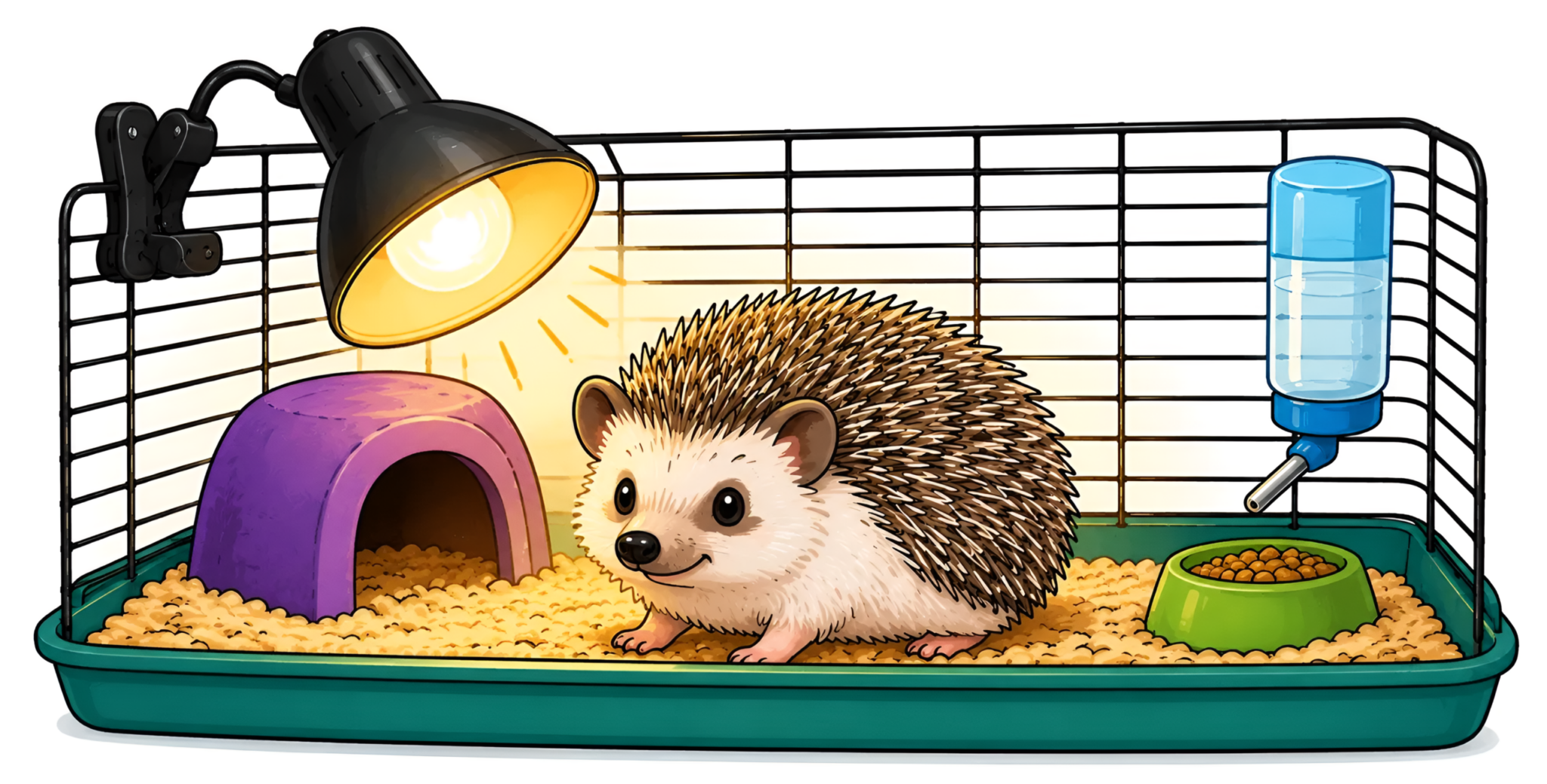
Heat lamps produce both heat and light. This can be an issue for hedgehogs because they need a clear day/night cycle — constant light disrupts their circadian rhythm, which affects sleep, behavior, and long-term health. If you use a heat lamp, a ceramic heat emitter (which produces heat without light) is generally preferred for overnight use. If you’re looking at options, check out the best hedgehog heat lamp guide for what works well in practice.
Ceramic heat emitters screw into a standard lamp socket but emit no light — only heat. This makes them ideal for overnight use because they don’t disturb the hedgehog’s natural darkness cycle. They’re one of the most popular heating solutions among experienced hedgehog keepers.
Heating pads sit beneath or to the side of the enclosure and provide a warm surface. They’re useful but come with a caveat: they heat the surface, not the air. A hedgehog curled up in its hideout won’t necessarily benefit from a heating pad the way it would from ambient warmth. Some owners use a heating pad as a secondary heat source rather than a primary one. The best hedgehog heating pad options are worth looking at if you want to supplement your primary heat source.
Room heaters are another option if you can dedicate a room or keep a space heater running safely near the enclosure. The downside is energy cost and the risk of overheating if the room gets too warm.
The Critical Role of a Thermostat and Thermometer
Whatever heating method you use, running it without a thermostat is asking for trouble. Overheating is just as dangerous as being too cold — temperatures above 85°F (29°C) can cause heat stress, and without a way to regulate the output of your heat source, you’re relying on guesswork.
A thermostat lets you set a target temperature and automatically controls your heat source to maintain it. Paired with a reliable thermometer placed at the level of the enclosure floor (where the hedgehog actually spends its time), you get real-time feedback on whether your setup is working. The best hedgehog thermostat and best hedgehog thermometer pages cover specific product recommendations if you need somewhere to start.
The Veterinary Partner website notes that maintaining stable, consistent temperatures is more important than hitting a precise number — fluctuations are more stressful than a steady temperature that’s slightly outside the ideal range.
Where Should the Heat Source Be Positioned?
Positioning matters quite a bit. You want to create a temperature gradient in the enclosure — a warmer area and a cooler area — so the hedgehog can self-regulate by moving between zones. An enclosure that’s uniformly hot with no escape gives the animal no choice but to overheat.
Place the heat source over or near one end of the cage, leaving the other end at ambient room temperature. The hedgehog’s hideout or sleeping area is usually best placed in the warmer zone. Make sure the heat source itself is positioned safely — too close to bedding or the cage walls can create fire risks, and the surface of a ceramic heat emitter gets extremely hot and should never be within reach of the animal.
A well-designed cage setup takes heating into account from the start, so it’s worth thinking about placement before you commit to a particular enclosure configuration.
Signs Your Hedgehog Is Too Cold
Knowing what to look for can genuinely save your hedgehog’s life. A hedgehog that’s becoming too cold will typically:
Become unusually lethargic and slow to move. Feel cold to the touch, particularly on the belly and feet. Curl into a tight ball and be difficult to rouse. In more advanced torpor, become completely unresponsive, with slow, shallow breathing.
If you notice any of these signs, warm the hedgehog slowly using your body heat — hold it against your skin and let it warm gradually. Do not use hot water, heating pads directly on the animal, or any rapid heat source, as sudden temperature changes can cause shock. Once the animal is responding, consult a vet familiar with exotic animals. Having a reliable emergency heat source on hand for power outages or heating failures is something every hedgehog owner should think about in advance.
Signs Your Hedgehog Is Too Hot
On the flip side, overheating is also a real risk, particularly in summer. A hedgehog that’s too warm will stretch out completely flat, often in an unusual position, and may become sluggish. It may drink more water than normal. In severe cases, heat stroke can occur.
If your home gets warm in summer, monitoring the enclosure temperature during heat waves is important. A cage hygrometer can help you track both temperature and humidity — high humidity makes heat feel worse and can create skin and respiratory issues on top of the thermal stress.
Does Cage Type Affect Heating Efficiency?
Yes, significantly. Wire-sided cages — the most common type for hedgehogs — allow heat to escape easily, which means your heat source needs to work harder to maintain the target temperature. An enclosure with solid sides retains heat much better. If you live somewhere cold and are choosing between cage types, this is worth factoring in. Have a look at best hedgehog cage options to compare the thermal properties of different setups.
Bedding choice also plays a role. Deeper bedding provides better insulation and lets the hedgehog burrow down to a warmer layer if the surface air cools. According to research cited by the Association of Exotic Mammal Veterinarians, appropriate substrate depth is one of the underappreciated factors in hedgehog thermal comfort.
What About Wild Hedgehogs — Do They Need Supplemental Heat?
Wild European hedgehogs have evolved to handle cold by genuinely hibernating — a process that’s physiologically very different from the dangerous torpor that affects pet African hedgehogs. In the wild, European hedgehogs build insulated nests of leaves and plant material, accumulate fat reserves, and undergo a controlled physiological slowdown that allows them to survive winter safely.
Pet hedgehogs in a domestic setting don’t have that adaptation to fall back on. They need their environment to do what the warm African climate does for their wild cousins. That’s the fundamental reason supplemental heating isn’t optional for most pet owners.
If you’re curious about how wild hedgehogs manage temperature across different environments, where hedgehogs live in the wild gives a solid overview of the range of climates different species have adapted to.
Putting It All Together
Do hedgehogs need heat lamps? Most pet hedgehog owners in temperate climates do need some form of supplemental heating, whether that’s a ceramic heat emitter, a heat lamp on a thermostat, a heating pad, or a combination. The exact setup depends on your home, your climate, and your enclosure type — but the non-negotiable is maintaining that 72–80°F range consistently, day and night, all year round.
Getting heating right is one of the most impactful things you can do for your hedgehog’s health and longevity. It’s not a luxury — it’s a core part of responsible ownership.
For everything else you need to set your hedgehog up properly, head over to our best hedgehog products section — it’s the fastest way to find what works.