
Origin And History
The English Springer Spaniel is one of the great British gun dog breeds, a medium-sized flushing and retrieving spaniel that takes its name from its working method of springing game birds from cover for the waiting hunter, and that has been one of the most consistently popular and most genuinely capable sporting dogs in the English-speaking world for more than a century. It is the breed from which the English Cocker Spaniel was distinguished by size, the larger littermates becoming the Springers while the smaller ones became the Cockers, and it is also the breed that has undergone one of the most pronounced show-field splits in the sporting group, producing two visually distinct populations that share a breed name but would be difficult for a casual observer to identify as the same breed.
The word spaniel is believed to derive from the Spanish word Hispania, suggesting ancient Iberian origins for the type, though the development of organized spaniel breeding took place primarily in Britain. Earliest paintings from the 1600s show spaniels at work with hunters, and in 1667 Nicholas Cox described small land spaniels of courageous mettle with busy nostrils and wanton tails in terms still applicable to the modern English Springer Spaniel. Throughout the 17th and 18th centuries, spaniels in England were primarily categorized by size and function rather than as distinct breeds, with the larger dogs that flushed, or sprang, game for falcons and nets called springers, and the smaller woodcock hunters called cockers.
The first pure line of what would become the English Springer Spaniel was developed around 1800 in Shropshire, England. From the same litter, the smaller dogs were designated cockers and the larger ones springers, a size-based distinction that continued to create classification confusion for decades, with the same dog occasionally registered as a field spaniel one year and a springer the next as he grew. The founding of the Spaniel Club in England in the 1880s provided the organizational structure for developing breed standards, and in 1902 the Kennel Club in England officially recognized the English Springer Spaniel as a distinct breed, simultaneously recognizing the Welsh Springer Spaniel as a separate related breed. The English Springer Spaniel was also known at some point as the Norfolk Spaniel, in association with the Duke of Norfolk.
The AKC registered its first English Springer Spaniel in 1910, placing the breed in the Sporting Group. The English Springer Spaniel Field Trial Association, known as the ESSFTA, was founded in 1924 and became the parent club in 1927. The first ESSFTA field trial was held on Fishers Island in October 1924, and in the breed’s early American history dogs competed in both field trials and conformation shows on consecutive days, with the dual champion designation representing the pinnacle of achievement.
The defining development that most shapes the modern breed is the show-field split that occurred from the mid-20th century onward. The last dual champion English Springer Spaniel was Green Valley Punch, who won in 1938. After this point, breeders increasingly specialized toward either show or field performance, and the two populations diverged dramatically in appearance, coat, energy level, and working drive. Show-bred Springers are larger, heavier, more heavily coated, and calmer. Field-bred Springers are smaller, faster, lighter-coated, higher-set in the ears, and more intensely working-oriented. Today these two types, while technically the same breed, have little connection to each other in practical breeding or working terms.
Breed Overview
| Trait | Details |
|---|---|
| Breed Group | Sporting |
| Height | Males 51 cm (20 inches) / Females 48 cm (19 inches) |
| Weight | Males 22–25 kg (48–55 pounds) / Females 18–22 kg (40–48 pounds) |
| Lifespan | 12–14 years |
| Coat | Medium length, flat or wavy; feathering on ears, chest, legs, belly |
| Colors | Black and white, liver and white, tricolor; field dogs more white |
| Temperament | Friendly, energetic, obedient, eager-to-please, affectionate |
| AKC Recognition | 1910 |
Appearance And Size
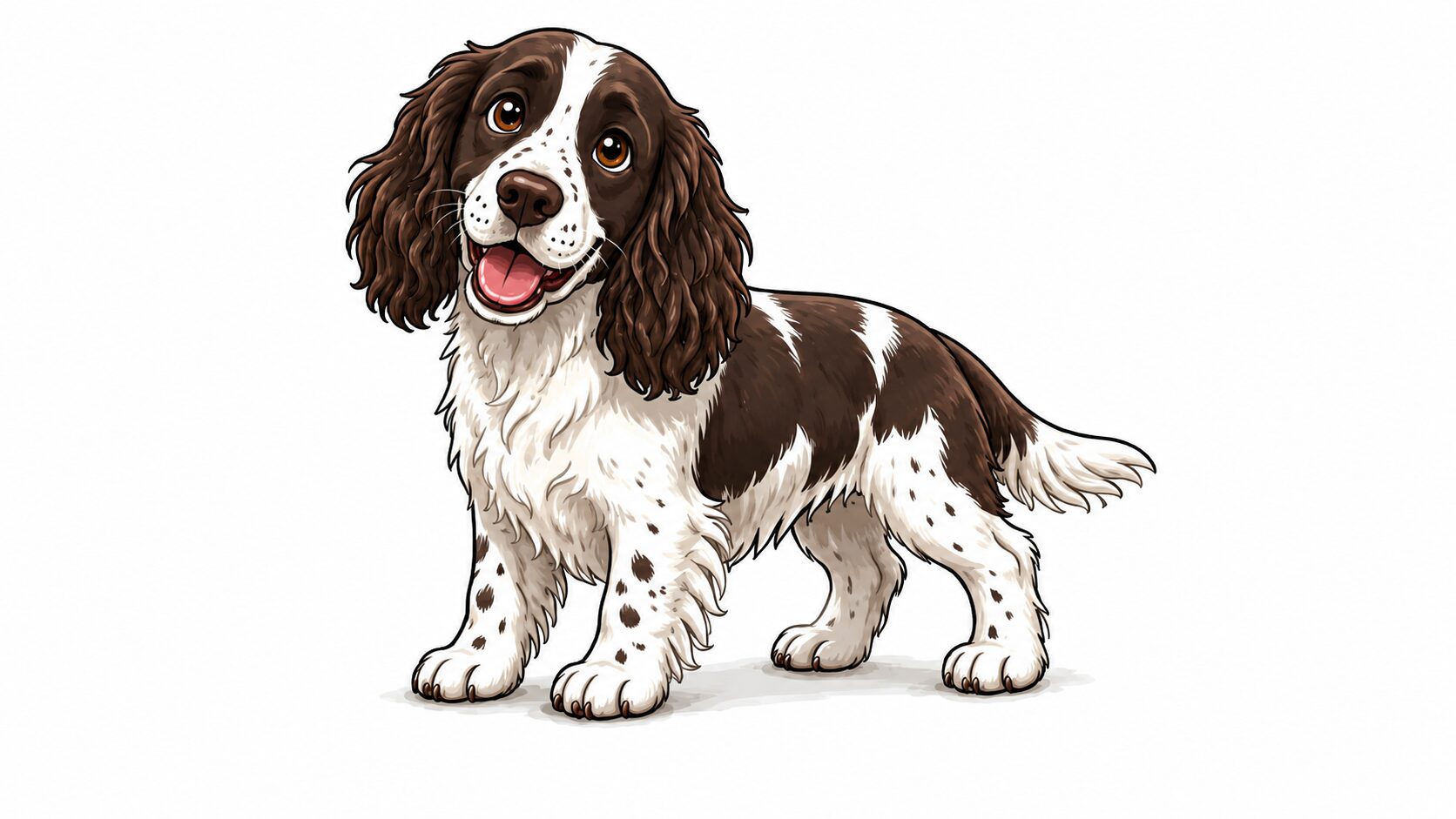
The English Springer Spaniel is a medium-sized, compactly built, and symmetrically proportioned sporting dog that presents with the athletic, capable appearance of a breed built for a full day’s work in varied cover. Male show-type dogs ideally stand 51 centimeters at the shoulder and weigh between 22 and 25 kilograms. Females are somewhat smaller. Field-type dogs are somewhat lighter and more compact. The overall impression, particularly in show-type dogs, is of a sturdy, balanced, well-muscled gun dog that carries itself with the cheerful, forward-moving energy that the breed consistently expresses.
The head is moderately large, with a slightly rounded, medium-width skull and a muzzle equal in length to the skull, producing the balanced head profile that is the breed’s most immediately distinguished characteristic. The eyes are medium-sized, oval, and either dark hazel or dark brown, set well apart and carrying the warm, earnest, friendly expression that is one of the English Springer’s most immediately appealing features. The ears are long, lobe-shaped, and hang close to the cheeks, covered with long, silky hair.
The neck is moderate in length, muscular, and well-arched, flowing into well-laid-back shoulders. The body is moderately long, with a deep chest, a level topline, and well-muscled hindquarters. The tail is docked in countries where this remains legal, customarily to medium length, and carried at or below the level of the back with a lively wagging action.
The coat differs meaningfully between show and field types. Show-type dogs carry a fuller, longer, silkier coat with more pronounced feathering on the ears, chest, belly, and legs. Field-type dogs have a shorter, harder, more water-resistant coat with less feathering, providing better protection and less debris-collecting capability in heavy cover. Colors are black and white, liver and white, or tricolor (either black and white or liver and white with tan points). Field-type dogs typically carry more white in their coat than show-type dogs.
Housing And Living Requirements
The English Springer Spaniel’s housing requirements reflect its sporting heritage as an active flushing and retrieving dog built for sustained outdoor work, though the breed’s adaptability and people-oriented character make it more flexible across different living situations than many other sporting breeds of similar energy.
The breed adapts reasonably well to suburban living when daily exercise is genuinely provided, and a home with access to a garden of meaningful size is the most naturally suited domestic setting. Rural environments that provide outdoor access and working opportunities suit the breed most completely. Urban apartment living is a poor match for a breed this active and this outdoor-oriented regardless of how committed the owner is to structured daily exercise.
The exercise requirement and the appropriate domestic setting differ meaningfully between show and field types, and prospective owners should evaluate their lifestyle against the specific type they are considering rather than assuming all English Springer Spaniels have identical needs. Field-type Springers have considerably higher working drive and exercise needs than show-type dogs.
A securely fenced garden is important for a breed with active hunting instincts. The English Springer’s nose and its enthusiasm for following bird and small animal scents make adequate containment a practical management requirement. Inside the home, a well-exercised English Springer is a warm, cheerful, and actively engaged companion. A comfortable dog bed in a social area suits the breed’s people-oriented nature during rest periods.
Exercise Requirements
The English Springer Spaniel has genuine daily exercise needs that reflect its heritage as an active gun dog built for sustained work through varied cover. At least one to two hours of vigorous daily exercise is appropriate for most adults, with field-type dogs requiring more and show-type dogs being somewhat more manageable at the lower end of this range.
They push through any kind of thick cover, be it grouse woods, woodcock river edges, or dense quail fields, and this field capability is fully present in the modern Springer. Activities that engage the working instinct alongside the physical component are the most genuinely satisfying. Scent work and nose activities directly engage the breed’s exceptional scenting heritage. Dog agility suits the breed’s athleticism and handler-focused enthusiasm, and a set of dog agility equipment at home provides structured physical and cognitive engagement. Swimming is a naturally enjoyed activity.
Puzzle toys and enrichment activities are important between outdoor sessions. A GPS tracker is a practical safety investment for outdoor exercise in open or unfenced areas.
Grooming Requirements
The English Springer Spaniel’s coat requires consistent maintenance appropriate to its type, with show-type dogs having considerably higher grooming demands than field-type dogs.
Show-type dogs carry a fuller, longer, silkier coat with more pronounced feathering that requires brushing three to four times a week to prevent the tangles and mats that develop readily in the longer feathering. The ears, chest, belly, and leg furnishings are the areas most prone to matting and require particular attention. Professional grooming every six to eight weeks provides the bath, blow-dry, and trim that maintain the coat in appropriate condition. Field-type dogs require brushing two to three times a week under normal conditions, with a harder, shorter coat that is more weather-resistant and less tangle-prone.
After outdoor work in heavy cover, prompt brushing to remove burrs, foxtails, and debris is important for both types, with the show-type’s longer feathering collecting considerably more debris per outdoor session.
The ears are the most critical health-related grooming consideration for both types. The long, pendant ears that hang close to the cheeks reduce airflow to the ear canal, and the breed is particularly susceptible to ear infections because of the structure of their ears, which traps moisture and creates an ideal environment for bacteria and yeast. Weekly inspection and cleaning with a veterinarian-recommended ear cleaner, with particular attention after swimming and wet weather, is the most effective preventive measure.
Dental care should be established as a consistent routine from puppyhood. Nails should be trimmed monthly.
Diet And Nutrition
The English Springer Spaniel is a medium-sized, active sporting breed with significant daily caloric needs that should be calibrated to its actual size and activity level. A high-quality medium breed formula with a named protein source as the first ingredient provides the nutritional foundation this athletic breed requires. Active and sporting breed formulas are appropriate for field-active or sport-active dogs.
Most adults do well on two measured meals per day. Maintaining appropriate weight throughout the dog’s life is one of the most practically meaningful ongoing health investments for this breed, directly protecting against the hip and elbow dysplasia to which the breed is predisposed. Discussing joint supplements with your veterinarian from the dog’s early adult years is worthwhile. Training treats are highly effective motivators and should be counted into the daily calorie total.
Compatibility
The English Springer Spaniel is one of the most broadly family-compatible sporting breeds available, combining genuine athletic capability with a warmth, friendliness, and eager-to-please character that suit it to a wide range of household compositions.
With its own family, the breed is demonstrably affectionate and genuinely devoted. The English Springer bonds closely with every household member and expresses those bonds with the cheerful, enthusiastic presence of a breed that genuinely delights in its people. This warmth is authentic and consistently expressed.
With children, the breed is excellent when properly socialized from puppyhood. The combination of moderate size, genuine playfulness, and natural warmth makes the English Springer one of the most reliably appropriate sporting breeds for family households with children of various ages. Show-type dogs are typically calmer and more suited to households with young children than field-type dogs with more intense working drive.
With strangers, the breed is typically friendly and outgoing. It is not a suspicious guardian breed and should not be expected to function as one, though its alert nature means it will announce arrivals.
With other dogs, the breed is consistently sociable and adaptable. With birds and small wildlife, the flushing and hunting instinct is genuine and should be managed appropriately. A dog crate is useful during puppyhood and the settling-in period.
Behavior And Temperament
The English Springer Spaniel’s temperament is one of the most consistently enthusiastic and people-oriented in the sporting group, combining the active field energy of a working gun dog with a warmth and eagerness to please that makes it one of the more genuinely family-friendly sporting breeds available.
The cheerfulness is authentic and pervasive. The English Springer Spaniel approaches its world with the forward-moving, tail-wagging enthusiasm of a breed that genuinely enjoys virtually everything it does, and this quality makes it one of the most pleasant active companions in the sporting group. The eagerness-to-please that characterizes the breed makes it particularly responsive to training and particularly rewarding to engage with in structured activities.
The show-field split that has created two distinct populations within the breed also produces two meaningfully different temperamental expressions. Show-type Springers are calmer, more settled, and more adaptable as pure companion dogs. Field-type Springers are more intense, more focused, higher-energy, and require the kind of sustained working engagement that reflects their more specialized working heritage. Buyers should understand which type they are acquiring and evaluate their lifestyle accordingly.
Rage syndrome deserves honest acknowledgment in any responsible guide to this breed. Certain show-type bloodlines have been associated with episodic aggression that is distinct from the breed’s typical friendly temperament. This is more common in show lines and while it’s called Springer Rage Syndrome there are probably a number of different temperament problems within the broader designation. It is relatively rare, but its potential severity makes assessing the temperament of both parents and their relatives an important step when selecting a puppy, and responsible breeders are transparent about this issue.
Training And Handling
The English Springer Spaniel is one of the most trainable and most responsive breeds in the sporting group, combining genuine intelligence with the eager-to-please character that makes training sessions among the most productive available in the medium-sized sporting breed world.
Positive reinforcement methods are the approach that works most reliably. The English Springer responds to reward, to genuine engagement, and to training that feels collaborative and purposeful. Its food motivation and its deep desire to please its handler make treat-based training highly productive, and training treats are among the most effective tools available for a breed this food-motivated and this genuinely eager to engage.
The breed excels across a wide range of structured activities including obedience, agility, tracking, hunting, and field trials, reflecting the genuine versatility of its sporting intelligence. Owners who channel the English Springer’s enthusiasm through structured activities find it one of the most rewarding sporting breed training partners available.
Early socialization from puppyhood is important, particularly given the documented rage syndrome concerns in certain bloodlines. Broad, positive early socialization and thorough assessment of parental temperament before acquiring a puppy are the most practically meaningful precautions.
Health And Lifespan
The English Springer Spaniel is a generally healthy breed with a lifespan of 12 to 14 years. The breed is not unusually prone to health problems overall, but several specific conditions require proactive DNA testing, screening, or monitoring. Most notable is phosphofructokinase deficiency, a breed-specific metabolic condition for which the English Springer Spaniel is the primary affected breed in the dog world.
Phosphofructokinase (PFK) Deficiency PFK deficiency is a genetic defect in glucose metabolism in which the PFK enzyme required to produce energy from sugar is deficient. The condition follows an autosomal recessive inheritance pattern, meaning both parents must carry the gene for offspring to be affected. Symptoms range from mild and unrecognized for years to severe episodes of exercise intolerance, hemolytic anemia, hyperventilation, fever, and muscle disease appearing anywhere from 2 to 3 months of age to several years. Careful breeding practices have largely eliminated this disease from responsible breeding programs since the development of DNA testing. DNA testing identifies affected and carrier dogs, and responsible breeders test all breeding animals and provide documentation to buyers. At minimum, one parent should be confirmed clear of the PFK mutation before acquiring a puppy. The University of Pennsylvania offers testing, and the OFA maintains a PFK deficiency database.
Hip and Elbow Dysplasia Abnormal joint development causing pain, restricted movement, and progressive arthritis is documented at higher than average rates in the breed. Sourcing puppies from breeders who conduct OFA hip and elbow screening on breeding animals and providing documentation of results is the most important preventive step. Maintaining appropriate weight throughout the dog’s life and discussing joint supplements with your veterinarian are meaningful ongoing protective measures.
Ear Infections The breed’s long, pendant ears create the conditions for chronic ear infections, one of the most consistently managed health concerns in any dog with this ear conformation. Weekly inspection and cleaning, with particular attention after swimming and wet weather, is the most effective preventive measure.
Progressive Retinal Atrophy (PRA) English Springer Spaniels are particularly susceptible to PRA, the inherited condition causing gradual retinal degeneration and eventual blindness. DNA testing identifies affected and carrier dogs, and CAER ophthalmological examination provides clinical monitoring. Responsible breeders test all breeding animals and provide documentation.
Rage Syndrome and Temperament Issues Episodic aggression documented more commonly in show-type bloodlines is a genuine concern that requires transparent discussion between buyer and breeder. Buyers need to be extremely cautious about the temperament of the parents and relatives of any puppy they are considering. Responsible breeders are transparent about any temperament concerns in their lines and conduct behavioral assessments on their breeding animals.
Hereditary Seizures Familial epilepsy is documented in some breed lines, with seizures typically beginning before age five. Asking breeders for full disclosure of any seizure disorders within the puppy’s pedigree is important, and responsible breeders are transparent about this history.
Autoimmune Hemolytic Anemia (AIHA) English Springer Spaniels are overrepresented in published case series of AIHA, indicating higher risk than the general canine population. Awareness of early signs including lethargy, pale gums, and rapid breathing allows for prompt veterinary attention.
Cancer Cancer is a leading cause of death in the breed, particularly in older dogs. Regular veterinary examinations from middle age onward that specifically include cancer monitoring provide the best opportunity for early detection.
Routine preventive care, including regular vet checks, consistent dental hygiene, up-to-date vaccinations, and parasite prevention, provides the foundation for a healthy English Springer Spaniel across its lifespan. Pet insurance is worthwhile given the range of conditions the breed is predisposed to.
Price And Availability
The English Springer Spaniel is a well-established and widely available breed in the United States, consistently ranking among the top 30 most popular breeds in AKC registrations. From reputable breeders, expect to pay between $800 and $2,500 for a well-bred puppy from health-tested parents, with show-quality dogs from champion bloodlines and field trial bloodlines at the upper end of that range.
The English Springer Spaniel Field Trial Association is the most authoritative starting point for locating breeders who adhere to the AKC breed standard and conduct appropriate health testing. Responsible breeders will conduct PFK DNA testing on all breeding animals and provide documentation for both parents, conduct OFA hip and elbow evaluations and CAER eye certification, screen for PRA, and be transparent about any seizure or temperament history in their lines. They will ask thorough questions about the prospective buyer’s lifestyle and which type, show or field, best matches their activity level.
Adoption is a meaningful option. English Springer Rescue America and regional rescue organizations regularly have dogs of various ages available. The breed’s popularity means rescue dogs are consistently available.
Conclusion
The English Springer Spaniel spent more than a century as one of the most capable and most beloved gun dogs in England and America, equally comfortable springing woodcock from dense hedgerows as sitting by the fire in a country house, before the show-field split of the mid-20th century created two distinct populations that the same breed name now covers. Whether show-type or field-type, the English Springer brings the same core character to its household: cheerful, warm, eager-to-please, and possessed of an enthusiasm for life and for its people that is one of the most consistently celebrated qualities in the entire sporting group. The PFK testing is non-negotiable and must be the first documentation requested from any breeder. The ear care is a weekly commitment. The temperament assessment of parental lines is an important due diligence step given the documented rage syndrome concerns in some show bloodlines. And within all of that, the English Springer Spaniel delivers a sporting companion of genuine warmth, capability, and whole-hearted engagement that has made it one of the most genuinely rewarding medium-sized sporting dogs in the world. Get properly set up before bringing one home. Our Best Dog Products page has everything you need for feathered, enthusiastic, whole-heartedly devoted British flushing dogs that carry over a century of field and show heritage into every home they grace.