
Origin And History
The Pyrenean Mastiff, known in Spain by its Spanish name Mastín del Pirineo — the Mastiff of the Pyrenees — is a giant, predominantly white, dark-masked livestock guardian dog from the Kingdom of Aragon in the autonomous community of Aragon in northeastern Spain, a breed fundamentally distinct from and specifically not to be confused with three superficially related breeds that share parts of its name or its geography: it is not the Spanish Mastiff (Mastín Español) of the Castilian plains, it is not the Pyrenean Mountain Dog (Grande Pyrénées) of the French Pyrenean slopes, and it is not the Pyrenean Shepherd of the smaller herding tradition — three separate and specifically documented distinct breeds that the Pyrenean Mastiff is routinely confused with in canine literature written by authors who have not worked directly with the breed, and that confusion about which itself tells the specific founding story of the breed’s origin in the most geographically precise individual livestock guardian breed family in Europe.
The breed’s most ancient origins connect it to the foundational molosser tradition that produced most of the world’s livestock guardian breeds. It is generally accepted that the Pyrenean Mastiff is descended from molosser dogs brought from Sumeria and Assyria to Spain by Phoenician traders approximately 3,000 years ago — the same ancient commercial seafaring network that introduced molosser-type dogs to every major port on the Mediterranean and Atlantic coastlines of Europe, Africa, and western Asia, producing through subsequent regional isolation and specific landscape adaptation the specific family of white or predominantly white mountain livestock guardian breeds that includes the Great Pyrenees of France, the Kuvasz of Hungary, the Komondor of Hungary, the Maremma Sheepdog of Italy, and the Akbash of Turkey — all sharing the white or predominantly white coat that camouflages these dogs among the white-wooled flocks they protect, and all descending from the same ancient Central Asian molosser tradition.
The specific development of the Pyrenean Mastiff in the Kingdom of Aragon reflects the most specifically medieval and the most specifically Spanish of the political contexts that shaped European livestock guardian breeds. During the medieval period, the Iberian Peninsula was divided between the Christian kingdoms of Castile and Aragon in the north and the Muslim-controlled territories of the south. The wide, flat plains of Castile produced the smooth-coated Spanish Mastiff adapted to long-distance sheep migration across open terrain. The rugged, cold, predator-rich mountains of Aragon produced the heavier-coated, larger-boned Pyrenean Mastiff adapted to the specific demands of mountain terrain, extreme cold, and the large predators — wolves and brown bears — that the Aragonese highlands still harbored when the breed was at its working peak.
The transhumance tradition that gave the Pyrenean Mastiff its specific working purpose is among the most ancient agricultural practices in Europe. Transhumance — the seasonal movement of livestock from lowland winter grazing to highland summer pasture and back — was formalized in the Kingdom of Aragon from as early as the 6th century CE under Visigothic rule, with organized records of sheep migrations through the Aragonese highlands documented from this period. Historical records from 504 CE describe shepherds traveling through Aragon with flocks of more than 1,000 sheep, accompanied by small groups of Mastiffs whose specific function was to protect these enormous flocks from wolves and bears during the dangerous mountain crossing.
The breed’s most critical and the most specifically personal welfare tool was the carlanca — the spiked metal wolf collar fitted to the dog’s neck to protect it when wolves attacked, turning the dog’s most anatomically vulnerable individual point into a weapon against predators that habitually targeted the throat. Like other European flock guardian breeds fitted with carlancas, the Pyrenean Mastiff wore this armament as working equipment on every transhumance journey, and the carlanca became so specifically associated with these dogs that it appears in historical depictions of the breed as a defining visual characteristic.
In 1659, the Treaty of the Pyrenees between France and Spain split the Pyrenean Mountains between the two nations, with the northern slopes becoming French and the southern slopes remaining Spanish. This political division directly influenced the divergent development of the related livestock guardian breeds on each side of the mountains: the northern French slopes produced the Pyrenean Mountain Dog (Grand Pyrénées) — a more refined, longer-coated, elegantly proportioned breed that enjoyed widespread international recognition through French breeding programs — while the Spanish mastiffs of the south remained more massive, more primitive in type, less homogenous in conformation, and more specifically adapted to their rugged working function than to aesthetic conformation standards.
The breed’s near-extinction is among the most dramatically specific and the most multi-causal individual crises of any livestock guardian breed in this series. The disappearance of the wolf from the Pyrenees in the late 1940s removed the breed’s primary functional justification. The Spanish Civil War (1936–1939) and the subsequent World War II created food scarcity that made maintaining extremely large dogs economically impossible for most Spanish farmers. The modernization of livestock transport by rail eliminated the traditional transhumance routes that had always been the breed’s working context. These three simultaneous crises reduced the Pyrenean Mastiff population to the point of near-extinction by the mid-20th century.
The recovery began in 1977 when Rafael Malo Alcrudo, along with Daniel Llorens Guerrero and Jaime Graus Morales, founded the Club del Mastín del Pirineo de España — an act of specifically personal dedication to a breed whose recovery required searching the Aragonese highlands to find any surviving examples. Approximately 100 possible dogs were located through this search; these were narrowed to the top 30 individuals who would serve as the foundation of the modern Pyrenean Mastiff. From these 30 dogs, the entire modern breed descends. The FCI had formally accepted the breed in 1954 with the official standard published in 1982. The breed gradually spread through Spain and subsequently to other European countries — particularly Finland, where it has found a particularly strong enthusiast community — and later to the Americas, Australia, and Japan. The first Pyrenean Mastiff arrived in the United States in 1996. The AKC admitted the breed to its Miscellaneous Class in 2024. The UKC recognizes the breed in the Guardian Dog Group. In 2026, the Real Sociedad Canina de España listed the breed among sixteen Spanish breeds considered vulnerable — a conservation designation that reflects the continued fragility of the breed’s population despite the recovery efforts.
Breed Overview
| Trait | Details |
|---|---|
| Origin | Kingdom of Aragon, northeastern Spain (Aragonese Pyrenees) |
| Spanish Name | Mastín del Pirineo |
| FCI Recognition | Accepted 1954; official standard published 1982 |
| UKC | Guardian Dog Group |
| AKC Status | Miscellaneous Class (since 2024); working toward full Herding Group recognition |
| Parent Club (USA) | Pyrenean Mastiff Association of America (PMAA) |
| Parent Club (Spain) | Club del Mastín del Pirineo de España (CMPE; founded 1977) |
| Recovery Leader | Rafael Malo Alcrudo (1977 club co-founder; found approximately 100 survivors; top 30 became modern foundation) |
| RSCE Status | Listed as vulnerable breed (2026) |
| Foundation Population | 30 dogs selected from approximately 100 found through country-wide search |
| First USA Arrival | 1996 |
| Near-Extinction Causes | Wolf disappearance (1940s); Spanish Civil War + WWII food scarcity; rail transportation replacing transhumance |
| Transhumance Records | From 504 CE under Visigothic rule; documented migrations with 1,000+ sheep and mastiff packs |
| Wolf Collar | Carlanca — spiked metal collar worn for wolf protection |
| Not to Confuse With | Spanish Mastiff (Mastín Español); Pyrenean Mountain Dog (Great Pyrenees); Pyrenean Shepherd |
| Height | Males minimum 77 cm (30 inches); no upper limit; larger preferred / Females minimum 72 cm (28 inches) |
| Weight | 55–90 kg (120–200 pounds); some exceptional males exceed 90 kg |
| Lifespan | 8–12 years |
| Coat | Dense, thick, medium to long; bristly texture (not woolly); ideal length 2.5–3.5 inches at midline |
| Primary Color | White (always predominantly white) |
| Markings | Well-defined dark mask; darker patches on body; ears always darker |
| Accepted Colors | Agouti; sable; badger; gold; brown; black; brindle; grey |
| Expression | Alert, noble, sympathetic, intelligent; extraordinarily stern toward threats |
| Body Proportion | Slightly longer than tall (9:10 height to length ratio) |
The Transhumance Tradition
Before discussing care, the Pyrenean Mastiff’s working heritage in the Aragonese transhumance tradition deserves dedicated acknowledgment, because this ancient pastoral migration practice is the most specifically defining context of the breed’s centuries of development and because it explains every physical and behavioral characteristic the breed possesses.
Transhumance — the seasonal migration of livestock from lowland winter pastures to high mountain summer pastures and back — was one of the most economically important agricultural practices of medieval and early modern Aragon. Thousands of sheep moved along established migration routes across the mountains each spring and autumn, accompanied by shepherds who depended on their mastiffs for every moment of that journey. The dogs walked hundreds of miles, guarded enormous flocks in all weather conditions, confronted wolves and brown bears with the courage that the spiked carlanca specifically equipped them for, and lived outdoors in the most extreme mountain conditions that the Pyrenees produced in every season. Every physical characteristic of the Pyrenean Mastiff — the massive, heavy-boned frame; the dense, weather-resistant coat; the remarkable endurance; the calm, guardian-minded temperament that does not agitate unnecessarily — is a direct adaptation to the specific demands of this working tradition.
Appearance And Size
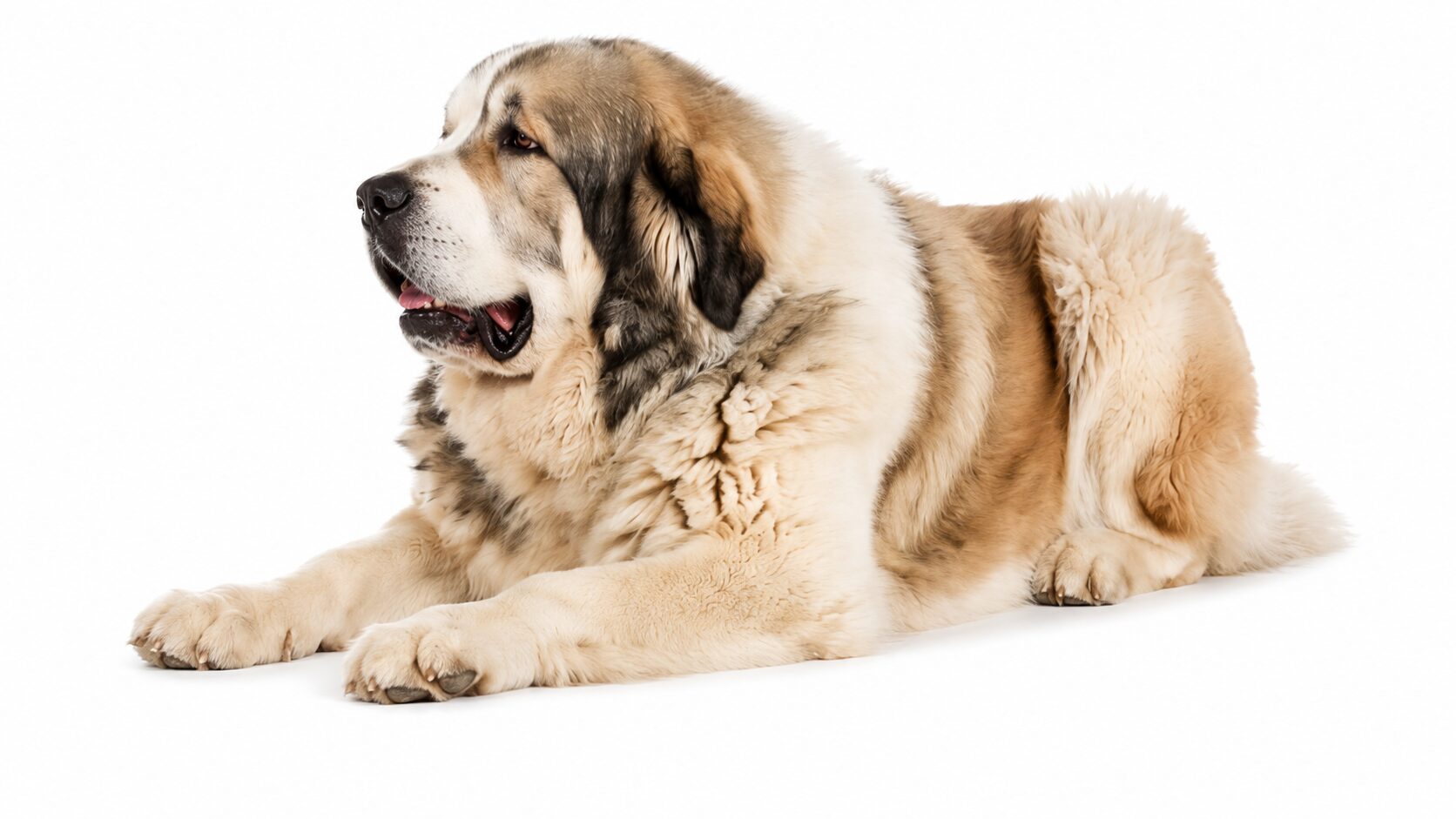
The Pyrenean Mastiff is one of the largest and most physically imposing breeds in this series — a giant dog of genuine substance whose minimum acceptable height of 77 centimeters for males and 72 centimeters for females has no upper limit, with the explicit breed standard preference that the larger dog is always preferred when quality is equal, producing individuals that can stand over 90 centimeters and weigh over 90 kilograms in the most impressively sized examples.
Despite their immense size, Pyrenean Mastiffs should never look heavy or sluggish — the breed standard specifically emphasizes the harmonious, emphatically strong and muscular movement that belies the dog’s massive frame. The coat is dense, thick, medium to long, and bristly rather than woolly — a texture distinction that separates the Pyrenean Mastiff’s coat from the softer, fluffier coats of some related white guardian breeds. The primary color is always white with a well-defined dark mask and darker patches on the body, with the ears always carrying darker coloring. The expression is specifically celebrated in the breed standard as alert, noble, sympathetic, and intelligent — but capable of becoming extraordinarily stern toward threats in the most specifically powerful individual shift of any guardian breed’s expression in this series.
Housing And Living Requirements
The Pyrenean Mastiff’s most immediately honestly stated housing requirement is space — a great deal of it. These dogs are versatile and can adapt to different living situations, provided they have enough space. A country or suburban home with substantial outdoor space and secure fencing is the minimum appropriate housing context. Apartment life or small-space urban living is genuinely incompatible with the welfare of an animal this large with this guardian heritage.
Secure fencing is non-negotiable — the Pyrenean Mastiff’s natural guardian instinct to patrol and protect its territory means it will investigate the perimeters of its property with the methodical persistence of a dog bred to patrol mountain pastures, and fencing that is inadequate to contain a 90-kilogram motivated guardian will not remain a barrier for long.
The breed is specifically adapted to cold weather — the dense coat that protected working dogs on the high Aragonese Pyrenean pastures continues to provide genuine cold tolerance, but creates meaningful heat stress risk in warm climates and seasons. Outdoor exercise must be limited in high heat with access to shade and water always available.
An orthopedic dog bed is specifically and urgently important for a giant breed with the documented joint disease risk that large body weight consistently creates. A comfortable dog bed in a social area of the home suits the breed’s family-devoted domestic character.
Exercise Requirements
The Pyrenean Mastiff’s exercise requirements are more modest than its enormous size might initially suggest — the breed is described as often preferring to relax as couch potatoes indoors while conserving its strength for the outdoor activity and vigilance that its guardian nature makes constant. Two moderate daily walks of 30 to 45 minutes, supplemented with free roaming in a secured outdoor space, is appropriate for most adults.
The most important exercise management consideration is the breed’s growth period. Giant breed puppies whose immense size concentrates significant orthopedic stress on developing joints during rapid early growth require carefully controlled exercise that avoids high-impact activity on hard surfaces until skeletal maturity at approximately 18 to 24 months.
Dog agility at a pace appropriate to the breed’s size provides structured engagement. Scent work and tracking activities engage the guardian breed’s environmental awareness in purposeful organized sport. The breed’s most natural and most personally fulfilling individual activity is exactly the work it was bred for — free outdoor roaming across secured property with the guardian awareness that makes it the most alert and the most engaged version of itself.
Puzzle toys and enrichment activities provide cognitive engagement appropriate to a breed that historically made independent guardianship decisions without constant handler supervision. A GPS tracker is a practical safety investment for outdoor exercise given the guardian breed’s tendency to expand its patrol range.
Grooming Requirements
The Pyrenean Mastiff’s dense, medium-to-long coat requires consistent weekly grooming to prevent the matting that develops in the dense coat when brushing is inconsistent, with the twice-yearly heavy shedding seasons requiring the most intensive attention.
Weekly brushing with a pin brush, slicker brush, and metal comb removes loose hair and prevents tangles from progressing to mats. The coat is longer and denser on the shoulders, neck, chest, belly, back of legs, and tail — these areas requiring the most specific and the most sustained individual brushing attention. The coat sheds moderately throughout the year with heavier seasonal shed periods. Bathing a giant-breed dog with a coat this dense is a substantial individual undertaking — professional grooming every six to eight weeks between home maintenance is genuinely practical for most owners.
Dental care should be established as a consistent routine from puppyhood — specifically important for a large breed whose jaw structure creates specific plaque accumulation patterns. Ears should be checked and cleaned weekly given the ear fold structure’s tendency to trap moisture and debris. Nails should be trimmed regularly — the specific nail trimming challenge of a 90-kilogram dog that does not wish to cooperate is most manageably addressed through consistent handling conditioning from puppyhood. Joint supplements discussed with your veterinarian from the dog’s early adult years are specifically warranted.
Diet And Nutrition
The Pyrenean Mastiff’s dietary management is the most specifically consequential of any breed in this series purely in terms of the individual volumes involved — a 90-kilogram giant breed requires significantly more food than any medium or large breed, and the specific nutritional management requirements of giant breed growth make puppy nutrition the most critically important dietary investment.
Giant breed puppy formulas that promote slow, steady growth are the most specifically appropriate choice for Pyrenean Mastiff puppies through the first 18 to 24 months. Feeding high-calorie puppy formulas that accelerate growth in giant breeds produces skeletal development that outpaces structural maturation, dramatically increasing the orthopedic disease risk to which this breed is already predisposed by its size.
Adults do best on two measured meals daily — the deep chest creates very significant GDV risk, making two smaller meals, slow-feeder bowls, and avoiding vigorous exercise for at least one hour before and after meals permanent preventive practices. Training treats are effective motivators in training sessions and should be selected appropriately for a large breed. Maintaining lean body condition throughout the dog’s life is the most practically meaningful individual protective measure for the orthopedic health of a breed this size.
Compatibility
The Pyrenean Mastiff is genuinely and specifically one of the most warmly family-compatible of any giant guardian breed — the characterization gentle giant is not marketing language but the most accurate individual description of a breed that combines the genuine physical capability to deter any predator with the specific, deeply warm, family-devoted character that centuries of shepherd-companion life specifically produced.
These dogs exhibit low energy levels indoors, often preferring to relax while conserving their strength for outdoor activities — a quality that makes them surprisingly manageable companions indoors for owners whose home can accommodate a dog of this size. With its own established family, the breed is completely devoted. With children, the breed is consistently appropriate and specifically gentle — their protective nature extends naturally to the children of their household as the most specifically vulnerable individual family members.
With strangers, the breed is typically calm and reserved rather than aggressive — the guardian’s thoughtful assessment of whether a visitor represents a threat before responding is the breed standard’s most specifically celebrated individual behavioral quality. With other dogs, the breed is typically appropriate when properly socialized from puppyhood. With livestock and farm animals, the breed is specifically cooperative — the guardian tradition requires the dog to live peacefully alongside the animals it protects, and the Pyrenean Mastiff’s calm acceptance of farm animals reflects this heritage directly. A dog crate is a useful management tool during puppyhood for a breed this large.
Behavior And Temperament
The Pyrenean Mastiff is gentle and loving yet independent — the AKC’s most concise individual characterization captures the essential behavioral truth of a breed that has always made its own guardian decisions without waiting for handler direction. The deep, resonant bark that the breed uses as its primary deterrence tool is used purposefully rather than incessantly — barking to alert to genuine threats rather than to anything that moves or sounds, a discrimination that makes the breed’s guardian alarm both effective as a real security tool and specifically manageable in residential settings where indiscriminate barking would create significant community relations challenges.
The perceptive intelligence and the genuinely sympathetic expression that the breed standard specifically describes as a desirable quality are the most personally and the most specifically compelling individual behavioral qualities of any giant guardian breed in this series — a dog this large, this physically capable, this thoughtfully self-governed in its guardian decisions, and this warmly devoted to its family is the most compelling argument for the specific value of the livestock guardian tradition in domestic companion contexts.
Training And Handling
The Pyrenean Mastiff is a highly independent thinker — the most specifically and the most honestly important training reality for any prospective owner to understand before acquisition. This is not a breed that waits for a command before making decisions, because centuries of independent mountain guardianship specifically required dogs capable of making correct guardian decisions without handler input. This independence is the breed’s most specifically valuable individual working quality and its most specifically challenging individual domestic training characteristic simultaneously.
Positive reinforcement methods are the most effective and the most specifically appropriate approach. Training treats are effective motivators in patient, varied sessions that engage the breed’s genuine intelligence. Early socialization from the earliest possible puppyhood — particularly exposing the growing puppy to diverse people, environments, sounds, and situations — is the most critically important behavioral investment for managing the guardian breed’s natural tendency toward reserve with the unfamiliar. The breed responds best to consistent, confident, calm leadership rather than to repeated commands or escalating pressure.
Health And Lifespan
The Pyrenean Mastiff has a lifespan of 8 to 12 years — the lifespan range that most giant breeds share, reflecting the specific correlation between very large body size and the cardiovascular and orthopedic demands that limit longevity in the largest domestic dog breeds.
Hip and Elbow Dysplasia Hip and elbow dysplasia are the most consistently documented and the most specifically urgently important orthopedic concerns for a breed whose minimum weight starts at 55 kilograms and can reach 90 kilograms or more. OFA hip and elbow evaluation of all breeding animals is non-negotiable. Giant breed puppy nutrition management from the earliest weeks is the most practically meaningful individual protective investment against the dysplasia that accelerated growth in giant breeds disproportionately produces.
Bloat (Gastric Dilatation-Volvulus) The deep chest creates extremely significant GDV risk — among the most urgently important individual health concerns for any deep-chested giant breed. Two smaller meals daily, slow-feeder bowls, and avoiding vigorous activity for at least one hour before and after meals are permanent preventive practices. Prophylactic gastropexy surgery should be discussed seriously with your veterinarian before any planned surgical procedure.
Osteochondrosis Dissecans (OCD) Abnormal cartilage development leading to stiffness and lameness is documented in the breed. Proper puppy nutrition management to prevent excessive growth rate and avoiding over-exercise during the growth phase are the most meaningful preventive investments.
Heart Conditions Cardiac conditions are documented in the breed. Annual cardiac evaluation by a veterinary cardiologist from early adulthood is recommended.
Dewclaw Management The Pyrenean Mastiff may have double rear dewclaws — a characteristic shared with the Great Pyrenees and a few other mountain breeds. These require specific monitoring to prevent overgrowth and injury.
Routine preventive care including regular vet checks, OFA hip and elbow evaluation, annual cardiac evaluation, giant breed puppy nutrition management, consistent dental hygiene, up-to-date vaccinations, and parasite prevention provides the foundation for a healthy Pyrenean Mastiff.
Price And Availability
The Pyrenean Mastiff is rare outside Spain and specifically rare in the United States, where the breed arrived only in 1996 and the total breeding population remains small. The Pyrenean Mastiff Association of America is the most appropriate starting point for prospective American owners, connecting them with the small community of dedicated breeders who maintain breeding stock with verified Spanish ancestry and appropriate health testing. From reputable breeders with OFA hip, elbow, and cardiac documentation, expect to pay between $1,500 and $3,000 for a well-bred puppy.
Conclusion
The Pyrenean Mastiff has guarded sheep and cattle during the annual transhumance across the Aragonese Pyrenees since at least 504 CE when Visigothic-era records documented mastiff packs accompanying flocks of over 1,000 sheep on mountain migration routes, descends from ancient molosser dogs believed to have been brought to Spain by Phoenician traders 3,000 years ago and that diverged into distinct regional guardian breeds across the isolated mountain ranges of the Iberian Peninsula, wore the spiked carlanca wolf collar during every mountain journey as functional armament against the wolves and bears that were its primary adversaries, was separated from the French development of the Pyrenean Mountain Dog by the 1659 Treaty of the Pyrenees, was nearly destroyed by the triple crisis of wolf disappearance in the 1940s, Spanish Civil War and World War II food scarcity, and rail transport replacing transhumance, was recovered from approximately 100 surviving dogs narrowed to 30 foundation individuals by Rafael Malo Alcrudo and colleagues who founded the Club del Mastín del Pirineo in 1977, had FCI formal acceptance since 1954 with an official standard published in 1982, arrived in the United States in 1996, was admitted to the AKC Miscellaneous Class in 2024, is listed as a vulnerable breed by the RSCE in 2026, and stands today as the most specifically transhumance-504-CE-Visigothic-era-documented, the most specifically carlanca-spiked-wolf-collar-wearing, the most specifically 1659-Treaty-of-Pyrenees-French-Spanish-split-from-Great-Pyrenees, the most specifically wolf-disappearance-plus-Civil-War-plus-rail-transport-triple-near-extinction, the most specifically 100-found-30-selected-Rafael-Malo-Alcrudo-1977-recovered, the most specifically no-upper-height-limit-larger-preferred, and the most specifically extraordinarily-stern-expression-toward-threats of all the livestock guardian breed partnerships available. Get properly set up before bringing one home. Our Best Dog Products page has everything you need for white-predominantly-dark-masked, dense-bristly-coated, giant-boned, carlanca-heritage-bearing, whole-heartedly devoted Aragonese Pyrenean mountain livestock guardian dogs that carry the full heritage of the ancient Phoenician molosser introduction, the medieval Kingdom of Aragon’s transhumance tradition, the spiked wolf collar confrontations with Pyrenean bears and wolves, the 1659 Treaty split from the French Great Pyrenees, the 1940s triple crisis and near-annihilation, Rafael Malo Alcrudo’s 1977 country-wide survivor search and 30-dog foundation recovery, the 1982 FCI official standard, the 1996 American arrival, the 2024 AKC Miscellaneous Class, and the specific gentle-at-home, extraordinarily-stern-when-threatened, independent-guardian-decision-making, deep-bark-used-purposefully, loyal-and-devoted-to-family intelligence of the giant white guardian that the Pyrenean Mountains shaped across three millennia of the most demanding mountain livestock protection work in Europe.